


Say the word "entrepreneurship" to most parents and they picture an adult in a meeting room: pitch decks, investor calls, a shop lot with rent to pay. Applied to a nine-year-old, the word used to shrink down to something quaint, a lemonade stand, a bake sale table at the school fair, twenty ringgit counted out at the end of the afternoon.
Those models describe how value was created a generation ago. They do not describe 2026. A ten-year-old with a secondhand laptop and a Wi-Fi password can write a script that automates something tedious, publish a playable web game, or wire up a small AI tool that a few hundred strangers actually use.
None of this is an argument for children skipping school to start companies. It is an argument about mindset, technical fluency and money sense, three things that turn a child from someone who consumes what other people built into someone who builds. Children who learn to make things stop seeing a screen as a place where entertainment arrives and start seeing it as a workshop.
What follows is a look at why entrepreneurship education has become a serious part of a young learner's foundation in Malaysia, what modern tools have changed about the learning curve, and how you can move your child from vague interest to a working product.
Table of Contents
- Key Takeaways
- Reason 1: Software and AI Have Lowered the Cost of Creation
- Reason 2: It Converts Passive Screen Time into Active Creation
- Reason 3: It Teaches Resilience Through Prototyping
- Reason 4: It Grounds Abstract Mathematics in Financial Logic
- Reason 5: It Prepares Youth for a Shifting Labor Market
- Traditional Projects vs Tech-Driven Product Building
- Age-Appropriate Milestones for Young Product Builders
- How Kidocode Integrates Entrepreneurship with Tech, AI, and Math
- Action Plan: How Parents Can Nurture Entrepreneurial Thinking at Home
- Printable Child Business Project Discovery Worksheet
- Frequently Asked Questions
- References
Key Takeaways
| Metric or Focus Area | Traditional Understanding | Modern Tech-Driven Reality |
|---|---|---|
| Core Activity | Selling static physical goods or trade items. | Building digital software, mobile apps, and AI-assisted tools. |
| Primary Skill Learned | Basic transaction negotiation and cash counting. | Computational thinking, systems design, and product iteration. |
| Failure Cost | Wasted inventory and physical materials. | Zero-cost code revisions and rapid learning loops. |
| Math Connection | Memorising arithmetic formulas for paper tests. | Applying geometry, logic, and probability to product pricing and physics engines. |
| Role of Technology | Consuming media, playing games, or scrolling social platforms. | Directing code and AI assistants to build real artifacts. |
Reason 1: Software and AI Have Lowered the Cost of Creation
Every project used to start with a receipt. A child who wanted to sell something needed a parent to buy raw materials, find somewhere to store them, and drive everyone to a venue on a Saturday morning. That friction is why school business projects stayed one-off weekend events, nobody wants to fund a second batch of cupcakes after the first batch didn't sell.
Software removes the receipt. A child who can program writes a script, builds a website, or sets up an AI assistant without spending a sen on materials.
Age progression in youth entrepreneurship
| Age Range | Tools | Build Focus | Milestone |
|---|---|---|---|
| Ages 5 to 8 | Block coding | Game mechanics | Logic basics |
| Ages 9 to 12 | Python and web | Interactive prototypes | User experience |
| Ages 13 to 15 | Full stack and AI | Database integration | Product launch |
| Ages 16 to 18 | Autonomous AI agents | Analytics and deployment | Market validation |
Early childhood education research published in Education Sciences found that entrepreneurship initiatives for young children tended to fall flat when they concentrated on formal economic mechanics instead of hands-on problem solving [4]. Building things, by contrast, develops self-confidence, stress management and the ability to work through a task alongside other people [4].
AI coding assistants have shortened the runway further. A young learner no longer has to memorise years of syntax before producing anything usable. They can state the logic they want, have an assistant draft the structural code, and spend their own effort on whether the thing is actually pleasant to use. Pair that with genuine coding literacy and children reach a working, deployed tool far sooner than a learner would have a decade ago.
There is a second effect, less obvious. When creation costs only time, a child can afford to be wrong repeatedly. Ten ideas can be tested in the space that one physical product would have occupied. What sticks is the lesson that an idea is worth nothing until somebody else can use it.
Reason 2: It Converts Passive Screen Time into Active Creation
Screen time comes up in almost every conversation we have with parents at our Kuala Lumpur and Penang campuses. The hours add up: games, short video, group chats. Banning devices outright usually produces a fight rather than a change, because the interest underneath the behaviour hasn't gone anywhere.
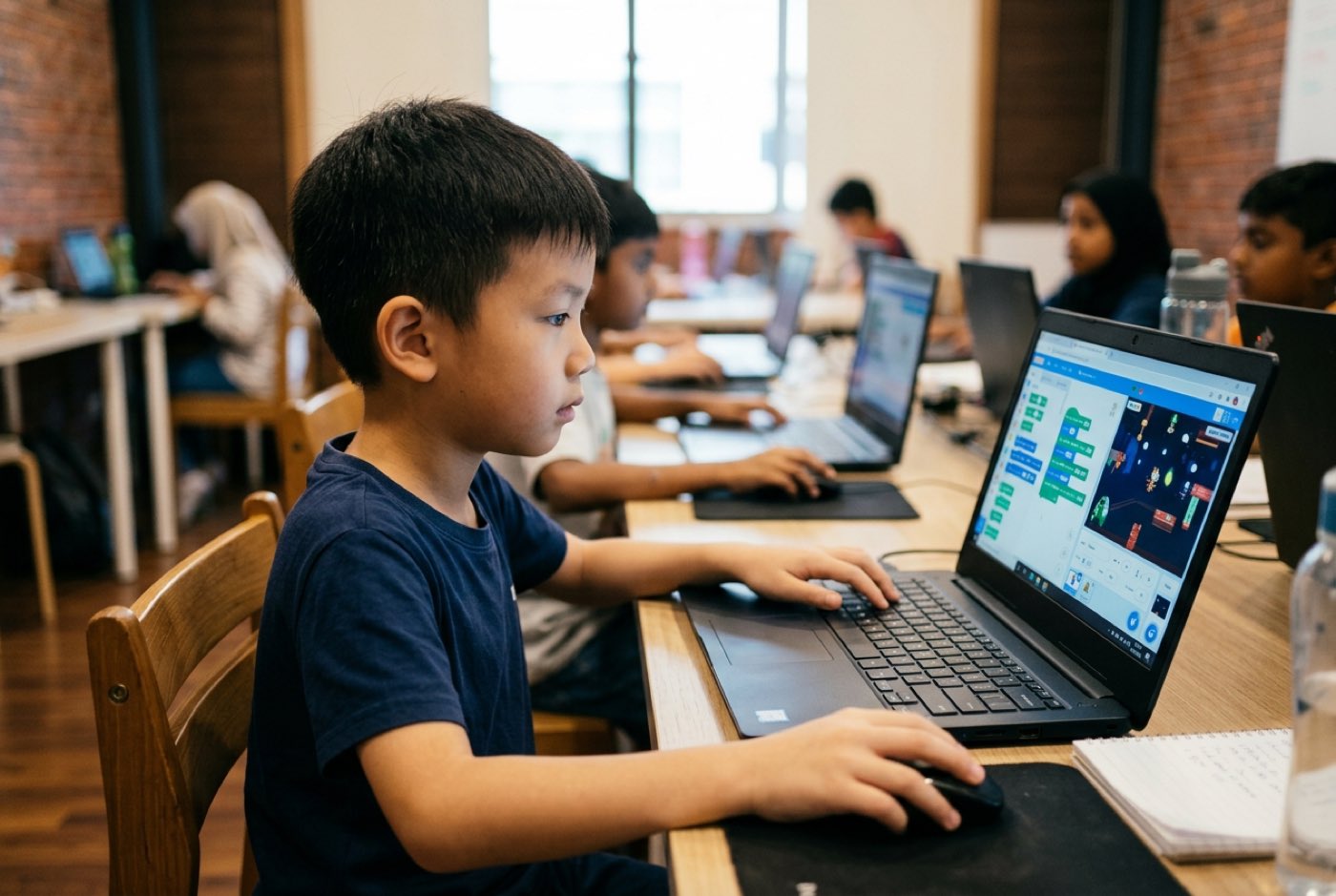
The more workable move is to change what the screen is for. Once a child understands how software is engineered and how products are designed, the way they look at an app changes and does not change back.
A child with a bit of building experience watches a mobile game differently:
- How was this user interface constructed?
- What database stores the player's high score?
- Why did the game developer choose this reward structure?
- How could I build a better version of this mechanic using Python or JavaScript?
Ask those questions often enough and playing turns into reverse-engineering. The first time a child stops mid-game to open an editor and try building the mechanic themselves, the four hours on the laptop have quietly become engineering hours.
That is the whole trade: same device, different output. If you want more tactics for shifting a child's digital habits, we cover them in our article on growing your child's entrepreneurial spirit.
Reason 3: It Teaches Resilience Through Prototyping
School punishes wrong answers. A red mark on a paper teaches a child, quite reasonably, that the safest strategy is to produce the answer the examiner expects and take no risks along the way.
Product work runs on the opposite logic. Things break first and work later. The code throws an error, the database query returns nothing, a tester opens your app and immediately taps the wrong button.
A conceptual study on youth-led ventures in the Journal of Technology Management and Technopreneurship cites Global Entrepreneurship Monitor data showing that only 5% to 8% of youth-led startups in Malaysia are still operating after three years [3]. What separated the survivors was not a better initial idea but adaptive behaviour, willingness to act, and iterative problem solving [3].
Software gives children that feedback on a loop measured in seconds. The program runs or it doesn't. Nobody is disappointed in you; there is just a line number and a puzzle.
Three habits come out of that loop:
- Decoupling failure from personal identity: A broken build means the logic needs adjustment, not that the student lacks capability.
- Rapid debugging: Children learn to isolate variables, test assumptions, and identify exactly where an error occurred.
- Iterative improvement: Instead of seeking perfection on the first attempt, young builders learn to ship a basic working prototype, gather feedback, and release improvements.
Teachers notice the transfer before parents do. A student who has spent three months hunting bugs in a Python script or reworking a clumsy app screen tends to meet a hard exam question by taking it apart rather than freezing in front of it.
Reason 4: It Grounds Abstract Mathematics in Financial Logic
Plenty of children struggle with mathematics for a reason that has nothing to do with ability: nobody has told them what the equations are for. A worksheet of disconnected sums offers no answer to the only question the student is actually asking.
Building something answers it immediately. Once a child is shipping a piece of software or planning a small digital service, the numbers acquire consequences:
- Algebra and Variables: Used to calculate variable costs, server resource usage, or user engagement logic.
- Geometry and Trigonometry: Applied directly when designing 3D assets, game physics engines, or interface layouts.
- Probability and Statistics: Used to analyze user traffic, test feature variants, and measure conversion rates.
We see this in class often enough to expect it. A student who announced in week one that they hate maths spends week six arguing about the drag coefficient in their game's jump physics, or recalculating what to charge for an app that costs them a few ringgit a month to host.
The syllabus is not the problem. IGCSE, Cambridge and the national curricula are all mathematically sound, and most children have the capacity for them. What is usually missing is the application, the moment where the equation does something.
If you want to gauge where your child currently stands, our guide on benchmarking your child's math progress gives practical indicators.
Reason 5: It Prepares Youth for a Shifting Labor Market
The shape of work is moving. Automation, AI and platform-based employment are rearranging the paths that used to run neatly from certificate to career.
Department of Statistics Malaysia (DOSM) figures from the Economic Census show that formal youth-owned establishments generated RM80.7 billion in gross output across 71,112 establishments in 2022, accounting for 6.5 per cent of all registered business establishments in the country [1]. Almost all of them, 97.6 per cent, operated within the Services sector [1], and Small and Medium Enterprises made up 98.4 per cent of total youth establishments [1]. Selangor held the largest share with 19,888 youth establishments, ahead of Kuala Lumpur with 9,649 [1].
The employment side of the picture is harder reading. National labor statistics presented by the Asia School of Business put the number of unemployed Malaysian youth at 444,800, with roughly 40 per cent of tertiary diploma and degree holders underemployed [2]. In 2022, 28.7 per cent of tertiary graduates started on monthly salaries below RM1,999 [2].
 Read together, those numbers say something plain: a certificate on its own no longer secures well-paid work. A graduate whose only offering is the ability to follow instructions is competing directly with the industries doing the most automating.
The graduate who can spot an unsolved problem, design a technical fix for it and get other people to help ship it is in a different position entirely, and stays in that position whether they join a firm or start one.
Research on side hustles from Deakin University looked at 1,497 young adults aged 18 to 34 and found median earnings of a modest $200 AUD weekly, with passion and intrinsic enjoyment cited as the main reasons people started their ventures [5]. The ventures that went somewhere, the study noted, generally had either financial backing or a real skill base in place beforehand [5].
A survey of entrepreneurs aged 18 to 35 published in the International Journal For Multidisciplinary Research delivered a matching warning about unstructured "hustle culture." Relentless work pressure without a sustainable skill foundation produced short-term results and a marked rise in burnout and stress [6].
Which is the point parents should take away. Nobody benefits from a stressed fifteen-year-old running a business under pressure. The work worth doing during primary and secondary school is the unglamorous foundational kind, computational thinking, product creation, financial management, built in an environment where failure costs nothing.
Traditional Projects vs Tech-Driven Product Building
The contrast between an old-style school business exercise and modern product building is easiest to see side by side.
| Feature | Traditional School Business Project | Modern Tech-Driven Product Building |
|---|---|---|
| Product Type | Physical items (food, crafts, printed cards). | Software applications, web tools, game assets, AI utilities. |
| Target Audience | Local family, classmates, immediate neighborhood. | Global online users, niche online communities, specific end-users. |
| Upfront Capital | Requires cash for physical inventory and supplies. | Requires zero physical materials beyond computing hardware. |
| Iteration Speed | Slow. Modifying a physical item requires re-purchasing stock. | Rapid. Code updates and UI fixes take minutes. |
| Underlying Discipline | Basic manual labor and manual ledger recording. | Software engineering, database management, AI integration. |
| Scalability | Limited by physical production capacity and geography. | Infinite. Digital products serve 10 or 10,000 users at identical marginal cost. |
Age-Appropriate Milestones for Young Product Builders
A lot changes cognitively between five and eighteen, and a curriculum that ignores that will fail in one of two directions. Hand a seven-year-old a financial model and you get frustration. Keep a fifteen-year-old on drag-and-drop blocks and you get boredom, which is worse.
Ages 5 to 8: Algorithmic Logic and Storytelling
At this age the whole subject reduces to cause, effect and sequence. No text-based code yet, children work in visual environments like Scratch or ScratchJr, making interactive stories and small games.
- Core Focus: Cause and effect, sequence design, basic user interaction.
- Product Artifact: An interactive digital storybook or a simple single-screen maze game.
- Entrepreneurial Concept: User experience. "Is this game clear to another child who sits down to play it?"
Ages 9 to 12: Applied Programming and User Problem Solving
This is the crossover from blocks to real languages: Python, HTML, CSS, JavaScript. It is also where building starts pointing at somebody other than the builder.
- Core Focus: Data structures, user input handling, layout design, and basic AI tool utilization.
- Product Artifact: A web-based utility tool, a multi-level web game, or a specialized calculator app (e.g., an allowance planning tool).
- Entrepreneurial Concept: Value proposition. "What specific problem does this tool solve for the person using it?"
For a stage-by-stage breakdown of what children learn, read our guide on what AI-savvy looks like at ages 8, 12, and 16.
Ages 13 to 18: Full-Stack Systems, AI Integration, and Deployment
Teens can hold a whole development lifecycle in their heads. They connect databases, call AI application programming interfaces (APIs), and push live tools to the web where real users find them.
- Core Focus: Full-stack development, database architecture, AI prompt engineering, and product deployment.
- Product Artifact: An AI-powered study assistant, a mobile application published to an app directory, or a custom web service.
- Entrepreneurial Concept: Market validation, unit economics, and security considerations. "How do we measure user retention, cover operational costs, and protect user data?"
If your teen is heading toward AI-based business models, our article on launching AI-based businesses goes deeper.
How Kidocode Integrates Entrepreneurship with Tech, AI, and Math
Entrepreneurship at Kidocode is not a subject with its own textbook. We don't ask students to memorise business vocabulary or produce a theoretical business plan on poster paper for a grade nobody remembers.
Three pillars run through everything instead:
- Artificial Intelligence Literacy: Teaching students how to direct modern AI assistants safely, write effective prompts, and integrate intelligent models into their software projects.
- Practical Mathematics: Teaching mathematical logic through active construction. Students apply algebra, geometry, and statistical logic to build game physics engines and financial models.
- Technology and Software Engineering: Training students across six structured technical tracks (Python, Web Development, Mobile App Development, Game Engineering, Electronics, and 3D Modelling).
Coding is bundled free with every enrolment package, and the reasoning is straightforward: syntax is public knowledge now, freely searchable and increasingly written by machines. What we charge for is computational thinking, system architecture and the discipline of finishing a product. Code is the chisel, not the sculpture.
Students here do not fill in worksheets. Each session ends with something that exists, a script, a page, a game mechanic, an AI workflow, built by the student. Term after term, those pile up into a portfolio.
You are welcome to see the method for yourself. Book a free trial session at any of our campuses in Kuala Lumpur (Solaris Mont Kiara, Sunway Nexis PJ) or Penang (Q2 Waterfront, Vantage Tanjung Tokong, Icon City Bukit Mertajam), or join through our live online interactive classroom.
Action Plan: How Parents Can Nurture Entrepreneurial Thinking at Home
You do not need an engineering degree or a business background for any of this. Most of it happens in ordinary conversation, by changing the question you ask about the things your child already uses.
Four steps you can start this week:
Step 1: Conduct a Daily Problem Audit
Get your child hunting for small friction in their own day. Useful prompts:
- "What task took you longer than it should have today?"
- "What app or website did you use today that felt confusing or frustrating?"
- "If you could design a tool to automate one household chore, what would it do?"
Keep the answers in a notebook. The habit being built is noticing, treating annoyances as openings rather than facts of life.
Step 2: Shift from "How Do I Buy This?" to "How Was This Made?"
The next time your child asks for a game, a toy or a subscription, take the product apart before you take out your wallet:
- Research who designed the product.
- Discuss how much time and engineering effort was required to build it.
- Ask your child to estimate how many users buy the product and what costs the developer must pay to run it.
Step 3: Encourage Rapid Toy or App Prototyping
When an idea arrives, resist both praise and criticism. Ask one question instead: "How can we build a simple working version of this in 60 minutes?"
Physical idea? Paper, cardboard, building blocks. Software idea? Block coding or an AI assistant to rough out the screens. Either way the message lands: ideas are cheap, execution is what matters.
Step 4: Establish a Clear Learning Roadmap
Pick a track that matches what your child already gravitates toward:
- If your child loves visual art and design, explore web layout design and 3D modelling.
- If your child loves gaming, explore game engine mechanics in Python or JavaScript.
- If your child enjoys logic and puzzles, start directly with data analysis and simple AI tool building.
For help choosing a structured path, read our guide on how to choose coding classes for kids in Malaysia.
Printable Child Business Project Discovery Worksheet
Print this and work through it with your child before a single line of code gets written.
- Identify the End User: Who specifically will use this tool or game? (e.g., classmates, parents, younger siblings, online players).
- Define the Single Core Problem: What exact problem or need does this project address in one plain sentence?
- Map the Inputs and Outputs: What information does the user put into the app, and what result does the app produce back?
- Select the Technical Stack: What tools are required to build the initial version? (e.g., Scratch, Python, HTML/CSS, AI Assistant).
Designed, ready to print and sign. We email it to you together with a 5% discount on your next registration.
Frequently Asked Questions
What is the best age for my child to start learning entrepreneurship?
Five is not too early, provided the content matches the age. From 5 to 8 the work is cause-and-effect logic, creative problem solving and visual block coding. From 9 to 12 children move to text-based code and start building tools aimed at other people. From 13 to 18 they can run full development cycles and take on market dynamics.
Does my child need to know how to code before learning tech entrepreneurship?
No. Today's tools and AI assistants let a complete beginner get an interactive project running quickly. At Kidocode, computational thinking and software engineering are built into the curriculum itself, so students pick up coding while building real products rather than before touching one.
Is entrepreneurship training useful if my child does not want to run a business?
It is, and this is the more common case. Computational thinking, fast problem solving, system design, resilience and clear communication carry into any profession. A doctor, a civil engineer, a designer and a researcher all need to turn an idea into something that works in practice.
How does tech entrepreneurship differ from traditional school business projects?
Traditional projects revolve around physical goods, food, crafts, paper products, with material costs, slow revisions and a customer base that stops at the neighbourhood. Tech-driven building produces software, mobile apps, web utilities and AI tools: nothing to manufacture, bugs fixable in minutes, and distribution that reaches anyone online at no extra cost.
How can I tell if a coding or entrepreneurship class is legitimate?
Look at what the child walks out with. A good program ends each session with something the student built, not a video watched or a definition memorised. Be cautious with courses built entirely on pre-made drag-and-drop templates that never explain the logic underneath, and with anyone promising guaranteed examination grades.
References
- Department of Statistics Malaysia (DOSM). (2023). Economic Census 2023: Profile of Youth-Owned Establishments (Reference Year 2022). Official Statistics Publication. Available at: https://www.dosm.gov.my/portal-main/release-document-log?release_document_id=14717
- Asia School of Business (ASB). (2023). Malaysian Youths' Limited Attraction to Entrepreneurship Calls for Greater Outreach & Mentorship Programme. Research Report on Youth Employment and RYSE Project Data. Available at: https://asb.edu.my/malaysian-youths-limited-attraction-to-entrepreneurship-calls-for-greater-outreach-mentorship-programme/
- Dunsima, N. Q. W., Jabar, J., & Murad, M. A. (2025). SCORE Analysis on the Implementation of Entrepreneurial Elements and Startup Survival Models. Journal of Technology Management and Technopreneurship (JTMT), 13(3). Available at: https://jtmt.utem.edu.my/jtmt/article/view/6140/4076
- Chojak, M. (2024). Entrepreneurial Kids: Developing Soft Skills and Problem-Solving Competencies in Early Childhood Education. Education Sciences, 14(1), 74. Available at: https://www.mdpi.com/2227-7102/14/1/74
- Deakin University. (2025). Youth Hustle Culture Not All It's Cracked Up to Be, Research Finds. Media Release & ARC Research Summary. Available at: https://www.deakin.edu.au/about-deakin/news-and-media-releases/articles/youth-hustle-culture-not-all-its-cracked-up-to-be,-research-finds
- Vinayak, M. (2025). Evaluating the Impact of Hustle Culture on Psychological Well-Being and Performance Outcomes in Young Entrepreneurs. International Journal For Multidisciplinary Research (IJFMR), 7(5). Available at: https://www.ijfmr.com/research-paper.php?id=59425