

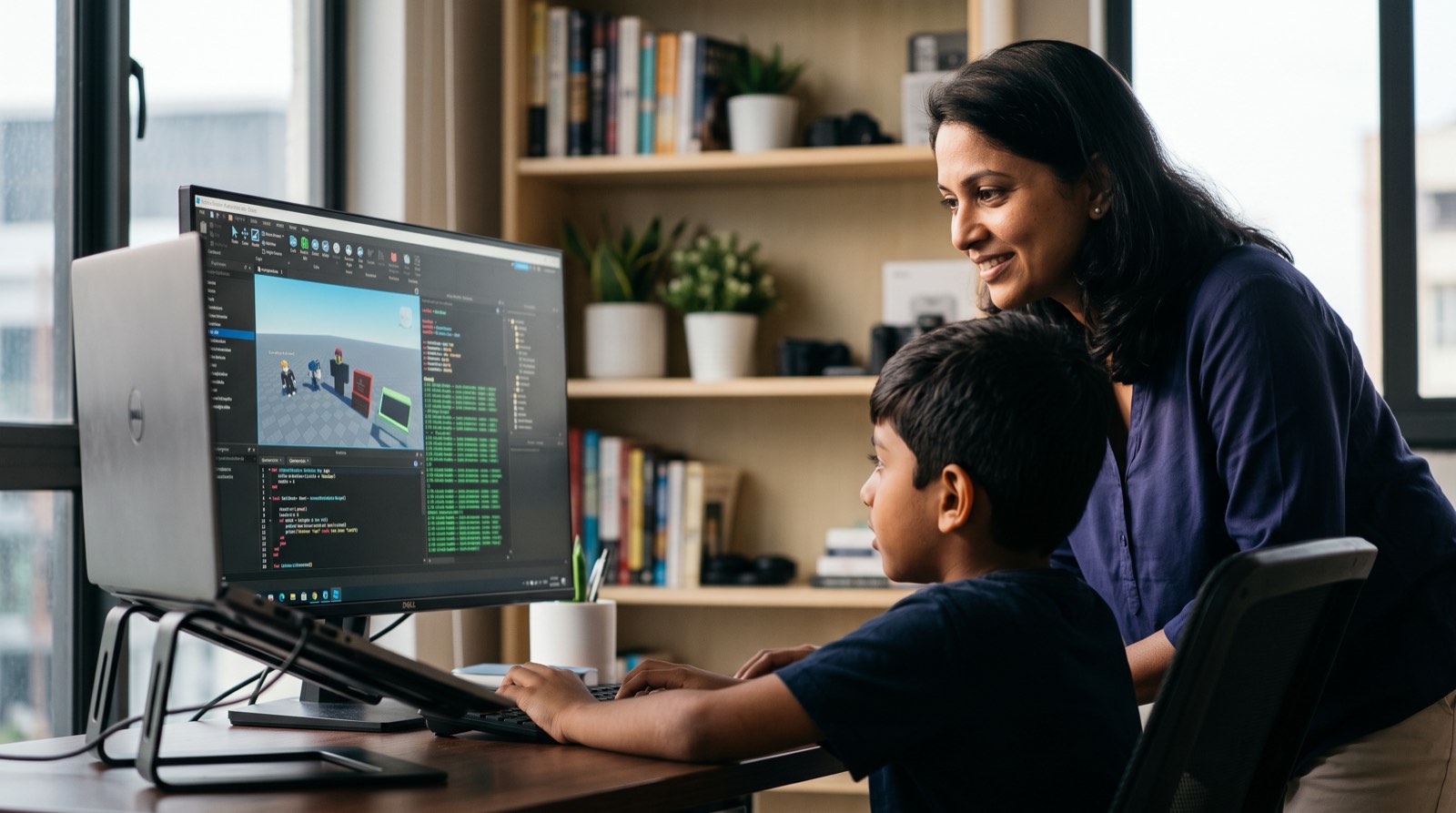
Your child has been on Roblox for two hours. Again. From the doorway it looks like the same blocky avatars, the same shouting into a headset, the same homework sitting untouched on the table. Fair enough. But the thing your child is playing inside was built by someone, often someone barely older than they are, using a free 3D game engine that ships with the platform.
So the question worth asking isn't whether Roblox is good or bad. It's what your child is doing inside it, and whether that can be shifted. Below: what skills the platform can actually teach, what the research says about its risks, and a four-step plan for moving a child from the player side to the builder side.
Key Takeaways
| Topic | What Parents Need to Know |
|---|---|
| Roblox vs Roblox Studio | Roblox is the playing platform, whereas Roblox Studio is a free, professional-grade 3D game engine using Lua code. |
| Real Technical Skills | Children learn text-based Lua scripting, 3D spatial geometry, event-driven logic, and user interface design. |
| Research on Risks | Peer-reviewed studies highlight predatory monetization (Robux dark patterns), unauthorized purchases, and moderation gaps. |
| The AI Ladder | Modern AI coding tools allow children to bypass years of drag-and-drop blocks and write real text code much earlier. |
| Structured Guidance | Self-learning through unstructured forums often leads to frustration or unsafe online spaces. Structured mentorship bridges the gap. |
Table of Contents
- What Roblox Actually Is: Platform vs. Game Engine
- What Can Kids Learn From Roblox? Real Skills vs. Screen-Time Myths
- How Roblox Coding Moves Beyond Block-Based Tools
- The Risks Parents Must Watch: Monetization, Scams, and Moderation
- What Academic Research Reveals About Youth Developers
- Comparing Self-Taught Roblox Play to Structured Tech Education
- How to Turn Roblox Screen Time Into Learning: A 4-Step Plan
- The Kidocode Approach: Integrating Gaming Energy into AI, Math, and Tech
- Frequently Asked Questions
- References
What Roblox Actually Is: Platform vs. Game Engine
Playing Roblox and building in Roblox Studio are two different activities, and almost every parenting argument about the platform comes down to confusing them.
Roblox is the online user-generated content platform. Your child logs in and plays games other users made, anything from a simple obstacle course (an "obby") to a multiplayer roleplaying simulation with an economy. Roblox reported over 380 million monthly active users in 2024, with 56% of those users under 16 years old, according to data cited in peer-reviewed literature [1]. Platform statistics from 2021 put children under 13 at 54.86% of the global user base [2].
graph TD
    A[Child's Interest in Roblox] --> B{Interaction Mode}
    B -->|Passive Play| C[Playing Games / In-App Purchases]
    B -->|Active Build| D[Roblox Studio Environment]
    D --> E[3D Geometry & Spatial Physics]
    D --> F[Lua Text Scripting]
    D --> G[Logic & Algorithmic Thinking]
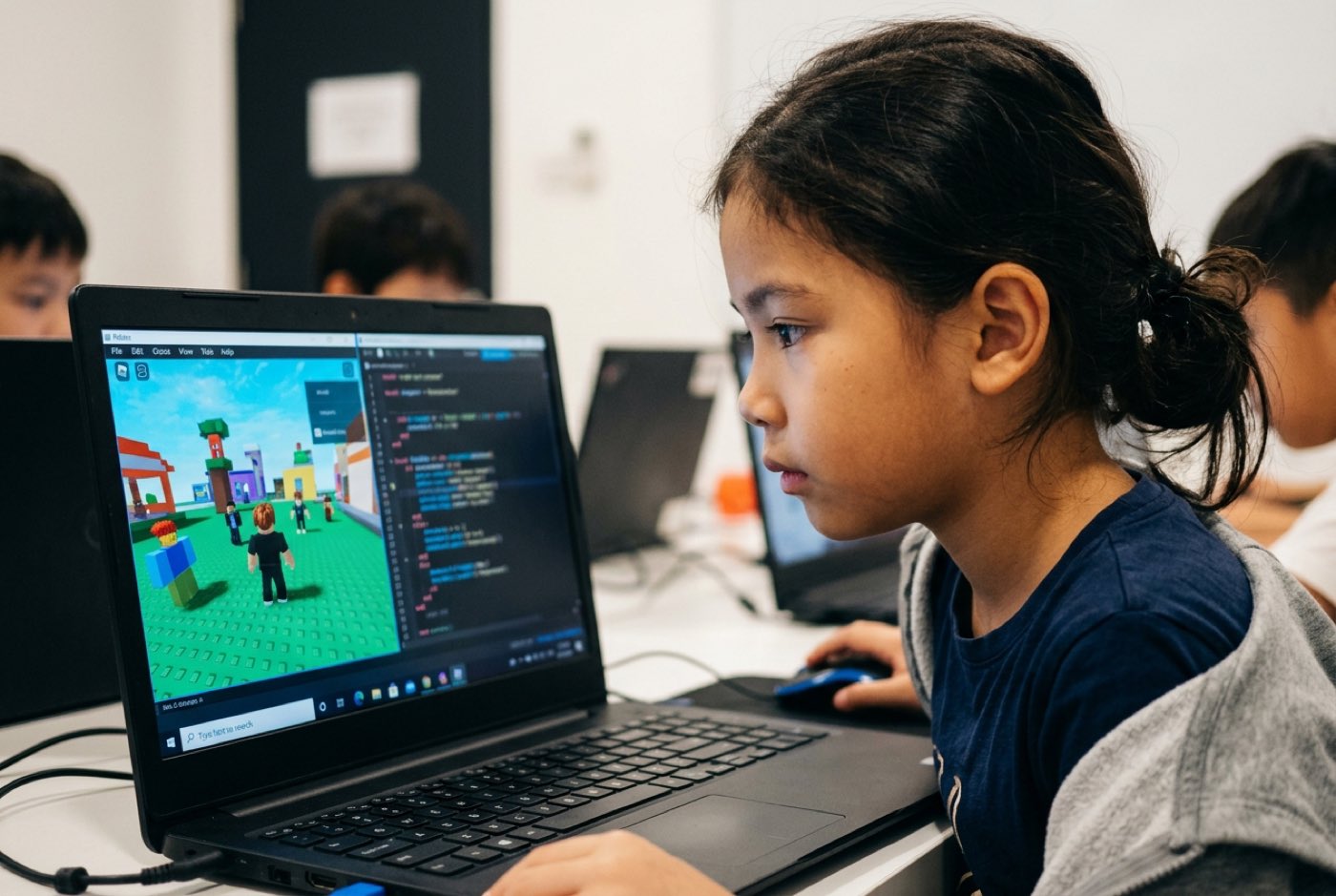
Roblox Studio is the creation suite underneath all of it. It's a desktop application for Windows and Mac with 3D modeling tools, a physics engine, lighting controls, and a code editor running the Lua programming language. Every world, every character behavior, every game mechanic on the platform was assembled inside this software.
When parents ask about roblox coding for kids, this is the move they're asking about: from the player interface into Studio. A child who opens Studio is no longer choosing what to consume. They're writing programs.
What Can Kids Learn From Roblox? Real Skills vs. Screen-Time Myths
The teaching advantage of an environment like Roblox Studio is the feedback loop. Write a line of code, press play, and a car accelerates or a door unlocks or a leaderboard updates. Nothing is abstract for long.
Four skills come out of that loop.
1. Text-Based Coding in Lua
Block languages snap code together like puzzle pieces. Studio doesn't. It runs Lua, a lightweight text-based language used widely in the professional game industry, so kids type real syntax: variable declarations, conditionals (if-then-else), loops (for and while), functions, and event-driven architecture.
2. Applied Physics and Spatial Mathematics
A working 3D game needs Cartesian coordinates , vector math, acceleration, and collision detection. A student calculating projectile speed or tweaking gravity inside Studio is doing the same physics and geometry that arrives in a textbook two years later looking far less interesting.
3. User Interface (UI) and Experience Design
Players quit games they can't navigate. Kids learn to build interactive graphical interfaces, lay out HUDs (Heads-Up Displays), format buttons, and shape environments so that players understand where to go without a wall of instructions.
4. Algorithmic Problem Solving
Things break constantly. A script fails, a character clips through the floor, and the child has to read the error log, isolate the variable, guess at a cause, and test the fix. That cycle is computational thinking, and it also builds tolerance for being stuck, which is arguably the rarer skill.
This is the real answer to the screen time vs coding time debate. Passive consumption drains a child. Solving problems in a development environment leaves them with something.
How Roblox Coding Moves Beyond Block-Based Tools
For years the standard coding pathway ran on rails: Scratch at age 7, block coding for several years, then text coding in Python or JavaScript somewhere around 13 or 14.
Scratch is a good on-ramp. The problem is staying on it. Kids who spend four years dragging blocks often hit text syntax with no preparation and decide coding isn't for them. Roblox Studio closes that gap by putting real text syntax inside a medium they already care about.
timeline
    title The Evolution of Learning to Code
    Traditional Route : Scratch Block Coding : Text Syntax Shock : Python or JavaScript
    Modern AI-Assisted Route : Visual Play & Roblox Studio : Lua Text with AI Assistance : Full AI & Text Mastery
AI tools have compressed the timeline further. Instead of grinding through strict syntax rules for months, a child can ask an AI assistant to explain an error, suggest a Lua function, or translate a concept into plain language. Our breakdown of Scratch vs Python covers this in more detail: with proper AI-assisted instruction, kids reach text-based coding years earlier than the old models assumed.
Pair Studio with structured AI guidance and a missing semicolon stops being a brick wall. The AI absorbs the syntax friction. The child spends their attention on logic, game architecture, and algorithm design, which is where the learning actually lives.
The Risks Parents Must Watch: Monetization, Scams, and Moderation
Studio's upside is real. The wider Roblox ecosystem is a different matter, and handing a child an unsupervised account because "it's educational" walks them straight into deceptive design and online hazards.
Research from the security and human-computer interaction communities flags three areas.
Predatory In-Game Monetization
A 2025 peer-reviewed study in the Proceedings of the Symposium on Usable Privacy and Security (SOUPS) examined monetization practices across child-friendly Roblox experiences [3]. The researchers documented widespread deceptive interface design, including:
- False Visual Hierarchies: Purchase buttons sized and colored to dominate the screen while the decline option is easy to miss.
- Obscured Costs: Stacked virtual currencies, real money to Robux, Robux to in-game gems, so the cash price of an item is buried.
- Artificial Urgency: Emotional pop-ups such as "DON'T MISS OUT" in bright red when a player taps "Maybe Later."
Discrepancies in Risk Awareness
A 2026 study presented at the ACM Conference on Human Factors in Computing Systems (CHI '26) analyzed 2,000 parent and child reviews from Common Sense Media [5]. Parents and children do not report the same problems:
| Common Online Risk Reported on Roblox | Parents | Children |
|---|---|---|
| Physical violence depictions | 23.4% | 28.4% |
| Personal info leaks & scams | 14.9% | 23.0% |
| Bullying & harassment | 16.3% | 22.8% |
| Inappropriate social acts | 12.9% | 21.5% |
| Unauthorized purchases | 13.1% | 10.0% |
| Ineffective moderation | 25.2% | 15.7% |
Source: Panchanadikar et al., CHI '26 dataset (N=2,000)
Read the two columns side by side and the gap is obvious. Kids run into social risks, scams, and harassment more often than their parents realize. Parents, meanwhile, are watching the credit card and the moderation queue.

Developer Monetization Realities
Some parents see Roblox as a business plan, imagining their child publishing a hit and earning from it. Investigative reporting and platform analyses suggest the odds are poor for individual young creators, even though top studios do generate serious revenue [4].
The mechanics explain why. Roblox requires developers to accumulate a minimum of 100,000 Robux and hold a paid monthly subscription before converting virtual currency into real money through the Developer Exchange (DevEx) system [4]. The cash-out rate values 100,000 Robux at $350 USD, well below what that currency costs to buy [4]. Treat game creation as an education in computation and problem solving. Anything else is speculation.
What Academic Research Reveals About Youth Developers
The commercial side is discouraging. The developmental side is not, provided the environment is safe and structured.
A 2025 study of teenage Roblox creators published at the ACM Conference on Human Factors in Computing Systems interviewed 18 active youth developers with a mean age of 16.3 years [6]. Three findings stand out:
- Technical Mastery: Building technical capability was the main reason these teens joined developer communities in the first place. Of the 18 interviewed, 15 had advanced Lua scripting skills, 7 had mastered 3D modeling, and 5 had developed environment building expertise [6].
- Platform Specialization: They used official text documentation (DevForum) for structured technical research and real-time platforms like Discord for peer collaboration and code reviews [6].
- Key Challenges: They struggled with unverified third-party deals, with balancing school against project deadlines, and with online conflicts they had to handle without any adult nearby [6].
That third point is the one parents should sit with. The move into game development works. Leaving a child to source technical guidance from unmoderated forums is how it turns into scams and burnout.
Comparing Self-Taught Roblox Play to Structured Tech Education
Is downloading Studio and watching YouTube tutorials enough? For a small number of unusually driven teenagers, yes. Most children hit a syntax wall, end up with disorganized copied templates, and pick up some security risks along the way.
Here's how the three paths compare:
| Parameter | Unguided Roblox Play | Self-Taught Roblox Studio | Structured Coding & AI Program |
|---|---|---|---|
| Primary Activity | Consuming games, spending Robux | Copying code from tutorials | Designing original algorithms and systems |
| Code Understanding | None | Patchy; relies on copy-pasting | Deep comprehension of Lua, Python, and logic |
| Math Integration | None | Trial and error without math theory | Explicit alignment with 3D geometry and physics |
| AI Utilization | Unassisted | Basic search | AI tutors for real-time debugging and logic |
| Online Safety | Exposed to public chat & UI traps | Unmoderated forum exposure | Moderated, safe environment with privacy controls |
| Long-Term Outcome | Passive screen-time habit | High frustration; frequent abandonment | Transferable fluency in text coding, AI, and math |
The motivation Roblox generates is genuine and hard to manufacture any other way. Guided learning keeps that motivation and adds the structure that stops most self-taught kids from quitting in month three.
How to Turn Roblox Screen Time Into Learning: A 4-Step Plan
If your child is deep into Roblox right now, banning it wastes the one asset you have: they already care. Use it.
graph LR
    Step1[1. Audit & Frame] --> Step2[2. Install Studio]
    Step2 --> Step3[3. Link Physics & Math]
    Step3 --> Step4[4. Add Structured Mentorship]
Step 1: Shift the Framing From Consumer to Creator
Sit next to them while they play and ask about mechanics instead of scores:
- "How do you think the developer made this floor disappear when the timer hits zero?"
- "What happens behind the scenes when your character purchases an item with in-game coins?"
Then tell them the people who built their favorite experiences started exactly where they are, and that building a better one is a thing they can learn to do.
Step 2: Set Up Roblox Studio with Safety Controls
Install Roblox Studio on a home desktop or laptop. Before they start experimenting, lock down the account:
- Disable public messaging and restrict incoming chat permissions.
- Set spending limits and turn on two-factor authentication for any linked payment method, so Robux purchases can't happen without you.
- Set game privacy so early project tests stay private or are shared only with family.
Step 3: Connect Game Mechanics to Math and Physics
Make the math visible. If they're building an obstacle course, talk about jump power and speed as variables. Show them how changing gravity reshapes a jump arc:
Adjust initial velocity () or gravitational acceleration () inside a Lua script and the equation stops being homework. It becomes the difference between a level that feels good and one that doesn't. Our guide on math tuition vs learning math by building goes further into why project work dissolves math resistance.
Step 4: Integrate AI Tools and Structured Guidance
Get them using AI assistants while they code. When a Lua script throws an error in Studio, teach them to paste the message into a prompt and ask: "Explain why this code failed and how I can fix the variable logic."
For a child who wants to go past tweaking other people's templates, pair the game building with a curriculum that teaches computational thinking, algorithms, and real text programming.
Printable Roblox-to-Creator Activity Tracker
Print this and stick it near the computer. Four weeks, player to builder.
- Week 1: The Studio Setup
- Download Roblox Studio on desktop/laptop.
- Configure account security: disable public chat and lock Robux spending.
- Complete the built-in Studio tutorial: spawn basic 3D parts and alter colors.
- Week 2: The First Lua Script
- Create a script that changes a block's color when touched by a player (
Touchedevent).
- Create a script that changes a block's color when touched by a player (
Designed, ready to print and sign. We email it to you together with a 5% discount on your next registration.
The Kidocode Approach: Integrating Gaming Energy into AI, Math, and Tech
At Kidocode we don't treat Roblox or Minecraft as the enemy. They're the entry layer, the thing that gets a 9-year-old to sit still long enough to learn computational thinking, AI literacy, and mathematics. Our students are aged 5 to 18.
Plenty of tuition centers teach coding as a list of syntax rules to memorize, and plenty of math programs run on worksheets. We work differently.
1. AI School First
Students learn to direct, prompt, and orchestrate AI safely. That means using AI tutors to debug their own code, unpack an algorithm they don't understand, and generate assets, from the first week rather than the last.
2. Math Through Builds
We deliver international math standards (IGCSE, Cambridge, US Common Core) through hands-on project creation, and every student gets a personalized AI math tutor. Apply geometry or algebra directly to a 3D game engine or a physics simulation and the resistance tends to evaporate. The child was never the problem. The memorization method was.
3. Tech and Coding Bundled Free
Basic syntax is free on the internet now, so we stopped charging for it. Six core technology tracks come bundled into our membership packages at no extra cost: Python, Web, Mobile Apps, Game Development, Electronics, and 3D Modeling. Syntax mastery isn't the point. Computational thinking is.
Kidocode was founded in 2014 by computer scientist and AI researcher Unclecode (Hossein Tohidi, creator of Crawl4AI). We've trained over 9,500 active students and hold a 4.6-star Google rating across 177 verified parent reviews.
Classes run in person at our flagship campus in Solaris Mont Kiara (KL), at Sunway Nexis (Kota Damansara), and at our Penang centers (Q2 Waterfront, Vantage Tanjung Tokong, Icon City). They also run live and camera-on online. Either way the child builds something and sees it work.
If yours is currently spending hours gaming on a tablet or PC, book a free trial class at the nearest center or online. It's two hours, hands-on, and your child leaves having built a real project in AI, math, or tech while you watch what happens when that gaming energy gets pointed at engineering. Our campuses page has locations across Malaysia.
Frequently Asked Questions
Is Roblox Studio completely free for kids to use?
Yes. Roblox Studio is entirely free to download and use on Windows and Mac. It does not require purchasing Robux to write code, build 3D environments, or publish games.
What is the ideal age for a child to start learning Roblox coding?
Children aged 7 to 8 can begin exploring Roblox Studio to understand basic spatial positioning, 3D modeling, and simple script modifications. By ages 9 to 12, students can learn text-based Lua scripting, logic loops, and variable management, especially when supported by AI tools and structured mentorship.
Will learning Lua in Roblox help my child learn other programming languages?
Yes. Lua shares core structural principles with major languages like Python, JavaScript, and C#. Once a child understands concepts like variables, conditional logic, arrays, and functions in Lua, transitioning to languages like Python or JavaScript becomes straightforward.
How can I stop my child from buying Robux while using Roblox?
To prevent unauthorized spending, turn off saved credit card information on your devices, set up PIN protection on account settings, enable daily spending limits inside Roblox, and turn off in-app purchases at the operating system level (iOS, Android, or Windows).
What is the difference between learning coding through Roblox vs. learning Python?
Roblox uses Lua, a language tailored for game mechanics, render loops, and 3D objects, providing instant visual feedback. Python is a broader language used widely in data science, artificial intelligence, and backend systems. Both are text-based languages; many students start with Roblox for visual engagement before expanding into Python and AI modeling.
How does Kidocode address a child who only wants to play games?
We use that interest rather than fight it. Our trainers show students how the mechanics inside their favorite games work, then teach them to write the Lua code, calculate the 3D physics, and engineer the AI systems behind those experiences.
References
- Song, Q., Zhang, Z., Hernandez, R. H. L., Gui, X., & Kou, Y. (2025). Predatory Monetization Designs in Child-Friendly User-Generated Games: A Developer and Game-Walkthrough Perspective. Proceedings of the 21st Symposium on Usable Privacy and Security (SOUPS 2025), USENIX Association. https://www.usenix.org/system/files/soups2025-song.pdf
- Han, J., Liu, G., & Gao, Y. (2023). Educational Applications and Risks of Roblox in STEM Learning: A Systematic Literature Review. Education Sciences, 13(3), 296. MDPI. https://www.mdpi.com/2227-7102/13/3/296
- Yin-Poole, W. (2021). Roblox exploiting young game developers, new investigation reports. Eurogamer.net. https://www.eurogamer.net/roblox-exploiting-young-game-developers-new-investigation-reports
- Smith, Q. (2021). Investigation: How Roblox Exploits Young Developers. People Make Games. https://www.youtube.com/watch?v=_gXlauRB1EQ
- Panchanadikar, R., Hu, Y., Guo, K., Hall, A. L., Hu, H., Vishwamitra, N., & Freeman, G. (2026). Divergent Perceptions of Online Risks in UGC Games: A Comparative Analysis of Parent and Child Reviews on Roblox. Proceedings of the 2026 CHI Conference on Human Factors in Computing Systems (CHI '26), ACM. https://guof.people.clemson.edu/papers/chi26age.pdf
- Choi, Y., Choi, J., & Seering, J. (2025). Teen Developer Communities on Roblox: Technical Growth, Social Dynamics, and Career Aspirations. ACM CHI Conference on Human Factors in Computing Systems (CHI '25), arXiv:2502.18120v1. https://arxiv.org/html/2502.18120v1