

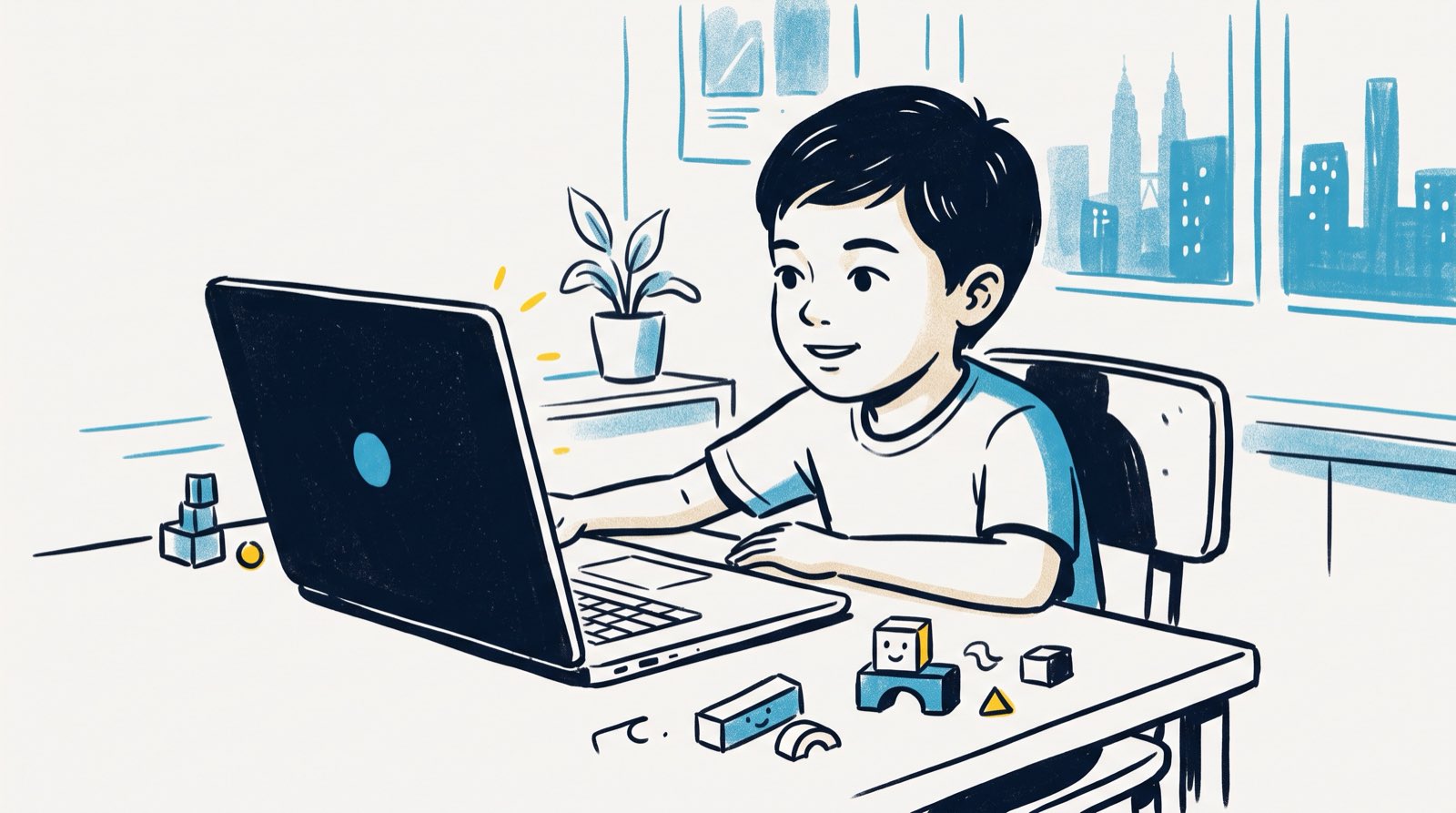
It's a familiar Saturday scene in Kuala Lumpur, Petaling Jaya, and Penang: a child hunched over a screen, stacking virtual blocks, digging tunnels, raising a castle wall one cube at a time. To most adults, it reads as screen time with nothing to show for it.
Parents usually ask the question bluntly. Can all that focus turn into anything real, engineering, spatial mathematics, actual programming?
It can, but not on its own. The shift happens when a child stops consuming the world and starts writing the rules that govern it. At that point Minecraft stops being a distraction and starts working as a gateway into computational thinking.
Key Takeaways
| Dimension | Passive Minecraft Play | Guided Minecraft Coding |
|---|---|---|
| Primary Activity | Consuming pre-built mechanics, placing blocks manually | Writing scripts, automating construction, defining game rules |
| Math Application | Intuitive estimation of space | Explicit spatial coordinates (), 3D geometry, and logic gate math |
| Cognitive Skill | Pattern recognition and hand-eye coordination | Algorithmic thinking, abstraction, and debugging |
| Future Pathway | Entertainment | Text-based Python programming, AI direction, and software engineering |
Table of Contents
- The Screen-Time Reframe: Player vs Builder
- What Minecraft Actually Teaches: Logic, Spatial Math, and Systems
- The Learning Ladder: From Visual Blocks to Text-Based Python
- Why Sandboxes Need Structured Scaffolding
- The AI Acceleration: Moving Past Blocks Faster
- Minecraft Coding in the Malaysian Education Landscape
- Comparison: Pure Gaming vs Modding vs Guided AI Training
- How Kidocode Turns Gaming Passion into Engineering
- The 4-Step Home Plan for Parents
- Printable 4-Week Minecraft to Creator Transition Planner
- Frequently Asked Questions
- References
The Screen-Time Reframe: Player vs Builder
When parents worry about gaming hours, the screen itself is rarely the problem. What matters is whether the child is consuming or constructing.
At Kidocode we read gamer engagement as evidence, not damage: a child who can hold attention on a complex digital world for hours has focus and persistence most adults would envy. The useful question is what those four hours could become if they were spent building a game instead of finishing one.
Research on game-based learning backs the reframe. A meta-analysis of game-based learning across global educational settings found a statistically significant positive effect on students' overall computational thinking (Hedges' ) [8]. Broken down, the gains covered computational thinking concepts (), skills (), and perspectives () [8].
The most useful finding for parents is about beginners. Gamified learning had a noticeably larger impact on students with no prior programming experience () than on students who had already coded () [8]. Sandbox worlds work best as a first door into computer science, for the child who would find a syntax tutorial intimidating.
For a broader look at how gamified environments build core engineering skills, see our breakdown on whether kids can learn engineering from online games.
What Minecraft Actually Teaches: Logic, Spatial Math, and Systems
Minecraft runs on a three-dimensional grid of cubic blocks. Every object, mob, and landscape feature sits somewhere on a three-axis coordinate system (). Children play inside a mathematical and logical framework whether they notice it or not.
timeline
    title Minecraft Coding Progression
    Ages 5-7 : Block Mechanics : Spatial Coordinates
    Ages 8-11 : Redstone Logic : MakeCode Blocks
    Ages 12-14 : Python Scripting : Modding Basics
    Ages 15-18 : AI Assistant Code : Full Software Builds
1. Digital Logic and Redstone Circuits
The game includes a resource called Redstone, which behaves like virtual electrical wiring. Players use it to build circuits, switches, and automated systems. Wire a pressure plate to a wooden door and you have built an input-output circuit.
As builds get more ambitious, children end up constructing digital logic gates without being taught the terminology:
- AND Gates: Two levers must be pulled at once for the mechanism to fire.
- OR Gates: Either lever triggers the outcome.
- NOT Gates (Inverters): An input switches the signal off.
These are the same structures that sit underneath microprocessors and computer architecture. The difference is that the learner watches the logic run in a world they built, instead of memorising a truth table on paper.
2. Spatial Geometry and Coordinate Mathematics
Building in 3D means working inside a Cartesian coordinate system. Spawning an item or placing a wall through code requires calculating relative positions on three axes.
Work out the block distance between a player at and a build site at , and you are using the 3D distance formula:
Write a short program to generate a hollow stone cube and you are applying algorithms for volume, surface area, and perimeter loops. That maps straight onto international mathematics curricula, including IGCSE, Cambridge, and US Common Core standards.
Resistance to math drops fast when the math controls something the child cares about. For more on how building projects change a child's relationship with numbers, explore our guide on learning math through building versus traditional tuition.
The Learning Ladder: From Visual Blocks to Text-Based Python
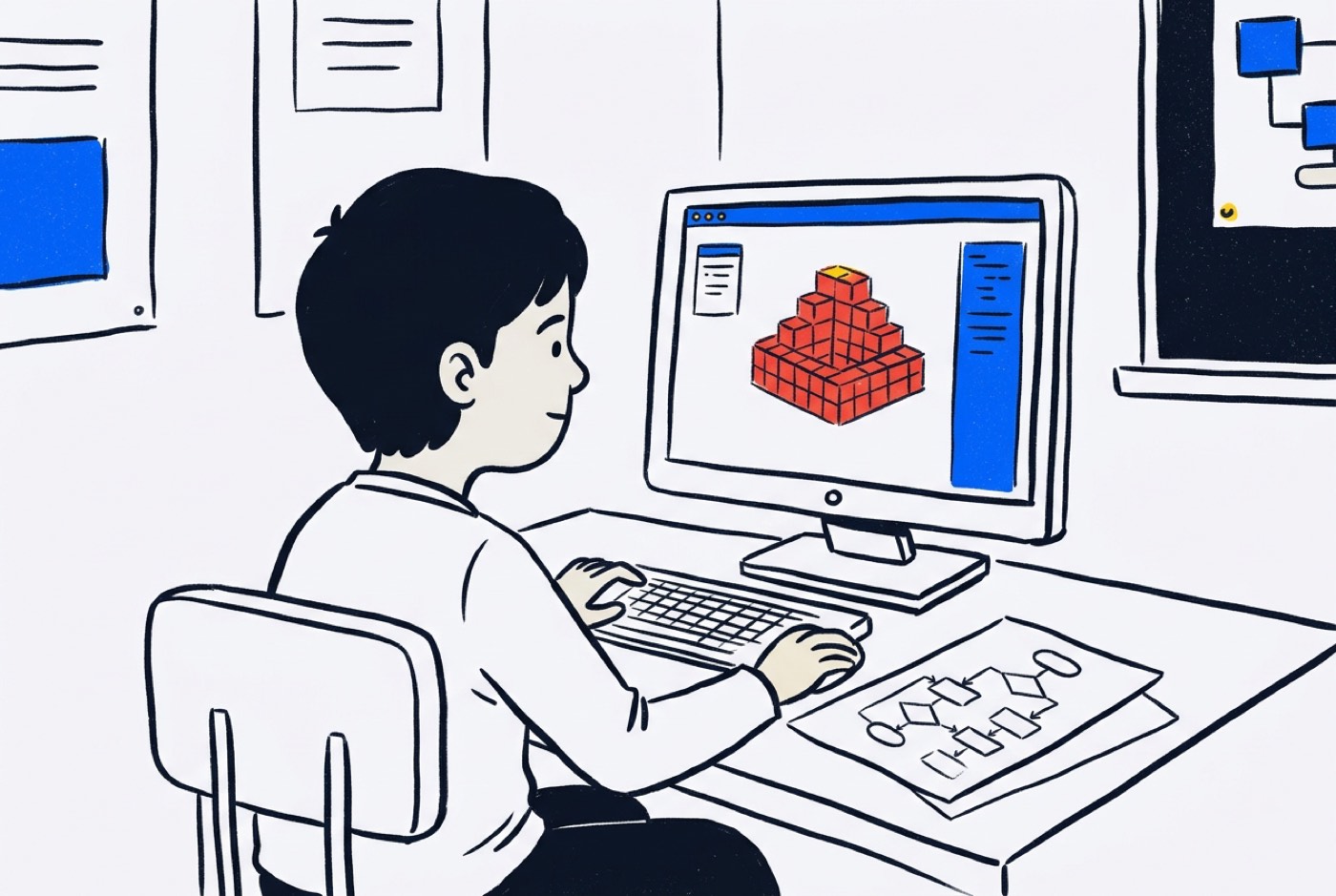
Teaching a child to program through Minecraft does not mean dropping them into a hundred lines of syntax on day one. Computer science education uses a progression ladder.
Microsoft's official Computer Science Progression framework maps over 200 hours of standards-aligned instructional content across four stages [4]:
- Lower Primary (Grades K-2): Basic computational thinking and physical directional logic.
- Upper Primary (Grades 3-5): Block-based visual programming interfaces such as Microsoft MakeCode, introducing loops, variables, and conditionals [4].
- Lower Secondary (Grades 6-8): The move from drag-and-drop blocks to text-based Python code [4].
- Upper Secondary (Grades 9-12): Advanced Python written in notebook-style editors and integrated development environments (IDEs) [4].
What Classroom Trials Reveal About Skill Acquisition
The ladder looks seamless on paper. Classroom data shows where children actually stall.
A peer-reviewed study of 284 fourth-grade students working through an 8-week Minecraft coding curriculum recorded a high overall average of 88.49 out of 100 across creative and technical rubrics [2].
Task-level scores told a more interesting story:
- Basic Block Programming: A mean of 28.34 out of 30. Execution, sequencing, and spatial loops came easily [2].
- Debugging and Problem Identification: Performance fell to intermediate levels, 22.87 out of 30, once students had to isolate logic errors, debug code, or spot structural flaws [2].
The pattern is consistent with what teachers see: children absorb basic visual commands through play, but systematic debugging and error diagnosis need a mentor.
To understand how visual block languages compare to text-based code as a foundation, read our comparison of Scratch versus Python for young beginners.
Why Sandboxes Need Structured Scaffolding
An open sandbox gives unlimited creative freedom. Freedom alone does not produce software engineers.
In a design analysis of educational game platforms, researcher Herschel Meusa noted that Minecraft's open-ended structure supports creative constructivist exploration but lacks built-in instructional scaffolding, adaptive difficulty, and systematic feedback [5]. Without explicit guidance, students with different focus levels or learning styles hit a wall when a script fails and have no route forward [5].
There is a second trap, and it belongs to the adults. Writing in Education Week, technology journalist Alyson Klein warns that effective ed-tech has to avoid "chocolate-covered broccoli", the habit of bolting game mechanics onto dull tasks without teaching the concept underneath [6].
Real skill develops when children use the game to reach industry-aligned competencies: writing genuine scripts in Java or Python and applying computational logic to them [6].
The AI Acceleration: Moving Past Blocks Faster
For years, the standard path kept children in block-based environments like Scratch or MakeCode long before anyone let them touch Python or JavaScript.
By 2026, generative AI tools and coding assistants have rewritten that timeline.
The old bottleneck was syntax friction: a missing bracket, a misspelled function, a forgotten colon. That friction is what kept an 8-year-old parked in drag-and-drop blocks. When a child learns to direct an AI assistant safely and deliberately, the assistant absorbs the routine syntax work, and learners aged 8 to 12 can start writing real Python far earlier than traditional frameworks assumed.
| Path | Sequence |
|---|---|
| Traditional learning ladder | Visual Scratch blocks → years of drag-and-drop → syntax roadblocks → text Python |
| AI-accelerated model (Kidocode) | Engagement layer (Minecraft / Roblox) → AI coding assistant + logic → direct Python scripting |
The child keeps the parts that matter: the logic, the architecture, the decomposition of the problem. The assistant handles syntax lookup and error detection.
Directing AI well is itself the literacy of the moment. Coding comes bundled free in our curriculum because syntax knowledge is now public domain; what we actually teach is the computational thinking and prompt architecture needed to command these tools.
To read more about how AI assistants accelerate real code literacy, see our breakdown on why Python remains the fundamental language for young builders.
Minecraft Coding in the Malaysian Education Landscape
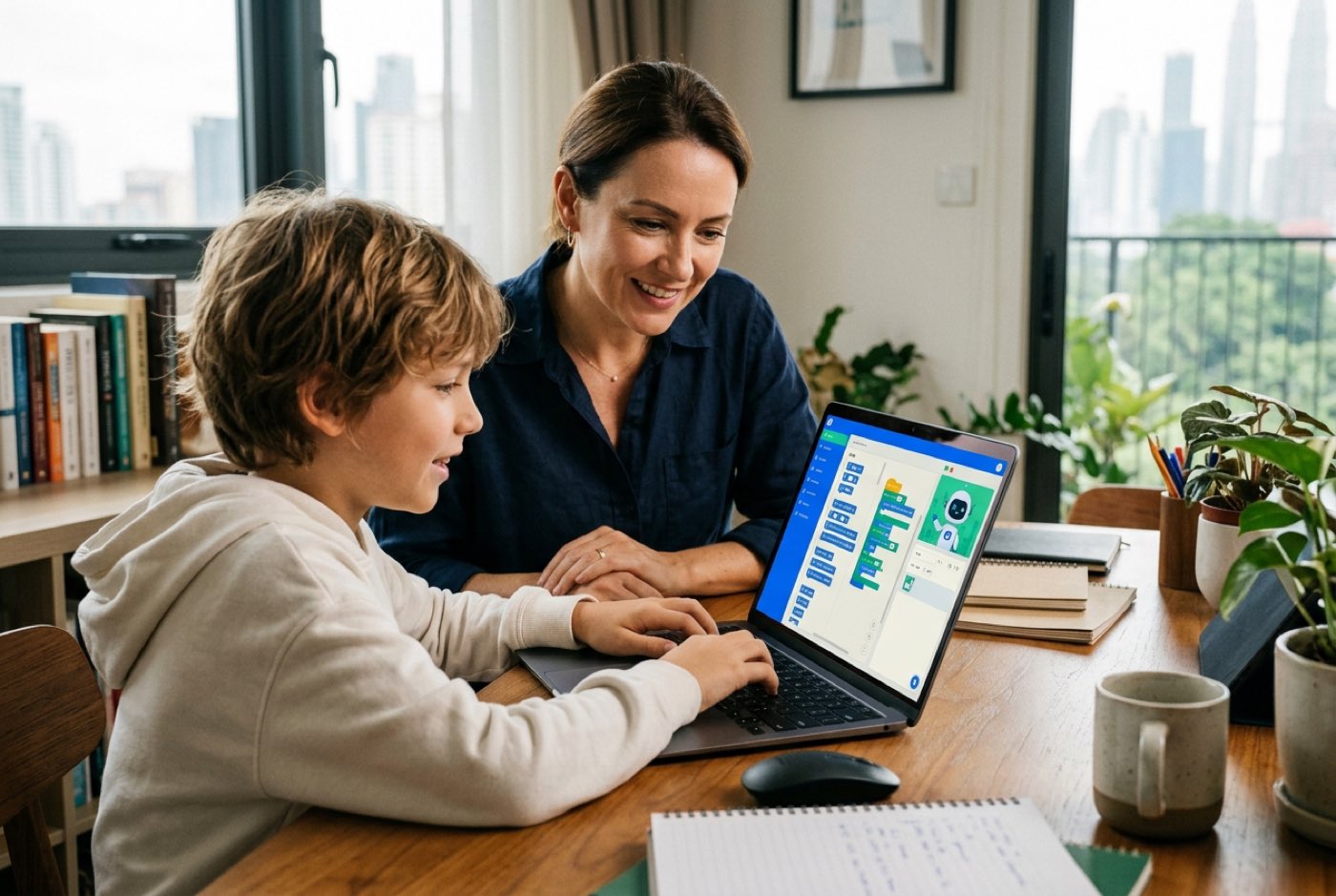
Malaysian public initiatives and private frameworks have both recognized what game-based learning can do. Implementation is another matter, and it varies sharply from school to school.
National Initiatives and Outreach
Outreach programmes have shown strong student interest whenever technical concepts arrive attached to a familiar game:
- Hour of Code Outreach: Malaysia served as a regional launchpad for global coding initiatives, including the 2015 Hour of Code campaign, which reached over 25,000 children across 247 locations nationwide [7]. The campaign included workshops teaching basic visual programming logic through Minecraft to more than 150 juvenile students at the Henry Gurney Prison School in Malacca [7].
- MDEC #mydigitalmaker Movement: The Malaysia Digital Economy Corporation (MDEC) launched #mydigitalmaker, which trained roughly 1.3 million Malaysian students in digital creation skills spanning coding, robotics, and 3D design [3]. Digital champion teachers such as Cikgu Goh Kok Ming in Perak pioneered "app smashing" methods that combined Minecraft Education Edition with interactive assessment tools in primary classrooms [3].
Infrastructure Realities in Malaysian Schools
Hardware access and dedicated class time remain the bottleneck.
An official infrastructure audit in the Ministry of Education Malaysia's Malaysia Education Blueprint Annual Report found that only 39.3% of Malaysian public primary and secondary schools met the target ICT device ratio of at least 1 device to 10 pupils [1].
Government programmes have moved to close the gap, CERDIK distributed 150,000 digital devices with data plans to low-income (B40) students [1], but a normal school timetable still cannot deliver the individualized, project-based computing hours that real software development takes.
That is why parents in Mont Kiara, Kota Damansara, and Penang increasingly look to specialized out-of-school programs for deep, practical technical literacy.
Comparison: Pure Gaming vs Modding vs Guided AI Training
To work out where your child currently sits, compare the three levels of interaction with a sandbox game:
| Feature / Dimension | Level 1: Pure Gaming | Level 2: Independent Modding | Level 3: Guided AI & Code Training (Kidocode) |
|---|---|---|---|
| Child's Role | Consumer / Player | Hobbyist Tinkerer | Software Developer & AI Director |
| Primary Tool | Keyboard / Controller | Community Mods, YouTube tutorials | Python, MakeCode, AI Assistants, 3D engines |
| Math Depth | Visual spatial estimation | Manual parameter tweaking | Vector geometry, algorithms, IGCSE math integration |
| Problem Solving | Trial-and-error play | Copy-pasting forum code snippets | Systematic debugging, logic decomposition |
| Pedagogical Structure | None (unstructured) | Low (unguided online searching) | High (personalized AI tutor + expert mentor) |
| Future Outcome | Entertainment | Surface technical familiarity | Full computational thinking, real language proficiency |
How Kidocode Turns Gaming Passion into Engineering
Kidocode is Malaysia's coding and AI school for kids aged 5 to 18. We run five physical campuses across the Klang Valley and Penang, Solaris Mont Kiara, Sunway Nexis PJ, Q2 Waterfront Bayan Lepas, Vantage Tanjung Tokong, and Icon City Bukit Mertajam, plus a live, interactive online campus.
We make kids AI-savvy, end math-hate, and turn passive gamers into active builders.
| Kidocode Membership | Pillar |
|---|---|
| Pillar 1 | AI to Survive |
| Pillar 2 | Math to Think |
| Pillar 3 | Tech to Build, coding bundled FREE inside |
The three pillars sit inside a single flexible membership:
- AI to Survive (Pillar 1): Children learn to direct artificial intelligence responsibly and effectively. AI safety, prompt architecture, and critical evaluation are taught as core literacies alongside coding.
- Math to Think (Pillar 2): Ending math-hate in 2 to 4 weeks. We take the same syllabus covered by international standards (IGCSE, Cambridge, US Common Core) and deliver it in reverse: children build game physics, program Redstone logic, and use vector math to solve real build challenges. The child was never bad at math. The delivery just had no application attached.
- Tech to Build (Pillar 3): Six specialized tracks covering Python, Web Development, Mobile Apps, Game Development, Electronics, and 3D Modelling.
Coding is bundled free across every package. Raw syntax is public knowledge, a search away or an AI prompt away. What we teach is computational thinking: decomposing complex problems, designing system architecture, and debugging logical structures.
Kidocode was founded in 2014 by computer scientist and AI researcher Hossein Tohidi, known to students and parents as Unclecode and creator of the open-source Crawl4AI project. The school has trained over 9,500 active students and holds an independently audited 4.6-star Google rating across 177 parent reviews.
For families joining us, we usually recommend the Triple Degree membership, which covers three flexible trainer sessions per week across all three pillars at our lowest per-session rate. If you want unlimited flexible sessions or our pass-or-refund guarantee, ask about the Master's coaching track.
For membership terms and options, see our transparent pricing overview or our overview of physical and online campuses.
The 4-Step Home Plan for Parents
If your child is deep in Minecraft right now, four things you can do this week will start moving them from playing to building.
Step 1: Shift the Framing from Screen Time to Project Time
Stop treating Minecraft as leisure to be rationed. Ask about the build instead: "How does that door open automatically?" or "How many blocks wide is that fortress?" Treat the world as an architectural project, because that is what it is.
Step 2: Introduce Redstone Logic Challenges
Send them into Creative Mode with a brief. Build a hidden door, an automated crop harvester, a lighting system that switches on only at night. The focus moves from placing blocks by hand to designing systems.
Step 3: Connect Builds to Coordinate Mathematics
Switch on the "Show Coordinates" setting. Ask your child to write down the positions of two places in their world and work out the distance along each axis by hand, before teleporting or running a build command.
Step 4: Move Beyond the Sandbox into Structured Coding and AI
Introduce Microsoft MakeCode or a text-based Python tutorial. Show them a short loop that generates in seconds a structure they would otherwise stack by hand for an hour. That moment tends to land.
To see how this transition works in a guided, hands-on setting, book a free 2-hour trial class at any of our five campuses or online.
Printable 4-Week Minecraft to Creator Transition Planner
Week 1: The Systems Audit
-
Week 1: The Systems Audit
- Turn on "Show Coordinates" in your child's Minecraft settings menu.
- Have your child identify 3 distinct spatial coordinates for their primary home base, a nearby resource site, and a construction target.
- Ask your child to explain the mechanical step-by-step logic of 1 automated build in their world.
-
Week 2: Redstone Logic Foundations
- Set up a dedicated flat testing world in Minecraft Creative Mode.
Designed, ready to print and sign. We email it to you together with a 5% discount on your next registration.
Frequently Asked Questions
Is my child too young to start learning coding through Minecraft?
Age is rarely the limiting factor; the teaching approach is. If a child can navigate a game on screen, they can learn to build pieces of it. For ages 5 to 7 we start with spatial logic and visual block mechanics. From 8 to 12, children move into Redstone logic, Python scripting, and working with AI assistance.
Will AI make learning to code obsolete by the time my child grows up?
No. AI assistants handle syntax lookup; they do not do architectural design, algorithmic logic, or problem decomposition for you. Directing them well demands strong computational literacy. A child who can prompt an assistant to generate, test, and debug code is holding exactly the skill set an AI-driven economy pays for.
How does learning math through game building compare to traditional tuition?
Traditional tuition leans on repetition, worksheets, and formulas memorised out of context, which is where math anxiety usually starts. We follow the same international standards (IGCSE, Cambridge, US Common Core) but deliver them through build projects. Once a child is using spatial coordinates, vector geometry, and algebra to program game mechanics, math becomes a tool rather than a chore.
Does my child need a high-end gaming computer to learn Minecraft coding?
No. An entry-level laptop or desktop running Windows or macOS will handle Minecraft Education Edition, Microsoft MakeCode, and introductory Python environments. For live online classes with Kidocode, you need a stable internet connection and a working webcam.
What is the difference between free online tutorials and Kidocode's structured classes?
Free tutorials hand over code snippets. Research on unguided sandbox environments shows students then stall on debugging and complex logic errors [5]. Kidocode adds personalized mentoring, a dedicated AI tutor for every child, structured progression across the three pillars (AI, Math, Tech), and live help, the pieces that turn casual interest into verified engineering capability.
References
- Ministry of Education Malaysia. (2022). Malaysia Education Blueprint 2013–2025 Annual Report 2021. Education Performance and Delivery Unit (PADU). https://www.moe.gov.my/storage/files/shares/Dasar/PPPM/MEB%20Annual%20Report%202021.pdf
- Sripan, T., & Manyam, K. (2025). Developing Coding and Creative Thinking Skills of Fourth-Grade Students Using Minecraft: Education Edition. Journal of Education and Learning, 14(3), 118–127. https://files.eric.ed.gov/fulltext/EJ1480446.pdf
- Malaysia Digital Economy Corporation (MDEC). (2020, May 16). Digital Education Trailblazers. MDEC Blog. https://www.mdec.my/blog/digital-education-trailblazers
- Mojang Studios / Microsoft Education. (2022, June 24). New Coding Progression in Minecraft Education. Minecraft Education Blog. https://education.minecraft.net/en-us/blog/new-coding-progression
- Meusa, H. (2025). Evaluating Game-Based Learning Interfaces: Constructivism and Accessibility in Digital Media (Master's thesis, Long Island University). LIU Digital Commons. https://digitalcommons.liu.edu/cgi/viewcontent.cgi?article=1044&context=brooklyn_fulltext_master_theses
- Klein, A. (2025, February 27). How Playing Minecraft Can Help Students Learn Coding Skills. Education Week. https://www.edweek.org/technology/how-playing-minecraft-can-help-students-learn-coding-skills/2025/02
- Microsoft Malaysia. (2015, December 21). Microsoft Malaysia Takes the Hour of Code Journey from Prison School to International Schools and Beyond. Microsoft News Center. https://news.microsoft.com/en-my/2015/12/21/microsoft-malaysia-takes-the-hour-of-code-journey-from-prison-school-to-international-schools-and-beyond/
- Ma, J., Zhang, Y., Zhu, Z., Zhao, S., & Wang, Q. (2023). The Efficacy of Game-Based Learning on Students' Computational Thinking: A Meta-Analysis. Journal of Educational Computing Research, NIE Digital Repository. https://repository.nie.edu.sg/bitstreams/63fc2587-5c9b-43dc-bb93-d4081036ca88/download