


Ask a parent what an entrepreneurial child looks like and you'll usually hear about a weekend lemonade stand, or maybe a car wash in the driveway. Those activities do teach something about effort and customers. They just don't teach much about how value actually gets created now, when the product is more likely to be an app, a Roblox game, or a Canva template than a cup of lemonade.
Growing an entrepreneurial spirit doesn't mean handing a ten-year-old financial risk and startup pressure. It means helping them notice problems, chase down their own answers, understand what money is for, and finish things they start.
We've worked with more than 9,500 students across Malaysia since 2014. The pattern we keep seeing is simple: entrepreneurial thinking switches on the moment a child stops treating the world as something delivered to them and starts treating it as something assembled by people. That shift can happen at six or at sixteen, and it doesn't need a business plan. It needs a few household habits, adults who don't punish failed attempts, and tools good enough that a curious idea can become a working thing.
Key Takeaways
| Core Focus Area | Traditional Approach | Entrepreneurial Builder Approach |
|---|---|---|
| Problem Solving | Waiting for instructions or answers from adults | Experimenting with tools, asking questions, and iterating solutions |
| Screen Time | Consuming pre-made videos and mobile games | Designing original game levels, web apps, or digital art |
| Financial Literacy | Memorising rules or managing a piggy bank | Understanding value exchange, digital safety, and budget constraints |
| Handling Mistakes | Viewing errors as failures to be avoided | Treating bugs and setbacks as feedback to refine the project |
Table of Contents
- What Entrepreneurial Thinking Really Means for Children
- Moving Beyond the Lemonade Stand: Entrepreneurship in the Digital Era
- Habit 1: Shift from Passive Consumer to Active Creator
- Habit 2: Teach Financial Literacy Through Practical Value
- Habit 3: Build Resourcefulness Using Modern AI Tools
- Habit 4: Reframe Mistakes as Project Iterations
- Comparing Mindsets: Consumer vs. Builder vs. Business Owner
- Age-by-Age Guide to Home Entrepreneurship Activities
- The Journey from Game Player to Project Creator
- How Kidocode Nurtures Builders Through AI, Math, and Tech
- A 4-Week Action Plan to Start at Home
- Printable Household Builder Checklist
- Frequently Asked Questions
- References
What Entrepreneurial Thinking Really Means for Children
Some parents hesitate here, and the hesitation is reasonable. Career commentator Penelope Trunk has argued that pushing kids into early business ventures adds stress they don't need, pointing out that most self-employed adults live with constant financial uncertainty [1].
She's right that children shouldn't be carrying financial risk. But nobody needs to register a company at age eight for this to work. What we're really after is psychological: the belief that you can affect an outcome, and the willingness to try.
Research published in the Journal of Community Positive Practices, looking at high school students, found that authoritative parenting significantly boosts early entrepreneurial competence, and that the effect runs through self-efficacy and personal initiative [2]. In other words, the parenting style that combines warmth with clear expectations produces kids who believe their own effort matters.
Broken down for young learners, that competence has four parts:
- Initiative: Spotting a problem and doing something about it instead of waiting for a grown-up.
- Resourcefulness: Finding information, testing tools, and asking questions that get useful answers.
- Value Creation: Grasping that products and services exist because somebody else had a problem.
- Adaptability: Changing the plan without falling apart when attempt one fails.
These traits pay off in software engineering, in design work, in medicine, in running a warung. Business ownership is only one of the places they lead.
Moving Beyond the Lemonade Stand: Entrepreneurship in the Digital Era
The lemonade stand taught trade. Fine. But your child's economy is already digital, and the numbers say so. According to the OECD PISA 2022 financial literacy report, over 85% of 15-year-old students across the surveyed economies have made an online purchase, and roughly 60% hold a bank account or debit card [3].
Locally, Bank Negara Malaysia's Financial Capability and Inclusion Survey found that 92% of Malaysian adults now use digital financial services [4]. Use is not the same as fluency, though. In that same survey, 37% of adults said they had bought things online they didn't need, and 60% would struggle to raise emergency funds [4].
So teaching entrepreneurship at home has to deal with digital commerce, not just digital creation. A child who understands roughly how an app gets built, how digital items get priced, and how a checkout screen nudges you toward "buy now" is harder to manipulate later. Instead of just spending pocket money on virtual game currency, they start wondering who coded those items and why anyone pays for them.

Habit 1: Shift from Passive Consumer to Active Creator
If you only change one thing at home, change how your child relates to the screen in front of them. Four hours on Roblox or in a short-video feed isn't a problem because of the glass and pixels. It's a problem because nothing is being produced.
We say this to parents in our trial sessions all the time: don't fight the screen, redirect it. Often the redirection starts as a question:
- During a mobile game: "What rule would you add to make this harder?" Or, "How do you think they coded that jump?"
- While using an app: "What button is missing?" Or, "Could this help your grandmother keep track of her grocery list?"
- When a new hobby appears: "Let's put your drawings on a website." Or, "Let's turn your story into a mini-game."
Ask enough of these and something clicks. Every app, game, and service they touch was assembled by a team of people who once knew nothing about it either. Our guide on how Minecraft coding turns kids into creators walks through what that shift looks like inside a game they already love.
Habit 2: Teach Financial Literacy Through Practical Value
Nothing entrepreneurial survives long without money sense. A study in MethodsX on primary school students in northern Malaysia found something interesting: the students already scored above 80% on standard financial awareness questionnaires, yet their parents strongly preferred experiential methods such as practical school projects and educational games [5]. Knowing the right answer on paper and handling real money are different skills.
So skip the lectures. Three routines do more.
1. Budgeting for Real Choices
Hand your child a fixed amount at the supermarket and let them buy the family snacks. They compare unit prices, calculate, argue with themselves, and sometimes overspend. The PISA report notes that students who score well in financial literacy are 50% more likely to compare prices across options and 72% more likely to save money systematically [3]. Those habits form somewhere, and the snack aisle is as good a place as any.
2. Discussing Value Exchange
Talk about what you're paying for. When the mechanic hands over the invoice or the software subscription renews, name the problem being solved. Money follows solved problems, and children who see that connection early stop treating it as something that simply appears.
3. Digital Financial Safety
Security belongs in this conversation too. In the Malaysian survey, 15% of adults admitted to sharing bank passwords with friends, alongside the 37% making purchases they didn't need [4]. Show your child how online stores use countdown timers, scarcity messages, and one-click checkouts to shorten the gap between wanting and paying. Then explain why their personal data is worth protecting.
For the numeracy underneath all this, see our article on early math for young learners without worksheets.
Habit 3: Build Resourcefulness Using Modern AI Tools
Resourcefulness used to mean knowing your way around an encyclopedia. Now it means being able to point a powerful, occasionally wrong tool at a problem and judge what comes back.
The distinction that matters is between asking AI for the answer and asking AI for help thinking. Try steering your child toward the second:
- Brainstorming: "Give me five unique theme ideas for a 2D platformer game about environmental conservation."
- Troubleshooting: "What are three reasons why this logic loop might not execute properly?"
- Structuring work: Draft a presentation outline with AI, then rewrite every line in their own words.
Children who work this way discover they don't need to know every technical detail on day one. They need clear thinking, decent logic, and enough judgement to spot a bad answer. That's the reason Kidocode runs as an AI school first: we teach students to direct these tools safely while their computational thinking is still being built. For the business side of it, read our post on launching AI-based businesses.
Habit 4: Reframe Mistakes as Project Iterations
Most children who avoid initiative are avoiding embarrassment. If mistakes have historically meant criticism or a red mark, not trying is the rational move.
Software culture handles this differently. A script that fails isn't a character flaw; it's a bug, and debugging is just the job. That framing transfers to the dinner table:
- Keep the person out of it. "The code has a bug on line 12" lands very differently from "you got this wrong."
- Reward the discovery. When something breaks, ask what you both know now that you didn't ten minutes ago.
- Prototype fast. Small tests beat weeks of polishing something nobody has seen yet.
After a few projects, children internalise that version one is always rough. Once that's true for them, the fear drains out and the tinkering becomes the fun part.
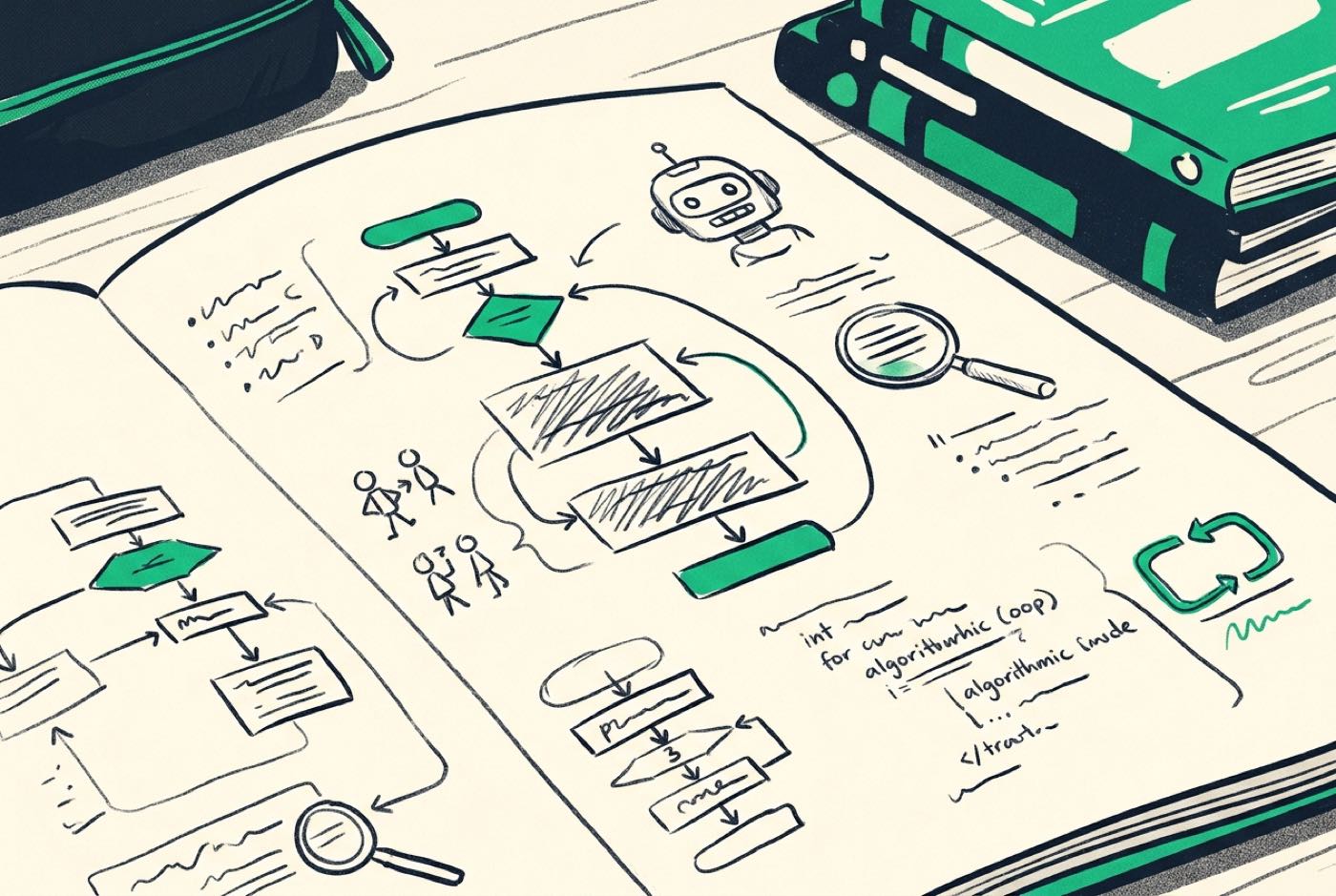
Comparing Mindsets: Consumer vs. Builder vs. Business Owner
These three mindsets react to the same situation in noticeably different ways. The table below is a useful reference when you're deciding which question to ask next.
| Everyday Scenario | Consumer Mindset | Builder Mindset | Business Owner Mindset |
|---|---|---|---|
| Playing a popular video game | Plays for hours to collect virtual rewards and cosmetics. | Analyzes how game physics work and tries building a custom level. | Considers how the game monetizes, keeps players engaged, and advertises. |
| Using a broken household tool | Complains that the tool does not work and demands a new one. | Examines how the tool is constructed and attempts a safe fix or modification. | Researches if others have the same issue and imagines a better product design. |
| Faced with a difficult task | Gives up quickly or waits for an adult to provide the solution. | Breaks the task into smaller steps and uses available search or AI tools. | Evaluates if the task can be automated, delegated, or streamlined. |
| Receiving pocket money | Spends the entire amount immediately on short-term wants. | Saves a portion and plans purchase decisions based on practical utility. | Evaluates how to invest resources into acquiring new skills or project materials. |
Age-by-Age Guide to Home Entrepreneurship Activities
What works at six will bore a fourteen-year-old. Here's a rough roadmap from ages 5 to 18.
Ages 5 to 8: Exploration and Physical Creation
- The Household Problem Workshop: Send them hunting for three small annoyances around the house, such as a messy shoe rack or keys that keep vanishing. Then have them draw or build a cardboard invention that fixes one of them.
- Visual Logic Games: Block-based tools like ScratchJr let them make interactive stories where a tap changes what happens next.
- Simple Value Games: Trading and resource-management games introduce money ideas through play rather than explanation.
Ages 9 to 12: Digital Prototyping and Logic
- Build a Mini Web Page or Game: A personal profile page in HTML and CSS, or a text-based quiz in basic Python. Our breakdown of 5 reasons kids should learn entrepreneurship has more project ideas at this level.
- Project Budget Planning: Give them the budget for a family outing and a target to hit. Let them research options and pitch you a proposal.
- AI-Assisted Storytelling: They own the plot and the logic; AI generates character dialogue on request. The division of labour is the lesson.
Ages 13 to 18: Functional Prototypes and Digital Solutions
- Solving a Real Community Need: A study-schedule app for their class, or a web database for local pet adoption. Real users, real feedback.
- E-Commerce and Security Analysis: Sit down with an actual online platform and pull it apart, including its interface choices, payment safeguards, and what it likely spends to acquire a customer.
- Iterative Product Launch: Have them demo a working project (a web app, a 3D asset, an AI workflow script) to the family, take the criticism, and ship version 2.0.
The Journey from Game Player to Project Creator
Children rarely jump straight from consumer to creator. They pass through stages, and knowing which stage your child is in tells you what kind of nudge helps.
flowchart TD
    A[Passive Consumer] -->|Asks how things work| B[Curious Explorer]
    B -->|Learns basic tools| C[Project Builder]
    C -->|Solves user problems| D[Resourceful Innovator]

    subgraph Stage 1: Consumption
    A
    end

    subgraph Stage 2: Exploration
    B
    end

    subgraph Stage 3: Creation
    C
    end

    subgraph Stage 4: Initiative
    D
    end
How Kidocode Nurtures Builders Through AI, Math, and Tech
We don't treat coding as a trade skill to be sold, and we don't teach entrepreneurship as vocabulary. Coding comes bundled free with every learning package, because syntax is public knowledge now and charging for it makes little sense. What takes actual teaching is computational thinking, logical reasoning, and the discipline to finish a build.
Three pillars hold the framework together:
- AI School First: Students aged 5 to 18 learn to direct AI tools productively and safely, using them to accelerate their own projects rather than to skip the work.
- Math Through Building: We end math friction by reversing the delivery. Geometry, coordinates, logic matrices, and probability show up inside game physics, graphics engines, and AI algorithms, where they visibly do something.
- Six Technology Tracks: Students pick from Python Programming, Web Development, Mobile App Development, Game Engineering, Electronics, and 3D Modelling based on what interests them.
Every session ends with something built. That holds at our Klang Valley flagships (Solaris Mont Kiara, Sunway Nexis PJ), at our Penang centres (Q2 Waterfront, Tanjung Tokong, Icon City), and in our live camera-on online classes. Students leave with functional artifacts, not completed worksheets.
Our learning approach page covers the methodology and the curriculum tracks in detail.
A 4-Week Action Plan to Start at Home
Nothing here requires reorganising your family life. One activity a week for a month is enough to change the tone at home.
Week 1: The Consumer-to-Creator Audit
- Spend a weekend afternoon going through your child's favourite games, apps, or channels.
- Ask for three features they love and one they'd change if they ran the company.
- Get the proposed change written down or drawn.
Week 2: The Value Exchange Experiment
- Bring your child into a real purchasing decision for the household.
- Set the budget, then have them weigh three competing options on quality, price, and whether it's actually needed.
- Talk afterwards about how the products were designed to appeal to buyers like you.
Week 3: The AI Assistant Challenge
- Pick something they're already curious about, such as how electric cars work or how game characters get designed.
- Write prompts together and run them through an AI assistant.
- Have your child check the answers, then bring two verified facts to the dinner table.
Week 4: The Prototype Build
- Choose one small project: a Scratch animation, a plain HTML page, a cardboard model.
- Build it together inside a fixed two-hour window.
- Aim for working, not impressive. Version two can be impressive.
Printable Household Builder Checklist
Track the habits weekly. Print this or copy it onto a sheet for the study desk or the fridge door.
- Creation Time: Converted at least 2 hours of passive screen time into project building, coding, or visual designing this week.
- Problem Identification: Spotted a minor real-world or household problem and proposed at least two potential solutions.
- Value & Budget Practice: Participated in a real budgeting decision by evaluating price, utility, and quality trade-offs.
- Guided Resourcefulness: Used an AI tool or online reference to research a solution independently before asking for the direct answer.
Designed, ready to print and sign. We email it to you together with a 5% discount on your next registration.
Frequently Asked Questions
Is my child too young to learn entrepreneurial skills?
Not if we're talking about resourcefulness, curiosity, and problem-solving. For ages 5 to 8, that means physical builds, visual logic games, and small decisions with real consequences. Financial calculations and business terminology can wait.
How does learning to code build entrepreneurial skills?
Code forces an idea to become specific. A child building a game or web app has to plan the logic, think about the person using it, hunt down errors, and get it to a working state. That sequence is the same one every product goes through.
Should I pay my child for household chores to teach money management?
Paying for basic responsibilities can blur the line between contributing to a family and creating value for someone else. A common recommendation is to keep everyday chores unpaid as part of household teamwork, then offer small payments for genuinely optional projects, such as reorganising a difficult storage area or assembling a family digital photo library.
Will AI make coding and entrepreneurial skills obsolete?
AI accelerates people who already know what they want to build. Understanding code and thinking logically is what lets a child direct these tools instead of accepting whatever they produce. In practice, young creators are now shipping more ambitious apps, games, and solutions than they could a few years ago.
How does Kidocode incorporate entrepreneurship into its classes?
References
- Penelope Trunk Education, Don't Teach Your Kids to Start a Business (2015)
- Journal of Community Positive Practices, Authoritative Parenting and Early Entrepreneurial Competence (2023)
- OECD, PISA 2022 Results (Volume IV): Financial Literacy (2024)
- Financial Education Network, National Strategy for Financial Literacy 2026-2030 (2025)
- PubMed / MethodsX, Financial Literacy Among Primary School Students in Northern Malaysia (2023)
- Bank Negara Malaysia, Launch of National Strategy for Financial Literacy 2026-2030 (2025)
Give Your Child the Tools to Build the Future
Habits at home go a long way. They go further when a child is also building something real on a regular schedule, with other kids doing the same thing beside them.
Book a free hands-on trial class at Kidocode. In a session of up to two hours, your child builds an actual project in AI, math, or coding, either at our campuses in Klang Valley (Solaris Mont Kiara, Sunway Nexis PJ) and Penang (Q2 Waterfront, Tanjung Tokong, Icon City), or live online with our camera-on trainers. Both parents are welcome to sit in and watch it happen.