

Point a phone camera at a quadratic equation and the full working appears in about two seconds. So parents ask the obvious question: why are our children still spending hundreds of hours on long division, expanding brackets, and times tables? For a lot of Malaysian families in 2026, why maths is important for kids has stopped being a rhetorical question and become a real one.
The short answer is that calculating was never the point of mathematics. Calculating is what we asked humans to do before we built machines that did it better. What is left over, and what gets more valuable as AI spreads, is mathematical thinking: structuring a messy problem, spotting a pattern, checking whether a machine's output is nonsense, and deciding which problems deserve attention at all.
Below, we look at what recent research says about AI and mathematics learning, why conventional instruction loses so many children along the way, and what changes when maths is learned by building things.
Table of Contents
- Key Takeaways for Parents
- The AI Paradox: High Practice Accuracy, Lower Conceptual Understanding
- The 1892 School Curriculum vs 2026 Reality
- What PISA 2022 Results Tell Us About Maths in Malaysia
- From Problem-Solving to Problem-Finding: The New Math Literacy
- The Math-Hate Trap: The Child Is Fine, the Teaching Wasn't
- Comparing Pathways: Traditional Drilling vs Math-by-Building
- How Coding and AI Bring Abstract Mathematics to Life
- How We Teach Mathematics at Kidocode
- Actionable 4-Week At-Home Strategy for Parents
- Frequently Asked Questions
- References
Key Takeaways for Parents
| Concept | The Traditional Perspective | The AI-Era Reality |
|---|---|---|
| Core Goal of Maths | Executing manual procedures and memorising formulae. | Formulating problems, understanding concepts, and verifying AI outputs. |
| Role of AI Tools | A tool to get fast homework answers or a threat to study habits. | A cognitive accelerator when paired with deep conceptual understanding. |
| Primary Skill Needed | Procedural problem-solving through repeated worksheet drills. | Problem-finding: identifying which problems warrant solving and framing them correctly. |
| Source of Math Anxiety | Believing the child is not a "numbers person" due to calculation errors. | Rigid, memorise-and-test teaching models that disconnect maths from real application. |
| Best Learning Approach | Repetitive paper-based tuition and speed computation drills. | Constructivist building: applying linear algebra, logic, and geometry to real digital builds. |
The AI Paradox: High Practice Accuracy, Lower Conceptual Understanding
One controlled study of high school mathematics students using AI homework tools shows the problem in numbers [2].
Researchers watched students work through practice problems with ChatGPT. On the practice itself, the AI group did well: they answered 48% more practice problems correctly than students working without it [2]. Then both groups were tested on the underlying concepts with no tool available. The AI-assisted students scored 17% lower than their peers [2].
flowchart TD
    A[Student Facing Math Problem] --> B{Approach Taken}
    B -->|Direct AI Generation| C[48% Higher Practice Accuracy]
    C --> D[Cognitive Offloading]
    D --> E[17% Lower Conceptual Retention]

    B -->|Conceptual Understanding First| F[Slower Practice Execution]
    F --> G[Deep Cognitive Engagement]
    G --> H[High Retention & Transferable Skill]
Cognitive scientists call this offloading germane load [2]. Used purely as an answer engine, AI removes the mental friction that builds understanding in the first place. The worksheet comes back with ticks on it. The student never had to wrestle with why the structure works.
The same technology can go the other way. Stanford research indicates that students using adaptive AI tutoring platforms gained 15% on standardised assessments compared with traditional classroom instruction [2].
What separates the two outcomes is how the tool is used. AI that replaces thinking erodes conceptual capability. AI that makes a student explain their reasoning, test a hypothesis, and steer the logic speeds it up.
The 1892 School Curriculum vs 2026 Reality
If procedural calculation is losing value while conceptual understanding gains it, why do school syllabi still revolve around calculation drills?
History, mostly. The standard high school mathematics sequence used across much of the world was set out in 1892 by the Committee of Ten, a group of American university leaders and educators [5]. They designed a straight line from arithmetic through algebra, geometry, and trigonometry to calculus, built to supply engineers and scientists to a late 19th-century industrial economy in which every calculation was done by hand.
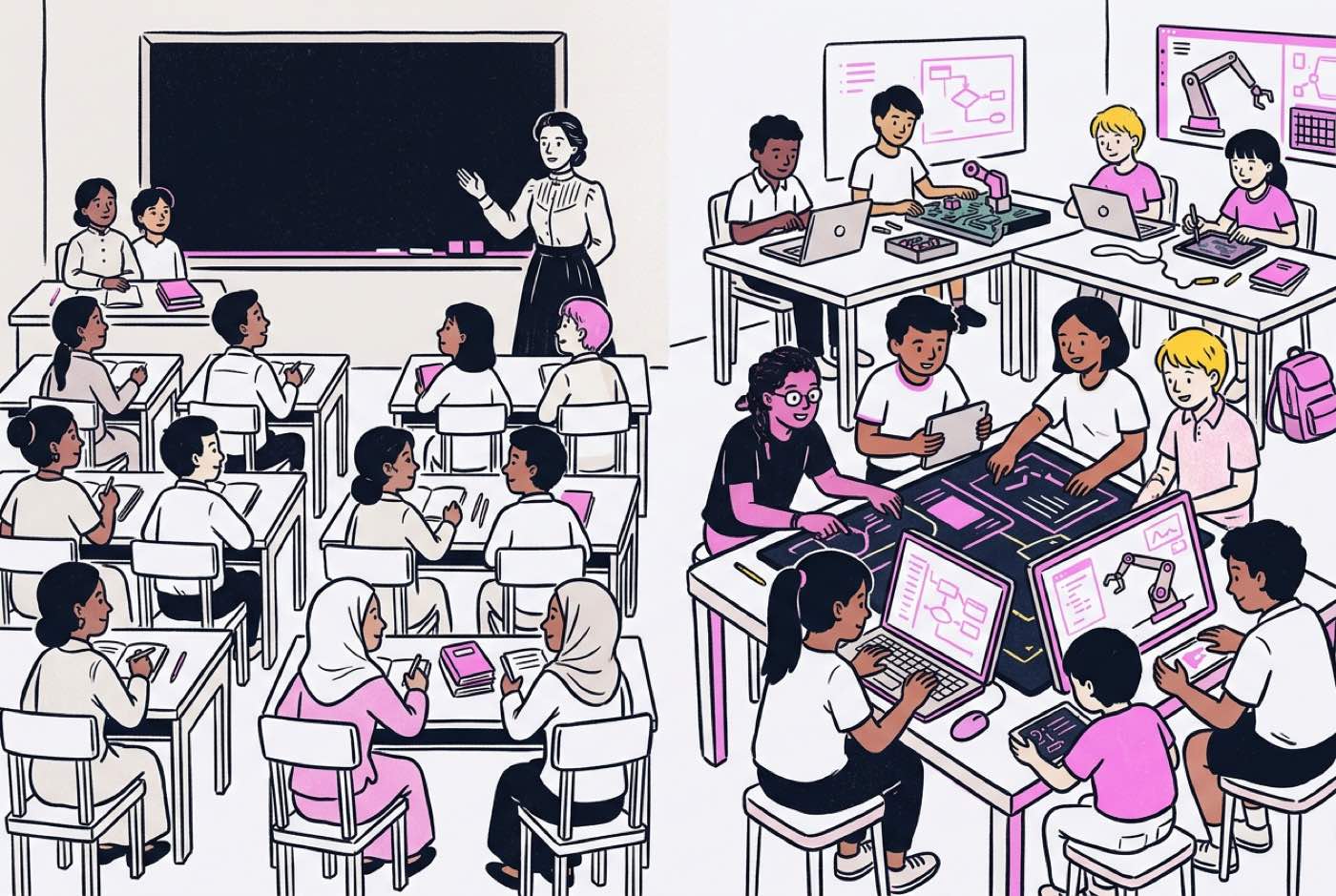 Computer scientist Conrad Wolfram argues that asking students to compete with machines at manual computation is a contest they cannot win [7]. Mathematics as it is actually practised in research labs, technology companies, and finance runs through four steps:
- Posing the right question about a messy real-world scenario.
- Translating that scenario into a mathematical model (equations, logic, data structures).
- Computing the results (calculating numbers, solving systems).
- Interpreting and validating the results against real-world constraints.
Industry hands step 3 to computers almost entirely. School spends over 80% of classroom time on step 3 alone [7]. Children get years of practice at the one step a machine does instantly, and almost none at steps 1, 2, and 4.
Parents asking why maths is important for kids are usually picturing step 3, and noticing that its value is falling. Steps 1, 2, and 4 are a different matter. They are what human problem-solving, reasoning, and judgement look like in an automated world.
What PISA 2022 Results Tell Us About Maths in Malaysia
National assessment data shows the gap between instruction and understanding. The Programme for International Student Assessment (PISA), run by the OECD, tests whether 15-year-olds can apply what they know to real contexts rather than recall memorised formulae.
In the PISA 2022 cycle, Malaysian secondary school students scored significantly below the OECD average in reading, science, and mathematics [6]. Research published in the Mathematics Teaching Research Journal found that Malaysia recorded the largest performance decline of any ASEAN nation in that cycle [3].
Two figures stand out for Malaysian 15-year-olds in PISA 2022 [3]:
- Nearly 60% of Malaysian students failed to reach the basic baseline proficiency level in mathematics (Level 2).
- Only 1% of Malaysian students achieved high-performing status (Level 5 or Level 6).
None of this started with the pandemic. The same analysis shows Malaysian secondary students struggling with mathematics well before 2022 [3].
School exams that reward memorisation let a student look competent on the strength of model answers. Put an application-heavy question in front of them, whether a High Order Thinking Skills (KBAT) item or a PISA task, and the missing structure underneath shows. For more on that specific hurdle, see our analysis on why children fail math word problems (KBAT).
From Problem-Solving to Problem-Finding: The New Math Literacy
As AI systems get better at generating procedural code and stepping through mathematical problems, the market value of procedural execution heads towards zero [1].
A joint synthesis by WestEd and Google points out that educational frameworks worldwide have poured attention into problem-solving while leaving problem-finding largely alone [4].
| Learning focus | The sequence a student practises |
|---|---|
| Traditional | Problem given → apply standard formula → calculate single answer |
| AI-era | Messy reality → identify the core problem → model it with maths and logic → direct AI execution → verify and refine |
Problem-finding means looking at a complicated situation, working out which questions are worth asking, judging whether AI or another digital tool suits the job, and then stating the problem precisely enough to be worked on [4].
An example helps. Any AI tool will happily evaluate or find the area of a circle from . What it cannot do is decide:
- Which variables matter when simulating realistic water physics in a game engine.
- Whether a sudden spike in user engagement data represents genuine interest or an algorithmic bot attack.
- How to balance resource allocation in a supply-chain simulation.
Those calls need mathematical intuition: a feel for how variables interact, how rate of change affects the stability of a system, how logical constraints shape outcomes. Adults in 2035 will rarely be asked to compute a sum. They will be asked to frame the problem, judge the machine's answer, and check that the logic holds.
The Math-Hate Trap: The Child Is Fine, the Teaching Wasn't
In trial sessions across Kuala Lumpur and Penang, we hear the same two sentences constantly: "My child just isn't a maths person," and "She has a total mental block when it comes to numbers."
We don't accept either. Our position on Pillar 2 (Maths) is blunt: the child is fine; the teaching approach was flawed.
| Loop | What the child experiences |
|---|---|
| Traditional memory loop | Memorise rule → drill 50 worksheets → marked wrong for execution errors → math anxiety |
| Math-by-building loop | Want to build a game feature → discover the maths it requires → apply the concept visually → immediate working result |
Introduce mathematics as pages of disconnected rules (, solve for ) and children read it as paperwork. One slip on line 4 of a ten-line algebra problem, and the whole answer is wrong. Repeat that for a few years and you get anxiety.
The same child meeting the same concepts in a constructivist setting, where maths is the thing that makes a game character jump convincingly, renders 3D graphics, or tunes a model's accuracy, behaves differently. Nobody is solving equations to satisfy a mark scheme. They are using mathematical structures to make something work.
In our experience, when a child moves from paper drilling to project-first builds, math anxiety disappears in 2 to 4 weeks.
Comparing Pathways: Traditional Drilling vs Math-by-Building
Parents weighing up how to support a struggling child, or how to push a capable one past the school syllabus, generally choose between three routes.
| Dimension | Traditional Tuition Centre | Speed Calculation / Abacus | Math-by-Building (Kidocode Approach) |
|---|---|---|---|
| Primary Method | Re-teaching school textbook topics and past-year exam papers. | Repetitive paper drills focused on rapid mental arithmetic execution. | Posing real project challenges where maths concepts are the building tools. |
| Core Skill Built | Formula memorisation and exam-specific answer strategies. | Speed calculation and basic procedural accuracy. | Computational thinking, spatial reasoning, and logical problem-finding. |
| Pillar Alignment | Aligns strictly with national exam papers. | Focuses heavily on lower-order arithmetic calculation. | Aligns with international standards (IGCSE, Cambridge, Common Core) delivered via software/AI builds. |
| AI Integration | None, or restricted as a potential source of cheating. | None. | Integrated deeply: kids direct personalised AI tutors to inspect and debug their own math models. |
| Long-Term Utility | Medium for short-term school exams; low for future AI-driven work. | Low (rapid calculation is completely automated by basic software). | High: develops structural intuition and high-level algorithmic thinking. |
For a closer look at the popular supplementary options, see our guides on Kumon and Abacus versus Math-by-Building and traditional math tuition versus learning math by building.
How Coding and AI Bring Abstract Mathematics to Life
Kidocode is an AI school first, then math, then tech. Coding comes free in every package, because programming syntax is now cheap and widely available; what we actually teach is computational thinking and structural logic.
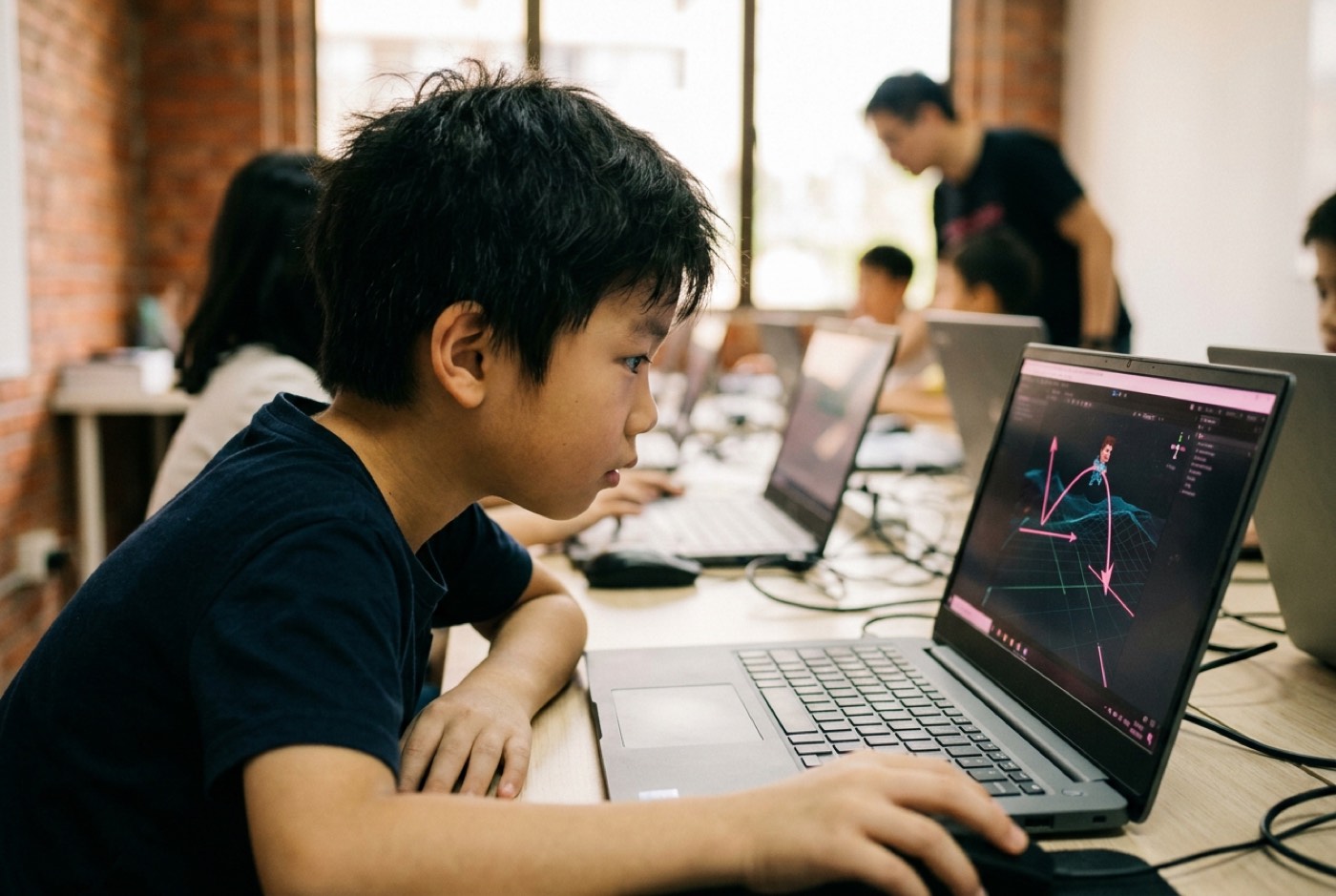 Put maths together with tech and AI and the abstractions become things you can see and move. Three examples of what changes when a topic leaves the page:
1. Cartesian Coordinates and Geometry
- Paper Approach: Plotting points on a grid sheet to draw a static triangle.
- Build Approach: Programming player movement and collision detection in a game engine. If the player's coordinate overlaps with an obstacle , calculate the distance using the Pythagorean theorem . The mathematical concept directly governs whether the game character survives or falls.
2. Trigonometry and Angles
- Paper Approach: Memorising , , and ratios for abstract right-angled triangles.
- Build Approach: Calculating the rotation trajectory of a space vehicle or generating procedural waves in a graphics environment. To make an object rotate smoothly toward a mouse cursor, the student calculates .
3. Probability, Statistics, and AI
- Paper Approach: Calculating the likelihood of pulling red marbles out of a bag.
- Build Approach: Training a machine learning classifier to recognise hand gestures or detect spam messages. Students manipulate training datasets, evaluate confidence percentages, and see how weighted matrices produce probability scores in modern neural networks.
Once mathematics arrives as working code, "Why do I need to learn this?" tends to stop coming up. The answer is on the screen.
How We Teach Mathematics at Kidocode
No lectures, no silent worksheet time. Our model rests on three pillars, for children aged 5 to 18, across five campuses in Kuala Lumpur (Solaris Mont Kiara, Sunway Nexis PJ) and Penang (Q2 Waterfront, Tanjung Tokong, Icon City), plus live online classes.
1. International Standards, Inverted Delivery
Rigour stays. Our mathematics syllabus mirrors Cambridge IGCSE, the UK National Curriculum, and US Common Core standards. What changes is the order:
- Traditional School: Teach theory memorise formula solve textbook equations (rarely) see real application.
- Kidocode Model: Present project goal hit structural hurdle discover and learn math concept implement in real code or AI build.
2. A Personalised AI Tutor for Every Child
Every student works with a personal AI learning environment set to their own pace and starting point.
When a student stalls on fraction operations or negative coordinate planes, the tutor withholds the answer. It asks Socratic questions, shifts the difficulty as it goes, and offers visual debugging prompts until the student gets there on their own. Our guide to AI math tutors for kids explains the mechanism in more detail.
3. Bundled Coding to Power the Math
Programming is the language modern mathematics is written in, so coding runs through all three pillars. Students pick up Python, JavaScript, visual logic, and data analysis, not as separate tech subjects, but as the means to construct, simulate, and check mathematical ideas.
Actionable 4-Week At-Home Strategy for Parents
You don't need to be a mathematician or a programmer to change how your child relates to maths. Here is a four-week plan you can run at home without a single extra worksheet.
| Week | Focus | The move |
|---|---|---|
| 1 | Audit the language around maths | Retire "I was never a maths person" from household conversation. |
| 2 | Shift screen time from consumption to creation | Go from watching gaming videos to building simple game mechanics. |
| 3 | Ask "How would you test that?" | Put logical checks on AI-generated homework output. |
| 4 | Bridge maths to real-world systems | Tie percentages, angles, and logic to everyday family decisions. |
Week 1: Reframe the Household Math Dialogue
Listen to how maths gets talked about at home. Drop lines like "Our family just isn't good at math" and "Maths is just something you have to survive for exams." When your child hits an error, treat it as a bug to be located, not evidence about their brain.
Week 2: Convert Screen Time into Build Time
If Roblox or Minecraft is eating the afternoons, push your child from player to builder. Ask spatial questions: "How many blocks wide is that building?" or "How would you work out the time it takes your character to cross that map at current movement speed?" Distance, time, and scale in a familiar world do a lot for spatial awareness.
Week 3: Implement the "AI Audit" Rule for Homework
If your child uses ChatGPT or Google Gemini for homework, add an audit step. No copying output. They explain the working logic back to you, or answer this: "How do we know the AI didn't make an error on step 3?" One habit, and they move from consumer to evaluator.
Week 4: Connect Maths to Daily Decisions
Put estimation and proportional reasoning into ordinary tasks. Percentage discounts at the grocery store, fuel use and arrival times on a long drive, ingredient ratios when doubling a recipe.
Printable At-Home Mathematical Thinking Tracker
Use this weekly checklist to track and encourage real-world mathematical reasoning habits at home.
-
Week 1: Language Shift
- Avoided using "I'm not a math person" in front of the child all week.
- Reframed at least two homework mistakes as "debugging challenges."
-
Week 2: Active Digital Creation
- Discussed the scale, distance, or speed mechanics of a game the child plays.
- Spent at least one session exploring how digital elements are built or coded.
Designed, ready to print and sign. We email it to you together with a 5% discount on your next registration.
Frequently Asked Questions
If AI can solve complex calculus in seconds, why is maths still important for kids?
AI computes fast, but it needs human direction, precise mathematical input, and someone to check the result. Learning mathematics now builds the higher-order skills: framing a messy problem, following structural logic, catching data errors, and judging which problems are worth solving. Manual calculation is being automated. The architecture underneath it isn't.
How does Kidocode's math approach differ from traditional tuition centres?
Tuition centres re-teach school topics through worksheets, drills, and past-year papers. Kidocode follows international mathematics standards (IGCSE, Cambridge, US Common Core) but runs them backwards: students build real software, AI models, and interactive games, and meet the mathematical principles as tools they need to finish the build.
Will learning maths through coding help my child perform better in school exams?
Yes, though as a by-product rather than the target. A child who has built a concept visually and understands why it works retains it far better than one who has memorised it. That makes application-heavy items and word problems, KBAT questions included, much less daunting in school assessments.
My child strongly dislikes maths and struggles with basic concepts. Is this programme suitable?
Yes. Dislike usually traces back to memorise-and-test teaching that punishes small calculation slips. A project-first model with a personalised AI tutor gives immediate, visible feedback on something the child made. In our experience, math anxiety typically resolves within 2 to 4 weeks of project-based learning.
At what age should children start learning computational and mathematical thinking?
From about age 5. Between 5 and 7, the work happens through interactive visual logic, block-based sequences, and spatial games. From 8 to 18, students move into text-based programming such as Python, then data analysis and algorithmic modelling.
Experience Math-by-Building at Kidocode
The quickest way to find out how your child responds to project-based mathematics is to watch it happen.
Book a free 2-hour hands-on trial class. Your child builds a working project using AI, logic, or tech while you watch our personal learning system run. We strongly encourage both parents to come.
Classes run at our campuses in KL (Solaris Mont Kiara, Sunway Nexis PJ) and Penang (Q2 Waterfront, Tanjung Tokong, Icon City), and on our live camera-on online platform.
Book Your Free Hands-On Trial Class at Kidocode
References
- Organisation for Economic Co-operation and Development (OECD). Skills in the AI Age. OECD Artificial Intelligence Papers, July 8, 2026. Available at: [1]
- Jose, B., Cherian, J., Verghis, A. M., Varghise, S. M., Mumthas, S., & Joseph, S. Cognitive Load, Generative AI, and Educational Outcomes. Frontiers in Psychology / PMC, April 14, 2025. Available at: [2]
- Lim, Y. W., Gabda, D., Pang, N. T. P., & Ho, C. M. Analysis of Malaysian Student Performance Trends in PISA 2022 Mathematics. Mathematics Teaching Research Journal (ERIC EJ1481827), 2025. Available at: [3]
- Kao, Y., et al. Why Problem-Finding Matters for Students in an AI-Powered Future. WestEd Insights & Impact, January 22, 2026. Available at: [4]
- Spector, C. Bringing Math Class into the Data Age. Stanford Graduate School of Education, March 3, 2020. Available at: [5]
- BFM 89.9. PISA 2022: Analyzing OECD Performance and National Educational Literacy. Broadcast December 7, 2023. Available at: [6]
- Wolfram, C. Read the Roadmap for ChatGPT-Age Education. Conrad Wolfram Perspectives, April 18, 2023. Available at: [7]