

Parents who ask me about Python are usually trying to solve a scheduling problem disguised as a technology question. Tech moves fast, AI is in the news every week, and they want to know whether text-based coding still earns a place in their child's week. Then come the timing worries. Is eight too young for text coding? Will syntax errors frustrate a ten-year-old? Should a child stay in Scratch, or go straight to professional code?
I have spent more than eleven years building educational tech and designing learning systems at Kidocode, where we have worked with over 9,500 students across Malaysia. What follows comes from watching thousands of children move from first curiosity to shipping real software. Python is one of the most powerful, readable, and versatile languages a child can learn. The way most schools teach it, though, is out of date.
Below, I cover why Python suits young minds, what the research actually measured, the age milestones people usually quote, and how AI tools have changed the old climb from visual blocks to text code.
Key Takeaways
| Subject Area | Key Insight for Parents |
|---|---|
| Readability & Design | Python syntax reads like plain English, so children spend their attention on logic instead of hunting for the right symbol. |
| Optimal Starting Age | Traditional pathways put Python at age 10 to 12. With AI-assisted environments, kids of 7 or 8 write real text-based scripts. |
| Cognitive Benefits | Structured coding instruction produces measurable gains in decomposition, abstraction, and logic. |
| School Math Connection | Python turns abstract school math into working tools for game physics, probability, and data visualization aligned with international standards. |
| The AI Reframe | Generative AI does not make Python obsolete. It absorbs syntax friction so children direct the logic and build real projects sooner. |
Table of Contents
- Key Takeaways
- What Makes Python Unique for Young Learners?
- The Cognitive Benefits of Learning Python (What Research Shows)
- The Traditional Age Ladder: When Should Kids Learn Python?
- Why the Scratch-to-Python Transition Breaks Down (and How AI Changes It)
- Python vs Other First Languages: A Parent Comparison Guide
- How Python Connects to School Math and Science
- The AI Reality: Will AI Assistants Make Learning Python Obsolete?
- The Kidocode Approach: AI-Accelerated Text Coding
- Step-by-Step Action Plan: How to Start Your Child with Python Today
- Frequently Asked Questions
- References
What Makes Python Unique for Young Learners?
Early computing education handed children C++ or Java. Both ask a learner to memorize boilerplate before a single line of text appears on screen. Miss a semicolon or leave a curly brace unmatched, and the compiler answers with an error message no ten-year-old can decode.
Python was designed around a different priority: readability. Its structure rests on clean indentation and human-like keywords. To display text, a child writes print("Hello"). No hidden setup files, no class declarations, no pointers to manage.
flowchart TD
    A[Child Conceives Logic / Idea] --> B{Syntax Complexity?}
    B -- High C++ / Java --> C[Syntax Error Friction & Frustration]
    B -- Low Python --> D[Immediate Execution & Visual Output]
    C --> E[Drop in Confidence]
    D --> F[Active Problem Solving & Iteration]
That simplicity matters because of how young minds handle cognitive load. A child who is programming is running two jobs at once:
- Computational logic: working out the step-by-step instructions that solve the problem.
- Syntax mechanics: remembering where the brackets, quotes, colons, and indentation go.
When the second job gets heavy, it eats the mental capacity meant for the first. Python keeps the second job small, which leaves room for the thinking that actually matters.
Python is also not a teaching toy built for classrooms. It runs modern enterprise software, artificial intelligence, data engineering, and scientific research. A child writing Python is using the same toolset as engineers at major tech organizations and research labs worldwide.
The Cognitive Benefits of Learning Python (What Research Shows)
Parents want to know whether early coding produces broader academic gains or stays a narrow vocational skill. The academic literature has a fairly clear answer.
A 2026 randomized controlled trial published in Frontiers in Psychology evaluated 200 primary school students aged 8 to 12 across three urban elementary schools [1]. The experimental group went through a 24-week coding curriculum: 16 weeks of visual block coding followed by 8 weeks of text-based Python, totaling 48 instructional hours [1].
Both problem-solving and computational thinking improved by statistically significant margins [1]:
- Problem-solving scores rose from a baseline mean of 17.8 to 23.5 (p < 0.001) [1].
- Computational thinking scores increased from 20.4 to 30.6 [1].
- Cumulative hours spent coding correlated strongly with gains in computational thinking (r = 0.87, p < 0.001) and problem-solving (r = 0.79, p < 0.001) [1].
When the researchers broke computational thinking into its components, the standardized effect sizes were largest in the structural skills [1]:
- Decomposition (breaking big problems into smaller parts): d = 1.18 [1].
- Abstraction (focusing on key details while filtering out noise): d = 1.05 [1].
- Pattern recognition (identifying similarities across tasks): d = 0.89 [1].
- Algorithmic thinking (designing step-by-step procedures): d = 0.85 [1].
One finding deserves a flag. Coding instruction lifted performance on non-programming logic puzzles and pattern recognition, but showed no statistically significant direct impact on raw arithmetic reasoning [1]. Python will not speed up a child's recall of multiplication tables. What it builds is the structural reasoning, abstraction, and logic needed to understand complex systems.
How Python is taught changes how much of it sticks. A 22-week study of middle school students found that those taught through Problem-Oriented Learning (POL) reached significantly higher mastery of core concepts (t = 4.99, p < 0.001, d = 2.00) than students taught by lecture and practice [2]. Children who learn Python by solving concrete problems, rather than copying code off a whiteboard, roughly double their depth of concept application [2].
The Traditional Age Ladder: When Should Kids Learn Python?
Traditional educational literature lays out an age-gated ladder tied to developmental stages [3]:
- Ages 5 to 7: Pre-readers use visual block tools like ScratchJr to explore sequences and loops through graphical icons.
- Ages 8 to 9: Students build interactive animations and simple games in block-based Scratch, where blocks snap together visually and syntax errors are impossible [3].
- Ages 10 to 12: The transition window, where children move from block coding to text-based Python as typing speed and abstract reasoning mature [3].
- Ages 13 and above: Teenagers work directly in text Python, taking on data structures, web scripts, and text-based game engines [3].
The ladder stuck around because block environments genuinely reduce early frustration for children under 10 [3]. Industry surveys put the share of teachers worldwide who use block tools to introduce computational concepts in elementary classrooms at over 70% [3].
Block platforms also have a ceiling. Most active learners run out of room in purely visual environments after 12 to 18 months of regular use [3]. Scratch cannot build full web applications, connect to external web APIs, train machine learning models, or produce professional software artifacts [3].
Children notice when they hit that wall. They know they are working inside a sandbox, engagement drops, and they start asking to build the real thing.
Why the Scratch-to-Python Transition Breaks Down (and How AI Changes It)
For more than a decade, the move from block coding to text-based Python has been the steepest hurdle in computer science education [4].
A student who is fluent in Scratch opens a standard Python editor and hits syntax shock. In Scratch, blocks snap together and a command cannot sit where it does not belong. In Python, one missing quote mark, one stray space, or one lowercase letter produces an error message that tells a young learner almost nothing useful.
Researchers have spent years testing tools to bridge that gap. An empirical study at KTH Royal Institute of Technology looked at how learners navigate the move between blocks and text [4]. It compared one-way transition environments, where blocks auto-generate read-only text code, against dual-modality environments, where side-by-side block and text views update live in both directions [4].
Participants found tasks in the dual-modality environment significantly easier than in the one-way environment (p = 0.00024) [4]. Every participant said that seeing their code as text and as structured blocks at the same time helped them learn Python more than a sudden one-way leap [4].
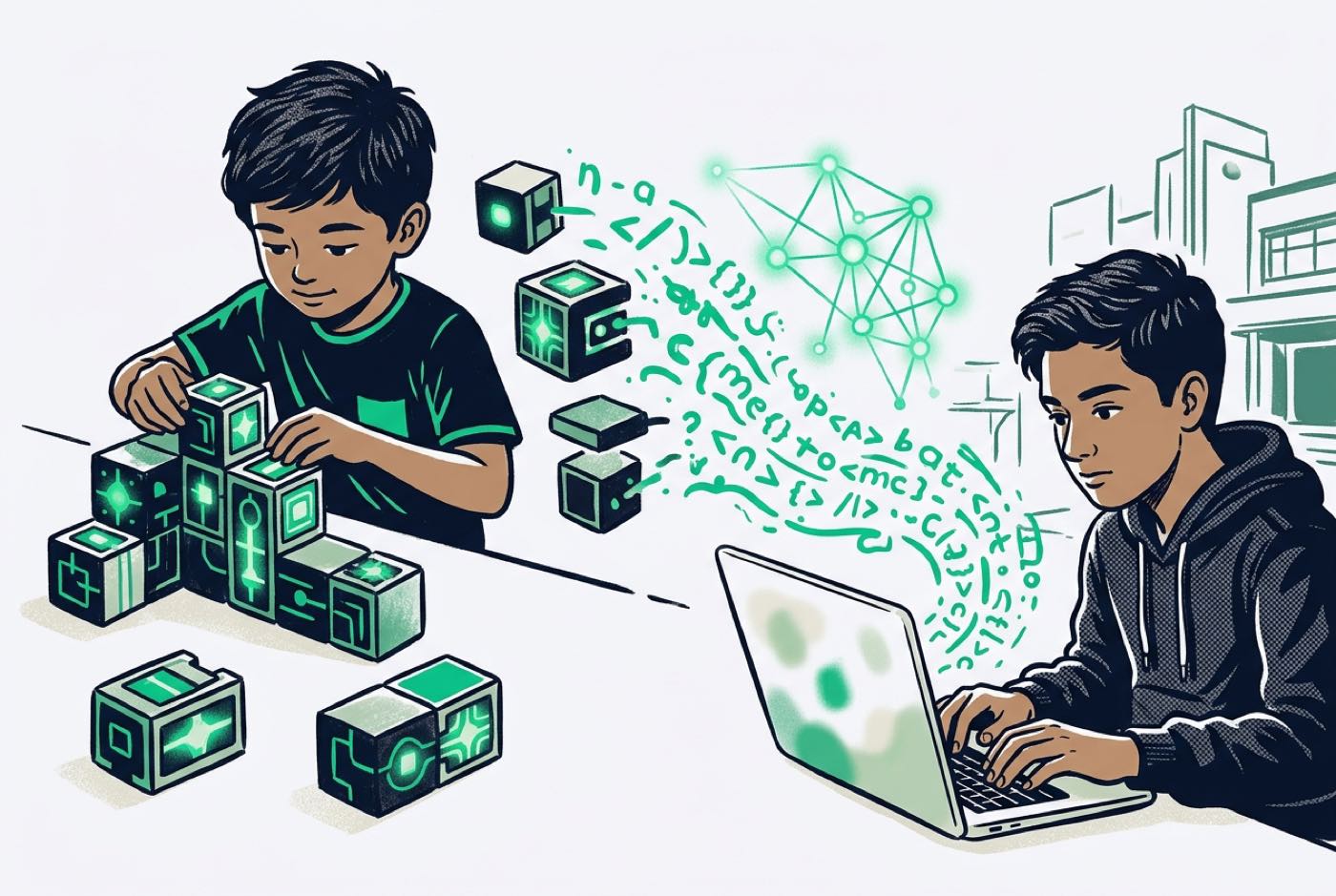 In our classes at Kidocode, something larger has happened over the past few years. Generative AI coding assistants removed the need for children to sit in visual block platforms for months.
We used to wait until a child was ten or eleven before starting Python, because typing speed and syntax memorization were the bottlenecks. An AI tutor now works as the bridge. When an eight-year-old mistypes a line of Python, the assistant does not throw a cryptic error. It names the mistake in plain language, shows the fix, and the child keeps going.
Kids reach real text-based Python far earlier than the old Scratch-then-Python ladder predicts. The assistant carries the syntax mechanics; the child keeps their attention on the thinking. For more on how AI tools reshape learning environments, see our guide on coding classes for kids in Malaysia.
Python vs Other First Languages: A Parent Comparison Guide
Parents weighing options usually want Python placed next to JavaScript, C++, HTML/CSS, and the block tools.
| Feature / Criteria | Python | Scratch (Block-Based) | JavaScript | C++ |
|---|---|---|---|---|
| Primary Format | Plain text commands | Graphical snap blocks | Plain text scripts | Strictly typed text |
| Ideal Entry Age | Ages 7 to 18 (with AI) | Ages 5 to 9 | Ages 10 to 18 | Ages 14 to 18 |
| Syntax Difficulty | Low (reads like English) | Zero (syntax error proof) | Moderate (curly braces) | Very High (manual memory) |
| Real-World Utility | AI, Data Science, Web, Scripting | Educational Sandbox | Web Apps, Front-end | Game Engines, Systems |
| Math Integration | Exceptional (built-in logic) | Basic visual geometry | Moderate | Advanced engineering |
| AI Tool Compatibility | Excellent (native AI ecosystem) | None | High | Moderate |
Scratch is a strong engagement layer for absolute beginners aged 5 to 7, but children should not stay in a visual sandbox indefinitely [3]. JavaScript shines for interactive websites, though its brackets, semicolons, and callback functions add symbols that trip up young beginners. C++ matters for low-level systems engineering, and its learning curve costs beginners more than it gives them.
Python sits in the middle: almost no syntax fluff for a beginner, full enterprise capability once the projects get serious. Our analysis of Scratch vs Python goes deeper into the block-versus-text comparison.
How Python Connects to School Math and Science
The line I hear most often in trial sessions is some version of "My child struggles with math at school" or "My child hates math worksheets."
My answer is always the same: the child is fine, the teaching method wasn't. School math tends to arrive as repetition, abstract symbols, and timed tests. Children solve equations on paper and never see where those concepts go.
Python flips the order. At Kidocode we align activities with international math standards, including IGCSE, Cambridge, and US Common Core, then deliver the syllabus backwards. Instead of static worksheets, children use math as a tool to build something.
| Approach | The path a math concept travels |
|---|---|
| Traditional school math | Abstract formula → paper worksheet → memorization and drill → exam test |
| Kidocode math through building | Game or AI project idea → identify the math it needs → write the Python script → instant visual result |
Here is how familiar school topics change once they are written in Python:
- Variables and Algebra: Instead of solving on paper, a child builds a score tracker in a Python game (
player_score = player_score + 10). Algebra becomes something you can watch move. - Coordinate Systems and Geometry: School geometry means plotting points on graph paper. In Python, placing a character sprite on screen (
hero.goto(x=100, y=-50)) makes Cartesian coordinates concrete. - Probability and Statistics: Rather than reading a textbook problem about coin flips, a child uses Python's
randommodule to simulate 10,000 dice rolls in two seconds and see the distribution.
In lower secondary education across Malaysia, initiatives under the Ministry of Digital's MyDigitalMaker framework have introduced over 2.5 million national school students to core technology concepts [5].
Papers in Malaysian educational journals describe how bringing Python into Basic Computer Science (BCS) and lower secondary Mathematics syllabi gives students practical data handling, visualization, and analysis skills [6].
Once a child sees that math is the engine behind their game physics or their AI model, the resistance drops. In our experience it usually fades within two to four weeks of real project work. Our comparison of math tuition vs learning math by building covers this shift in detail.
The AI Reality: Will AI Assistants Make Learning Python Obsolete?
Large language models and coding assistants brought a new question to trial sessions: "If AI can write Python code automatically, is there still any value in my child learning to code?"
The question rests on a misreading of what programming is. Writing software was never mainly about memorizing syntax. It is about breaking complex problems into logical steps, structuring workflows, spotting edge cases, and deciding how a system should behave.
AI tools raise the baseline rather than remove the job. A developer who knows how to direct AI tools now finishes in two hours what used to take two weeks. Directing those tools well still requires structural logic, computational thinking, and an understanding of how code executes.
flowchart LR
    SubGraph1[Old Software Workflow]
    A[Human Writer] -->|Manual Typing| B[Syntax Mechanics] -->|Debugging| C[Working Program]

    SubGraph2[Modern AI-Accelerated Workflow]
    D[Human Architect] -->|Directs Logic & Intent| E[AI Code Generator] -->|Outputs Code| F[Human Evaluator / Reviewer]
We frame the difference for parents like this:
- Using AI: asking a system to write an essay or generate a picture. The child is a consumer.
- Building with AI: writing Python that connects to AI models, processes data, automates workflows, and produces custom applications. The child is a builder.
Python is the language children need in order to direct and control AI systems. Far from replacing programmers, these tools hand a young learner with real computational thinking the ability to build projects nobody could have attempted a decade ago. Our article on AI literacy vs coding skills for kids unpacks the distinction further.
The Kidocode Approach: AI-Accelerated Text Coding
Kidocode is not a tuition centre and does not run short bootcamps. We are Malaysia's coding and AI school for kids aged 5 to 18, with five physical campuses across Klang Valley and Penang plus a live online programme serving families in Southeast Asia and beyond.
Three pillars sit inside a single membership:
| Pillar | What it covers | What students work on |
|---|---|---|
| 1. AI School First | Directing AI tools safely and effectively | AI literacy, AI safety, hands-on AI direction |
| 2. Math Through Builds | Ending math resistance | Personalised AI tutoring, syllabus-aligned software projects instead of static worksheets |
| 3. Tech to Build | Computational thinking across six tracks | Python, Web Development, Mobile Apps, Game Development, Electronics, 3D Modelling |
Computational thinking is the real product, so coding skills come bundled into the core curriculum. We do not run passive lecture series. Every session is hands-on and project-based, and it ends with something working that the student built.
When a child starts Python with us:
- Personalised Progression: each student works with a dedicated AI tutor that adapts to their pace, interests, and background.
- Early Text Acceleration: instead of years in a visual sandbox, kids use AI-assisted feedback to move comfortably into text-based Python by age 7 or 8.
- Real-World Artifacts: students write Python that powers interactive games, builds data visualization dashboards, programs hardware sensors, and plugs into custom AI models.
Families can choose our flagship campus at Solaris Mont Kiara, Sunway Nexis in Petaling Jaya, our Penang centres at Q2 Waterfront, Tanjung Tokong, and Icon City in Bukit Mertajam, or the live camera-on online classes, where parents are always welcome to sit in. All locations and online options are listed on our branches page.
Step-by-Step Action Plan: How to Start Your Child with Python Today
To introduce Python without adding academic pressure, work through these four steps.
flowchart LR
    Step1[1. Assess Readiness] --> Step2[2. Reframe Screen Time]
    Step2 --> Step3[3. Set Up Clean Tools]
    Step3 --> Step4[4. Book Hands-On Trial]
Step 1: Assess Readiness (Focus on Logic, Not Typing Speed)
Watch how your child handles technology. A child who navigates a tablet, follows multi-step rules in a board game, or builds structures in Minecraft already has the logic needed to start programming. Typing is not a prerequisite; keyboard familiarity arrives on its own through project work.
Step 2: Reframe Screen Time ("Build Games, Not Just Play Games")
Screen time worries most parents, and passive consumption really is different from creation. Two hours spent writing a Python script to control a character in a game your child designed is two hours of problem solving.
Step 3: Set Up a Clean, Beginner-Friendly Environment
Skip complicated installations at the start. Browser-based Python environments or lightweight editors made for education, such as Mu Editor or Thonny, strip out the professional configuration panels and leave a clean surface for the code.
Step 4: Schedule a Hands-On Practical Experience
The fastest way to find out whether your child enjoys text coding is to let them build something real with guidance. Book a session where they build an AI or Python project and watch how they respond when a problem needs solving.
Printable Python Readiness Checklist
Save or print this checklist to review your child's readiness and track early progress in text-based coding.
- Interest Check: Does your child express interest in how video games, apps, or AI tools are made?
- Logic Foundation: Can your child follow 3-step conditional instructions (e.g., "If it rains, grab an umbrella, otherwise grab a hat")?
- Screen Time Audit: Have you identified 2 to 3 hours of weekly passive screen time that can be converted into active coding and building?
- Hardware Setup: Do you have a working laptop or desktop computer with a stable internet connection available for practice?
Designed, ready to print and sign. We email it to you together with a 5% discount on your next registration.
Frequently Asked Questions
Is my child too young to learn Python at age 7 or 8?
No. Readiness depends on the teaching approach more than the birthday. Older text-coding methods leaned on typing and memorization; AI-assisted environments let kids of 7 or 8 grasp Python logic and write working scripts without stalling on syntax mechanics.
How does Python compare to Scratch for absolute beginners?
Scratch uses snap-together graphical blocks that make syntax errors impossible, which suits children aged 5 to 7. Python uses plain text and matches what software engineers actually write. Scratch is a good first sandbox, but most children exhaust it within 12 to 18 months, and Python is where the ceiling disappears.
Will learning Python help my child with their school math performance?
Yes, though not through drill and memorization. Python turns variables, Cartesian coordinates, geometry, and probability into working parts of games and AI models. Applying math to real projects builds structural logic and clears math anxiety within weeks.
Does AI code generation make learning Python unnecessary for kids?
No. AI handles syntax, but steering it takes computational thinking, structural logic, and the ability to read code. Python gives children the language they need to instruct and control AI systems, which moves them from consumers to builders.
How much time should my child spend learning Python each week?
Consistency beats marathon sessions. One or two guided sessions a week, roughly 2 to 3 hours in total, keeps progress steady alongside school work and other activities.
Can my child learn Python online, or is physical attendance better?
References
- Frontiers in Psychology, Computational Thinking and Problem-Solving Gains in Primary School Coding Interventions (2026)
- Frontiers in Psychology, Problem-Oriented Learning Model vs Lecture-and-Practice in Python Instruction (2021)
- GrowWise School, Python vs Scratch: Parent Guide and Age Transitions (2026)
- KTH Royal Institute of Technology, Evaluating Transitions from Block-Based to Text-Based Programming (2023)
- Malaysia Digital Economy Corporation (MDEC), MyDigitalMaker Initiative Overview
- Data Analytics and Applied Mathematics (DAAM), Integrating Python into Lower Secondary Mathematics and Computer Science (2026)