

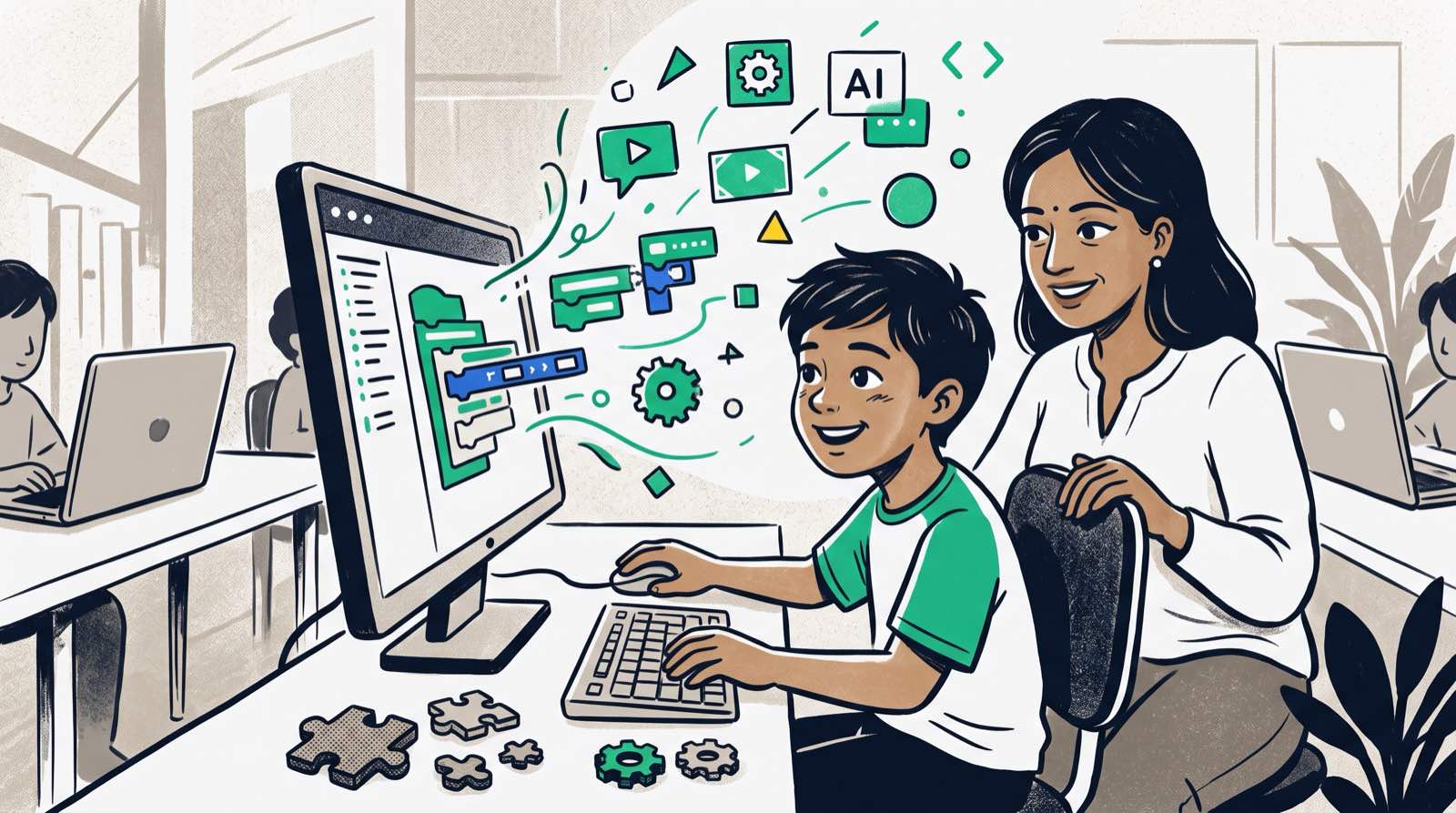
The same child who cannot survive a 45-minute school lecture, or who freezes at an ambiguous word problem, will sit for two hours building a virtual world or wiring up a logic circuit. Parents of neurodivergent children in Malaysia describe this contradiction over and over. Classrooms ask for a uniform pace and a certain kind of social compliance, and for children with Attention Deficit Hyperactivity Disorder (ADHD), Autism Spectrum Disorder (ASD), or dyslexia, that demand produces friction from the first bell to the last.
Programming works differently. A computer is deterministic and predictable, and it carries no social subtext. Write a line of code, and the machine answers immediately without a hint of judgment. What follows looks at why coding for kids with special needs often works where conventional instruction stalls, what the peer-reviewed research actually shows, and how parents can set up support at home.
Key Takeaways for Parents
| Perspective | Traditional Classroom Model | Tech & Computational Building Model |
|---|---|---|
| Instruction Style | Passive listening, fixed pacing, group-based benchmarks | Active creation, self-paced trial, immediate digital feedback |
| Error Handling | Red marks on paper, delayed grading, performance anxiety | Execution error messages, instant retry, systematic debugging |
| Cognitive Match | Heavy reliance on rote memory and open-ended reading | Clear visual logic, structured rules, cause-and-effect loops |
| Sensory Needs | Noisy environments, rigid posture requirements | Adaptable setups, custom interfaces, variable input devices |
| Skill Outcome | Standardised test scores | Working software, custom games, transferable logic skills |
Table of Contents
- Why Traditional Schooling Creates Friction for Special Needs Learners
- The Cognitive Alignment: Why Computer Logic Appeals to ADHD and Autistic Minds
- Synthesising the Research: What Studies Reveal About Coding and Neurodiversity
- Navigating Interface and Sensory Challenges: Block-Based vs. Text-Based Tools
- AI Assistants as Cognitive Scaffolding for Learning Differences
- The Math Reframe: Moving from Abstract Worksheets to Building Physics
- Comparing Educational Support Options in Malaysia
- Hardware, Ergonomics, and Behavioral Contracts at Home
- Progression Roadmap for Neurodivergent Learners
- How Kidocode Supports Neurodivergent Learners
- Home Assessment & Action Plan
- Frequently Asked Questions
- References
Why Traditional Schooling Creates Friction for Special Needs Learners
Mainstream classrooms run on auditory processing, sustained receptive attention, and fast text comprehension. A child with ADHD, ASD, dyslexia, or dyscalculia may be perfectly capable of the thinking involved, but the delivery method hides that capability behind barriers the child never chose.
Malaysia does have state support in place: the Special Education Integration Program (PPKI) inside mainstream schools, specialized vocational secondary schools (SMPKV), and early childhood daycare frameworks such as TASKA OKU under the Department of Social Welfare [2]. Even so, the ordinary academic classroom is rarely designed to let one child move at one child's pace.
Open-ended verbal instructions and abstract rules that must be memorised tend to produce anxiety, and anxiety produces disengagement. At trial sessions, parents routinely tell us their child has been labelled distracted or incapable of focusing. That same child might spend an afternoon dissecting the mechanics of a game or a technical system. Focus is usually not what is missing. What is missing is a match between how the information arrives and how the child's brain handles logic.
The Cognitive Alignment: Why Computer Logic Appeals to ADHD and Autistic Minds
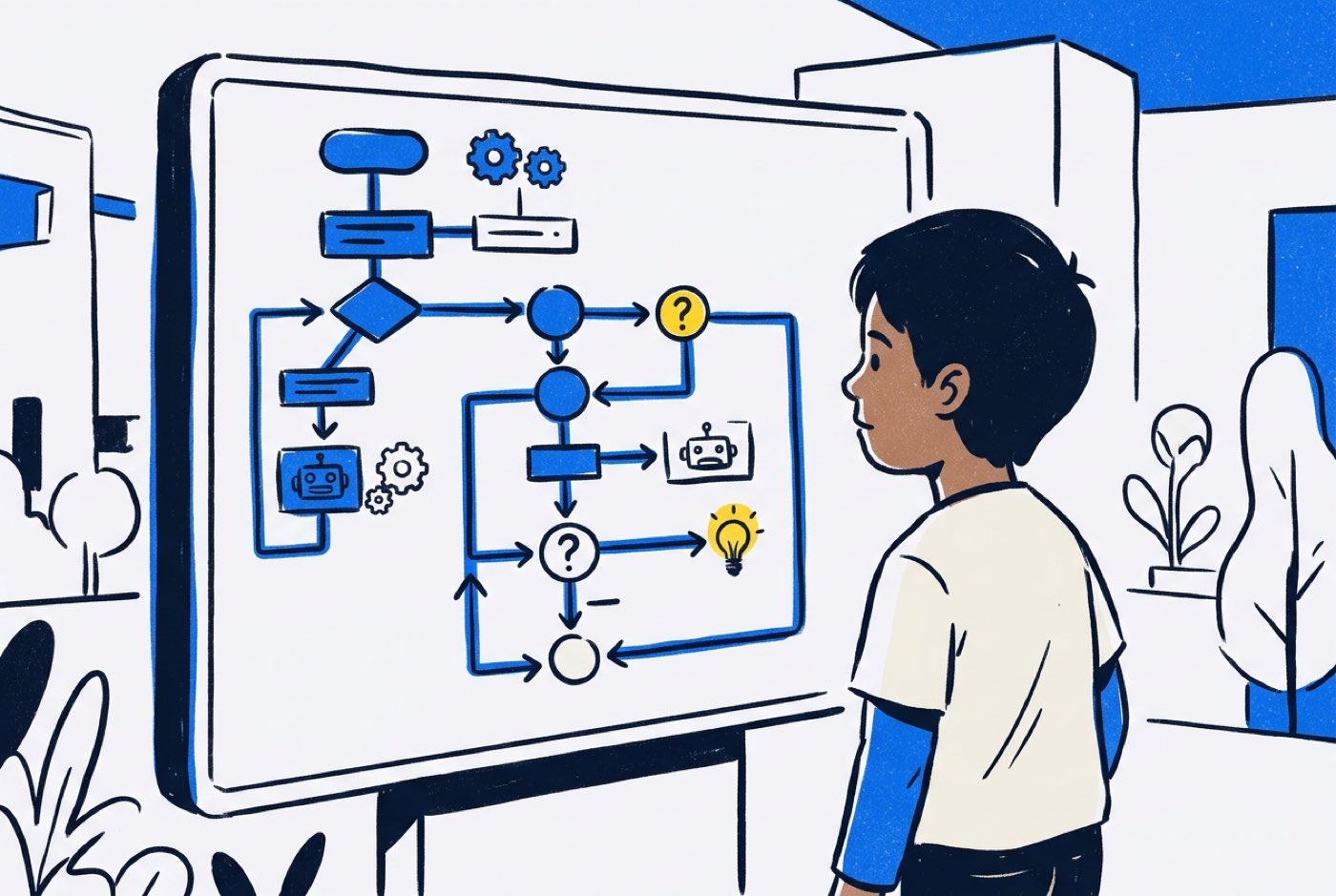
In code, the rules are absolute and visible. A compiler has no implied context and no emotional subtext to read. The code runs, or it returns an error.
Predictability and Reduced Social Anxiety
Autistic children often find that predictability comforting. The same input produces the same output, every time. Assign a variable a value and it holds that value through execution. Pattern recognition and systematic thinking, strengths many autistic learners already have, become the skills the task actually rewards [1], [2].
Hyperfocus and Instant Feedback Loops
Children with ADHD often drift during tasks that supply too little stimulation. Programming supplies a stream of micro-rewards instead. Write the code that jumps a character over an obstacle and the result appears on screen in milliseconds. Action, feedback, adjustment, repeat: that tight loop engages the brain's reward pathways and can carry an ADHD learner into extended hyperfocus [1].
Error Normalisation (Debugging as Discovery)
A wrong answer in a normal subject comes back circled in red, which reinforces the idea of failure. Bugs, by contrast, are expected. Nobody treats a broken build as a character flaw; debugging is simply part of the engineering. That neutral framing gives neurodivergent children room to build persistence, because the mistake is a puzzle rather than a verdict [3].
Synthesising the Research: What Studies Reveal About Coding and Neurodiversity
The published evidence points toward real cognitive benefits from technology education for special needs learners, with some clear conditions attached about how the teaching is structured.
Scoping Scenarios and Skill Acquisition
A scoping review of empirical studies published between 2006 and 2019 examined computing interventions for children aged 6 to 15 diagnosed with ASD and/or ADHD [4]. Across the 21 empirical studies it identified, teaching programming and computational thinking produced consistent acquisition of computing concepts along with social-emotional gains.
The authors attached a caveat worth repeating: 100% of the reviewed studies lacked a control group, and 18 of the 21 focused exclusively on ASD. ADHD and co-morbid conditions remain comparatively under-researched in the published literature [4].
Case Study Evidence: Explicit Instruction and Block Coding
One single-subject study followed direct coding instruction with a 10-year-old student with ASD and mild intellectual disability (WISC-R IV IQ 74) [3]. Working through systematic explicit direct instruction, the student completed 37 lessons covering 342 levels and 7,372 lines of visual code on Code.org over three months. By the end, he was completing complex coding tasks with no assistance at all [3].
The secondary results were the surprise. The study also recorded improved desktop management skills, basic English vocabulary, peer greetings, and a noticeable reduction in sound sensitivity [3].
The instructional sequence ran in three stages:
- Explicit direct instruction (modelling)
- Guided practice
- Independent execution
| Outcome type | What the study recorded |
|---|---|
| Primary | Independent completion of complex coding tasks |
| Secondary | Reduced sound sensitivity, improved communication, computer operating skills |
Regional Perspectives and Employment Potentials
Cross-cultural qualitative research on emotion-oriented play-learning tools (EPLTs) and advanced educational technology in China and Malaysia (N = 30) found the two groups of stakeholders diverged [1]. Malaysian parents and frontline teachers were significantly more open to adopting advanced interactive technologies for autistic learners; Chinese participants were more cautious, citing socio-environmental constraints [1].
There is a career argument here too. Data compiled by the Malaysian Information Network on Disabilities puts the global employment rate for adults with autism at only 10% to 20% [2]. Early fluency in logic, web building, and software engineering feeds directly into the region's shortage of digital talent, and the work itself tends to be remote and structured, which suits many neurodivergent adults [2].
Navigating Interface and Sensory Challenges: Block-Based vs. Text-Based Tools
The benefits are real, but a badly configured environment can hand a child visual and sensory overload before they write a single line.
| Stage | Typical tools | How the child works | What it develops |
|---|---|---|---|
| Visual block platforms | Scratch, Code.org | Drag-and-drop logic | Spatial coordination |
| AI-assisted text coding | Hybrid Python, Roblox Lua | Natural language prompts | Syntax scaffolding |
| Full text IDE environments | Clean custom themes | Focused code completion | Independent building |
Screen Overload and IDE Complexity
Professional Integrated Development Environments (IDEs) were never designed with ADHD students in mind. Research from Lancaster University points to cluttered interfaces, deeply nested menus, and unpredictable diagnostic notifications that pull attention away from the work [4]. Hide the toolbars nobody is using and switch off the pop-up alerts before the first session, not after the third meltdown.
Input Hardware: Touchscreen vs. Mouse and Keyboard
Educational tools tend to default to touchscreen tablets, which turns out to be a poor default. Empirical findings show touchscreen drag-and-drop interfaces creating severe usability obstacles for autistic children through multi-touch errors, erratic scrolling, and imprecise finger tracking [3].
In the single-subject research cited above, moving instruction from a tablet to a standard desktop computer with a physical mouse and keyboard resolved the input non-responsiveness immediately, and the behavioral frustrations attached to it disappeared with it [3].
Text-Based Coding and Syntax Barriers
Visual block environments such as Scratch remove syntax errors entirely, which makes them a sensible first step. They do carry accessibility limitations of their own, particularly for visually impaired students [3].
For the move into text, Python is the strongest candidate. Literature syntheses point to its clean syntax, mandatory indentation, and English-like readability as a good fit for the learning profiles of both ADHD and autistic students [1].
For a broader evaluation of language transitions, explore our guide on Scratch vs. Python.
AI Assistants as Cognitive Scaffolding for Learning Differences
Moving from visual blocks to a text language used to mean memorising strict syntax, punctuation, and exact keyword spelling. For a dyspraxic or dyslexic student, hunting for the right bracket or colon is friction with no educational payoff.
| Pathway | Sequence | Result |
|---|---|---|
| Traditional | Visual blocks → manual syntax memorisation → text coding | High barrier |
| AI-accelerated | Visual blocks → AI prompting and directing → real text projects | Accelerated |
AI assistants change that sequence. Instead of months spent wrestling with syntax rules, the student states the logical intent in plain language and the assistant helps generate or correct the structure, acting as real-time cognitive scaffolding.
Directing vs. Syntax Memorisation
Children reach real text programming in Python or JavaScript much sooner this way. The assistant is a partner that never runs out of patience. A child with ADHD who forgets how to construct a loop, or a dyslexic student who misspells a function name, gets the correction instantly and without a sigh attached to it.
What the child spends their attention on changes accordingly: less mechanical typing, more high-level computational thinking and creative problem-solving. To understand more about this approach, read our overview on why kids should learn coding with AI tools.
The Math Reframe: Moving from Abstract Worksheets to Building Physics
Math anxiety comes up in almost every initial consultation. The child struggles with school math, so the parent assumes coding will be worse.
We think the assumption is backwards. The capability is rarely the issue; traditional math instruction is simply broken for this learning style. Static worksheets and memorised procedures lose neurodivergent students quickly. Hand them math as a tool for building something real and the engagement looks nothing alike.
Applying Math to Physics and Game Mechanics
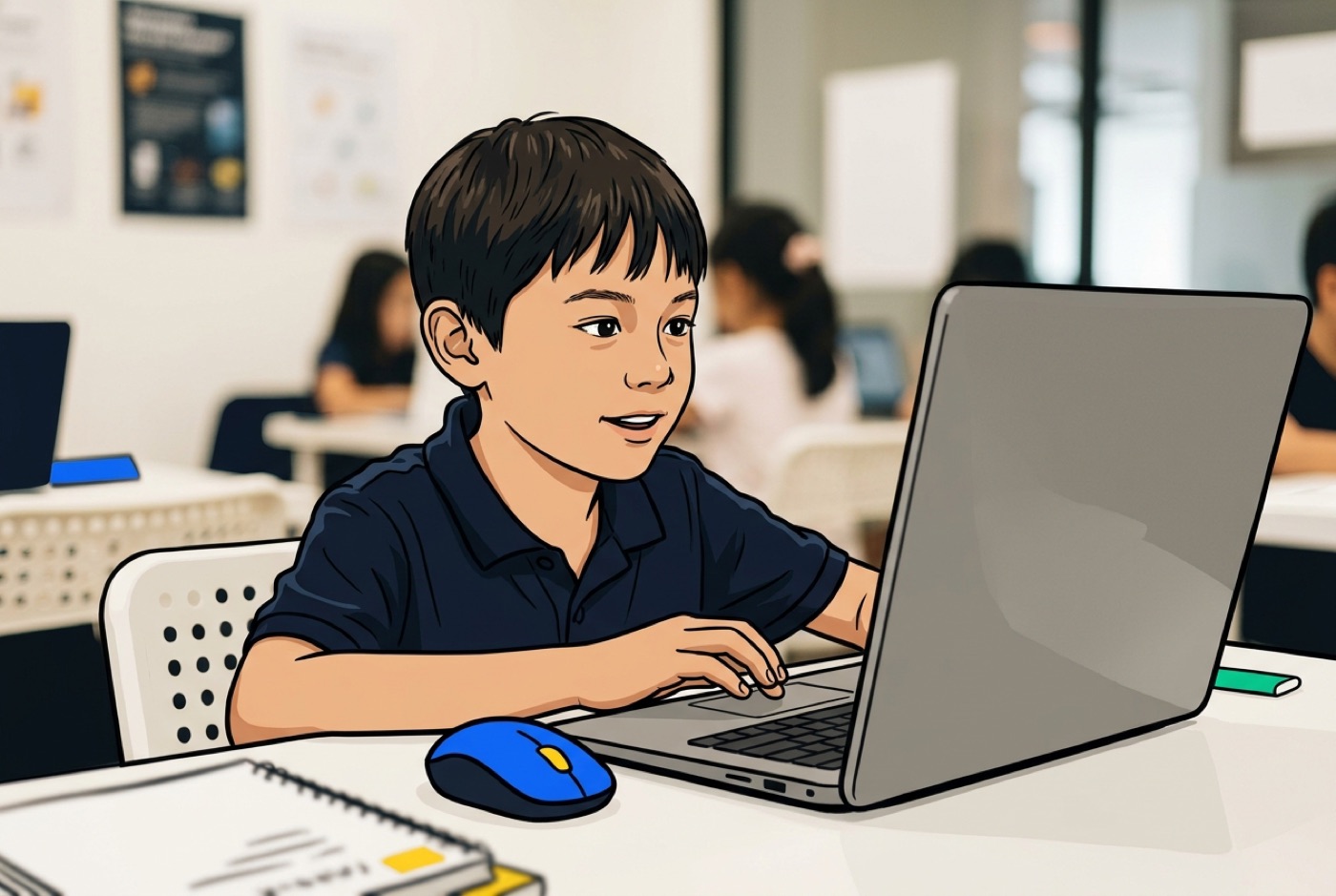
Take a basic game physics problem. A textbook would ask the student to calculate displacement with an algebraic formula:
To a child with dyscalculia or ADHD, that equation is a wall of symbols with no purpose. In a coding environment, the same relationship is the code that makes a character clear an obstacle:
# Updating character jump position in a game loop
player_y += velocity_y
velocity_y += gravity  # acceleration due to gravity
Change the gravity variable, watch the character jump higher or drop faster, and the math stops being a chore. It becomes a control panel.
Synergies Between Coding, Math, and AI
Combining AI tools, interactive mathematics, and computational building lets neurodivergent learners build confidence across all three at once:
- Artificial Intelligence: Teaches students to direct technology, organise complex ideas, and break big challenges into clear steps.
- Applied Mathematics: Delivered through interactive building so students experience how mathematical rules create digital models, ending math anxiety in 2 to 4 weeks.
- Software Technology: Provided across tracks like Python, Web, Mobile, Game, Electronics, and 3D modeling, giving students practical outlets to build real software artifacts.
Comparing Educational Support Options in Malaysia
Malaysian parents have several options, and they differ in ways that matter a great deal for a neurodivergent child.
| Feature / Model | Standard Tuition Centres | Special Needs Schooling (PPKI/Private) | Specialized Computational Schooling |
|---|---|---|---|
| Primary Focus | School syllabus memorisation & exam prep | Core life skills & adapted academic pace | Applied logic, AI literacy & software creation |
| Pacing Model | Fixed group schedule based on school term | Individualized Education Plan (IEP) pace | Modular, self-paced, mastery-based advancement |
| Feedback Mechanism | Graded homework assignments & mock exams | Educator evaluation & behavioral tracking | Real-time code execution & personal AI tutoring |
| Class Environment | High student-to-teacher ratio | Small group setting with direct support | Trainer-guided small sessions & flexible direct support |
| Math Pedagogy | Rote drilling & formula memorisation | Adapted worksheets & functional numeracy | Math-by-building (game physics, AI logic, electronics) |
| Tech Integration | Minimal (paper and whiteboards) | Basic computer literacy | Advanced (Python, AI assistants, web, electronics) |
For parents evaluating options, our guide on 5 criteria when picking coding classes provides an in-depth decision framework.
Hardware, Ergonomics, and Behavioral Contracts at Home
A workable home setup comes down to two things: the physical equipment, and the expectations agreed on before anyone sits down.
Hardware Considerations
- Desktop Preference: A desktop with a dedicated physical mouse and full-sized keyboard gives far better tactile feedback than a touchscreen tablet or a cramped trackpad [3].
- Display Setup: A large monitor in dark mode with high contrast cuts visual clutter and eye strain.
- Audio Scaffolding: Noise-cancelling headphones help autistic children manage ambient household noise while they work [1].
Implementing a Behavior Contract
Hitting the keys when the code fails is a common enough reaction. Research indicates that behavioral disruptions and hardware misuse of this kind can be managed by agreeing on a clear, written behavior contract before instructional sessions begin, rather than after the first incident [3].

Progression Roadmap for Neurodivergent Learners
Children move at their own speed, but a structured route keeps the challenge ahead of boredom and behind overwhelm.
Phase 1: Interactive Cause-and-Effect (Ages 5–8)
- Focus on visual spatial logic, drag-and-drop mechanics, and simple event triggers using tools like Scratch.
- Build basic animations, character stories, and simple maze navigation games.
- Reframe screen time from passive video watching to active game creation.
Phase 2: Logic, Physics, and Game Mechanics (Ages 9–12)
- Transition to structured block-and-text environments using platforms like Roblox Studio (Lua) or Minecraft education environments.
- Introduce foundational math concepts through practical building: coordinates, variables, velocities, and conditional statements.
- Begin introducing AI coding assistants to handle text completion and syntax checking.
Phase 3: Applied AI and Text Software Engineering (Ages 13–18)
- Transition fully to professional text programming languages, focusing primarily on Python and web frameworks.
- Teach students how to direct AI systems responsibly to build real-world applications, custom algorithms, and interactive web tools.
- Explore specialized technical tracks, including app development and machine learning models.
How Kidocode Supports Neurodivergent Learners
Given the right environment, we have yet to meet a child who cannot handle technology. Since 2014 our programs have supported over 9,500 students across our campuses in Klang Valley (Solaris Mont Kiara HQ and Sunway Nexis in Kota Damansara) and Penang (Q2 Waterfront, Vantage Tanjung Tokong, and Icon City), plus live, camera-on online classes.
The model was built around personalized learning systems, which is why it tends to suit neurodivergent students without much adaptation:
- Personalized AI Tutor Per Child: Every student works with a personal AI tutor that adapts to their exact learning pace, so they can sit with a concept as long as they need to without peer pressure in the room.
- Math Through Building: We are not a tuition centre. We align with international math standards (IGCSE, Cambridge, US Common Core) and deliver the concepts through physical hardware builds, digital physics, and AI algorithms.
- Bundled Computational Thinking: Coding knowledge has become public knowledge, so coding comes free with every enrollment package. Our direct instruction goes into high-level computational thinking, logic, and AI direction.
- Trainer-Guided Flexibility: Our trainers work as mentors rather than lecturers, adjusting guidance and support to each child's sensory and emotional needs.
If you want to see how your child reacts to a hands-on environment, come to one of our campuses or join a live online session. Our how we teach page covers the wider philosophy.
Home Assessment & Action Plan
Use this checklist to audit your child's home learning setup and track what happens over the first month of computational building.
Printable Home Learning Setup & Observation Checklist
- Desktop Equipment: Provide a stationary desktop computer setup with a physical keyboard and optical mouse, replacing touchscreen tablets.
- Visual Simplification: Configure the coding workspace interface to dark mode, remove unnecessary browser toolbars, and close background tabs.
- Auditory Supports: Equip the workspace with comfortable, over-ear noise-cancelling headphones to reduce environmental noise.
- Clear Ground Rules: Display a brief, written 4-to-5-item behavior contract near the screen outlining session expectations and break times.
Designed, ready to print and sign. We email it to you together with a 5% discount on your next registration.
Frequently Asked Questions
Is my neurodivergent child too young to start learning to code?
If a child can play a digital game, they are ready to start building one. Learners aged 5 to 8 begin with spatial logic and block-based cause-and-effect tools. What matters is matching the teaching method to the child's developmental stage, not waiting for a particular birthday.
Will coding replace my child's necessary school special education services?
No. Coding and computational building sit alongside programs like PPKI or a specialized school support plan. School services handle core academic benchmarks and daily living skills; coding adds a creative outlet that develops abstract logic, systematic problem-solving, and technology literacy.
What if my child has severe dyscalculia and struggles with basic math?
Dyscalculia makes memorising abstract arithmetic tables hard. It does not stop a child from understanding spatial logic or computational systems. In a building-first environment, math shows up as graphics, speed variables, and digital physics, so dyscalculic students can work with mathematical relationships without a paper worksheet in sight.
How does coding help a child with ADHD who gets easily distracted?
Passive listening fatigues an ADHD brain fast. Coding replaces it with immediate visual feedback and short execution loops: run the code, see the result of your own logic, adjust. Attention management turns into part of the challenge rather than a prerequisite for it.
Should my child learn visual block coding or start directly with text coding?
Block coding on Scratch introduces logic without typing obstacles, which is a good place to begin. That said, modern AI coding assistants let neurodivergent learners reach text programming in Python far sooner than the traditional ladder assumes, because the assistant absorbs the syntax rules and leaves the student free to solve the actual problem.
References
-
Xing, Y., Jomhari, N., Zakaria, N., Zhou, X., Lai, S., & Liu, Y. (2026). Stakeholder perspectives on emotion-oriented play-learning tools for autistic children: A qualitative thematic analysis in China and Malaysia. Frontiers in Psychology, 17, Article 42145534. https://pubmed.ncbi.nlm.nih.gov/42145534/
-
Malaysian Information Network on Disabilities (BAKTI-MIND). (2026). A code to succeed: Coding education for people with autism. https://mind.org.my/article/a-code-to-succeed-coding-education-for-people-with-autism/
-
Sola-Özgüç, C., & Altın, D. (2022). Teaching block-based coding to a student with Autism Spectrum Disorder. Ankara University Faculty of Educational Sciences Journal of Special Education, 23(3), 541-568. https://www.researchgate.net/publication/356643866_Teaching_Block-Based_Coding_to_a_Student_with_Autism_Spectrum_Disorder
-
Oswald, C., Paleczek, L., Maitz, K., Husny, M., & Gasteiger-Klicpera, B. (2023). Fostering programming and computational thinking in children with ASD and/or ADHD: A scoping review. Review Journal of Autism and Developmental Disorders, 10(2), 215-234. https://d-nb.info/1299668658/34
-
Halpin, L. (2025). Designing better coding tools for students with ADHD. Lancaster University School of Computing and Communications. https://portal.lancaster.ac.uk/portal/news/article/designing-better-coding-tools-for-students-with-adhd
-
Bramlett, V. (2025). Empowering neurodivergent learners through Python programming: A literature review. Kennesaw State University DigitalCommons. https://digitalcommons.kennesaw.edu/cgi/viewcontent.cgi?article=1547&context=cday
-
Official Government of Malaysia. (2026). Special Education Services and PPKI Framework. Department of Social Welfare & Ministry of Education Malaysia. https://www.malaysia.gov.my/en/categories/school--education/special-education
-
MastersinDataScience.org. (2026). How to teach coding to students with learning disabilities. 2U / edX Educational Resources. https://www.mastersindatascience.org/resources/how-to-teach-coding-to-students-with-learning-disabilities/
Experience How Your Child Learns at Kidocode
Come and see how your child responds to an adaptive, hands-on environment. Parents and students are both welcome at a free trial session, available at our campuses in Solaris Mont Kiara, Sunway Nexis, Penang Q2 Waterfront, Vantage Tanjung Tokong, and Icon City, or live online.