

Every after-school centre in Malaysia now advertises STEM exposure, which makes it hard for a parent to tell a serious programme from an expensive novelty. The questions we hear at our front desk are specific: is an eight-year-old too young to grasp anything about machine learning? Does building a small motor-driven vehicle do anything for a child's maths marks at school?
Learning AI and robotics does change how children process information, but not in the way the brochures usually imply. Taught well, neither subject is about memorising syntax or following an instruction sheet until a plastic kit looks like the photo on the box. They give abstract logic, spatial reasoning, and computational thinking somewhere physical to land.
This guide walks through five benefits with evidence behind them, for children aged 5 to 18. It cites the academic research, names the things robotics does not fix, and gives Malaysian parents a way to judge the programmes in front of them.
Table of Contents
- Key Takeaways: What AI and Robotics Actually Do for Your Child
- Why AI and Robotics Are Different from Standard Screen Time
- Benefit 1: Sharpening Visuospatial Memory and Abstract Reasoning
- Benefit 2: Shifting from Passive AI Consumers to Active AI Directors
- Benefit 3: Ending Math-Hate Through Physical and Digital Builds
- Benefit 4: Accelerating Text-Based Coding and Computational Thinking
- Benefit 5: Developing Non-Automatable Analytical Skills
- Educational Robotics vs Conventional Tuition
- How Age Progression Works: From Screen Play to Directing Systems
- How Kidocode Integrates AI, Math, and Free Coding
- A Parent's 4-Week Action Plan to Introduce AI and Robotics at Home
- Frequently Asked Questions (FAQ)
- References
Key Takeaways: What AI and Robotics Actually Do for Your Child
The table below sets early AI and robotics exposure against the passive learning most children get by default.
| Cognitive & Skill Domain | Traditional Classroom Approach | AI & Robotics Building Approach | Measured Impact / Evidence |
|---|---|---|---|
| Cognitive Reasoning | Paper-based logic exercises and rote memory tasks. | Hands-on spatial assembly, sensor calibration, and algorithmic debugging. | 5% bi-monthly gain in Raven abstract reasoning scores [7]. |
| AI Literacy | Passive consumption of generative AI output and chatbots. | Constructing models, understanding training data, and evaluating output bias. | Moves children from blind trust to critical evaluation of machine outputs [5]. |
| Mathematical Mastery | Memorising formulas for IGCSE/KSSR exams without physical context. | Applying geometry, coordinate systems, and physics variables () to builds. | Stops math-hate by connecting abstract symbols to immediate visual feedback [3]. |
| Coding Progression | Years of static block coding before touching real syntax. | Accelerated transition to Python using AI assistants to absorb initial syntax friction. | Faster transition to professional programming languages. |
| Workforce Preparedness | Routine task completion vulnerable to future workplace automation. | Cultivating complex analytical thinking and human-edge decision making. | Analytical thinking ranked as top core skill by 70% of enterprise employers [2]. |
Why AI and Robotics Are Different from Standard Screen Time
Four hours on a tablet looks the same from the doorway whatever the child is doing, which is why most parents reach for a time limit rather than a content rule. But watching an algorithmic video feed and debugging a rover demand almost nothing in common. One asks the child to keep watching. The other asks the child to figure out why the thing on the floor keeps driving into a wall.
flowchart LR
    A[Child on Screen] --> B{Activity Type?}
    B -->|Passive Consumption| C[Video Streams & Social Feeds]
    C --> D[Low Cognitive Retention & Attention Fatigue]
    B -->|Active Construction| E[Robotics & AI Engineering]
    E --> F[Visuospatial Working Memory & Logical Reasoning]
Hardware is an unusually honest teacher. Misalign an ultrasonic sensor by five degrees and the rover hits the wall. Leave the exit condition out of a conditional loop and the program hangs. The machine runs the instruction it was given, not the one the child meant to give.
AI tools add a second layer. Under guidance, children who work with language models or computer vision tools stop treating software as magic and start seeing probability, training data, and prompts. The tablet stops being an entertainment terminal and starts being a workbench. Parents looking for practical rules at home can read our guide on screen time vs coding time.
Benefit 1: Sharpening Visuospatial Memory and Abstract Reasoning
Abstract reasoning and visuospatial working memory sit underneath higher-level mathematics, engineering, and architectural thinking, and both are measurable. That makes them the strongest place to start any honest argument about early robotics.
A six-month peer-reviewed study published in the Journal of Science Education and Technology followed children aged six to eight through an after-school robotics education programme [7]. Researchers took repeated measurements using standardised instruments, including Raven's Progressive Matrices for abstract reasoning and Corsi Block-Tapping tests for visuospatial memory.
Three results stood out:
- Abstract reasoning: scores on Raven Progressive Matrices tasks rose an average of 5% every two months () [7].
- Visuospatial working memory: Corsi block scores improved 4% every two months () [7].
- Processing efficiency: eye-tracking during robot building showed average fixation durations across work areas shortening over the six months, evidence that the children were reading physical and visual space faster as they gained experience [7].
The same study found no statistically significant change in 3D mental rotation () or symbolic dot-comparison tasks () [7]. That null result is worth as much to a parent as the positive ones. Robotics is not a general-purpose brain upgrade. It sharpens spatial working memory and logical pattern recognition specifically, because building hardware forces a child to translate a flat diagram or a line of code into three-dimensional space.
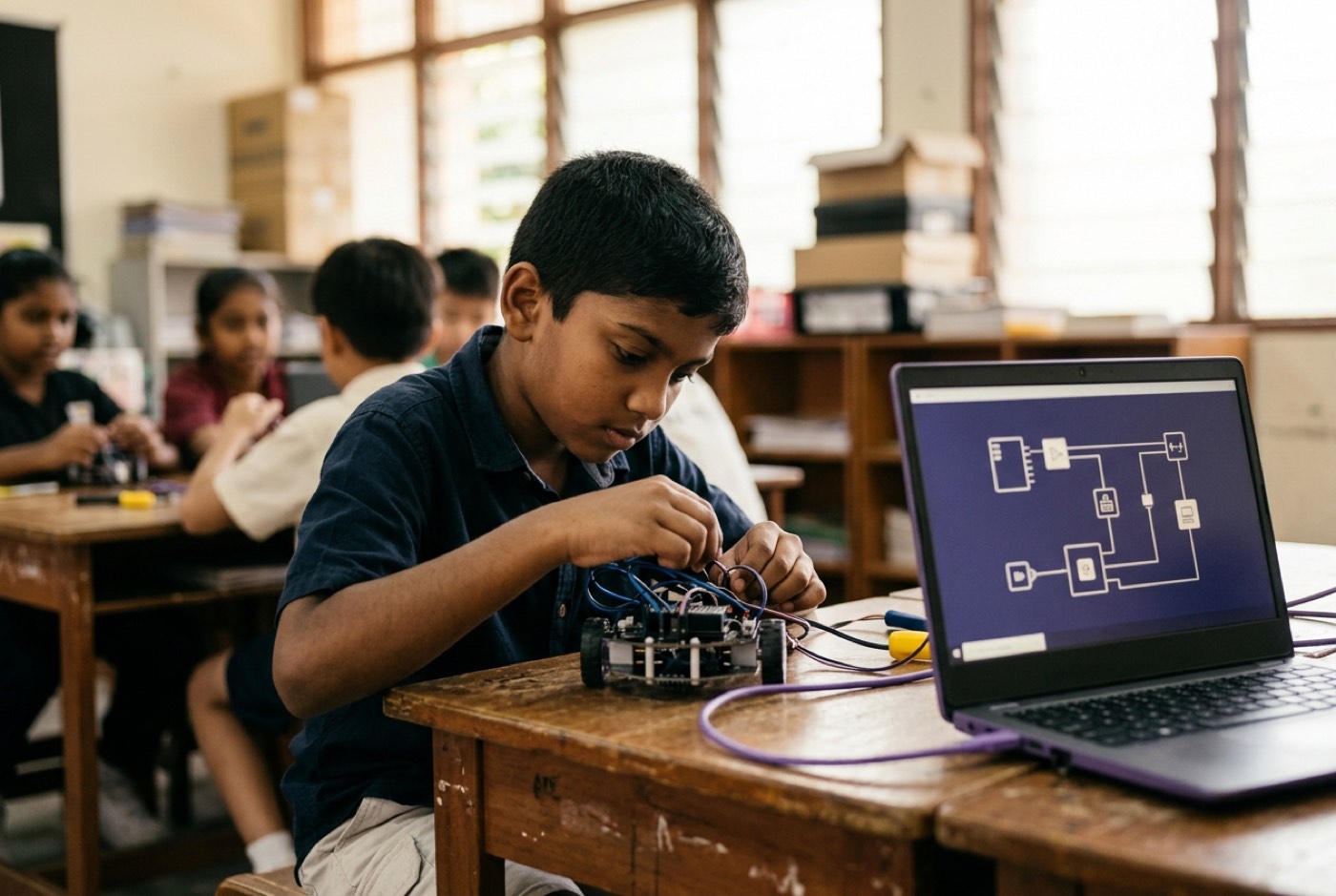
You can watch this happen over a single afternoon. A student designing a basic autonomous chassis has to picture how motor-axle rotation becomes forward travel, then check clearances, balance the weight, and get the microcontroller pins right. Our breakdowns of electronic components and digital circuits cover the hardware side in more depth.
Benefit 2: Shifting from Passive AI Consumers to Active AI Directors
Children in 2025 are already surrounded by artificial intelligence. They ask a voice assistant for songs, generate pictures for school projects, and hand homework questions to a chatbot. Using the tools without understanding them produces a fragile kind of dependence.
Researchers at the National University of Science and Technology POLITEHNICA Bucharest surveyed engineering students and found 95.6% using AI tools for academic work, with 88.2% using virtual assistants daily or weekly [6]. At the same time, 48.2% reported ongoing anxiety about receiving incorrect or imprecise answers [6]. That gap is the problem in miniature: students who were never taught how a model produces text have no basis for deciding whether to trust what it produces.
Work from the Harvard Graduate School of Education points the other way. Children build usable evaluation strategies when AI tools are designed around active learning principles [5], and young learners who hold interactive, prompt-driven dialogues with AI systems show stronger story comprehension and vocabulary retention than children consuming media passively [5].
Teaching the mechanics moves a child from user to director in three concrete ways. They learn that a large language model predicts probable text rather than retrieving truth, which is the reason to check a source. They learn to write prompts with system context, output constraints, and formatting rules instead of typing a search term. And they look at training data closely enough to see why a vision model fails in low light, or why a translation tool carries a cultural bias with it.
UNESCO's global policy report on K-12 AI curricula argues that regulation on its own cannot protect citizens, and that foundational AI literacy for all children is what preserves future digital agency [1]. A child who has built and fine-tuned a simple model loses the awe and keeps the control. For how we balance the two, see our guide on AI literacy vs coding skills for kids.
Benefit 3: Ending Math-Hate Through Physical and Digital Builds
Math-hate is everywhere in Malaysian primary and secondary schools. At trial sessions in Solaris Mont Kiara and Penang, the sentence we hear most often from parents is some version of: "My child hates math, they simply aren't a numbers person."
Our reading is different. The child is usually fine; the sequence was wrong. School curricula ask students to manipulate abstract symbols on a worksheet long before showing them what the symbols are for. Multiplication matrices and coordinate geometry rules, memorised in isolation at nine years old, feel like arbitrary hurdles because that is exactly what they are at that point.
Builds flip the order. Turning a two-wheeled robot ninety degrees to the left cannot be guessed: the child works out wheel circumference (), then arc length, then how long to run the motor. Reporting the speed of an autonomous car means putting into the code itself. Setting a light-sensor threshold introduces an algebraic inequality () as a switch that turns a real buzzer on and off.
A study across Malaysian secondary schools looked at Robotics Competition-based Learning and student attitudes toward STEM subjects [3]. The robotics group scored significantly higher on attitude measures in the technology and engineering domains, with a mean of 24.2 against 20.2 for matched non-participant controls [3].
Once maths is the thing that gets the robot through the maze or makes generative art render properly, the resistance tends to go quiet. In our classrooms the shift usually lands somewhere in the second to fourth week of project work: maths stops being homework and becomes a tool the child reaches for. Our comparison of math tuition vs learning math by building goes into the mechanics.
Benefit 4: Accelerating Text-Based Coding and Computational Thinking
For years the standard advice ran one way: start five-year-olds on Scratch, keep them there until twelve, then introduce Python.
Visual blocks do remove early syntax frustration, which is why the advice made sense. But leaving a capable eleven-year-old on drag-and-drop tiles for a fifth year is a ceiling, not a scaffold, and AI coding assistants have changed the maths of when to move on.
| Age band | Old paradigm | Modern AI-assisted paradigm |
|---|---|---|
| Ages 5–7 | ScratchJr | Visual logic and robotics |
| Ages 8–12 (old) / 8–11 (modern) | Scratch blocks | MicroPython with AI scaffolding |
| Ages 13+ (old) / 12+ (modern) | First exposure to Python, plus syntax friction | Full text stack and AI direction |
With an assistant scaffolding in real time, children reach real text-based code years earlier than the old sequence allowed. Missing colons, mismatched brackets, and stray indentation get caught immediately, so the child's attention stays on logic and system architecture instead of punctuation.
We treat syntax as public knowledge, freely available to anyone who asks for it. Computational thinking is the part that holds its value:
- Decomposition: breaking a system such as an automated delivery drone into sub-tasks that can each be solved.
- Pattern recognition: spotting the repeated sensor cycle and writing one clean, reusable loop for it.
- Abstraction: putting low-level hardware detail behind a function and reasoning about the function.
- Algorithm design: writing steps that behave predictably when the inputs change.
Pair a physical platform like Micro-bit or Arduino with Python and students are writing production-shaped routines before they finish primary school.
Benefit 5: Developing Non-Automatable Analytical Skills
Parents asking which careers survive the next decade are asking a reasonable question. The old answer, teach the child a fixed set of procedures and let them execute it, weakens once software can read technical documentation in seconds.
The World Economic Forum's Future of Jobs Report 2025 found that employers globally expect 39% of workers' core skills to be fundamentally transformed by 2030 [2]. Notably, no particular software syntax tops their list. Analytical thinking does, named as essential by 70% of surveyed corporate executives [2].
Closer to home, the Institute of Strategic and International Studies (ISIS) Malaysia mapped automation risk task by task across the national labour force [8]. It put 4.2 million Malaysian workers, 28% of the workforce, in the high-exposure band for generative AI [8]. The same report found that occupations built on human-edge skills carry clear wage premiums in the market [8].
Those human-edge competencies include:
- Complex system evaluation and architectural judgment.
- Interpersonal reasoning and social-emotional negotiation.
- Creative problem reformulation when the standard routine fails.
- Physical dexterity paired with real-time hardware calibration.
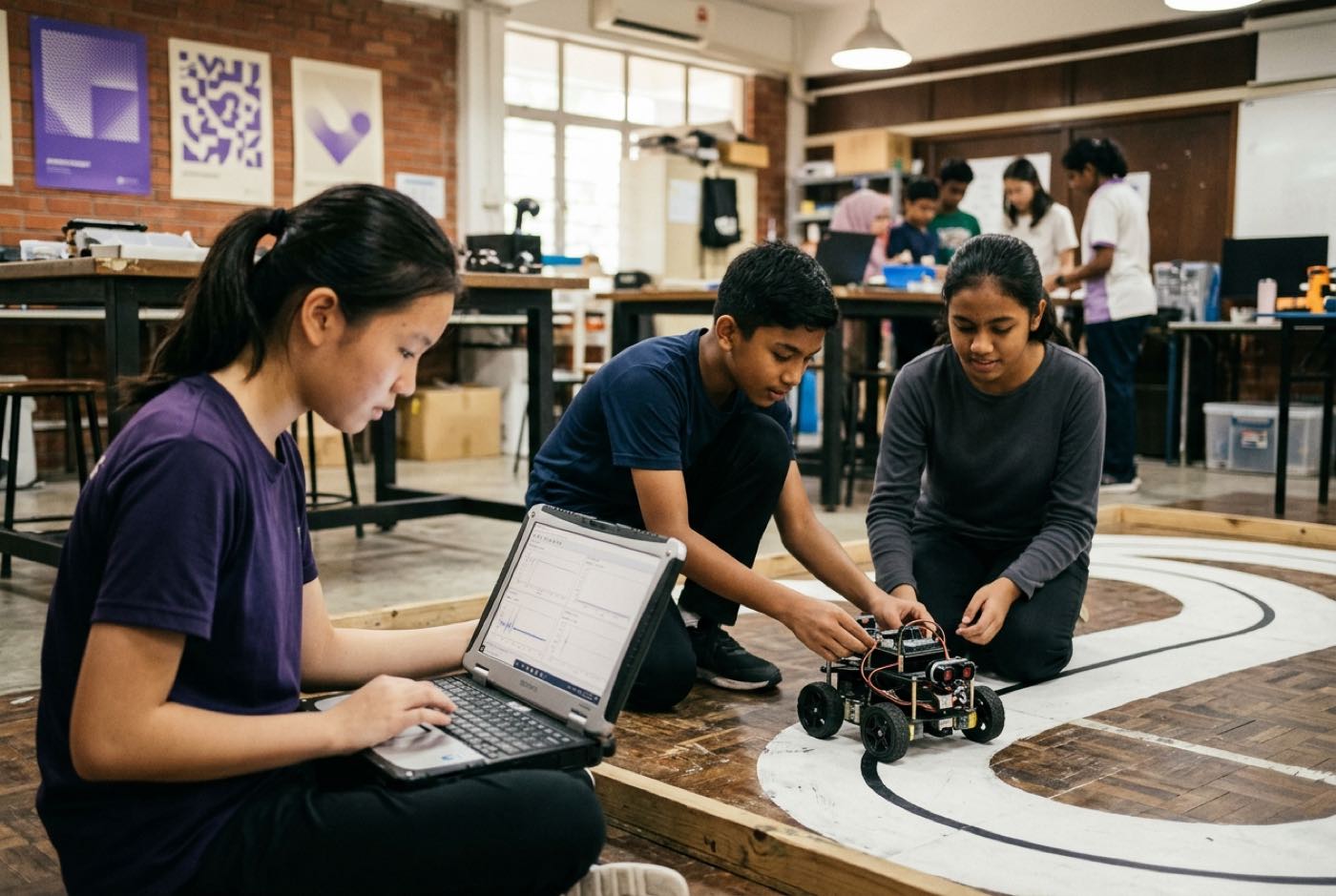
Robotics exercises exactly these. When a line-following robot loses a white line on a black surface, no algorithm can go and fix the room. The student has to look at the ambient light, retune the optical sensor threshold, check whether battery voltage has sagged, and reconsider the loop rate. That kind of layered diagnosis is not something a textbook can hand over; it comes from having been stuck and having got unstuck. On the longer career horizon, see our post on whether AI will affect your child's career in Malaysia.
Educational Robotics vs Conventional Tuition
Most families are choosing between academic tuition and a project-based technology class, often with the same budget. The table below lays out where the two differ in practice.
| Feature / Dimension | Conventional Academic Tuition | Constructivist AI & Robotics Learning |
|---|---|---|
| Primary Goal | Memorising past-year exam questions for immediate test scoring. | Developing foundational computational thinking and problem-solving skills. |
| Instructional Method | Teacher-led lectures, chalk-and-talk, drill worksheets. | Hands-on project builds, iterative hardware testing, direct software execution. |
| Feedback Loop | Delayed grading on test papers days or weeks later. | Immediate mechanical and digital execution output (code works or robot stops). |
| Role of AI Tools | Often treated as a shortcut for homework copy-pasting. | Used as an active scaffolding partner and code-debugging assistant. |
| Mathematics Integration | Theoretical drill exercises separated from physical reality. | Direct application to gear ratios, physical velocity, coordinate grids, and logic gates. |
| Long-Term Outcome | Temporary grade gains that fade after examination cycles. | Permanent mental framework for analyzing complex physical and digital systems. |
How Age Progression Works: From Screen Play to Directing Systems
Developmental readiness moves fast between five and eighteen. Push machine learning algorithms at a six-year-old and you get frustration; keep a fourteen-year-old on block puzzles and you get boredom. Both failures look like the child's fault and neither is.
Our founder, computer scientist Unclecode (creator of Crawl4AI), puts the principle plainly: "The moment your child can play a game on a mobile device is the moment they should learn to build the game as well. It is never too early, the outcome depends entirely on the teaching approach."
Here is how the progression tends to run across the three developmental stages.
Ages 5 to 7: Physical Play and Concrete Logic
Learning at this age runs through touch, movement, and cause and effect a child can see.
- Engagement Layer: Screen-free floor robots, physical tactile coding blocks, and simple visual logic environments like ScratchJr.
- Core Concepts: Sequential ordering, directional orientation, spatial awareness, and basic loops.
- Robotics Hardware: Large motor blocks, simple light sensors, and push-button trigger interfaces.
- AI Literacy: Voice interaction concepts, pattern recognition through basic image sorting games.
Ages 8 to 12: Visual Systems, Hardware Components, and AI Tools
Primary school children move from single triggers to systems with parts that depend on each other.
- Engagement Layer: Roblox Studio construction, Minecraft Education logic, block-to-text Python bridges.
- Core Concepts: Variable storage, conditional branching (
if-then-else), ultrasonic distance calculation, coordinate geometry (). - Robotics Hardware: Micro-bit controllers, servo motors, breadboard circuitry, and basic line-following chassis.
- AI Literacy: Prompt structuring, image classifier generation, training basic machine vision models to recognize hand gestures.
Ages 13 to 18: Text Stacks, Real Hardware, and System Architecture
Secondary students work with the tools professionals use, in text.
- Engagement Layer: Pure text coding in Python, JavaScript, and C++, paired with AI development assistants.
- Core Concepts: Algorithmic optimization, REST API integration, neural network topology, electronic component signal analysis.
- Robotics Hardware: Arduino, Raspberry Pi, ESP32 microcontrollers, custom 3D-printed chassis, serial bus communication.
- AI Literacy: Fine-tuning open-source language models, deploying computer vision pipelines (OpenCV), evaluating algorithmic bias and data ethics.
For a stage-by-stage route into hardware specifically, see our guide for kids to start learning robotics.
How Kidocode Integrates AI, Math, and Free Coding
Kidocode is Malaysia's dedicated AI and tech school for kids aged 5 to 18. We teach across five campuses, Solaris Mont Kiara (flagship) and Sunway Nexis PJ in the Klang Valley, plus Q2 Waterfront, Vantage Tanjung Tokong, and Icon City in Penang, and through live, interactive online classes.
One membership covers three pillars:
- AI School First (Pillar 1): Children learn to direct AI systems safely rather than hand their thinking over to them. That means understanding how machine learning architectures work, writing structured prompts, and auditing automated output for accuracy and safety.
- Math Through Builds (Pillar 2): We deliver international mathematics standards (Cambridge, IGCSE, US Common Core) through project engineering. Every child works with a personalised AI tutor that adapts to their pace, which is how most maths hesitation clears inside two to four weeks.
- Tech & Coding Bundled Free (Pillar 3): Raw syntax is public knowledge, and AI assistants now write most of the routine kind. So all six tech tracks, Python, Web Development, Mobile Apps, Game Engineering, Electronics, and 3D Modelling, come at no extra charge inside our membership plans. The teaching time goes to computational thinking.
For most families we recommend the Triple Degree package: three flexible trainer-led sessions a week spread across all three pillars, so a child gets hardware, mathematics, and software in the same month rather than in sequence.
The fastest way to judge any of this is to watch your own child do it. Bring them to any branch, or join a camera-on online session, for a free hands-on trial: two hours, one real working project in AI, maths, or robotics, and a clear look at how your child handles something that does not work on the first try. Book at kidocode.com/trial-class.
A Parent's 4-Week Action Plan to Introduce AI and Robotics at Home
None of this requires an engineering degree on the parent's side. Four weeks is enough to move a household from passive technology use toward building.
Week 1: Audit Screen Consumption
- Watch how your child actually spends screen time over seven days.
- Sort the hours into Passive Consumption (watching videos, scrolling feeds) and Active Construction (building in Minecraft, editing media, creating game maps).
- Set one house rule: every hour of passive media earns 30 minutes of creative digital building.
Week 2: Explore Physical Hardware Logic
- Set simple building challenges using household items or a basic electronics starter kit.
- Have your child map a physical process with flowchart symbols: Start Action Decision Point End.
- Talk about how ordinary appliances decide things, such as an air conditioner reading a temperature sensor to cycle its compressor.
Week 3: Introduce Prompt Engineering and AI Auditing
- Sit down together and open a conversational AI tool.
- Pick something your child already knows well: a hobby, or a history chapter from school.
- Ask five detailed questions, then fact-check the answers together against a reliable book or a trusted site.
- Show what happens to the output when you add context and a role instruction to the prompt.
Week 4: Book a Hands-On Practical Demo
- Take your child somewhere they can handle real sensors, microcontrollers, and a live coding environment with a trainer present.
- Watch what they do when the code fails on the first run: do they start debugging, or wait for a hint?
- Ask whether the programme rewards memorising code snippets or working a problem out.
Printable AI and Robotics Evaluation Checklist for Parents
Print this or keep it on your phone when you visit a STEM programme, buy a robotics kit, or sit in on an after-school technology class.
- Curriculum Focus: Does the program teach underlying computational thinking and logic, or does it rely on pre-built kits with step-by-step assembly guides?
- AI Integration: Are children taught how AI models function, how to evaluate dataset bias, and how to write structured prompts safely?
- Mathematics Context: Is math presented as a practical tool for game physics, sensor telemetry, and spatial coordinate grids?
- Hardware Variety: Do students interact with real sensors, microcontrollers (such as Micro-bit or Arduino), motors, and digital circuits?
Designed, ready to print and sign. We email it to you together with a 5% discount on your next registration.
Frequently Asked Questions (FAQ)
Is my five-year-old child too young to learn robotics and AI?
Not too young, as long as the teaching matches the stage. Between five and seven, that means tactile floor robots, visual logic cards, and cause-and-effect triggers with very little reading. The goal at that age is spatial orientation, sequential logic, and the habit of trying again.
Will learning AI make my child rely on automated tools instead of thinking independently?
Unstructured access does encourage copy-pasting. Structured AI education does the opposite: children learn to inspect the output, write precise prompts, and judge what comes back. Used that way, AI is a scaffold that lets a child attempt bigger projects than they could alone.
How does robotics help a child who is struggling with school mathematics?
It turns formulas into events on a test track. Angles, wheel circumference, speed, and conditional logic all become things the child can see happen or fail to happen. When maths is the tool that solves a build problem, hesitation usually drops within two to four weeks.
Does my child need prior coding experience before starting robotics?
No. Programmes built on constructivist principles start beginners on visual interfaces before any text syntax, and because AI tools absorb the early syntax errors, a complete beginner can get a hardware project working in the first session.
What is the difference between buying a consumer robotics kit and attending guided classes?
A kit gives you the parts. In practice most children build the one default model, finish the printed steps, and lose interest when the novelty goes. Guided classes supply successive project challenges, a continuous problem-solving loop, a trainer who knows your child, and a curriculum that ties each build back to computer science principles.
Where can my child try hands-on AI and robotics classes in Malaysia?
Kidocode runs hands-on trials at five campuses: Solaris Mont Kiara (flagship) and Sunway Nexis in the Klang Valley, and Q2 Waterfront, Vantage Tanjung Tokong, and Icon City in Penang. Live interactive online classes are available too. Free trial sessions run up to two hours and can be booked at kidocode.com/trial-class.
References
- UNESCO, K-12 AI curricula: A mapping of government-endorsed AI curricula (2022)
- World Economic Forum, The Future of Jobs Report 2025: Skills Outlook (2025)
- Journal of Human Capital Development, Robotics Competition-Based Learning in STEM Education (Pang et al., 2019)
- MDPI Applied Sciences, Determinants of Emotion Recognition System Adoption Among Malaysian Youth (Yamin et al., 2023)
- Harvard Graduate School of Education, The Impact of AI on Children's Development (Harvard EdCast, 2024)
- MDPI Education Sciences, Students' Perception and Use of Artificial Intelligence Technologies in Academic Activities (Vieriu & Petrea, 2025)
- Journal of Science Education and Technology / PMC, Longitudinal Impact of Afterschool Robotics Education on Children's Visuospatial Working Memory and Reasoning (Liu et al., 2023)
- ISIS Malaysia, Novel AI Technologies and the Future of Work in Malaysia (Cheng et al., 2025)