


Say the words "data science" to a parent and the picture that comes to mind is usually a university lecture hall, a whiteboard covered in matrix algebra, or a corporate analyst buried in spreadsheets. Attach that picture to a nine-year-old who is still working out fractions and spelling, and the hesitation makes sense. Too technical. Too abstract. Surely something to worry about later.
The version taught to young learners looks nothing like that. It is mostly about asking a precise question, noticing a pattern, checking whether the evidence actually supports the claim, and pointing an AI tool at a problem worth solving. Algorithms already decide a good deal of what our children read, watch, and buy. Knowing how those systems take in data and hand back answers has stopped being a career specialisation and started being ordinary literacy, the difference between using the software and understanding it.
Key Takeaways
| Dimension | Traditional Approach | AI-Integrated Data Science Approach |
|---|---|---|
| Core Focus | Memorizing formulas and plotting static graphs on paper | Asking questions, identifying patterns, and solving real problems |
| Tool Stack | Hand-drawn bar charts and textbook exercises | Interactive visual blocks, Python scripts, and AI tools |
| Math Connection | Isolated arithmetic drills (KSSR, IGCSE, SPM) | Applied mathematical logic embedded directly into projects |
| Child's Role | Consumer of pre-packaged problems and solutions | Builder who trains models, tests hypotheses, and interprets results |
| Long-Term Outcome | Rote exam performance without practical context | Computational thinking, AI literacy, and structural problem-solving |
Table of Contents
- What Data Science for Kids Actually Means in the Age of AI
- Why Traditional School Worksheets Miss the Mark on Data
- The Malaysian Data Economy: Workforce Realities
- How Data Literacy and AI Literacy Intersect
- Age-by-Age Learning Progression (Ages 5 to 18)
- Comparing Learning Paths: Theory vs Project-Based
- Linking School Math to Real-World Data
- How Kidocode Teaches Data Science and AI
- Addressing Parent Concerns and Misconceptions
- A 4-Step Home Framework for Families
- Frequently Asked Questions
- References
What Data Science for Kids Actually Means in the Age of AI
Data science means pulling something meaningful out of raw information. For a seven-year-old, the raw information might be a list of favourite video game characters and their stats. For a fourteen-year-old, it might be air quality readings across Klang Valley neighbourhoods, or a season of weather data from Penang.
Ten years ago, getting to the interesting part took a long time. A student had to grind through programming syntax and statistical theory before they could clean a small spreadsheet or draw a scatter plot, and most gave up somewhere in the middle of that.
Generative AI and modern machine learning tools have flipped the order. The tools now handle most of the repetitive syntax, which frees a young student to spend their attention on the reasoning:
- Posing the right questions: What information do we actually need to collect to answer this problem?
- Structuring raw data: How can we organize observations so a machine or an algorithm can process them?
- Evaluating conclusions: Does the output make sense, or is the underlying data biased and flawed?
Approached this way, kids find out fairly quickly that data is just the material AI models learn from. A student building a game recommendation engine is doing data science. So is a student training a simple image classifier. To explore how AI technologies shape data analysis, read our deep dive on demystifying data science and AI.
Why Traditional School Worksheets Miss the Mark on Data
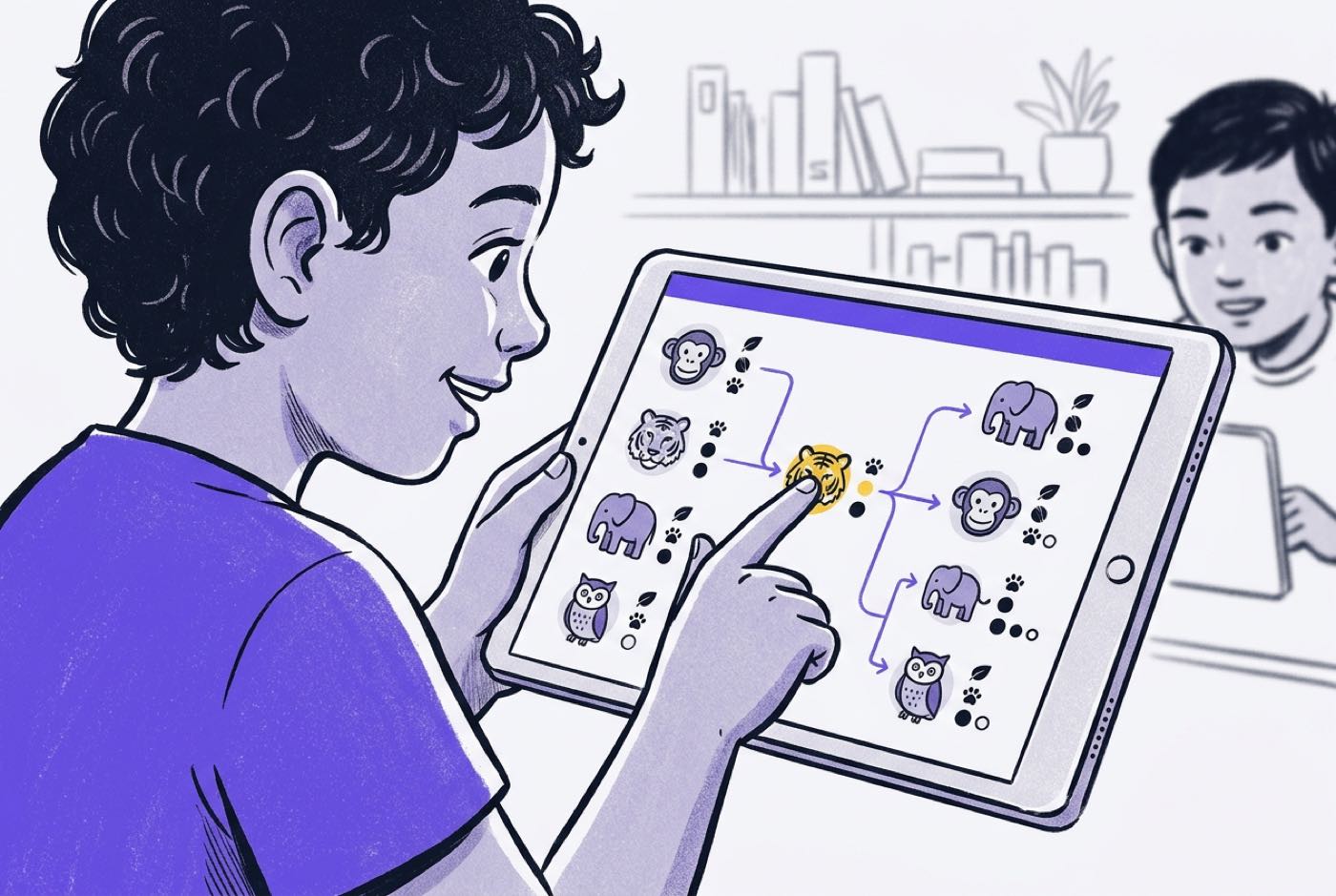
In KSSR, KSSM, and IGCSE alike, data handling shows up as an isolated topic parked inside the mathematics syllabus. Students measure temperatures, count coloured marbles, and rule bar charts onto graph paper.
Manual graphing does teach coordinate plotting, and there is nothing wrong with that. It just rarely produces data literacy, for three reasons:
- Static and artificial datasets: Textbook problems rely on small, pre-cleaned, artificial numbers where the answer is always a clean whole integer. Real-world data is messy, incomplete, and uncertain.
- Lack of interactive feedback: Drawing a bar chart on paper does not allow a child to ask "What if?" What if we double the sample size? What if we remove an extreme outlier? On paper, changing the query means erasing the entire page and starting again.
- Absence of real-world agency: When a child plots data from a textbook exercise, they have no personal investment in the output. There is no project to build, no game mechanism to tweak, and no AI model to train.
A systematic literature review published in 2026 examined 26 empirical studies on K-12 STEM data literacy [1]. The synthesis found that instruction still clusters around routine mathematical calculation, and that students seldom get to use data for evidence-based decision-making or real-world problem solving [1].
Cut off from application, data handling becomes one more sequence of arithmetic steps to memorise before an exam. Hand a child the same numbers as the steering wheel of a game they are building, and the whole thing changes character.
The Malaysian Data Economy: Workforce Realities
Parents reasonably want to know whether any of this pays off in Malaysia, or whether it is a trend that will pass. The national and global employment data points fairly clearly in one direction.
TalentCorp studied 10 key Malaysian economic sectors representing roughly 60% of national GDP and found that over 620,000 employees, 18% of the workforce in those sectors, face significant skill transformation from technological change [2]. The same research identified 60 emerging job roles gaining importance over a three- to five-year window, with data analysis, artificial intelligence, and digital systems management sitting at the centre of the shift [2].
The Malaysia Digital Economy Corporation (MDEC) Digital Talent Snapshot recorded 42,835 digital job vacancies across five major job portals between January and March 2024 [3]. Kuala Lumpur accounted for 50.4% of that demand, while active digital profiles clustered heavily in Selangor and W.P. Kuala Lumpur [3]. MDEC also noted Computer Science as the fastest-growing digital skill region-wide, with +71% year-on-year growth in Malaysia [3].
Internationally, the World Economic Forum's Future of Jobs Report drew on more than 1,000 major corporate employers representing 14 million workers [4]. Those employers named technical skill gaps as the largest single barrier to organisational transformation through 2030 [4].
A workshop report from the National Academies of Sciences made the point that meeting this demand means reaching down into early education, since the data scientists and technologists of the next decade are currently sitting in elementary, middle, and high school classrooms [5].
flowchart TD
    A[Traditional Math & Memory Drills] --> B[Rote Exam Performance]
    B --> C[Skill Gap at University & Workplace]

    D[Early Data & AI Exposure] --> E[Computational Thinking]
    E --> F[Interactive Project Building]
    F --> G[Data-Literate & AI-Savvy Young Innovator]
None of this means your child has to become a data scientist. It means that medicine, law, finance, engineering, and design will all be practised on top of data systems and AI platforms, and that knowing how data moves through those systems is useful almost everywhere.
How Data Literacy and AI Literacy Intersect
Modern data science and artificial intelligence are not really separable subjects. Large language models, computer vision systems, and recommendation engines all run on data, and the quality of that data decides what they can do.
Once a student has the data side, several AI concepts arrive almost for free:
- Training Data Quality: Kids learn that an AI image recognition system trained only on photos of cats will fail when asked to identify a dog. This introduces the concept of dataset coverage and sample bias in a visual, intuitive manner.
- Pattern Extraction: Children observe how machine learning models calculate probabilities to predict the next word or frame.
- Critical Evaluation: When an AI tool gives a wrong or hallucinated answer, a data-literate student checks the sources, questions the logic, and rewrites the prompt instead of accepting the output.
A global mapping report from UNESCO found that although governments widely acknowledge the urgency of AI literacy, only 11 countries have formally endorsed national K-12 AI curricula [6]. Among those that have, project-based learning is the most common and most effective teaching method [6].
There is a real gap between using an AI app and understanding the data underneath it. For a broader look at this distinction, read our guide on AI literacy versus coding skills for kids.
Age-by-Age Learning Progression (Ages 5 to 18)
Every one of these concepts can be pitched at any developmental stage. What changes from age to age is the teaching framework and the way the work is presented, not the child's capacity to handle the idea.
Early Years (Ages 5 to 7): Pattern Recognition and Unplugged Logic
Young children pick up data foundations through physical sorting, visual patterns, and games like ScratchJr.
- Core Concepts: Categorization, visual sorting, attributes (color, size, shape), and basic logical conditionals (IF / THEN).
- Practical Project: Sorting virtual game items into treasure chests based on rules, or creating an interactive story where a character reacts differently depending on selected inputs.
- Parent Reframe: The moment a young child plays an interactive mobile game, they are ready to learn the logic behind how the game sorts scores and choices.
A systematic review in the Journal of Educational Research & Practice analysed 42 empirical studies on pre-K–5 computational and data literacy [7]. Its conclusion was that early work with computational thinking tools and structured sorting activities lays down the cognitive building blocks that later data literacy depends on [7].
Middle Childhood (Ages 8 to 12): Structured Datasets and Visual Machine Learning
Somewhere in primary school, visual sorting gives way to block-based programming (Scratch, Blockly) and visual machine learning tools such as Teachable Machine.
- Core Concepts: Arrays, tables, variable collection, basic statistical averages, and supervised image/audio training.
- Practical Project: Building a custom Roblox mini-game that records player scores in a leaderboard table, or training an AI camera vision model to distinguish between recyclables and trash.
- Math Connection: Understanding how averages, frequencies, and percentages alter game balances or AI prediction confidence levels.
Teenagers (Ages 13 to 18): Text-Based Data Science and Python AI Integration
Teens go straight to text-based languages, Python above all, with AI coding assistants speeding up the syntax learning curve.
- Core Concepts: Data structures (dictionaries, lists), Pandas dataframes, data visualization libraries, API integration, and prompt engineering.
- Practical Project: Analyzing open public datasets (such as Malaysian weather or traffic patterns) to predict trends, building an automated financial tracker, or creating a personal AI study tutor.
- University Advantage: Developing authentic project portfolios that stand out in university admissions and scholarship applications. Discover how tech projects strengthen university applications in our guide on coding and AI for university admissions in Malaysia.
Comparing Learning Paths: Theory vs Project-Based
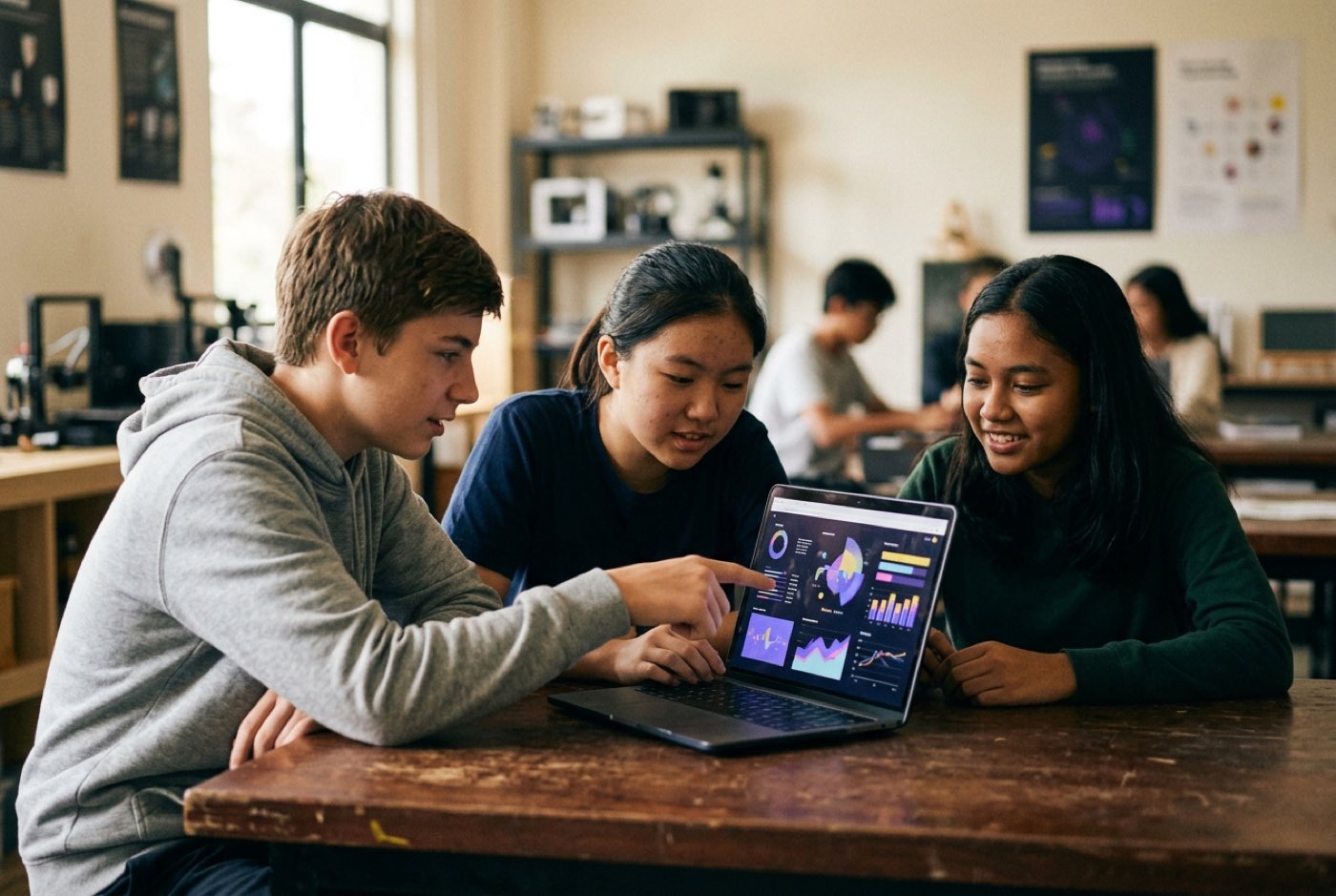
Here is where the two approaches diverge, and why one of them tends to hold a child's interest longer than the other:
| Feature | Theoretical Math Approach | Project-First Data Science & AI Approach |
|---|---|---|
| Primary Medium | Textbooks, paper worksheets, printed tables | Interactive coding platforms, Python, AI tools |
| Student Motivation | Solving isolated questions for marks | Building working games, apps, or AI models |
| Handling Mistakes | Red ink marks and lost exam points | Debugging code and retraining models iteratively |
| Data Source | Artificial, simplified numbers | Real-world datasets, live user inputs, sensor feeds |
| Role of Coding | Taught as abstract syntax rules | Bundled free as the natural tool to process data |
| Outcome | Rote procedural memory | Deep computational thinking and creative confidence |
A randomized controlled trial with elementary school students measured the cognitive effects of learn-to-code interventions [8]. Children in the hands-on coding programs showed statistically significant gains in computational thinking scores relative to control groups [8].
To learn more about how logical problem-solving skills transfer across domains, read our article on how coding builds problem-solving skills in kids.
Linking School Math to Real-World Data
Math anxiety comes up in almost every parent consultation we run. The phrasing varies, but the substance is usually the same: my child cannot get through word problems, or my child says they hate math.
Across thousands of trial sessions we keep seeing the same thing. The child is fine. The delivery wasn't. School math tends to introduce the abstraction well before the student has any reason to care about it, and drilling formulas in isolation is a reliable way to lose a ten-year-old.
Data science puts the purpose back in front of the formula:
1. Fractions, Percentages, and Probability
Instead of twenty near-identical percentage exercises, a student builds a game where a character's loot drop rate is governed by a probability formula: Change the denominator in the code, run the game, watch the drops change. At that point probability is not a formula to remember, it is a dial the student is turning on purpose.
2. Coordinate Geometry and Data Plotting
Plotting points on graph paper in school feels arbitrary, because it is. In a project, is time and is a game score or an air quality index. A few lines of Python plot several hundred points at once, and the trend appears on screen.
3. Word Problems and KBAT (Higher-Order Thinking)
Malaysian national exams (KSSR/KSSM) lean hard on KBAT (Kemahiran Berfikir Aras Tinggi) word problems. The usual sticking point is not arithmetic, it is decomposition: students have had little practice turning a dense paragraph into structured logical parts. That is precisely what computational thinking trains, by breaking a large messy problem into small solvable ones.
If your child struggles with school word problems, read our guide on diagnosing KBAT word problem difficulties. For an in-depth comparison between traditional math tuition and applied learning, explore our analysis on math tuition versus learning math by building.
How Kidocode Teaches Data Science and AI
Kidocode is an AI school first. Mathematics and technology are taught through it rather than beside it, with the aim of moving students from using software to making it.
Our curriculum rests on three pillars, with AI framing the other two:
| Pillar | What it covers |
|---|---|
| AI Pillar (sits over both) | Directing AI, AI ethics, machine learning |
| Math Pillar | Math by Build, personal AI tutor for every student |
| Tech Pillar | Coding and the six tech tracks, bundled free |
What those pillars mean in practice:
- AI School First: We do not teach coding as a standalone, manual syntax drill. With modern AI coding assistants, kids reach real text-based programming (like Python) much faster than traditional visual ladders allowed. We teach children how to direct AI models safely and critically, placing AI literacy at the center of their education.
- Math Through Builds: International math standards (IGCSE, Cambridge, Common Core) are delivered through hands-on project builds, which is our answer to math anxiety. Every student gets a personalised AI tutor that follows their actual pace, so nobody is dragged along or held back.
- Coding Bundled Free: Basic coding syntax is public knowledge now. The computational thinking behind the code is the part that still has to be taught, so coding comes bundled free across our learning memberships. Students can work through six tech tracks: Python, Web, Mobile, Game, Electronics, and 3D Modeling.
Kidocode was founded in 2014 in Solaris Mont Kiara and has since taught over 9,500 students across Malaysia. Our founder, computer scientist and AI researcher Hossein Tohidi (known to students and parents as Unclecode), created Crawl4AI, an open-source web-crawling technology with over 12 million downloads that runs inside Fortune 500 AI pipelines.
Students attend at our flagship centres in Kuala Lumpur (Solaris Mont Kiara, Sunway Nexis PJ), our Penang campuses (Q2 Waterfront Bayan Lepas, Vantage Tanjung Tokong, Icon City Bukit Mertajam), or on our live camera-on online platform. Wherever they sit, every session ends with something built and working. Learn more about our overall educational framework on our how we teach page.
Addressing Parent Concerns and Misconceptions
These are the questions that come up most often in trial sessions, along with our honest answers.
"Is my child too young? Should we wait until secondary school?"
Age is rarely the limiting factor; teaching method is. If a child can play an interactive game on a tablet, they can start understanding how that game stores scores and applies rules. Starting early also means the logical habits get laid down before exam anxiety attaches itself to anything numerical.
"Will AI make learning coding and data science obsolete?"
AI amplifies thinking rather than replacing it. An assistant can produce code in seconds, but it still needs someone to define the problem, direct the work, and check the data behind the answer. That direction and verification is the literacy the current economy actually rewards. For guidance on managing AI usage at home, read our recommendations on what parents should do when kids use ChatGPT for homework.
"My child already has a heavy school workload. Will this add stress?"
Sessions are designed to displace passive screen time, not to pile on homework. The hours that would otherwise go to scrolling or playing get spent building games, training models, and working through math. Parents regularly tell us that focus and academic confidence improve across other subjects as a side effect.
"Is this self-learning, or are there real trainers involved?"
Every Kidocode student works with live, trained instructors in small groups, backed by AI tutoring platforms that track progress line by line. Trainers mentor individually, walking students through difficult logic while leaving room for them to solve things themselves.
A 4-Step Home Framework for Families
None of this requires a computer science degree from you. Four things you can start this weekend:
- Step 1: Turn Daily Questions into Data Discussions When your child makes a statement ("This game is too hard" or "Everyone in my class has this toy"), ask them how they could measure that claim. How many levels did you try? How many classmates did you actually survey? Teach them to look for evidence behind assertions.
- Step 2: Explore Real-World Recommendation Engines Sit together and discuss why YouTube, Netflix, or Spotify suggests specific videos or songs. Explain that an algorithm tracks watch history, skip rates, and view times to predict what they might like next. This simple discussion demystifies automated data collection.
- Step 3: Experiment with Visual AI Tools Use free, age-appropriate platforms like Google's Teachable Machine. Spend 15 minutes training a simple image classifier to recognize different household items or hand gestures using your webcam. Your child will visually see how adding more sample photos improves the model's accuracy rate.
- Step 4: Connect Data to Their Favorite Hobbies Whether your child loves football, drawing, or playing Roblox, help them track data related to their passion. Create a simple table tracking player statistics or game build times. Show them that data is simply a tool to enhance what they already love doing.
Printable Data Literacy and AI Thinking Checklist for Families
Use this printable checklist to track practical data literacy milestones at home:
- Level 1 (Awareness): Identified three places where data is collected in daily life (e.g., supermarket loyalty cards, traffic apps, smart watches).
- Level 2 (Categorization): Created a physical or digital table sorting items by at least two distinct properties (e.g., sorting toys by type and material).
- Level 3 (Pattern Spotting): Analyzed a visual chart or graph together and predicted what will happen next based on existing trends.
- Level 4 (AI Dataset Understanding): Demonstrated how training an AI model with bad or incomplete data leads to inaccurate predictions.
Designed, ready to print and sign. We email it to you together with a 5% discount on your next registration.
Frequently Asked Questions
What is data science for kids, in simple terms?
Data science for kids is learning how to collect, organize, analyze, and interpret information to solve real problems. In modern classes, it involves using visual tools, Python code, and AI assistants to train machine learning models, build games, and make data-driven predictions.
What age can a child start learning data science and AI?
Children as young as 5 to 7 years old can start learning foundational concepts like pattern recognition, visual sorting, and logical conditionals through unplugged activities and ScratchJr. By age 8 to 12, kids progress to visual machine learning tools and structured datasets, while teens aged 13 to 18 work with text-based Python code and real AI models.
Does my child need to be advanced in school math to start?
No. In fact, many students who struggle with abstract school math thrive in project-based data science. Seeing math applied directly to game physics, AI training, and data visualization makes mathematical concepts intuitive, often boosting school performance as a natural side effect.
What is the difference between coding and data science?
Coding is the language used to write instructions for computers. Data science is the process of analyzing information to extract insights and train models. At Kidocode, coding is bundled free as the natural tool students use to explore AI, solve math problems, and build projects.
How does Kidocode teach data science and AI to children in Malaysia?
Kidocode offers hands-on, project-based memberships for ages 5 to 18 across five campuses in Kuala Lumpur and Penang, as well as live camera-on online classes. Students build real applications using our three integrated pillars: AI school first, math through builds, and tech tracks with free bundled coding.
How can we try a class before making any commitment?
You can book a hands-on free trial class lasting up to 2 hours at any Kidocode campus (Solaris Mont Kiara, Sunway Nexis PJ, Q2 Waterfront Penang, Icon City BM) or online. Your child will build a real AI, math, or tech project during the session, and both parents are welcome to attend. Register directly on our free trial class page.
References
- Manouchehri, A., & Al Balad, A. A. F. (2026). Data Literacy in K-12 STEM Education: A Systematic Literature Review. Education Sciences, 16(6), 860. https://www.mdpi.com/2227-7102/16/6/860
- Talent Corporation Malaysia Berhad (TalentCorp) / Ministry of Human Resources (KESUMA). (2024). Impact Study on Workforce Transformation Across Key Economic Sectors. https://www.talentcorp.com.my/impact-study/
- Malaysia Digital Economy Corporation (MDEC). (2024). Digital Talent Snapshot Q1 2024. https://www.mdec.my/publications/digital-talent-snapshot-q1-2024
- World Economic Forum. (2025). The Future of Jobs Report 2025. World Economic Forum Publications. https://www.weforum.org/publications/the-future-of-jobs-report-2025/
- National Academies of Sciences, Engineering, and Medicine. (2023). Foundations of Data Science for Students in Grades K–12: Proceedings of a Workshop. Board on Science Education. https://www.nationalacademies.org/publications/26852
- UNESCO. (2022). K-12 AI Curricula: A Mapping of Government-Endorsed AI Curricula. UNESCO Publishing. https://www.unesco.org/en/articles/k-12-ai-curricula-mapping-government-endorsed-ai-curricula
- Sager, M., Miller, S., & Drozda, Z. (2026). Early Childhood Data Literacy and Computational Thinking: A Systematic Literature Review. Journal of Educational Research & Practice, 16(1), 2139. https://scholarworks.waldenu.edu/cgi/viewcontent.cgi?article=2139&context=jerap
- Özcan, M. Ş., Çetinkaya, E., Göksun, T., & Kisbu-Sakarya, Y. (2021). The effects of learning to code on children's computational thinking, fluid intelligence, and spatial reasoning skills. British Journal of Educational Psychology, 91(4), 1200–1220. https://pubmed.ncbi.nlm.nih.gov/34042178/