


Dinner is on the table. You call once, then twice. Your child, halfway through a Roblox round or a Mobile Legends match, asks for five more minutes. Twenty minutes later the device is still in hand, the food is cold, and the volume in the house has gone up.
Somewhere in that argument sits a question most Malaysian parents eventually ask themselves: is this just a hobby my child has fallen hard for, or is it something a doctor would put a name to?
The honest answer is that the gap between the two is wider than most headlines suggest, and knowing which side your child is on changes what you should do next. Below is what the international diagnostic manuals actually require, what Malaysian research has measured, and a practical way to move a gaming-obsessed child from playing games to building them.
Key Takeaways
| Topic | Core Insight | Action for Parents |
|---|---|---|
| Clinical Definition | True gaming disorder requires severe functional impairment over 12 months, not just long hours playing. | Look for functional loss (grades, sleep, relationships), not just screen hours. |
| Malaysian Context | Malaysian children spend an average of 3 to 4 hours daily on screens, but true addiction affects a minority (3.5%). | Set clear boundary structures without jumping straight to panic or outright bans. |
| The Reframe | Screen time is not the enemy; passive screen time is. Gaming interest shows high problem-solving potential. | Shift your child's role from a consumer who plays games to a creator who builds them. |
| The Bridge | Coding, math, and AI tools use the exact same logic loops that make games engaging. | Introduce tools like Scratch, Roblox Studio, or Python to channel gaming drive into creation. |
Table of Contents
- Understanding Gaming Disorder: What the Diagnostic Criteria Say
- Gaming Reality in Malaysia: What the Data Shows
- Why Games Hook Young Brains: Mechanics vs Addiction
- High Passion vs Behavioral Addiction: A Comparison
- The Screen Time Reframe: Build Games, Do Not Just Play Games
- How Computational Thinking Turns Gaming into Skills
- Age-Appropriate Strategies for Malaysian Families
- Printable Screen Time to Creator Agreement
- How Kidocode Helps Redirect Gaming Energy
- Frequently Asked Questions
- References
Understanding Gaming Disorder: What the Diagnostic Criteria Say
Hours played is the number parents count. It is not the number clinicians count. The diagnostic manuals care about whether a child can stop, what the gaming is pushing aside, and what it is costing.
The World Health Organization (WHO) included "Gaming Disorder" in the 11th Revision of the International Classification of Diseases (ICD-11) [1]. The WHO defines gaming disorder as a persistent or recurrent gaming behavior characterized by three key markers:
- Impaired control over gaming (such as onset, frequency, intensity, duration, termination, and context).
- Increasing priority given to gaming over other life interests and daily activities.
- Continuation or escalation of gaming despite the occurrence of negative consequences.
A formal ICD-11 diagnosis also requires that the pattern causes significant impairment in personal, family, social, educational, or occupational functioning, and that it has normally been evident for at least 12 months [1]. Twelve months is a long window. A rough school term is not enough.
The American Psychiatric Association (APA) takes a similar line, listing "Internet Gaming Disorder" (IGD) in the DSM-5-TR under conditions for further study [2]. Its proposed threshold is at least five out of nine criteria within a 12-month period, including preoccupation, withdrawal symptoms, tolerance, unsuccessful attempts to control gaming, loss of interest in previous hobbies, continued excessive play despite psychosocial problems, deceiving family members, using gaming to relieve negative moods, and jeopardizing educational or career opportunities [2].
flowchart TD
    A[Observe Child's Gaming] --> B{Functional Loss?}
    B -- No --> C[High Passion or Bad Habit]
    B -- Yes --> D{Lasted 12+ Months?}
    D -- No --> E[Temporary Phase or Stress Response]
    D -- Yes --> F[Potential Clinical Disorder]
    C --> G[Redirect Screen Time to Building]
    E --> G
    F --> H[Seek Clinical Professional Support]
For context, a multi-country study published in the American Journal of Psychiatry estimated that 0.3% to 1.0% of the general population qualifies for a potential diagnosis of IGD [2]. Most heavy-playing children sit well outside that boundary. They are deeply engaged, bored by schoolwork that asks less of them than a raid boss does, or living without clear rules at home.
Gaming Reality in Malaysia: What the Data Shows
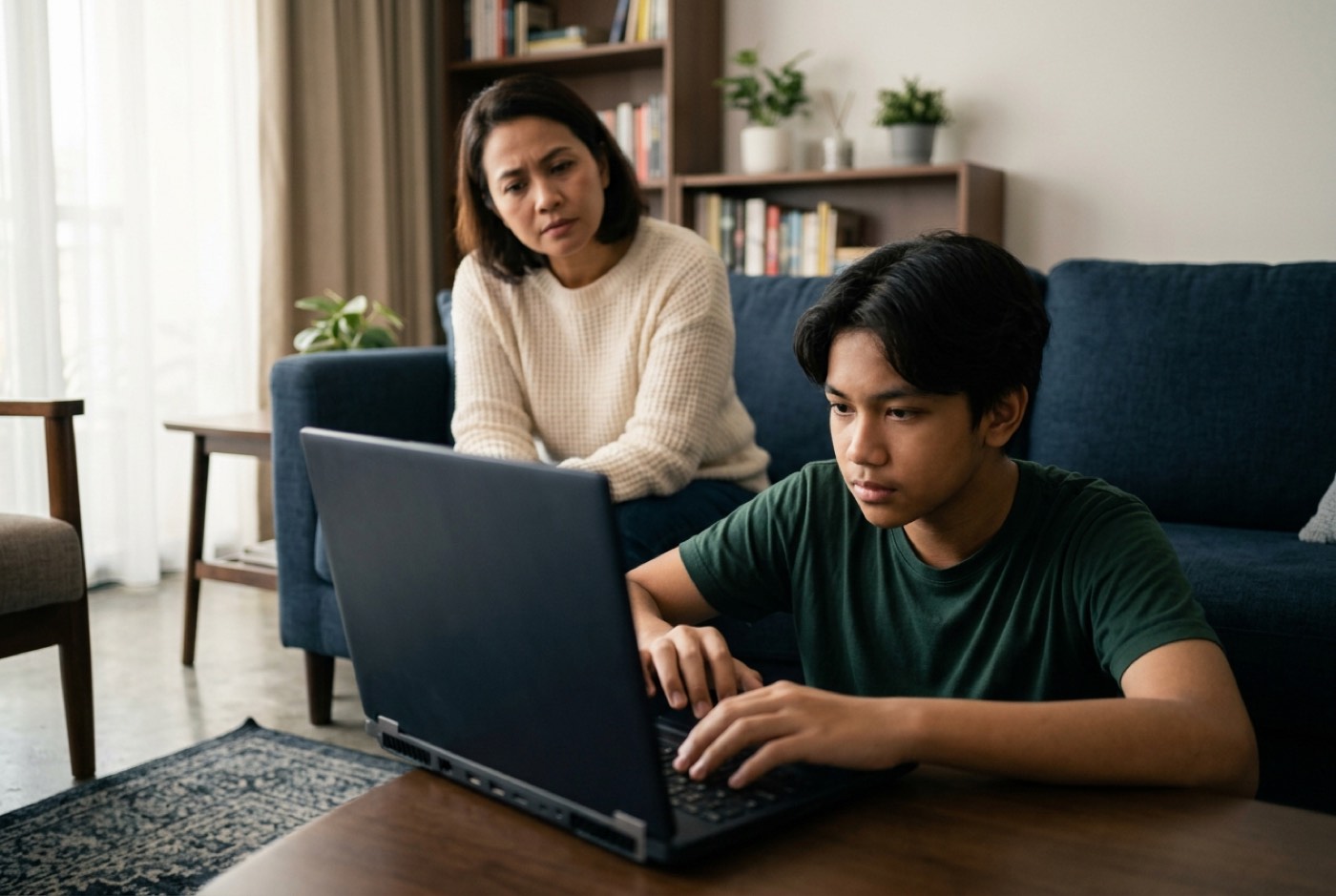
Screen engagement here is high, and nobody disputes that. Research compiled by Gleneagles Hospitals indicates that children in Malaysia aged 2 to 17 spend an average of 3 to 4 hours daily on screens, with smartphones being the primary device [8]. A 2024 Malaysian Communications and Multimedia Commission (MCMC) survey presented in Parliament found that 55.7% of Malaysian children use the internet for 1 to 4 hours per day, and 60.7% of children with internet access own their own device [3].
During parliamentary proceedings in December 2025, statements based on a select committee report highlighted that an estimated 315,000 children in Malaysia live with internet gaming disorder or video game addiction, contributing to social withdrawal and reduced attention spans [3].
Peer-reviewed work on specific Malaysian cohorts fills in the picture:
- Secondary school students nationwide. A study sampling 5,290 secondary school adolescents across seven Malaysian states found an Internet Gaming Disorder (IGD) prevalence of 3.5% [5]. Adolescents who met the IGD criteria were 9 times more likely to experience extremely severe stress levels [5].
- Urban low-income cohorts. A study in the Malaysian Journal of Medicine and Health Sciences surveyed 288 low-income adolescents aged 13 to 17 living in a Kuala Lumpur public housing project (PPR) [4]. Within that sample, 8.7% were classified as addicted to mobile gaming [4]. Older adolescents aged 16 to 17 showed significantly higher odds of addiction than peers aged 13 to 15, and every detected case in the sample was male [4].
- Youth and social anxiety. A study evaluating 377 Malaysian youth confirmed a direct statistical association between mobile game addiction and social interaction anxiety [7].
Read together, the numbers say two things at once. Severe gaming addiction is real and affects a measurable minority of Malaysian children, somewhere between 3.5% and 8.7% depending on the group studied. And the far larger group of children clocking 3 to 4 hours a day does not have a mental health disorder. They have unstructured digital habits, which is a parenting problem rather than a clinical one.
Why Games Hook Young Brains: Mechanics vs Addiction
Before you can pull a child out of a passive screen loop, it helps to know what is holding them there. Roblox, Minecraft, Mobile Legends and Fortnite are built on well-documented psychological feedback loops:
- Variable reward schedules. Loot boxes, rare items and random drops arrive unpredictably, which triggers dopamine release in the brain.
- Social connection and peer pressure. Games work as virtual playgrounds. A child logs into Roblox to hang out with classmates, not only to play, so missing a session can feel like missing recess.
- Immediate mastery and feedback. Learning long division or the violin takes weeks before it feels rewarding. In a game, a button press gives instant visual and auditory feedback.
- Low-stakes failure. Failing a school test is public and anxious. Failing a game level costs nothing, and the player restarts instantly.
So when a child plays four hours straight, they are responding to an environment engineered to capture and keep human attention. Cutting off access without offering a substitute removes their social life, their sense of mastery and their entertainment in one move. That is why cold-turkey bans usually end in shouting.
High Passion vs Behavioral Addiction: A Comparison
Most parents struggle to judge whether their child's enthusiasm is healthy. Look back over the past few months and compare what you have actually seen against the table below.
| Aspect | High Passion (Enthusiastic Gamer) | Behavioral Addiction (Clinical Disorder) |
|---|---|---|
| School & Homework | Homework is completed, though sometimes rushed or negotiated. Grades remain stable. | Schoolwork is completely neglected. Falling grades, missing assignments, or school refusal. |
| Emotional Response | Gets annoyed when asked to stop, but turns off the device after a short negotiation. | Outbursts of severe physical or verbal aggression when the device is removed. |
| Social Life | Maintains real-world friendships, talks about games with friends, attends family meals. | Complete social isolation from family and non-gaming friends; refuses to leave the bedroom. |
| Basic Needs & Hygiene | Sleeps, eats, and bathes regularly, even if sleep timing needs enforcement. | Severe disruption to sleep schedules, skipping meals, or neglecting basic personal hygiene. |
| Alternative Interests | Willing to engage in outdoor activities, trips, or family outings if planned in advance. | Total loss of interest in all previously enjoyed non-screen activities and hobbies [2]. |
If your child sits in the left column, there is no medical disorder to treat. What you have is a child pouring a lot of cognitive energy into consuming something rather than making it. That is a redirection problem, and redirection works better than prohibition.
The Screen Time Reframe: Build Games, Do Not Just Play Games
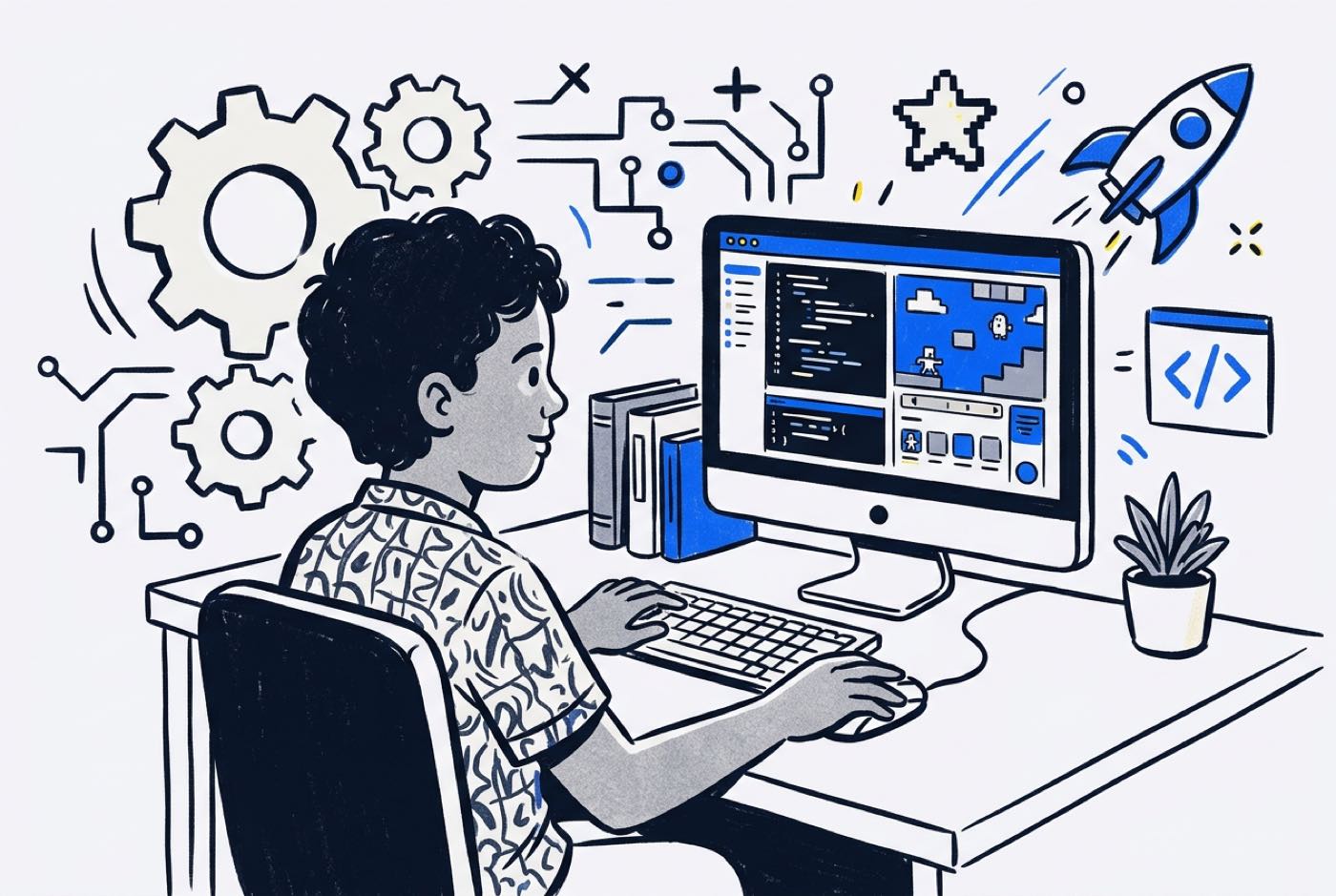
Parents tell us during trial classes at Kidocode that their child spends four hours every Saturday on Roblox, usually bracing for a lecture. We do not tell them to confiscate the tablet. We ask a different question: what if those four hours went into building their own Roblox game instead of playing someone else's?
Our founder, Unclecode (creator of Crawl4AI), set the principle we teach by: the moment a child can play a game on a phone or computer is the moment they are ready to learn how to build one. Screen time is not the enemy here. Passive screen time is.
The cognitive gap between the two activities is large:
- Playing a game. The child follows rules someone else wrote, clicks reactively, and consumes content designed to keep them in a loop.
- Building a game. The child writes the rules, designs the world, programs character physics, calculates collision mechanics, manages variables, and hunts down logic errors.
Move a child from consumer to creator and everything they love about gaming stays on the table, including the visuals, the storytelling and the fast feedback. What changes is what their brain does with the time. Our guide on screen time vs coding time goes deeper into this philosophy.
How Computational Thinking Turns Gaming into Skills
A child who builds a game is not only learning to code. Game development pulls in three learning pillars at once: tech skills, applied mathematics, and artificial intelligence.
1. Technology and Programming
Making a character jump takes more than a mouse click. The child has to write code that listens for a keystroke, adjusts an object's position along an axis, and checks whether the character has landed on a platform.
Children aged 5 to 8 can start with visual block programming like Scratch, where code blocks snap together like puzzle pieces. From there they move to Lua in Roblox Studio, or text-based programming in Python. In our classes, modern AI coding assistants have pulled that transition forward; kids reach real text-based programming faster than the traditional slow ladder suggests. For more on what game platforms actually teach, see our articles on learning from Roblox and Minecraft game creation.
2. Mathematics Through Applied Building
"My child hates math" is one of the most common sentences we hear at trial sessions. The hate usually attaches to worksheets, not to math itself, and it fades once math becomes the thing that makes a game work.
Inside a build, school mathematics turns into game mechanics:
- Geometry and coordinates. Placing a character on screen requires understanding the Cartesian coordinate system .
- Algebra and variables. Health points, score counters and inventory systems all require defining and manipulating algebraic variables.
- Physics and quadratic equations. Making an object fall realistically means applying gravity acceleration formulas, such as calculating vertical movement over time:
Tweak the gravity parameter and the character floats like it is on the Moon or drops like it is on Jupiter. At that point the physics stops being abstract. The child is using math as a tool rather than memorising it for an exam. This is why the approach ends math-hate in 2 to 4 weeks: the teaching method changes completely while the content stays aligned with international standards like Cambridge and IGCSE.
3. Artificial Intelligence Literacy
Game creation now runs on AI tools. Rather than hand-drawing every asset or spending a week writing basic NPC (non-player character) dialogue, young creators can direct AI models to generate graphics, build background scenery, or program smart enemy behaviors.
Directing AI safely and well is the core literacy of this generation. Children who learn to prompt and evaluate these models end up shaping technology instead of being shaped by it, which is a better outcome than either fearing AI or using it to dodge homework.
Age-Appropriate Strategies for Malaysian Families
What works for a six-year-old will backfire with a fifteen-year-old. Guidance from health authorities, including the Penang Institute [6] and American Academy of Pediatrics standards [8], points the same way: structured limits paired with something worth doing instead.
Ages 5 to 8: Establishing Healthy Foundations
Curiosity runs high at this age and concepts land quickly through play.
- Screen limit: guidelines recommend capping recreational screen exposure at a maximum of 1 hour daily for ages 3 to 6 [6].
- Strategy: drag-and-drop block coding tools like Scratch or ScratchJr. Sit with your child and ask them to explain how their code blocks move a sprite across the screen.
- Parental guidance: keep devices in shared family areas such as the living room or dining table, not private bedrooms.
Ages 9 to 12: Transitioning from Consumer to Builder
This is the multiplayer age, when Roblox and Minecraft dominate.
- Screen limit: cap recreational screen time at no more than 2 hours daily [6].
- Strategy: introduce Roblox Studio or Minecraft modding. Challenge your child to modify a level before playing it, and trade every 30 minutes of play for 30 minutes of building or programming.
- Parental guidance: agree in advance that schoolwork is finished before any gaming session starts.
Ages 13 to 18: Professional Skills and AI Directing
Teenagers game to socialise and to decompress. Malaysian data also shows that older adolescents aged 16 to 17 carry elevated vulnerability to excessive mobile gaming habits [4].
- Strategy: point their interest at text-based languages like Python, JavaScript or C#, plus web development and AI project building.
- Focus: connect tech skills to future academic pathways, portfolio work and real applications. Show them how game developers, data scientists and AI engineers build on exactly these foundations.
- Parental guidance: negotiate screen boundaries with your teenager instead of announcing them. Rules they helped write are rules they defend.

Step-by-Step Action Plan for Parents
To reset digital habits at home starting this week:
- Audit screen time without judgment. Spend three days logging when and how your child uses screens. Separate active creation (drawing, coding, building) from passive consumption (watching gameplay videos, endless scrolling).
- Hold a collaborative family discussion. Do not open with accusations. Say plainly that games are fun and that sleep, health and school still need their share of the day.
- Establish a dedicated creation area. Set up a quiet workstation with a computer running age-appropriate creative software such as Scratch, Roblox Studio or Python environments.
- Implement the "build first, play second" rule. Recreational gaming hours are earned by finishing creative coding sessions or school commitments first.
- Formalize the routine. Put it in writing, and have everyone sign it.
Printable Screen Time to Creator Agreement
Print this section, sit down with your child, fill in the blanks together, and stick it up near their desk.
- We balance recreational gaming with physical health, sleep, and schoolwork.
- We shift our time from passive screen consumption to active creation.
- School homework and daily revision are completed before recreational gaming.
- Sleep hygiene: all mobile devices and gaming consoles are turned off and placed in the charging station by _______ PM every night.
Designed, ready to print and sign. We email it to you together with a 5% discount on your next registration.
How Kidocode Helps Redirect Gaming Energy
At Kidocode we do not treat a child's gaming interest as a defect to be stamped out. It is curiosity that has found the nearest available outlet, and outlets can be changed.
Kidocode was founded in 2014 in Solaris Mont Kiara and has taught over 9,500 active students across Malaysia. We run five physical campuses across Klang Valley and Penang (Solaris Mont Kiara, Sunway Nexis in PJ, Q2 Waterfront in Bayan Lepas, Tanjung Tokong, and Icon City in Bukit Mertajam), alongside an equivalent live, camera-on online programme for families across Malaysia and internationally.
Three pillars sit inside a single membership:
- AI to Survive. Children learn to prompt, direct and evaluate AI tools responsibly, with safety and digital literacy from day one.
- Math to Think. We end math-hate in 2 to 4 weeks by swapping repetitive worksheets for project builds, using Cambridge and IGCSE-aligned mathematics to power game physics, logic engines and algorithms.
- Tech to Build. Six software tracks: Python, Web Development, Mobile Apps, Game Development, Electronics, and 3D Modeling. Coding is bundled free in every package, because computational thinking is what we are really teaching.
If your child loves gaming, our trainers walk them through building functional software of their own. They leave each session with a real, working project they designed and coded, rather than a session's worth of someone else's content.
Our how we teach page lays out the project-first methodology in detail, and branches shows which location is nearest to you.
To see how your child responds to building tech rather than playing it, book a free hands-on trial class. It runs up to two hours, costs nothing, comes with no sales pitch, and ends with your child having made something real in AI, math or tech. Both parents are welcome to sit in and watch.
Weekend slots at Solaris Mont Kiara, Sunway Nexis, Bayan Lepas or live online can be booked on our free trial booking page.
Frequently Asked Questions
How do I know if my child is addicted or just really passionate about video games?
Clinical Gaming Disorder involves severe functional impairment lasting at least 12 months, such as complete school failure, severe social withdrawal, or violent outbursts when screens are removed [1]. A child who plays long hours but still finishes schoolwork, sleeps normally and eventually respects a firm boundary is showing passion, not a disorder.
Will taking away all gaming devices solve the problem?
Usually it escalates the fight at home without touching the reason your child was playing in the first place. Games supply social contact, mastery and challenge. Replacing passive play with game creation, visual programming and hands-on tech building addresses the need instead of removing it.
Can learning to code cause the same screen addiction issues?
Coding uses different cognitive pathways than passive gaming. Games run on instant, engineered reward loops built for rapid consumption; programming demands deliberate problem solving, planning, structural thinking and debugging. Kids who code tend to build focus and patience rather than reactive impulse.
My child plays Roblox for 4 hours every weekend. Is this too much?
Malaysian children average 3 to 4 hours daily on screens [8], so four hours of pure passive play is on the high side and worth trimming. It is also convertible. Introduce Roblox Studio, and the time your child spends learning Lua to construct their own environments stops being consumption and becomes learning.
Is my 6-year-old child too young to learn coding instead of playing games?
Not if the teaching matches the child's stage. As our founder Unclecode puts it, the moment a child can play a game on a screen is the moment they can start learning to build one. Children aged 5 to 8 begin with visual drag-and-drop platforms like Scratch and move to text-based code such as Python once their typing and reading catch up.
References
- World Health Organization (WHO). (2020). Addictive behaviours: Gaming disorder. WHO Q&A. Available from: https://www.who.int/news-room/questions-and-answers/item/addictive-behaviours-gaming-disorder
- American Psychiatric Association (APA). (2023). Internet Gaming Disorder. Physician Review by James Sherer, M.D. Available from: https://www.psychiatry.org/patients-families/internet-gaming
- Free Malaysia Today (FMT). (2025). MP warns of mental health crisis among kids due to excessive internet use. Reporting by Minderjeet Kaur on Malaysian Parliamentary Proceedings. Available from: https://www.freemalaysiatoday.com/category/nation/2025/12/02/mp-warns-of-mental-health-crisis-among-kids-due-to-excessive-internet-use
- Mariot, M., Zulkefli, N. A. M., & Fauzi, F. A. (2025). Mobile Gaming Addiction and Its Associated Factors Among Low-Income Adolescents in Kuala Lumpur. Malaysian Journal of Medicine and Health Sciences (MJMHS), 21(1). Data collected March–April 2023. Available from: https://medic.upm.edu.my/upload/dokumen/2025021215480930_MJMHS_0524.pdf
- Mohamed, N. F., Ab Manan, N., Muhammad Firdaus Chan, M. F., Rahmatullah, B., Abd Wahab, R., Baharudin, S. N. A., Govindasamy, P., & Abdulla, K. (2023). Prevalence of Internet Gaming Disorder and its associated factors among secondary school adolescents in Malaysia. Clinical Child Psychology and Psychiatry. Available from: https://pubmed.ncbi.nlm.nih.gov/36927134/
- Penang Institute. (2026). Towards a Healthier Digital Childhood: Guidelines on Screen Use for Children. Policy Paper by Dr. Beh May Ting. Available from: https://penanginstitute.org/publications/issues/towards-a-healthier-digital-childhood-guidelines-on-screen-use-for-children/
- Masrek, M. N., Ahmed, W., Jalil, A., & Baharuddin, M. F. (2022). Mobile Game Addiction and Social Interaction Anxiety Among Malaysian Youth. Environment-Behaviour Proceedings Journal. Available from: https://ebpj.e-iph.co.uk/index.php/EBProceedings/article/view/4094
- Gleneagles Hospitals Malaysia. (2024). Children Screen Time Guideline. Health Digest Publication. Available from: https://gleneagles.com.my/health-digest/children-screen-time-guideline