

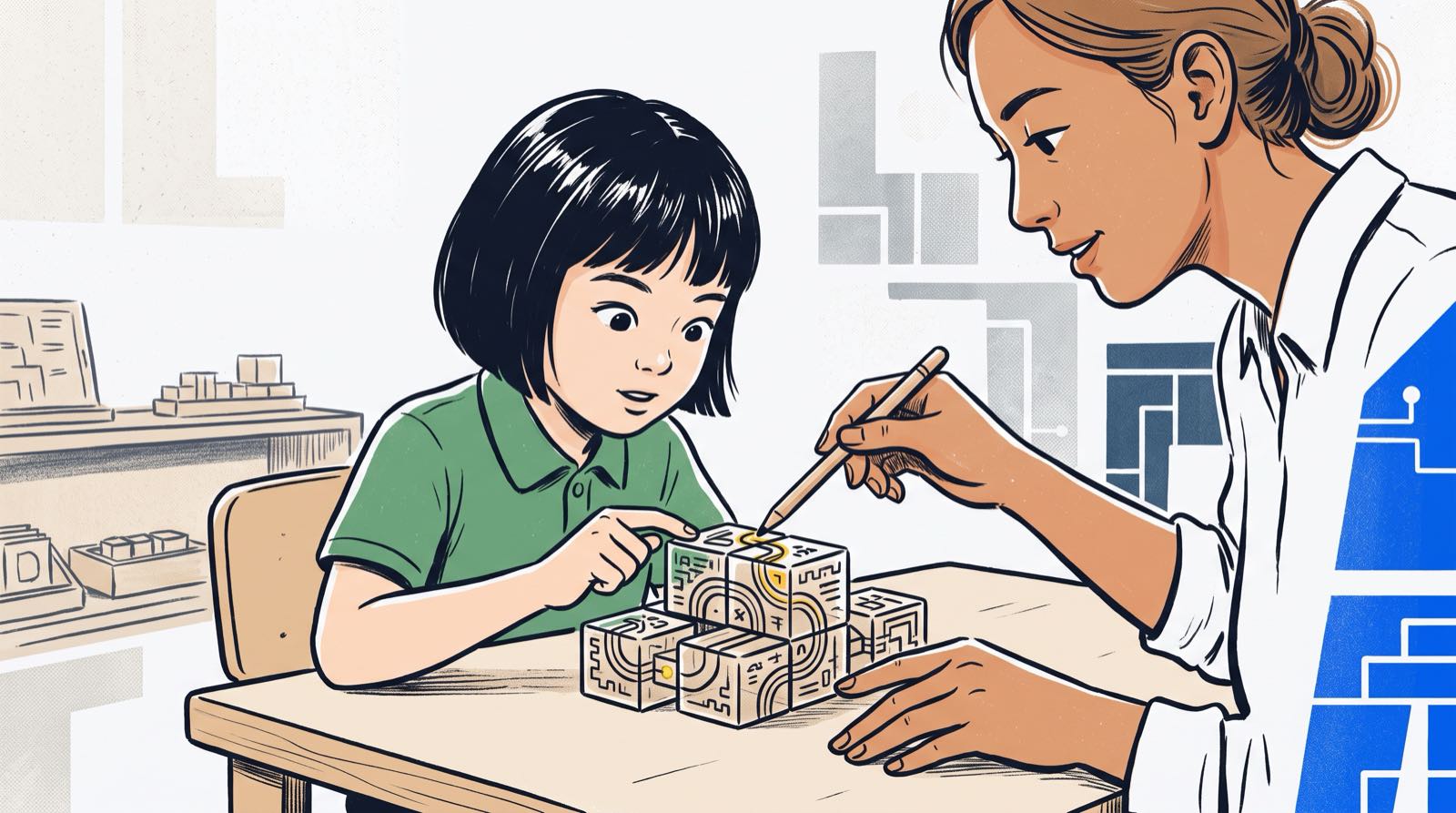
Kids run into the word blockchain everywhere: YouTube, gaming forums, news headlines about currencies that double or halve in a week. So when a child asks what a blockchain actually is, the answer usually turns into confusing financial talk, or worse, into somebody's investment pitch.
Underneath all of that, blockchain is a computer science topic. It combines cryptography, peer-to-peer networking, distributed consensus, and data integrity into one working system, and those are exactly the ideas young people need in order to understand how modern software networks hold together.
At Kidocode, we teach kids aged 5 to 18 to look at technology the way engineers do rather than the way consumers do. Coding itself is bundled free in our membership because syntax has become public knowledge. What we actually teach is computational thinking: how systems communicate, how security works, and how data stays tamper-proof across a distributed network.
This guide walks through how to teach your child the technology behind blockchain, with the speculation left out.
Key Takeaways
| Concept | What Most Kids Hear | The Technical Reality to Teach |
|---|---|---|
| Blockchain | A digital money scheme to make quick wealth | A shared, append-only database stored across multiple computers |
| Decentralisation | An unregulated, mysterious internet network | A system where no single machine or owner can alter history unilaterally |
| Cryptographic Hash | Secret magic codes used by hackers | A one-way mathematical signature that detects any change in data |
| Consensus | Voting for favourite online coins | A strict protocol where independent computers verify transactions |
| Smart Contracts | Automatic legal promises on the internet | Self-executing code rules that run when specific conditions are met |
Table of Contents
- Why Kids Hear About Blockchain (And Why Parents Worry)
- The Real Value: Computational Thinking, Not Financial Speculation
- The Core Technical Concepts Explained for Children
- How to Explain Hashing and Immutability Without Math Jargon
- Teaching Distributed Consensus Through Offline Physical Games
- Age-by-Age Progression: From Paper Games to Real Python Code
- Blockchain vs Traditional Databases: A Decision Framework
- The Role of AI in Accelerating Blockchain Learning
- How We Teach Distributed Systems at Kidocode
- A Step-by-Step Home Plan to Teach Blockchain Principles
- Printable 4-Week Blockchain Literacy Home Checklist
- Frequently Asked Questions
- References
Why Kids Hear About Blockchain (And Why Parents Worry)
Parents have good reason to be wary. Survey data from the OECD International Network on Financial Education found that 41% of adults across 39 surveyed economies were aware of crypto-assets, while digital financial literacy remains low overall: 71% of adults scored below basic literacy thresholds [1]. Only 55% of crypto holders understood that these assets do not have legal tender status [1].
Younger investors are already in the middle of this. Across international markets, 44% of Generation Z investors reported that their very first investment was in crypto-assets [1]. Locally, the activity is growing inside formal frameworks. Fitch Ratings reported that total trading value on Malaysia's regulated digital asset exchanges grew 23% year-on-year to over US$4 billion in 2025, helped along by Sharia compliance rulings from the Securities Commission Shariah Advisory Council covering key assets [2].
 None of those headlines teach distributed systems engineering. What children see instead are influencers promoting quick returns or non-fungible tokens (NFTs). A systematic review of K-12 computing literature found that public exposure to NFTs and digital tokens tends to foreground pump-and-dump schemes and fraud rather than the engineering underneath [3].
Banning the topic rarely works, since the child will keep hearing about it anyway. What does work is moving the whole conversation onto technical ground: cryptography, networks, and logic.
The Real Value: Computational Thinking, Not Financial Speculation
Take away the tokens and trading platforms and a blockchain is a distributed record-keeping system. Teaching how one works builds real skill in computational thinking and systems design.
The research supports this. A three-year empirical study of 704 elementary school students found that gamified, non-speculative blockchain instruction produced statistically significant gains in digital literacy, general literacy, and numeracy [5]. Classroom studies in European primary schools reached a similar conclusion: low-tech physical simulations of distributed ledgers gave children an intuitive grasp of network consensus and data integrity [4].
Four technical ideas come out of learning how distributed ledgers operate:
- Distributed Networks: How multiple independent devices communicate and agree on data without relying on a central server.
- Data Integrity: How cryptographic structures detect missing, modified, or corrupted information.
- Algorithmic Consensus: How machines follow explicit mathematical rules to resolve disagreements automatically.
- Logic and Automation: How self-executing rules (smart contracts) remove the need for manual approval in software systems.
All four carry over into cloud infrastructure, cybersecurity, backend software design, and database architecture.
The Core Technical Concepts Explained for Children
Start with concrete analogies, then add the technical vocabulary once the picture is clear.
1. The Shared Notebook (Distributed Ledger)
Picture a classroom where four students (Alice, Bob, Charlie, and Diana) want to record game scores. Rather than handing one teacher the scorebook, every student keeps an identical copy of the notebook on their own desk. When Alice scores a point, she announces it, and all four write the same line at the same time.
Now suppose Charlie quietly changes his score in his own notebook. The other three compare notes, see that Charlie's record disagrees with theirs, and refuse the change. That is a distributed ledger.
2. The Wax Seal (Cryptographic Hash)
Royal letters used to be sealed with hot wax and stamped with a signet ring. Anyone who opened the letter on the way broke the seal, and the recipient could tell.
A cryptographic hash does the same job digitally. It runs a piece of text or data through a mathematical formula and produces a fixed-length fingerprint. Change one letter of the original and the fingerprint comes out completely different.
3. The Chain of Blocks (Blockchain Structure)
A block is a page in our shared notebook, holding a list of verified entries. It becomes a chain because every new page carries the digital wax seal of the previous page at the top.
Alter an old entry on page one and page one's seal breaks. Page two contains page one's seal, so page two breaks too, and so does every page after it. That chain reaction is what makes editing past records obvious to every computer on the network.
How to Explain Hashing and Immutability Without Math Jargon
Cryptography is the part that scares kids off, but you can explain a hash without touching linear algebra. All a child needs to see is the input and the output.
Describe a hash function as a processing box. Words go in the top; a unique string of letters and numbers comes out the bottom.
| Input text | Hash function output |
|---|---|
"Hello World" |
7f83b1657ff1fc53b92dc18148a1d65d |
"hello World" |
5742a00c62c2f01201d1610419346f2a |
The only difference between those two inputs is a lowercase "h" instead of a capital one, and yet the outputs share nothing. Computer scientists call this the avalanche effect.
A Quick Hands-on Fingerprint Exercise
You can show the same idea at home with word replacement:
- Take a sentence:
"Sam gave 5 apples to Ben." - Assign a simple hash rule: count the total letters and add the position numbers.
- Change the sentence to
"Sam gave 50 apples to Ben."and the hash sum changes with it.
Real systems use secure algorithms such as SHA-256, which handle this math in a fraction of a second. In our tech track, students write Python functions that take strings of text and output genuine SHA-256 hashes using standard libraries. Watching a 64-character string rearrange itself after a one-character edit does more for a child's understanding of cryptographic security than any definition.
Teaching Distributed Consensus Through Offline Physical Games
Computers reaching consensus are not persuading each other; they are following rules. You can teach that at home with an analogue board game format tested in educational research [4].

The "Classroom Ledger" Game (4 Players)
Roles:
- 3 Ledger Keepers (Nodes): Maintain identical sheets of paper.
- 1 Hacker (Attacker): Tries to introduce a false transaction.
Rules of Play:
- A transaction is called out: "Player A transfers 2 tokens to Player B."
- Each Ledger Keeper writes the transaction down and calculates a simple check number (for example, summing the digits of the amounts).
- The Ledger Keepers show their slips of paper to each other.
- Consensus Rule: If at least 2 out of 3 sheets match exactly, the entry is approved and written permanently.
- The Hacker secretly hands one Ledger Keeper a slip that says "Player A transfers 50 tokens to Hacker."
- The Ledger Keepers compare notes. The two honest keepers see that the third slip differs from theirs. They reject the false slip.
Ten minutes of this teaches Proof of Authority and majority consensus with no computer in the room. Children come away understanding that the security comes from agreement across the network and from arithmetic, not from trusting one person in charge.
Age-by-Age Progression: From Paper Games to Real Python Code
Different ages need different levels of abstraction, so we build the concepts up gradually: tactile rules for the youngest children, real text-based code for teenagers.
title Blockchain Concept Progression by Age Group
    Ages 5 to 7 : Physical blocks and shared storybooks : Tactile understanding of sequential records
    Ages 8 to 11 : Block-based logic and physical hash games : Understanding ledgers and verification
    Ages 12 to 14 : Python data structures and hashing libraries : Coding a local blockchain from scratch
    Ages 15 to 18 : Peer-to-peer networking and smart contracts : Building distributed apps and web APIs
Ages 5–7: Visual and Tactile Foundations
Code syntax can wait. What matters here is sequence and shared rules.
- Activity: Building a physical block tower where each plastic brick has a colour pattern matching the brick below it.
- Lesson: You cannot remove a middle brick without collapsing everything above it.
- Tool: Unplugged physical games, storyboards, and ScratchJr sequence puzzles.
Ages 8–11: Conceptual Mechanics and Logic
Primary school children can handle hashes, ledgers, and the basics of network communication.
- Activity: Playing the Classroom Ledger game described above, followed by block-based simulations.
- Lesson: Data corruption detection and majority voting protocols.
- Tool: Scratch, Roblox logic scripts, and physical card-matching games. Our guide on learning blockchain for kids goes deeper into this age bracket.
Ages 12–14: Text Coding and Data Structures
Secondary school students can build a working blockchain in real text code.
- Activity: Writing a Python script that creates a
Blockclass containing an index, timestamp, data payload, and previous hash. - Lesson: Understanding arrays, lists, JSON formatting, and hashing functions.
- Tool: Python with standard libraries like
hashlibandjson.
Ages 15–18: Distributed Systems and Cryptography
Teens can take on client-server architecture, peer-to-peer networking, and logic automation.
- Activity: Connecting two independent Python scripts over a local network using sockets to synchronise ledgers.
- Lesson: Asynchronous networking, public-private key encryption, and smart contract conditionals.
- Tool: Python, JavaScript, Web Development tools, and local development environments.
Blockchain vs Traditional Databases: A Decision Framework
Knowing when not to use a technology is one of the clearest markers of engineering thinking. Plenty of public projects have failed because their creators reached for a blockchain when an ordinary database would have been faster, cheaper, and easier to maintain.
Give your child criteria to judge with:
| Metric | Traditional Centralised Database | Distributed Blockchain Ledger |
|---|---|---|
| Storage Speed | Milliseconds (Very Fast) | Seconds to minutes (Slower due to consensus) |
| Control | Single admin or central company | Distributed across multiple independent nodes |
| Editing Data | Records can be updated or deleted by admins | Records are append-only; past entries cannot be edited |
| Energy Consumption | Low operational cost | Varies; can be high depending on consensus model |
| Best Use Case | School report cards, library catalogs, online stores | Cross-border tracking, multi-party verification |
Database Selection Decision Tree
This logic flow works well as a discussion prompt with older kids:
flowchart TD
    A[Do you need to store data?] --> B{Multiple parties writing data?}
    B -- No --> C[Use Centralised Database]
    B -- Yes --> D{Do parties trust a central admin?}
    D -- Yes --> C
    D -- No --> E{Do records need to be immutable?}
    E -- No --> C
    E -- Yes --> F[Consider Blockchain Architecture]
Once a teenager can follow that tree, blockchain stops looking like a universal answer and starts looking like what it is: a specific tool with specific trade-offs.
The Role of AI in Accelerating Blockchain Learning
Learning distributed computing used to mean years of syntax memorisation first. Before you could build a simple working node, you had to get through low-level memory management or fiddly network code.
That barrier has largely gone. With an AI coding assistant, a 13-year-old can work on system design and logic while the assistant writes the boilerplate.
Student prompt: "Help me write a Python class for a block that calculates its own SHA-256 hash using the previous block's hash."
The assistant produces the syntax. The student reads the structure, tampers with the data to see what breaks, and adjusts the logic from there.
As we argue in our analysis of AI literacy vs coding skills, these tools let young learners skip past syntax hurdles and reach advanced computer science concepts years earlier than the traditional ladder allowed. The child is the architect; the AI handles implementation.
How We Teach Distributed Systems at Kidocode
We do not teach token trading or crypto investing at Kidocode. We teach the engineering foundations of software systems, across five physical campuses in Malaysia (Solaris Mont Kiara flagship and Sunway Nexis in KL/Selangor; Q2 Waterfront, Vantage Tanjung Tokong, and Icon City in Penang) and through our live interactive online campus.
Three pillars hold the method together:
- AI School First: Students learn to use AI assistants safely and effectively to write, debug, and understand complex code structures.
- Math Through Builds: We get rid of math-hate by showing children how formulas behave inside real systems. Instead of dry worksheets, students use probability, modular arithmetic, and cryptographic hashes to build secure tools. If your child struggles with school math, our personalised AI math approach rebuilds confidence within weeks by tying math to real projects.
- Tech Tracks Included: Coding is bundled free in every membership package. Students progress through six tracks: Python, Web Development, Mobile Apps, Game Development, Electronics, and 3D Modelling.
Our founder, Hossein Tohidi (Unclecode), is a computer scientist and the creator of Crawl4AI, which has passed 12 million downloads globally. He built the framework around computational thinking, so students leave knowing how systems think, how data moves securely, and how to build software on their own.
A Step-by-Step Home Plan to Teach Blockchain Principles
Four weeks, no paid software, mostly paper and a laptop at the end.
Week 1: Master the Ledger Concept (Offline)
- Spend 30 minutes playing the physical Classroom Ledger game using paper and markers.
- Practice updating four separate paper ledgers simultaneously.
- Introduce a deliberate entry error on one page and ask your child to spot which ledger was tampered with.
Week 2: Explore Cryptographic Hashes (Visual Tools)
- Use a free online SHA-256 visualizer (such as standard browser-based cryptography demo tools).
- Have your child type their name and observe the 64-character hash output.
- Add a single period at the end of their name and watch the entire string change.
- Discuss why this makes secret tampering impossible to hide.
Week 3: Build a Chain of Blocks on Paper
- Create three paper cards labeled Block 1, Block 2, and Block 3.
- Write a short message on Block 1 and calculate a simple numerical checksum (e.g., sum of letters).
- Copy that checksum onto the top line of Block 2 before writing Block 2's message.
- Change a word on Block 1 and trace how it invalidates the numbers on Block 2 and Block 3.
Week 4: Code a Python Hash Script (With AI Assistance)
- Open a basic Python environment (such as Replit or a local Python editor).
- Use an AI assistant to generate a 10-line Python script using the built-in
hashliblibrary. - Have your child modify the input data in the script and run it to see real cryptographic hashes in the terminal output.
Printable 4-Week Blockchain Literacy Home Checklist
Print this and tick items off as your child works through the four weeks.
-
Week 1: Ledger Fundamentals
- Set up 3 identical paper ledgers for a household activity (e.g., tracking game points).
- Run a simulated false entry test to let your child identify corrupted data via majority vote.
- Discuss the difference between a personal diary (centralised) and a shared tally sheet (distributed).
-
Week 2: Cryptographic Hash Exploration
- Open a standard browser SHA-256 text generator tool together.
Designed, ready to print and sign. We email it to you together with a 5% discount on your next registration.
Frequently Asked Questions
Is blockchain learning suitable for primary school children aged 5 to 8?
Yes, provided you teach it through offline physical games and visual analogies. Younger children do not need the cryptographic math; they need the logic of sequential records, shared rules, and tamper-proof building blocks. Research confirms that analogue board games teach primary students decentralisation and consensus effectively [4].
Does my child need to buy or trade cryptocurrency to learn blockchain?
No. Trading has nothing to do with the underlying computer science. At Kidocode we teach blockchain mechanics as distributed systems engineering, cryptographic data structures, and Python programming logic. Financial speculation and token trading are not part of it.
How does blockchain relate to the mathematics taught in Malaysian schools?
It leans on discrete mathematics, modular arithmetic, probability, and logic patterns. School curricula such as KSSR, IGCSE, and SPM often present these as abstract paper formulas, whereas building a data structure shows a child what the math is for. Applied cryptography is one of the easier ways to make that connection.
Will AI make learning blockchain code obsolete?
No. AI writes routine syntax, but somebody still has to design the security model, set the consensus rules, and weigh architectural trade-offs. If anything, an AI assistant helps kids build and test distributed network prototypes faster, since less time disappears into syntax errors.
What equipment does my child need to start learning at home?
For ages 5 to 11, paper, markers, and building blocks cover it. For ages 12 to 18 working in Python, any standard laptop (Windows, Mac, or Chromebook) with an internet connection will do. Our full guide on choosing a laptop for kids coding and AI has the details.
How can we experience how Kidocode teaches these concepts?
Book a free hands-on trial class at any of our five campuses across KL and Penang (Solaris Mont Kiara, Sunway Nexis PJ, Bayan Lepas, Vantage Tanjung Tokong, Icon City BM) or join through our live online campus. The session runs up to 2 hours, your child builds a real project in AI, math, or coding, and both parents are welcome to sit in and watch how we teach. Visit our free trial class page to reserve a weekend slot.
References
- OECD, Improving the Digital Financial Literacy of Crypto-Asset Users (2025)
- The Star, Malaysia Among More Open Islamic Markets for Crypto, Fitch Says (2026)
- MDPI Informatics, Blockchain Technology in K-12 Education: A Systematic Literature Review (2024)
- CEUR Workshop Proceedings, Teaching Blockchain Principles to Primary School Students Through an Analogue Game (2023)
- MDPI Sustainability, Development and Application of Gamified Blockchain Educational Program for Elementary Students (2022)
- Journal of Contemporary Management Studies, Factors Influencing Cryptocurrency Investment Intention Among University Students (2025)
- International Journal of Academic Multidisciplinary Research, Cryptocurrency Usage and Financial Literacy Among Senior High School Students (2022)