


Parents in Malaysia ask us this question almost every week. Their teenager already lives on TikTok, Instagram, and YouTube, so why not turn those hours into something useful? A digital marketing course looks like the obvious bridge: same platforms, same feeds, except now the child learns how businesses use them. A career skill, a side business, maybe an edge in a university application.
Then you read the syllabus. Most short marketing courses built for teenagers cover the same ground: operate a scheduling tool, write captions that get engagement, design a graphic from a template. The activities are creative and the students enjoy them. What is missing is everything underneath, such as web architecture, software code, data analytics, and artificial intelligence. A teenager who finishes one of these courses can promote a product. They still cannot build one, fix one, or understand why one performs better than another.
This guide looks at what the research actually says about teenagers and digital skills, where marketing training fits into a child's learning path, and why the technical foundation has to come first.
Key Takeaways
| Topic | Key Finding or Recommendation |
|---|---|
| Surface vs Technical Skills | Standalone marketing courses often teach tool usage, whereas long-term value comes from understanding underlying code, web architecture, and data. |
| Passive vs Active Literacy | Managing a social media account is not the same as technical literacy. True digital agency requires building digital products, not just publishing content. |
| The Role of Math & AI | Modern marketing relies on data analytics, probability, and generative AI. Understanding these underlying mechanics is essential for meaningful campaign management. |
| Parent Strategy | Focus on building core technical and computational skills first (web development, Python, AI literacy), then apply marketing concepts to real student projects. |
Table of Contents
- The Attraction and Reality of Digital Marketing for Teens
- Passive Media Use vs Digital Literacy: What Research Reveals
- Why Marketing Alone Is Not Enough: The Technical Foundation
- The Hidden Engine: Math and AI in Modern Digital Marketing
- Comparing Learning Paths: Standalone Marketing vs Integrated Tech
- When Does Marketing Training Make Sense for Your Child?
- The Kidocode Approach: Building Products Before Marketing Them
- Action Plan for Parents: How to Evaluate Your Teenager's Next Step
- Printable Digital Product & Marketing Readiness Checklist
- Frequently Asked Questions
- References
The Attraction and Reality of Digital Marketing for Teens
The appeal is real. Teenagers grew up inside these channels, so marketing feels like home turf in a way that a page of syntax does not. Computer science makes most beginners wait weeks before anything interesting happens on screen. Marketing pays out the same afternoon: publish a post, upload a video, launch a page, watch the numbers move.
Professional digital marketing, as practised by people who do it for a living, covers several distinct disciplines:
- Search Engine Optimisation (SEO): Structuring web pages and content so search engines can index and rank them.
- Content Strategy: Writing, designing, and editing media tailored to specific audiences.
- Digital Advertising: Managing campaigns across search engines and social platforms.
- Email Marketing & CRM: Building direct communications with subscribers and managing customer workflows.
- Marketing Analytics: Measuring user behaviour, conversion rates, and campaign performance using data.
Courses written for children rarely go near most of that. They compress the whole field into tutorials on visual template tools and post scheduling. The gratification is quick, and the knowledge has a short shelf life. Platform algorithms shift, interfaces get redesigned, and a student whose skill was tied to a particular button in a particular app has to start again.

Passive Media Use vs Digital Literacy: What Research Reveals
Screen hours do not convert into understanding. Parents often assume they do, because a teenager who navigates six apps fluently looks like someone who knows how the digital economy works. The research says otherwise.
The ySKILLS systematic evidence review from the London School of Economics and Political Science analyzed 110 quantitative studies covering adolescents aged 12 to 17 [1]. Its central distinction is between operational device skills and informational or critical digital skills. Teenagers with high operational skills who spent more time online were exposed to greater risk, and that exposure came with no matching gain in their understanding of how platforms actually operate [1]. Information and critical skills showed the opposite pattern, linked consistently to positive educational outcomes [1].
UNICEF's figures sharpen the point. Among adult search engine users, 43% cannot correctly identify a sponsored search result. An audit of 1,494 children's websites and mobile apps found 67% collecting personal information and 50% passing that data to third parties [2]. Children sit on the receiving end of commercial algorithms far more often than they sit at the controls.
Malaysian policy is moving in the same direction. Policy reviews note that from 2026, teenagers under 16 will be prohibited from opening standalone social media accounts, a measure aimed at screen dependency and mental health risks [3]. Signing a young teenager up for a course whose main activity is posting on public social platforms now runs against the grain of national guidance, on top of pulling time away from technical foundations.
Why Marketing Alone Is Not Enough: The Technical Foundation
A teenager who learns marketing without learning how software and websites are built hits a ceiling quickly. Every idea they have has to be routed through somebody else's commercial tool. Want to change how a page behaves, repair a broken layout, or hook a custom database into a form? That is where the ceiling is.
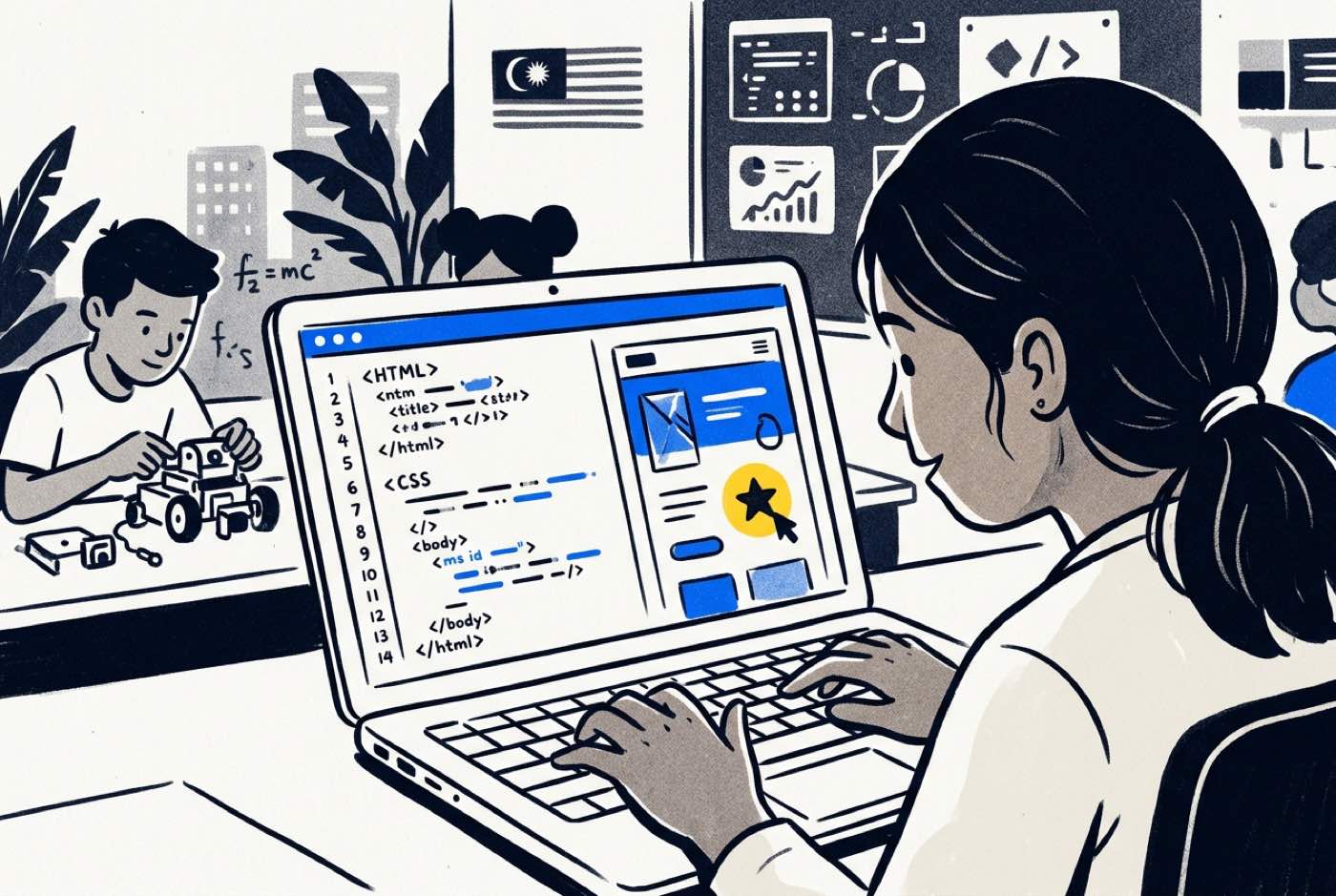
The picture changes when the technical layer comes first. A student who knows HTML, CSS, and the basics of web development is not only writing content for a page; they can see the semantic structure holding it together, why it loads in two seconds instead of nine, and how a search engine crawler reads the markup. Our guide on website design for kids walks through how children pick up those fundamentals.
The same logic applies to the choice of first track. Building real digital assets beats promoting assets that do not exist yet, which is why the question of web development or app development matters more at the start than any marketing module. Either path gives a student the ability to ship something: an application, an interactive tool, a working platform.
Lead with the building skills. Once a teenager has a functional web app or a finished game sitting on a URL, marketing stops being theory. It turns into the practical problem of getting real people to find and use the thing they made.
The Hidden Engine: Math and AI in Modern Digital Marketing
Creative writing is the visible part of digital marketing. Mathematical algorithms, data analysis, and artificial intelligence run the rest of it. Any teenager who wants to understand digital reach ends up needing the mechanics.
The Role of Mathematics
Judging whether a campaign worked means reading quantitative metrics, which means statistics, percentages, algebra, and probability. Customer Acquisition Cost (CAC) and Return on Ad Spend (ROAS) are financial algebra in everyday clothes:
Tracing how users move through a multi-step funnel is an exercise in probability:
Worksheets full of abstract percentages lose students by page three. Give the same student a live traffic dashboard for a site they built, and the arithmetic suddenly has stakes.
The Role of Artificial Intelligence
Drafting copy, scanning market trends, generating visual assets, laying out a campaign timeline: work that filled days now takes minutes with generative AI tools. That has reshaped what a marketing job even looks like.
Teach a teenager only the manual tactics and those skills may be stale before they sit their final secondary school exams. Teach them how to direct AI models responsibly and the role changes from content producer to system orchestrator, with prompt engineering, data validation, and automated workflow design as the working skills.
Comparing Learning Paths: Standalone Marketing vs Integrated Tech
To help you decide which educational path best serves your child, the table below compares a standalone introductory digital marketing course with an integrated tech, AI, and math framework.
| Feature / Dimension | Standalone Digital Marketing Course | Integrated Tech, AI & Math Path |
|---|---|---|
| Primary Focus | Operating social media platforms, writing copy, visual design templates. | Building web applications, writing code, analyzing data, directing AI tools. |
| Underlying Skill | Tool-specific operations and content posting. | Computational thinking, structural logic, and problem-solving. |
| Durability of Knowledge | Medium to Low (vulnerable to platform policy and algorithm updates). | High (core programming, mathematical, and AI principles endure). |
| Product Capability | Promotes products built by others. | Builds original software, websites, and applications, then markets them. |
| Math & Data Integration | Basic surface metrics (likes, views, follower counts). | Statistical analysis, conversion probability, financial algebra, and ROI metrics. |
| AI Preparedness | Uses basic public templates. | Learns AI prompt construction, automated workflows, and data ethics. |
| Long-Term Career Value | Entry-level content roles. | Software engineering, data science, tech entrepreneurship, and product management. |
When Does Marketing Training Make Sense for Your Child?
None of this makes marketing useless for teenagers. Timing and context decide whether it lands.
Ages 5 to 8: Exploratory Building
Formal marketing concepts have no place here. Children this age should be working on logic, spatial reasoning, and creative play through block-based coding and basic problem-solving.
Ages 9 to 12: Product Creation Over Promotion
Primary school children get the most out of computational thinking, basic web structures, and game logic. When they start wanting to show their projects to other people, that is the moment for user experience (UX) design and thinking about an audience, not for commercial advertising.
Ages 13 to 18: Applied Project Launching
For secondary students in IGCSE, SPM, or IB streams, marketing becomes genuinely useful once it is attached to entrepreneurial projects. A study published by RSIS International surveyed 1,440 young enterprise owners and found 91% using video marketing and 88% relying on structured content marketing to build their enterprises [5].
A teenager who has already shipped an app, written a Python script, or built an e-commerce site can use SEO, analytics, and targeted communication to push that work into the world. MDEC's national workforce data shows digital skills in high demand across both tech and non-tech industries, with data-driven roles leading the growth [4].
flowchart TD
    A[Is your child interested in digital media?] --> B{Has your child built a digital product?}
    B -- No --> C[Start with Tech & Web Building]
    B -- Yes --> D{Does your child understand data & AI?}
    C --> E[Learn HTML/CSS, Python & AI Literacy]
    D -- No --> F[Add Data Analytics & AI Prompting]
    D -- Yes --> G[Apply Digital Marketing to Real Build]
    E --> D
    F --> G
The Kidocode Approach: Building Products Before Marketing Them
Kidocode is Malaysia's specialist coding and AI school for children aged 5 to 18, and we run coding and marketing as parts of one system rather than separate subjects. Three pillars hold the curriculum together: AI to survive, Math to think, and Tech to build.
Coding comes bundled free with our membership packages. Syntax is public knowledge now, and charging for it makes little sense. The teaching happens around it: computational thinking, structural logic, AI-directed creation.
Rather than putting teenagers to work on someone else's social media account, we run six tech tracks: Python, Web Development, Mobile App Development, Game Development, Electronics, and 3D Modelling.
Take the web development track. A student there writes the code that builds the site, works the math that improves conversion, uses AI tools to generate and refine that code, and applies SEO principles to bring organic traffic in. Marketing is one layer of a stack they own end to end, from first sketch to launch day.
Students join us at our flagship Klang Valley campuses (Solaris Mont Kiara, Sunway Nexis PJ), our Penang centres (Q2 Waterfront Bayan Lepas, Vantage Tanjung Tokong, Icon City Bukit Mertajam), or in live camera-on online sessions. Every one of them leaves with projects they can point to. Since 2014 we have taught 9,500 active students and hold a 4.6-star rating from parents who want builders rather than consumers.
The curriculum comes from our founder, Hossein Tohidi (Unclecode), a computer scientist, AI researcher, and creator of open-source AI frameworks including Crawl4AI. Children here learn to direct AI safely and effectively, with the underlying logic in hand rather than a bag of surface-level tricks.

Action Plan for Parents: How to Evaluate Your Teenager's Next Step
Five checks to run on any digital enrichment course before you pay for it.
- Audit the Course Syllabus: Look at whether the teaching covers foundational technology (code, architecture, data mechanics) or stops at third-party interfaces such as design templates and social scheduling tools.
- Prioritise Building Capability: Aim for at least 70% of your child's class time going into original digital projects (websites, apps, scripts) rather than marketing theory.
- Verify Math and AI Integration: Ask whether the programme includes data analysis, basic statistics, and safe AI tool direction, or treats marketing as a purely aesthetic exercise.
- Evaluate Screen Time Quality: Research from the American Academy of Pediatrics finds educational screen use works best when it is active, structured, and goal-driven [6]. Check that the course pushes creation over consumption.
- Observe a Hands-on Trial Session: Watch your child in a real class before committing to anything long-term. Any provider worth choosing will let you sit in while your child builds something.
Printable Digital Product & Marketing Readiness Checklist
- My child has built at least one functional digital project (a website, simple app, or game).
- My child understands the basic difference between visual front-end interfaces and back-end code.
- My child can explain how search engines find and index information on a web page.
- My child understands basic data metrics like percentages, conversion rates, and user traffic graphs.
Designed, ready to print and sign. We email it to you together with a 5% discount on your next registration.
Frequently Asked Questions
Is a standalone digital marketing course worth the money for a 13-year-old?
Usually not as a first investment. At 13, a teenager gains much more from web development, Python programming, and AI literacy. Once they can build a working website or app, marketing concepts have something to attach to, and learning them at that point pays off properly.
Will learning digital marketing help my teenager get into university?
Admissions officers in STEM, business, and computer science want evidence of problem-solving: technical projects, initiative, things the applicant made. A portfolio with functional web applications, data analysis scripts, or software projects carries far more weight than a certificate from a theoretical social media course.
Can my child learn digital marketing without knowing how to code?
Yes, the basics are learnable without any code. The limitation shows up later, when everything has to run through pre-built platforms and templates. A student who codes can customise layouts, install advanced tracking tags, tune site performance, and automate data collection, which makes them considerably more useful in a digital business.
How does Kidocode incorporate marketing concepts into its classes?
Through the Web Development, Mobile App, and AI tracks, as the work calls for it. When students build web applications or games, trainers take them through interface design, search engine indexing, analytics, and user experience testing. Marketing arrives as the distribution layer for a product the student actually built.
How can we see if our child enjoys building digital products before enrolling?
Book a free hands-on trial class. Sessions run up to two hours, and your child builds a real project in AI, math, or tech with a trainer alongside them. Both parents are welcome to sit in and watch how their child takes to it. Reserve a slot at kidocode.com/trial-class.
References
- Haddon, L., Cino, D., Doyle, M.A., & Livingstone, S. (2020). Children's and young people's digital skills: a systematic evidence review. ySKILLS Deliverable 2.1, London School of Economics and Political Science. https://www.researchgate.net/publication/345763696_Children's_and_young_people's_digital_skills_a_systematic_evidence_review
- Nyst, C. (2019). Discussion Paper: Digital Marketing and Children's Rights. United Nations Children's Fund (UNICEF). https://www.unicef.org/childrightsandbusiness/media/256/file/Discussion-Paper-Digital-Marketing.pdf
- Beh, M.T. (2026). Towards a Healthier Digital Childhood: Guidelines on Screen Use for Children. Penang Institute ISSUES Report. https://penanginstitute.org/publications/issues/towards-a-healthier-digital-childhood-guidelines-on-screen-use-for-children/
- Malaysia Digital Economy Corporation (MDEC). (2024). Digital Talent Snapshot Q3 2024. MDEC Publications. https://www.mdec.my/publications/digital-talent-snapshot-q3-2024
- Ann, J., Paul, E.T., Anuli, N., Obinna, O.G., Comfort, O.I., & Okoro, M.O. (2025). Leveraging on Social Media and Digital Marketing to Enhance Youth Entrepreneurship Success. International Journal of Research and Innovation in Social Science (IJRISS), RSIS International. https://rsisinternational.org/journals/ijriss/articles/leveraging-on-social-media-and-digital-marketing-to-enhance-youth-entrepreneurship-success/
- Munzer, T., Parga-Belinkie, J., Milkovich, L.M., Tomopoulos, S., Ajumobi, T., Cross, C., Gerwin, R., & Madigan, S. (2026). Digital Ecosystems, Children, and Adolescents: Policy Statement. Pediatrics, American Academy of Pediatrics, 157(2), e2025075320. https://publications.aap.org/pediatrics/article/157/2/e2025075320/206129/Digital-Ecosystems-Children-and-Adolescents-Policy
- Manap, N.A. (2024). Good Practices in STEM Education: Malaysia Report. World Intellectual Property Organization (WIPO) & Universiti Kebangsaan Malaysia (UKM). https://dacatalogue.wipo.int/projectfiles/DA_1_3_10_19_30_01/Malaysia_Report%202/EN/MALAYSIA_Report%202_GoodPracticesin%20STEM%20Education_English.pdf
- Rao, G.S., Triveni, S., & Santosh, S. (2025). Digital Marketing Dynamics and Youth Consumer Behavior. International Journal For Multidisciplinary Research (IJFMR). https://www.ijfmr.com/research-paper.php?id=57925