

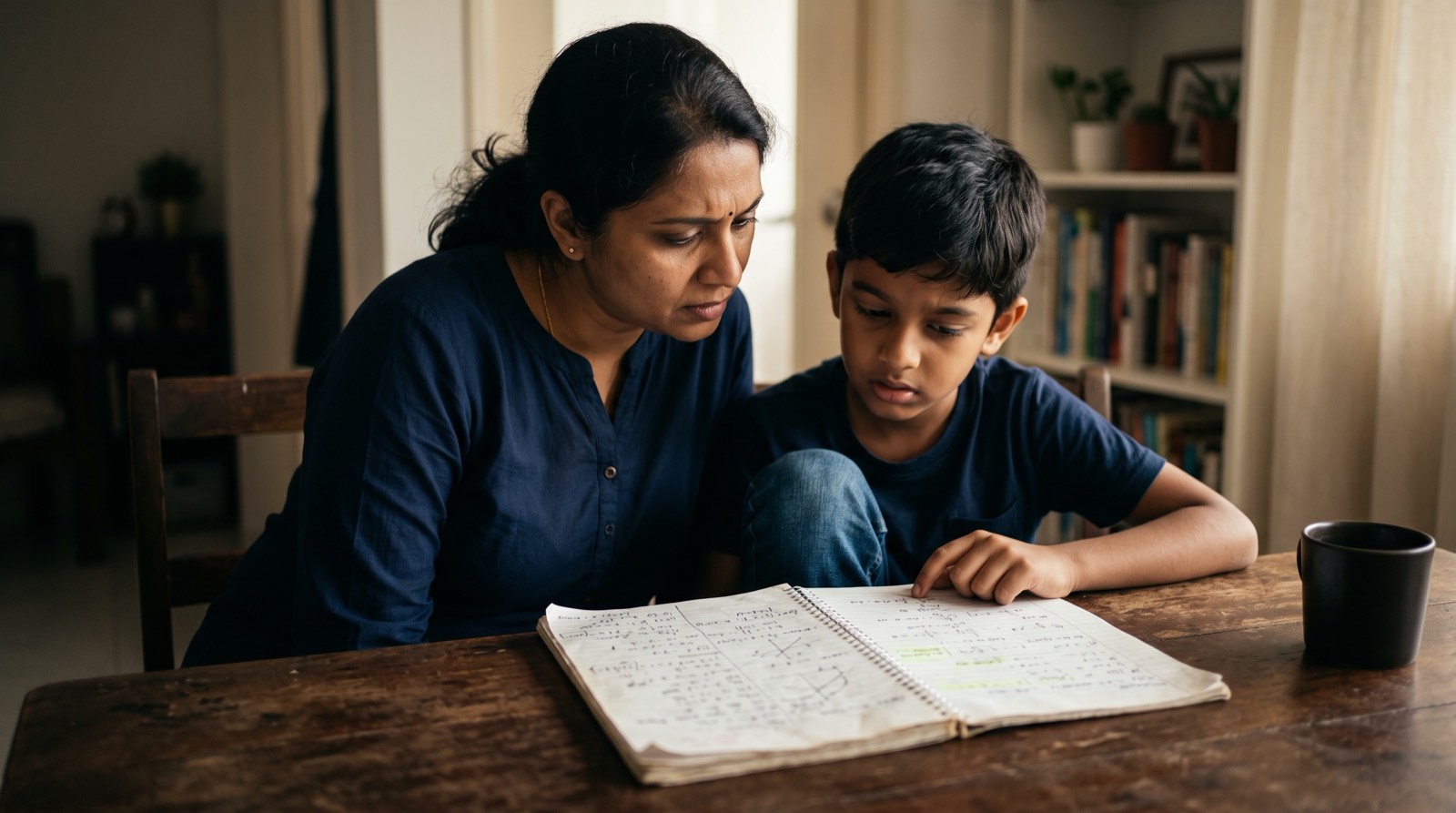
A 90 percent on a topical test buys a lot of peace of mind. The marks say the tuition is working, the child is fine, nothing needs fixing. And then, most weeks of the year, a parent sits across from me at our Solaris Mont Kiara campus or joins a live online session with the same story: straight As in Year 4 and Year 5, then a wall. Year 6 KBAT questions. Form 1 algebra. IGCSE Physics.
The child did not lose ability over a school holiday. Memorisation simply ran out of road.
A student can survive years of school mathematics by memorising steps: matching patterns on paper, running procedures nobody explained, laying out the working the way markers expect to see it. Change the format a little, or ask for two ideas at once, and the whole structure comes down.
Below are seven signs that memory, not understanding, is doing the work. You will also find three two-minute diagnostics you can run at home tonight without printing anything, an explanation of why exam formats quietly reward rote learning, and steps for turning fragile procedure into something that lasts.
Key Takeaways
| Indicator | Memorisation Strategy | Deep Conceptual Understanding |
|---|---|---|
| New Question Formatting | Panics or freezes when wording changes slightly | Identifies underlying structures regardless of wording |
| Formula Reliance | Needs a formula sheet to start any problem | Can reconstruct or explain the formula from visual logic |
| Estimation & Reasonableness | Accepts impossible answers without questioning | Catches calculation errors instantly by checking magnitude |
| Cross-Topic Connections | Sees algebra, geometry, and graphs as isolated boxes | Connects algebraic equations directly to graphical shapes |
| Retention After Exams | Forgets core concepts two weeks after the exam | Retains core relationships because they form a mental map |
| Reaction to "Why" | Feels defensive or says "because the teacher said so" | Explains the underlying mechanism using concrete examples |
Table of Contents
- The A-Student Who Cannot Explain What She Just Did
- 7 Clear Tells Your Child Is Memorising Math (Not Understanding It)
- 3 Two-Minute Home Tests You Can Run Today (No Worksheets Required)
- Why School Assessments Reward Memorisation Until It Breaks Down
- How International Standards Demand Application Over Recall
- Algorithmic Drills vs Creative Reasoning: What Cognitive Research Shows
- What Real Understanding Looks Like: Using Math to Build
- 5 Real Projects That Force Conceptual Understanding
- What to Do Next This Term: An Actionable Guide by Age Group
- How We Rebuild Math at Kidocode
- Frequently Asked Questions
- References
The A-Student Who Cannot Explain What She Just Did
Take an ordinary primary school question. A ten-year-old has to find the area of a right-angled triangle with a base of and a height of .
She writes the formula:
She substitutes, gets , double-underlines it, collects full marks. On paper, a competent young mathematician.
Then ask her: "Why do we multiply by one half?"
In eleven years of evaluating thousands of students, I have watched over 70 percent of the high scorers on routine tests go blank at that question. The textbook says so. The tuition teacher said divide by two. That is the rule for triangles.
 What they do not see is the rectangle. Any right-angled triangle is exactly half of a rectangle measuring by ; cut the rectangle along the diagonal and there it is. Without that picture, the half is just a symbol somebody inserted into a string of other symbols.
So when the exam hands them a compound shape, a triangle tipped on its side, or a base written as , the string stops working. This has nothing to do with how clever the child is. It has everything to do with an instruction habit that measures how fast a child executes rather than what the child sees.
7 Clear Tells Your Child Is Memorising Math (Not Understanding It)
You will spot most of these during ordinary homework, not during a test. Watch what the child does in the first thirty seconds of a question.
1. Complete Dependence on Formula Sheets and Example Layouts
A child who will not begin until they have found a worked example on the facing page is pattern matching, not thinking. They are hunting for a template to pour numbers into. The question itself has barely been read.
2. Panic When a Word Problem Changes Familiar Phrasing
Malaysian primary worksheets train children on keywords: "leftover" and "difference" mean subtract. Rewrite the same situation without those trigger words and a memorising student stalls, then guesses an operation. The gap shows up most brutally in higher-order thinking skills questions [[blog/child-cant-do-math-word-problems-kbat]].
3. Inability to Estimate or Spot Unreasonable Answers
A park bench that weighs 4,500 kilograms. A bus that crosses Kuala Lumpur in 0.2 seconds. If your child writes those down and moves on to the next question, the calculator in their head has no alarm attached to it. Children who understand numbers feel it when an answer is the wrong size.
4. Severe Resistance to "Why" Questions
Ask why dividing by a fraction is the same as multiplying by its reciprocal. Frustration, a shrug, "that is just how you do it", or genuine defensiveness all point the same direction: procedure without meaning. To that child, maths is a list of arbitrary instructions to be obeyed, and your question sounds like an accusation.
5. Sudden Drop in Performance Two Weeks After Exams
Top marks on a March topical test, a mess on the same topic in the May mid-year. Nothing was forgotten, because nothing was ever stored anywhere but short-term working memory. Understanding builds associations that survive a gap of months.
6. Isolating Topics into Disconnected Compartments
Research on Malaysian secondary students found many who can solve a quadratic equation symbolically yet cannot connect it to a quadratic graph [4]. Algebra in one box, geometry in another, graphs in a third, no doors between them.
7. Frustration When Asked to Solve a Problem in a Second Way
Ask for a drawing, a diagram, counters on the table, a different order of steps. A child who understands will try something. A child holding one memorised algorithm gets anxious, because that path is the only thing standing between them and a blank page.
3 Two-Minute Home Tests You Can Run Today (No Worksheets Required)
None of this needs a teaching background or a printer. Three questions, asked over dinner or in the car, will tell you most of what you want to know.
flowchart TD
    A[Ask child why a step works] --> B{Can child explain reason?}
    B -- Yes --> C[Conceptual Understanding]
    B -- No --> D{Can child solve reworded question?}
    D -- Yes --> E[Partial Understanding]
    D -- No --> F[Algorithmic Memorisation]
Diagnostic 1: The "Change the Units" Test
- The Question: "If a car travels at , how far does it go in 30 minutes?"
- What to Watch For: The memoriser reaches for , frets about converting minutes into hours, and wants paper. The child with a mental model says 30 kilometres almost before you finish the sentence, because half an hour is half of 60.
Diagnostic 2: The "Draw the Equation" Test
- The Question: Write and ask for a picture or a story of it before any solving happens.
- What to Watch For: A memoriser starts shunting terms across the equals sign, flipping into . If two identical mystery boxes and three loose blocks balancing eleven blocks on a scale never appears, the symbols have no physical meaning attached.
Diagnostic 3: The "Explain It to a Younger Sibling" Test
- The Question: Explain what a percentage is to a seven-year-old, without saying "percent" and without the sign.
- What to Watch For: Understanding sounds like cutting a whole thing into 100 equal parts and counting how many you take. Memorisation sounds like a rule: "you put the number over 100 and multiply".
Why School Assessments Reward Memorisation Until It Breaks Down
Traditional assessment hides these gaps rather than exposing them. Grading thousands of scripts consistently requires predictable item types, and predictable item types are exactly what a memoriser thrives on.
Teach to those formats long enough and children start reading pictures instead of problems. Right triangle, two numbers given, apply . Ask why the square built on the hypotenuse holds the same area as the two squares on the other sides, and the recognition trick has nothing to offer.
| Route | What happens in the child's head | Where it lands |
|---|---|---|
| Traditional memorisation | See pattern → recall formula → substitute numbers → calculate result | Fails when wording, context, or visual presentation changes |
| Conceptual understanding | See problem → build mental model → select mathematical tool → verify sanity | Adapts seamlessly to new contexts, KBAT questions, and real-world projects |
Through early primary, where most problems really are procedural, this works well enough. The bill arrives in upper primary and secondary, once higher-order thinking skills (KBAT) carry real marks.
The OECD PISA 2022 results show the scale of it. In Malaysia, 41 percent of 15-year-old students reached Level 2 baseline proficiency in mathematics, against an OECD country average of 69 percent [1]. At the top end, roughly 1 percent of Malaysian students reached Level 5 or Level 6, where the OECD average is 9 percent [8].
A comparison of mathematics performance across ASEAN nations recorded a significant Malaysian score drop in the 2022 cycle, with nearly 60 percent of test-takers falling short of baseline proficiency [3]. Once a test asks for reasoning in an unfamiliar scenario, a stack of memorised formulas simply does not reach.
How International Standards Demand Application Over Recall
KSSR/KSSM, IGCSE, Cambridge, US Common Core: whichever your child sits under, the modern versions ask for application, not recall alone.
International curricula build their assessments around three domains:
- Fluency: Recall of basic facts and execution of standard algorithms.
- Mathematical Reasoning: Explaining, proving, and evaluating mathematical relationships.
- Problem Solving: Applying mathematical tools to unfamiliar contexts and multi-step real-world scenarios.
Memorisation covers part of the first domain and nothing else. That is why IGCSE word problems and Cambridge problem-solving tasks feel so hostile to a child who has been drilled: those questions were designed to find exactly this gap.
| Assessment Framework | Procedural Expectation | Application Expectation |
|---|---|---|
| Primary (Ages 7-10) | Calculate perimeter and area using provided formulas. | Design a garden floorplan meeting fixed area and budget limits. |
| Lower Sec (Ages 11-13) | Solve linear equations like on paper. | Model a mobile phone tariff plan to determine the break-even point. |
| Upper Sec (Ages 14-16) | Factorise quadratic expressions using standard algorithms. | Program quadratic curves for trajectory physics in a video game engine. |
The standard response from traditional tuition is more worksheets [[blog/kumon-abacus-vs-math-by-building-malaysia]]. Doubling the repetitions of a mechanical pattern makes the pattern harder to break, not the concept easier to see.
Algorithmic Drills vs Creative Reasoning: What Cognitive Research Shows
Educational research separates two kinds of practice: Algorithmic Reasoning (AR) and Creative Mathematical Reasoning (CMR).
A controlled study in Frontiers in Psychology put upper secondary students through mathematics practice using either given algorithmic formulas or creative reasoning tasks [2]. In Experiment 1, tested after a one-week delay, the creative reasoning group outscored the algorithmic group on the practised formula tasks (20% vs 8%) and on transfer tasks that required new solution sequences (19% vs 12%) [2].
Constructing the method yourself, it turns out, lays down memory that is still there a week later. Being handed the method does not.
Timed drilling still has its place, in a narrow one. A study of 877 Swedish second graders in the Scandinavian Journal of Educational Research found that short, timed practice improved fluency in basic single-digit addition and subtraction combinations among low and average-achieving students [5].
For parents, the line falls here:
- Basic single-digit facts benefit from automated recall so working memory remains free.
- Multi-step operations, algebra, geometry, and problem-solving require creative reasoning and concrete mental models.
Drilling a child on long multi-step procedures they cannot picture loads working memory to the point of collapse, which is where most maths anxiety starts.
What Real Understanding Looks Like: Using Math to Build
At Kidocode we treat mathematics as a tool for building things rather than a body of rules to hold in your head. The child is rarely the bottleneck. The delivery usually is. Give a concept a job to do inside something the child wants to finish, and the learning stops being passive.
| Approach | Sequence |
|---|---|
| Traditional | Rule memorisation → repetitive drill worksheets → end-of-term examination |
| Kidocode build-based | Interactive project goal → applied mathematical tool → immediate visual feedback |
Inside a project, the topics stop being topics:
- Geometry determines collision boundaries in a game engine.
- Algebra controls character movement and item inventories.
- Trigonometry calculates camera angles and lighting in 3D environments.
- Probability and Statistics shape decision algorithms in artificial intelligence.
Faking it is not an option here. Get the coordinates wrong and the character misses the platform. Get the logic wrong and nothing runs. The screen tells the child immediately, and nobody has to put a red mark on anything.
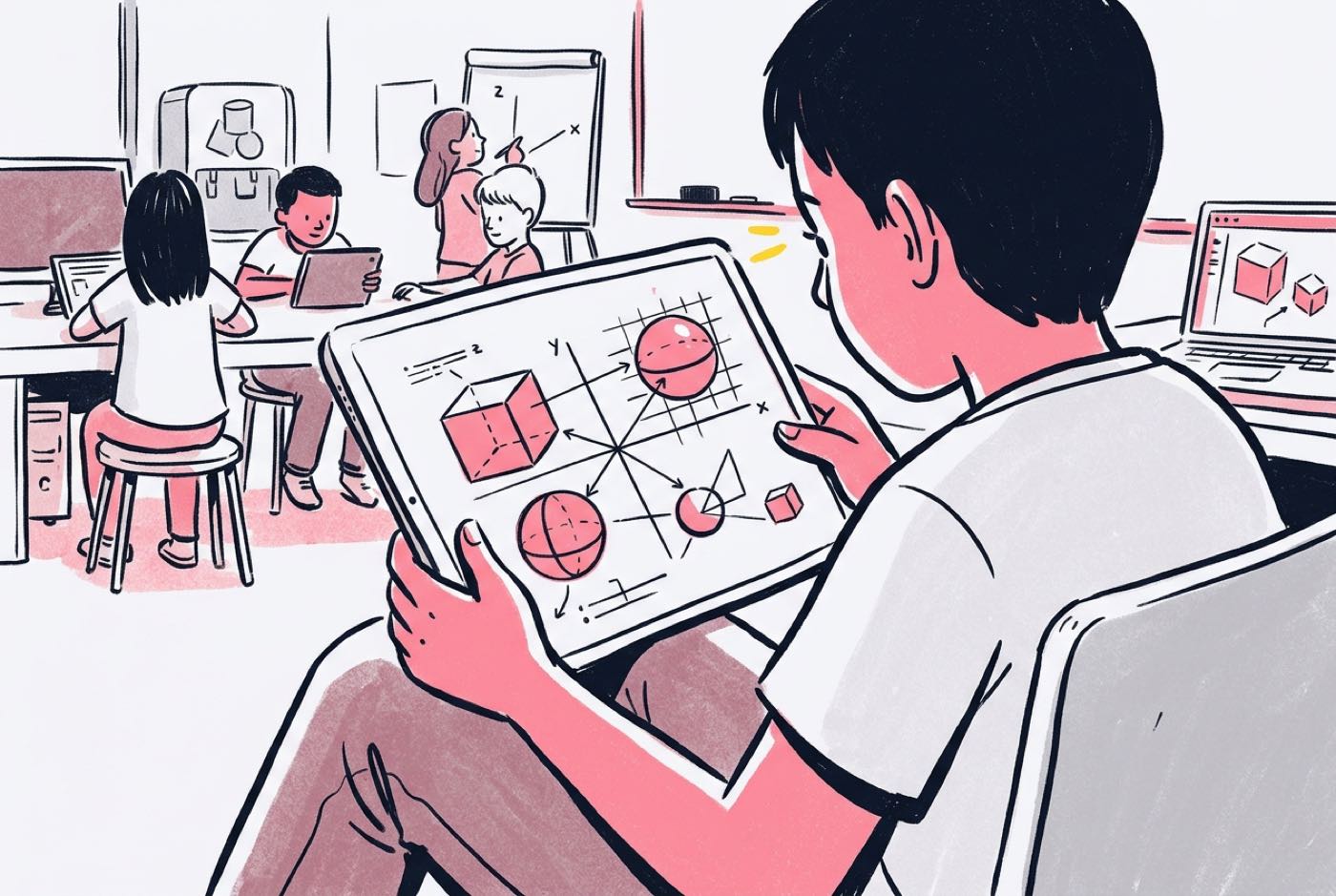 Children who meet mathematics this way tend to stop describing it as the subject they hate.
5 Real Projects That Force Conceptual Understanding
If you want to pull your child off memorisation, give the mathematics a purpose. Five projects that do the job:
Project 1: The Floorplan Architect (Topic: Area, Perimeter, and Scale)
Hand over a tape measure and let your child measure their own bedroom. Convert the measurements at a scale of and draw the floorplan on grid paper. Then set a floor-tiling budget per square metre and ask for the total cost, waste included.
Project 2: The Game Physics Engine (Topic: Angles, Vectors, and Coordinates)
In Scratch or Python [[blog/scratch-vs-python]], challenge your child to make a ball bounce off walls at realistic angles. That requires coordinate geometry ( and position vectors) and reflection rules for direction. Let them tweak speed and gravity and watch algebra turn into something they can see.
# Simple Python snippet showing geometry and vector logic in motion
ball_x = 100
ball_y = 150
velocity_x = 5
velocity_y = -3

# Updating position using displacement vectors
ball_x += velocity_x
ball_y += velocity_y

# Wall collision logic reversing horizontal trajectory
if ball_x >= 800 or ball_x <= 0:
    velocity_x = -velocity_x
Project 3: The Recipe Scaling Engine (Topic: Ratios, Fractions, and Proportions)
Take a recipe written for 4 people and ask for the quantities for 7. Insist on fractions and metric units. Then cook it with whatever numbers they produced, which is a far more memorable form of marking than a red pen.
Project 4: The Game Store Balance Simulator (Topic: Statistics, Probability, and Expected Value)
For the Roblox and Minecraft crowd [[blog/how-minecraft-coding-turns-kids-become-creator]], ask your child to design an in-game reward chest. Drop probabilities for common, rare, and legendary items have to total 100 percent (). Then have them work out expected virtual currency across 100 chest opens, which is expected value wearing a costume.
Project 5: The AI Sentiment Classifier (Topic: Logic Matrices and Probability)
In a beginner AI development environment [[blog/ai-math-tutor-for-kids-malaysia-parent-guide]], students build something that sorts user reviews into positive and negative. Underneath sits keyword frequency counting and probability weighting. Training the model shows them that machine learning runs on arithmetic they already own.
What to Do Next This Term: An Actionable Guide by Age Group
If the signs above look familiar, start where your child actually is.
Ages 5–8: Building Concrete Foundations
- Focus on Visual Manipulatives: Blocks, measuring tapes, and coins on the homework table. Hold back the abstract shortcuts until the physical version is solid.
- Prioritise Spatial Reasoning: Construction toys, spatial puzzles, and block-based coding environments.
- Encourage Spoken Explanations: Ask your child to show you the answer with objects before writing a single digit.
Ages 9–12: Connecting Models to Symbolic Notation
- Introduce Interactive Simulations: Visual tools for fraction equivalence, area preservation, and balanced equations.
- Discuss Word Problems Systematically: Read the problem aloud, highlight the structural information, draw a block diagram. Calculate last.
- Connect Math to Practical Coding: Move into text-based programming such as Python [[blog/python]], where variables, loop counters, and conditional statements put arithmetic and algebra to work.
Ages 13–18: Mastering Functional Relationships and Applications
- Connect Equations to Graphs: Get your child into Desmos or Geogebra, dragging and in and watching the line respond.
- Incorporate AI Assistance Safely: Steer them toward using AI as a tutor rather than an answer machine [[blog/child-using-chatgpt-for-homework-what-parents-should-do]]. A prompt worth teaching them: "Explain why the quadratic formula works using a completing-the-square geometric proof, without giving me final answers."
- Apply Mathematics to Real Projects: Mobile app development, 3D modelling [[blog/5-reasons-kids-should-learn-3d-modelling]], or game mechanics, where the maths is a design tool rather than an exercise.
Printable Math Understanding Diagnostic Checklist
Run through this during a weekly homework session and see how many boxes you can honestly tick.
- 1. Explanation test, Can your child explain why a specific operational step was taken?
- Observation: Explains structural logic without relying on "because the teacher said so".
- 2. Rewording resilience, Can your child solve a word problem when the key phrasing changes?
- Observation: Identifies core mathematical operations without relying on specific trigger words.
- 3. Visual representation, Can your child draw a sketch, diagram, or bar model of the problem?
- Observation: Translates written numbers into a visual layout easily.
- 4. Sanity check and estimation, Does your child estimate an approximate answer before calculating?
- Observation: Catches unrealistic answers independently.
Designed, ready to print and sign. We email it to you together with a 5% discount on your next registration.
How We Rebuild Math at Kidocode
Our position is simple. The child is rarely the problem; the presentation of the subject usually is. We deal with maths anxiety and rote memorisation by putting the mathematics inside projects children want to finish.
| Pillar | Purpose | What it covers |
|---|---|---|
| 1. AI | To survive | Directing AI systems safely, prompt logic, machine learning principles. |
| 2. Math | To think | Syllabus-aligned (IGCSE, Cambridge, Common Core) delivered by building. |
| 3. Tech | To build | Bundled free, Python, Web, Mobile, Games, Electronics, 3D Modelling. |
All three sit inside one membership:
- AI (To Survive): Students learn to guide AI models responsibly, build machine learning tools, and apply algorithmic thinking.
- Math (To Think): We align with international standards (IGCSE, Cambridge, US Common Core). Instead of static drill sheets, students use mathematics to drive graphics, physics engines, and AI algorithms, each child working with a personalised AI tutor that adapts to their pace.
- Tech (To Build): Coding comes bundled at no extra charge. Syntax is common knowledge now; what we teach is computational thinking and creative problem-solving across six tracks (Python, Web, Mobile, Games, Electronics, 3D Modelling).
 We teach across five Malaysian campuses and online:
- Klang Valley: Solaris Mont Kiara (HQ Flagship) and Sunway Nexis (Kota Damansara, Petaling Jaya).
- Penang: Q2 Waterfront (Bayan Lepas), Tanjung Tokong (Vantage), and Icon City (Bukit Mertajam).
- Live Online: A fully live camera-on program, accessible for families worldwide.
The free trial runs two hours. Your child builds something in AI, mathematics, or tech, and both parents are welcome to sit in and watch it happen.
To find out whether your child understands the mathematics or is running on memory, book an evaluation session at your nearest campus or live online at our free trial class page. Our flexible degree path structure is on the pricing page, and the math programme overview explains how the mathematical logic threads through the technology tracks.
Frequently Asked Questions
Is memorisation always bad in mathematics?
No. Single-digit addition tables and multiplication facts up to 10 are worth automating, precisely so working memory is free for the harder thinking [5]. The trouble starts when multi-step algorithms, algebraic manipulation, and geometric proofs get memorised the same way, because complex word problems and advanced topics will not cooperate.
Why does my child score high marks on tuition worksheets but fail school exams?
Tuition worksheets tend to be predictable, and twenty near-identical questions can be cleared by applying one rule twenty times. School examinations and KBAT questions mix topics, change the wording, and stack concepts on top of each other, which is exactly what pattern matching cannot survive.
Can a child who currently hates math recover conceptual understanding?
Yes. Maths anxiety usually grows out of being made to memorise procedures that never made sense, repeated until failure feels inevitable. Shift to visual representations and building projects and children re-engage. In our experience, once a child sees a concept produce a visible result in their own project, the attitude usually turns within two to four weeks.
How does learning to code help my child's math understanding?
Code makes abstract logic visible. Variables hold unknown quantities, loops behave like series, conditionals apply logical operations, and a mistake in the mathematics shows up immediately as a program that misbehaves. That feedback loop teaches what a static drill worksheet cannot [[blog/how-coding-helps-build-problem-solving-skills-in-kids]].
Does Kidocode follow national or international math syllabi?
Kidocode aligns with recognised international mathematics standards, including IGCSE, Cambridge, and US Common Core. We cover the core concepts those curricula require, delivered through practical projects and personalised AI instruction instead of lecture and drill.
References
- OECD, PISA 2022 Country Profile: Malaysia (2023)
- Jonsson, B., Granberg, C., & Lithner, J., Creative Mathematical Reasoning Practice Improves Performance (Frontiers in Psychology, 2020)
- Lim, Y. W., Gabda, D., Pang, N. T. P., & Ho, C. M., Comparative Analysis of PISA Mathematics Scores in ASEAN (Mathematics Teaching Research Journal, 2025)
- Tiew, N. N. A. M. F., Teoh, S. H., Singh, P. S. A. S., Walida, S. E., & Faradiba, S. S., Secondary Students' Understanding of Quadratic Functions and Graphs (Jurnal Pendidikan Sains dan Matematik Malaysia, 2023)
- Östergren, R., Träff, U., Elofsson, J., Hesser, H., & Samuelsson, J., Timed Memorization Practice vs Conceptual Practice in Early Math (Scandinavian Journal of Educational Research, 2024)
- Tajudin, N. M., & Chinnappan, M., The Interplay of Higher Order Thinking Skills and Representations in TIMSS Tasks (International Journal of Instruction, 2016)
- Bossé, M. J., & Bahr, D. L., Conceptual and Procedural Knowledge in Mathematics Education (International Journal of Mathematics Teaching and Learning, 2008)
- OECD, PISA 2022 Results Volume I & II Country Note: Malaysia (2023)