


Parents walk into our campuses in Solaris Mont Kiara, Sunway Nexis, and Penang holding school test papers that contradict themselves. On the calculation pages, their child scores 90% or 100% (, , no problem). Turn to the Kemahiran Berfikir Aras Tinggi (KBAT) higher-order thinking word problems in KSSR, IGCSE, or Cambridge exams and the same child drops to 30% or 40%.
The usual explanations are carelessness, weak reading focus, or plain hatred of maths. But when I go through the scripts, the arithmetic is almost always clean. What the child cannot do is the translation: taking a messy written scenario and turning it into a mathematical model. Nobody taught that step. The kid is fine.
Key Takeaways
| Core Question | Common Misconception | Actual Missing Skill | Actionable Fix |
|---|---|---|---|
| Why does my child freeze on KBAT word problems? | The child is bad at maths or bad at reading comprehension. | Missing the mathematical modelling layer (translating narrative text into structural schemas). | Use a 4-step translation routine (Read & Strip, Name Unknown, Draw Structure, Execute). |
| Why do calculation drills fail to fix KBAT scores? | Practice worksheets with more sums will eventually improve word problem scores. | Standard drills present pre-abstracted numbers with zero distractor information to filter. | Teach schema identification (change, group, compare) instead of numerical drilling. |
| Why do keyword shortcuts fail? | Keywords like "altogether" always mean addition, and "left" always means subtraction. | Keywords break down in multi-step problems and create misleading shortcuts. | Train children to draw structural diagrams of the situation before writing any equation. |
| How does building games fix this failure mode? | Coding is an extra activity unrelated to school maths. | Game building forces children to model logical variables and spatial rules continuously. | Turn screen time into construction where maths operates as the engine of the project. |
Table of Contents
- Why Calculation Drills Fail at KBAT Word Problems
- What a Math Word Problem Really Asks For (The Modelling Layer)
- The Reading-Comprehension Trap: Language vs Math
- The 4-Step At-Home Translation Routine
- Three Worked Malaysian Examples with Parent Scripts
- Traditional Math Tuition vs. Schema-Based Building
- Why Kids Who Build Games Never Freeze on Word Problems
- A 2-Week Home Experiment
- How Kidocode Fixes Math-Hate and KBAT Anxiety
- Printable Word Problem Translation Checklist
- Frequently Asked Questions
- References
Why Calculation Drills Fail at KBAT Word Problems
School worksheets and most practice centres strip calculation away from context. Fifty vertical additions, or a page of multi-digit multiplications. The mental task is procedural: apply the algorithm, carry the tens, write the answer.
A KBAT question asks for something else entirely before any arithmetic starts. The child has to read a story, pull out the facts that matter, throw away the ones that don't, work out how the quantities relate, and only then write an equation. That is where the marks are lost, not at the multiplication.
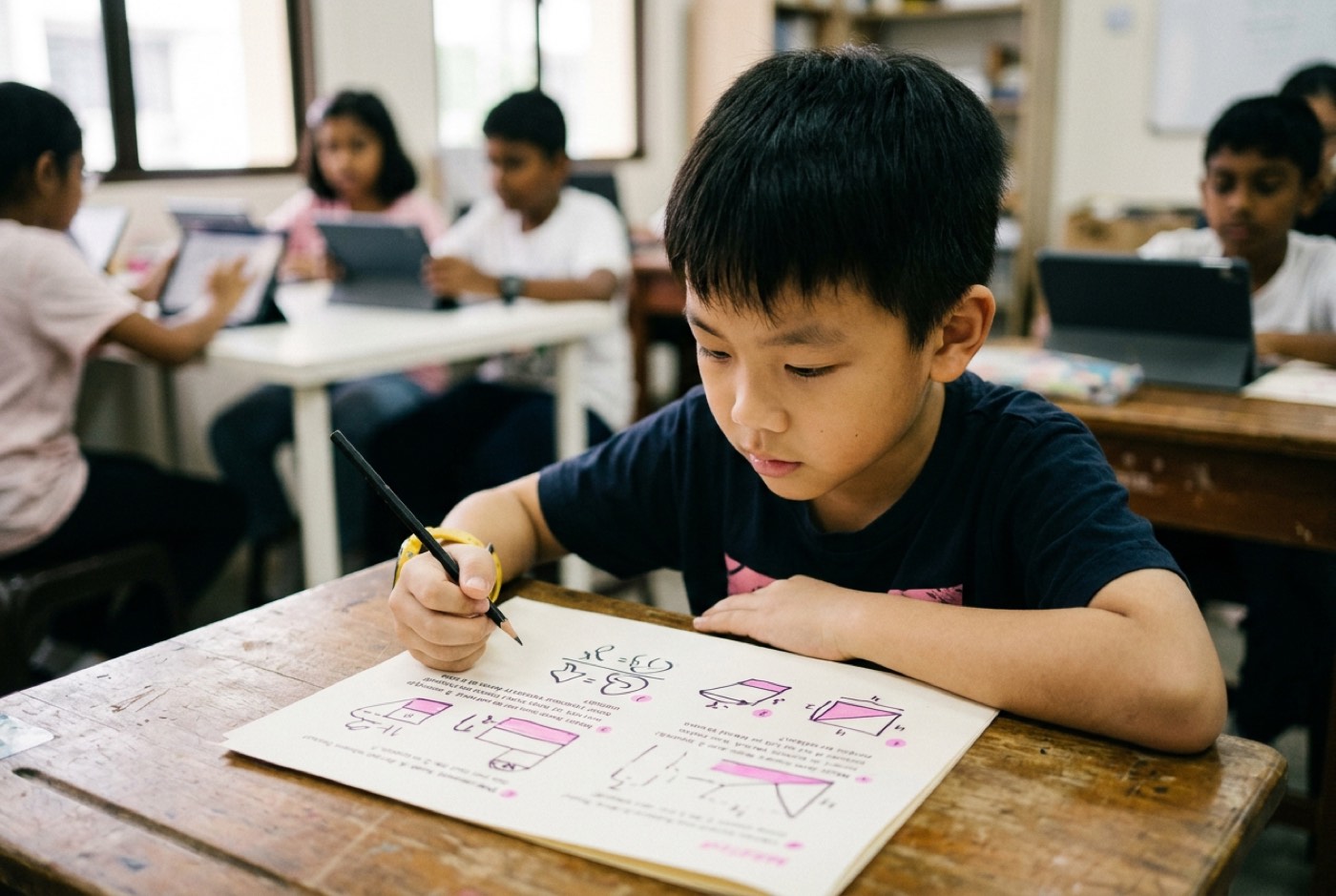 The pattern shows up in international data too. In the 2022 PISA cycle, Malaysia recorded the largest decline among ASEAN countries in mathematics performance [1]. Nearly 60% of Malaysian 15-year-old students failed to meet basic mathematics baseline proficiency, while only 1% reached high-performing levels [1]. OECD analysis of the same cycle found that mathematics performance uniquely accounts for 40% of the variation in creative thinking scores among Malaysian students [2].
Textbooks make the problem worse in a quiet way. Educational research shows that standard math textbooks implicitly suggest every word problem is solvable and that every piece of numerical information provided in the prompt is relevant [3]. A child raised on that diet meets a KBAT question stuffed with distractor numbers and real-world noise, reaches for the only strategy she knows (grab every number in sight, apply an operation), and stalls.
What a Math Word Problem Really Asks For (The Modelling Layer)
Solving a word problem means building a mental picture of the scenario first. Cognitive psychologists call that picture a situational model.
Add irrelevant information and the demand rises sharply. In a controlled study of primary school students, researchers compared performance on questions with and without irrelevant details [4]. Scores on the problems containing irrelevant information were significantly lower () than on the clean problems (), an effect size of [4].
The interesting part is what predicted success. Nonverbal reasoning, meaning the capacity to infer underlying rules and identify patterns, predicted accuracy on the problems with irrelevant information. Arithmetic skill on its own did not [4].
The Keyword Scanning Trap
Plenty of parents and tuition tutors try to close the gap with keyword shortcuts:
- "Altogether" means add.
- "Left" or "difference" means subtract.
- "Shared" means divide.
It survives lower-primary worksheets and collapses on KBAT. Take a question of the sort you see in Form 1 or Standard 6:
"Siti has 24 stamps. This is 6 fewer than three times the number of stamps Ahmad has. How many stamps does Ahmad have?"
The keyword scanner sees "fewer," subtracts 6 from 24, and never notices the relationship the sentence describes.
Research published by the American Psychological Association shows that general solution instructions and keyword searching fail low-performing students because they lack domain-specific structural training [5]. Schema-Based Instruction (SBI) does the opposite. It teaches children to sort problems into structural types such as change, group, and compare using visual diagrams, and students taught this way significantly outperform control groups on word problem tests and standardized state assessments [5].
The Reading-Comprehension Trap: Language vs Math
When a child stumbles on KBAT questions written in English or Bahasa Melayu, the question I get is always the same: language tuition or maths tuition?
Language and mathematical processing are separate systems that interact. Interdisciplinary research isolates three components of word problem difficulty: linguistic complexity, numerical complexity, and the interaction between the two [3].
| Component | What It Covers |
|---|---|
| Linguistic complexity | Text wordiness; syntax and grammar; key terms |
| Numerical complexity | Number magnitude; operations required; carrying and borrowing |
| Interaction / structural alignment | Order in which information appears; distractor text; schema mapping |
A diagnostic study across 31,842 students compared text descriptions against depictive visual representations in contextual maths problems [6]. The regression models confirmed that text wordiness exerts a statistically significant negative effect on student problem-solving accuracy [6]. When the situations were shown visually instead of described in long verbal passages, overall performance improved significantly [6].
Pictures are not a free win, though. The same study found that piling unhelpful visual elements into a diagram also hurts performance [6]. What works is neither wall-of-text nor decorative illustration, but clean structural diagramming that shows the quantitative relationships and nothing else [7].
The 4-Step At-Home Translation Routine
Here is a 10-minute routine you can run during homework to move your child from staring at the prompt to writing an equation.
flowchart TD
    A[Read & Strip] -->|Remove extra data| B[Name the Unknown]
    B -->|Define target x| C[Draw Structural Diagram]
    C -->|Map relationship| D[Execute & Sanity Check]
Step 1: Read & Strip
One read-through, out loud. Then pencil in hand: cross out anything that does not change the mathematical relationship. Names, background story, descriptive adjectives, object colours, dates.
Step 2: Name the Unknown
No calculator, no numbers yet. The child writes one sentence saying what she is hunting for. For example: "Target = Number of marbles Ahmad started with."
Step 3: Draw the Structural Diagram
Research on cognitive load shows that pairing structural diagrams with problem solving allows students to represent scenarios in single equations and skip unnecessary intermediate calculation steps [7].
Simple block diagrams are enough. Match the drawing to the structural category:
- Group: Part + Part = Whole
- Change: Initial Amount Change = End Amount
- Compare: Larger Quantity - Smaller Quantity = Difference
Step 4: Execute & Sanity-Check
Now the equation, the arithmetic, and the units, in that order. Last question before the pencil goes down: "Does this answer make physical sense in the real world?"
Three Worked Malaysian Examples with Parent Scripts
Three typical Malaysian questions, primary and secondary, run through the routine.
Example 1: Standard 3 / Primary 3 (Filtering Irrelevant Info)
The Question:
Aiman has 18 blue toy cars. His brother Harith has 12 red toy cars. Their storage box weighs 450 grams. Aiman buys 7 more blue toy cars at the mall. How many toy cars does Aiman have now?
- Child's Panic: "Do I add 450? What about Harith's 12 cars?"
- Parent Script: "Let's run Step 1. Does the weight of the plastic box change how many cars Aiman holds in his hands? No. Cross out 450 grams. Does Harith's car collection change how many cars Aiman bought at the mall? No. Cross out Harith's 12 cars. Now, what is left?"
- Structural Model: Change Structure (Initial Amount + Change = End Amount).
- Mathematical Statement:
- Sanity Check: 25 toy cars. Harith's cars and box weight are ignored.
Example 2: Standard 6 / IGCSE Foundation (Compare & Ratio Structure)
The Question:
In a robotics workshop at Mont Kiara, the ratio of boys to girls is . There are 12 girls in the room. Each student uses a laptop worth RM 2,000. If 4 more boys join the workshop, what is the new total number of students in the room?
- Child's Panic: "How do I calculate the laptop prices with the ratio?"
- Parent Script: "Step 1: Does the laptop price change the count of human students in the room? No, cross out the laptop value. Step 2: What is our unknown? Target = Final total student count. Step 3: Draw two bar blocks: Boys (3 units) and Girls (2 units)."
- Structural Model:
Example 3: Form 2 / Secondary Level (System & Geometry Modelling)
The Question:
A game developer is coding a rectangular boundary for a 2D game arena. The perimeter of the arena is 80 units. The length of the arena is 10 units longer than twice its width. Find the dimensions of the arena.

- Child's Panic: "I don't know where to start with '10 units longer than twice'."
- Parent Script: "Let's model the geometry. Draw a rectangle. Mark Width as . If Length is 10 longer than twice the width, how do we write Length in terms of ?"
- Structural Model:
- Sanity Check: Width = 10 units, Length = 30 units. Check perimeter: units.
Traditional Math Tuition vs. Schema-Based Building
The reflex, once word problem marks slide, is to book more tuition or a calculation speed program. Before that, look at what each framework actually trains.
For a deeper analysis of traditional frameworks versus constructivist methods, read our comparison of Kumon, Abacus, or Building Things and our guide on Math Tuition vs. Learning Math by Building.
| Dimension | Traditional Math Tuition | Speed Drills (Kumon / Abacus) | Schema & Build-Based Learning |
|---|---|---|---|
| Primary Focus | Syllabus exam paper practice, past-year drill questions. | Rapid calculation speed, procedural memorisation. | Mathematical modelling, computational thinking, system design. |
| Handling Word Problems | Teaches keyword scanning and repetitive paper solving. | Bypasses word problems initially to focus on calculation speed. | Teaches structural diagramming and real-world system translation. |
| Distractor Filtering | Taught through exam tips and manual correction. | Not covered (inputs are pre-cleaned numerical expressions). | Integrated natively (projects require extracting variables from environment). |
| Child Engagement | Passive worksheet completion, high reliance on tutor supervision. | Repetitive paper packs, potential friction and burnout. | Active construction (kids build games, simulations, and AI scripts). |
| Long-Term Outcome | Prepares for specific test formats; struggles on novel questions. | High arithmetic speed; may freeze when faced with unstructured KBAT tasks. | High structural flexibility; applies maths natively across science, coding, and logic. |
Why Kids Who Build Games Never Freeze on Word Problems
Coding is not a separate vocational subject at Kidocode. It is bundled free in every package because computational thinking is the thing we are really teaching. Our breakdown of computational thinking and our parent guide to coding for kids go into the detail.
A game or a script is a stack of word problems that have to be solved one after another. Build something in Scratch, Python, or Roblox and the narrative has to become a working model:
- "When the player touches the coin, increase score by 10" (Change Schema).
- "If the enemy is closer than 50 pixels, attack" (Distance & Geometry Model).
- "Keep track of health across three player lives" Variable management and conditional logic.
None of that is rule memorisation for an exam. It is maths used as a tool to make the game run. After twenty hours of tuning collision boundaries, jump gravity, and inventory algorithms, an exam question about speed, distance, or ratios reads like a system the child has already built once.
An AI math tutor helps here as well, handing the child a structural hint the moment she stalls on a word problem instead of the numerical answer.
A 2-Week Home Experiment
Before you add tuition hours to a child who already dreads KBAT homework, try fourteen days of this.
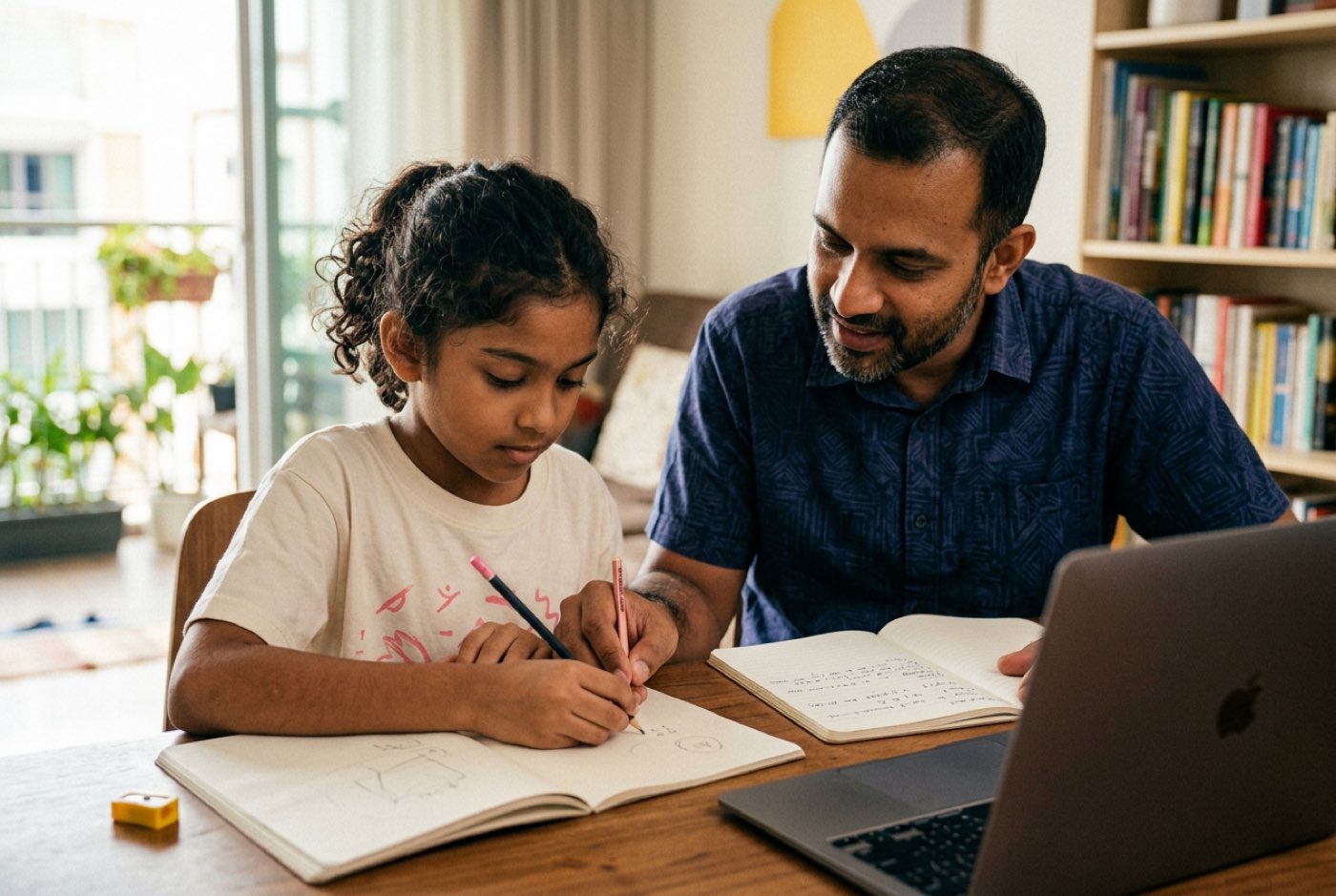
Week 1: Ban All Calculations on Word Problems
- For the first 7 days, pick 3 school KBAT word problems every evening.
- The Rule: The child is strictly forbidden from doing any arithmetic or writing down any numbers for the first 5 minutes.
- The Task: The child must read the problem, physically cross out all distractor text with a highlighter, and draw a simple block diagram representing the situation.
- The Outcome: If the structural diagram is correct, praise them and stop there. Do not even force them to compute the final sum. Rebuild their confidence in the translation layer first.
Week 2: The "Explain the Model" Routine
- During the second week, ask your child to teach the word problem back to you using their diagram.
- Have them point to each section of their sketch and state: "This block is what we know, this block is what changed, and this question mark is what we must calculate."
- Once the model is articulated clearly, allow them to execute the arithmetic and write down the final units.
How Kidocode Fixes Math-Hate and KBAT Anxiety
One conviction runs through everything we do at Kidocode: the kid is fine, the teaching wasn't.
We are an AI school first, teaching kids to direct AI safely and effectively, combined with maths and technology. We follow international math standards (IGCSE, Cambridge, US Common Core, and KSSR logic). Same syllabus the schools require, delivered in the opposite direction: through building real projects.
Our Three-Pillar Framework
- AI to Survive: Teaching children how to prompt, direct, and audit artificial intelligence models responsibly.
- Math to Think: Ending math-hate in 2 to 4 weeks by giving every child a personalized AI tutor and teaching maths through game physics, spatial coordinates, and algorithmic logic.
- Tech to Build: Six comprehensive tracks (Python, Web, Mobile Apps, Game Development, Electronics, and 3D Modelling). Coding is bundled free across our programmes because computational thinking is the foundation.
Our Klang Valley campuses are the Solaris Mont Kiara flagship and Sunway Nexis Kota Damansara; in Penang we run Q2 Waterfront Bayan Lepas, Vantage Tanjung Tokong, and Icon City Bukit Mertajam. Live online classes follow the same approach. No high-pressure drills in any of them.
To see how your child takes to build-based learning, book a free trial class. It runs up to 2 hours, hands-on, and your child leaves having built a real project in AI, maths, or tech. Both parents are welcome to sit in, watch the methodology, and see how fast confidence comes back once problem-solving makes sense.
Printable Word Problem Translation Checklist
Parents: Print or copy this checklist and attach it to your child's math study desk for daily homework practice.
-
Step 1: Read Aloud Once
Read the entire word problem out loud cleanly without calculating anything yet. -
Step 2: Cross Out the Noise (Strip)
Draw a pencil line through irrelevant details (names, object colours, background stories, dates, or unused measurements). -
Step 3: State the Target Unknown
Write down one line defining the target outcome (e.g., "Target = final number of books"). -
Step 4: Identify the Schema
Determine which structure fits the narrative:- Group Structure (Part + Part = Whole)
Designed, ready to print and sign. We email it to you together with a 5% discount on your next registration.
Frequently Asked Questions
Why does my child score high on calculation worksheets but fail school KBAT questions?
Calculation worksheets test procedural execution (). KBAT questions test mathematical modelling: reading narrative text, discarding irrelevant details, identifying quantitative structures, and constructing an equation. Failing KBAT questions points to missing structural translation practice, not missing calculation ability.
Is KBAT failure caused by poor language skills in Bahasa Melayu or English?
Language processing does play a role, and cognitive research shows that text wordiness increases cognitive load [6]. The main failure mode is usually structural, though: children who read the language perfectly still freeze if nobody has taught them to extract quantitative schemas (change, group, compare) using structural diagrams [5].
Should I send my child to traditional math tuition to fix word problem scores?
Traditional tuition tends to lean on past-year exam paper drills and keyword shortcuts (teaching that "altogether" always means addition, for instance). Those keywords break down on complex KBAT questions. Schema-based instruction and build-based methods teach structural logic, which holds up when the problem format is unfamiliar.
Can coding and game building really improve school maths scores?
Yes. Building a game means modelling physical boundaries, coordinate systems, velocity, and score variables in code. Software construction turns abstract mathematical concepts into visual, operational mechanics, and those intuitive structural models transfer directly to written word problems.
How does Kidocode teach the school math syllabus differently?
We cover international math standards (IGCSE, Cambridge, US Common Core, and KSSR logic) using a constructivist approach. Instead of completing paper worksheets, children solve maths problems by building real software, game physics engines, and AI applications, supported by a personalized AI math tutor.
References
-
Lim, Y. W., Gabda, D., Pang, N. T. P., & Ho, C. M. (2025). PISA 2022 Mathematics Performance Analysis in Malaysia and ASEAN. Mathematics Teaching Research Journal, 17(3), 201-222. https://eric.ed.gov/?id=EJ1481827
-
OECD. (2024). PISA 2022 Results (Volume III): Factsheet Malaysia. OECD Publishing. https://www.oecd.org/en/publications/pisa-results-2022-volume-iii-factsheets_041a90f1-en/malaysia_4aa2f8e4-en.html
-
Daroczy, G., Wolska, M., Meurers, W. D., & Nuerk, H. C. (2015). Word problem solving: A review on linguistic, numerical, and interaction factors. Frontiers in Psychology, 6, 341. https://pmc.ncbi.nlm.nih.gov/articles/PMC4381502/
-
Wang, A. Y., Fuchs, L. S., & Fuchs, D. (2016). Cognitive predictors of second-grade word-problem performance on problems with and without irrelevant information. Learning and Individual Differences, 52, 56-67. https://pmc.ncbi.nlm.nih.gov/articles/PMC5300308/
-
Dingfelder, S. F. (2007). Schema-based instruction improves math word problem solving. Monitor on Psychology, 38(4), 10. https://www.apa.org/monitor/apr07/schema
-
Hoogland, K., Pepin, B., de Koning, J., Bakker, A., & Gravemeijer, K. (2018). The effect of changing approaches to context in word problems on student performance. Research in Mathematics Education, 20(1), 37-52. https://www.tandfonline.com/doi/full/10.1080/14794802.2017.1413414
-
Ngu, B. H., & Phan, H. P. (2022). Unpacking structural diagrams and worked examples in mathematical word problem solving. Frontiers in Psychology, 13, 725280. https://www.frontiersin.org/journals/psychology/articles/10.3389/fpsyg.2022.725280/full