

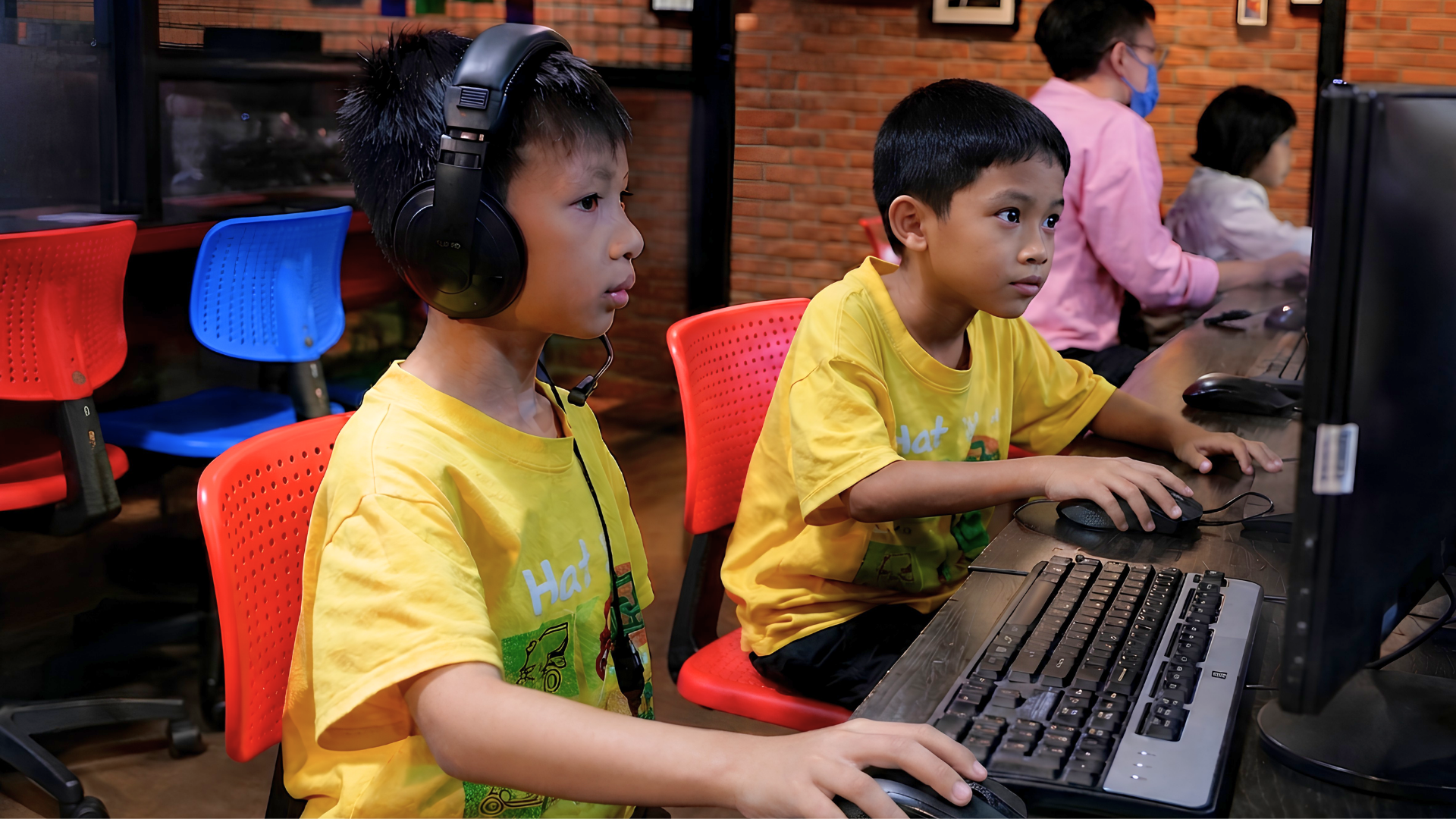
Your teenager finishes an essay in fifteen minutes. It is clean, well-argued, and clearly done with help from a chatbot. You feel two things at once: relief that it is done, and a quiet worry you can't quite name. Is this cheating? Is this simply how things work now?
That worry is worth listening to, but the usual way of framing it misses the point. The question isn't whether your child uses AI. They will, the same way they use a calculator or a search engine. The real question is which side of a quiet divide they end up on, the people who use AI, and the people who can build with it.
Two children, one chatbot
Picture two fifteen-year-olds with the same chatbot open. The first asks it to write a summary, copies the answer, and moves on. The second asks for a summary, reads it, notices it missed the main argument, and tells it exactly what to fix. Both finished the task. Only one was in charge.
That gap is small today and enormous in ten years. The first child is a consumer of AI: they take what it gives. The second is a builder: they direct it, judge it, and bend it toward what they actually wanted. The difference isn't intelligence, and it isn't even coding skill. It is a habit, the habit of staying the boss of the machine instead of its audience.
Why simply "using" AI is losing its value
Here is the uncomfortable part for any parent betting on good grades alone. The ability to use AI is quietly becoming worthless, precisely because everyone now has it. When the same tool is one sentence away for all of us, knowing how to ask it nicely is not a skill anyone will pay for.
The early evidence already points this way. In a 2023 study of customer-support agents, the economist Erik Brynjolfsson and his colleagues found that AI assistance raised the output of the least experienced workers the most. That sounds purely encouraging until you see what it means. AI is erasing the advantage that basic competence used to buy: if a machine can lift a beginner close to expert level, then being a competent beginner is no longer worth much. What keeps its value is the judgement to know when the machine is wrong, and the ability to build something it cannot.
What building with AI actually looks like
Building with AI is less mysterious than it sounds, and children take to it faster than their parents expect. It simply means using AI as one part inside something they made, rather than as a vending machine for answers.
Take a sixteen-year-old who is tired of getting stuck on Add Maths every time her SPM study group revises without her. Instead of asking a chatbot for the answers, she builds a small tool that turns her own past mistakes into fresh practice questions. The program is hers: that is the Tech. She connects it to an AI model and tells it exactly what kind of question to generate. And the logic that sorts each mistake into the right topic runs on the Math underneath. She is not asking the machine to think for her. She decided what it should do, then checked whether it did it well, which is the whole skill, in miniature.
Using AI isn't the enemy
None of this means AI should be banned at the desk. A parent who forbids it outright usually just teaches a child to hide it, and a child who never touches it will be as lost as one who only ever copies from it. The goal was never to stop your child using AI. It is to make sure they can also stand on the other side of it.
And to be honest, not every child will grow up to build software, nor do they need to. The habit underneath, direct the tool, question what it gives back, improve it, is the same whether your child becomes a doctor reviewing an AI diagnosis, a lawyer checking an AI-drafted contract, or a designer using AI as one brush among many. Nobody can tell you which job your child will hold in 2040. What seems safe to say is that in every version of it, the people in charge will be the ones who can build, not the ones who can only take.
What you can do at home tonight
You don't need to understand AI yourself to nudge your child toward the right side of this. The next time they use a chatbot for homework, don't ask whether they used it. Ask them to find one thing it got wrong, or one way it could be better. That single question moves them, gently, from audience to editor, from accepting the output to judging it.
It works at any age, scaled to fit. A seven-year-old can be asked which part of a story the AI simply made up. A fifteen-year-old can be pushed to find where its reasoning actually breaks. The habit is the same; only the difficulty changes.
Do that often enough and it becomes a reflex, the small daily habit that separates the two children with the same chatbot open. The ones who pull ahead are rarely the ones who used the tools earliest. They are the ones who learned to direct them.
From AI's audience to AI's editor
This is exactly what the AI programme at Kidocode is built to teach. From age 5, children learn to direct AI, judge what it gives back, and build with it, agents, tools, real projects, instead of prompting and pasting. Coding rides along free; the skill we spend the real time on is judgement.
The clearest test is a free trial class: watch your child build with AI for an afternoon, on campus or online, and see which side of the divide they're on.