

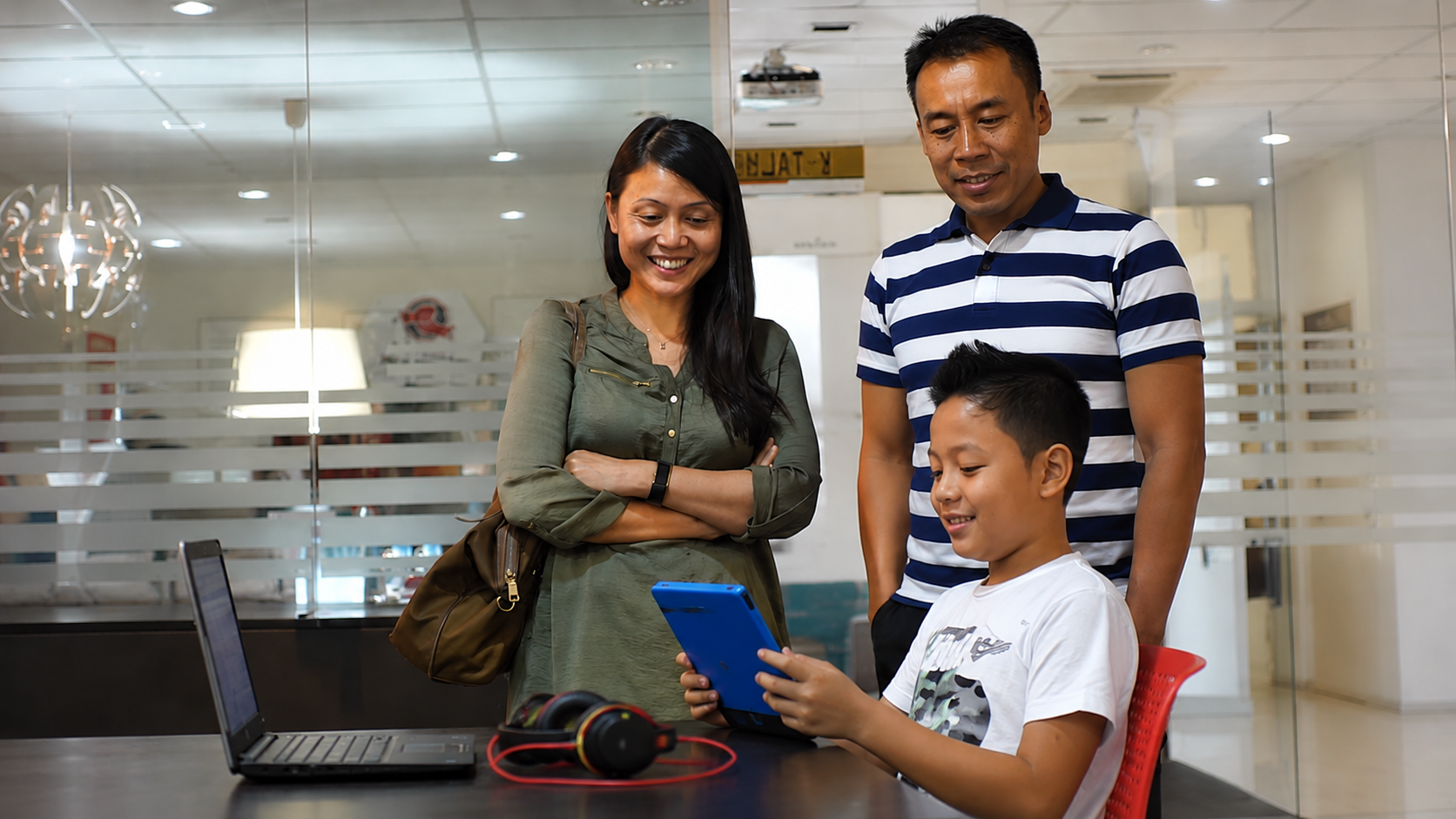
At the end-of-year showcase, you stand in front of your child's project and try to look impressed. There's a game on the screen, or an app, or a small robot that reacts to a sensor. Your child explains it quickly, in words you only half-follow. You smile and nod. And underneath the smile is a question you'd never say out loud: is this any good, and is it worth what I'm paying?
The honest problem is that you have no way to measure it. You know what a good report card looks like, the As, the class ranking, the teacher's comment. But no one has ever shown you what a good twelve-year-old's project looks like. That's not a gap in you. It's because the thing worth paying for was never the project on the screen. The project is just the surface. What you're really paying for is happening inside your child, in how they handle being wrong, what they try when no one is forcing them, and whether they end up controlling the tool or just obeying it.
What you can't see on the screen
Two children can hand in almost the same app and have learned very different amounts. One followed the steps closely and couldn't rebuild it tomorrow. The other broke it four times, understood why each time, and could explain every choice. On the night, both look the same. Underneath, they're worlds apart.
This leads somewhere most parents don't expect: the most polished project in the hall is often the weakest sign. A flawless app a child can't explain usually means they followed a template, or someone helped a little too much. The project that crashed twice and got fixed tells you far more than the one that never broke.
So the better question isn't "is this impressive?" It's "can you tell me how it works, and what almost stopped it from working?" A child who lights up, who walks you through the dead ends as happily as the finished part, has learned the thing that matters. A child who can only point at the screen built a project without really owning it.
Learning to be wrong well
School quietly teaches children to fear the wrong answer. A red mark is a small punishment, so being wrong starts to feel like failing, instead of just the normal middle of working something out. A good AI and tech programme flips that. Here, being wrong is normal. Code almost never works the first time, and the whole skill is finding where it went wrong, guessing why, and trying again without taking it to heart.
Picture a ten-year-old building a times-table quiz app for her younger brother. For three sessions, it keeps marking his correct answers as wrong. From the outside, she looks stuck. She isn't. She's working backwards to find the small mistake in how the app checks his answer. When she finds it, she can explain exactly what went wrong and why her fix worked. A child who does that a few times starts checking her own Maths the same way, looking for the step that slipped, instead of rubbing out the whole page.
The day they choose the harder version
One moment tells you something has clicked, and it rarely happens at a showcase. It's the day your child picks the harder version when the easy one was right there. A thirteen-year-old could stop at a simple list of how many basketball shots he sank each day. Instead, he decides to chart his accuracy week by week. That means using percentages and averages he'd only seen in a workbook, because now the numbers tell him something he actually wants to know. They might show he plays worse on the days he practises right after tuition, when he's tired. So he changes his week.
What that moment looks like depends on the age. For a seven-year-old it's quieter: they want to fix what broke instead of walking away. The basketball chart is the teenage version of the very same instinct, reaching past the easy answer because it has stopped being interesting enough.
Let's be honest, though. Not every child reaches for the harder version, and you can't force that spark from the outside. If your child finishes a project and doesn't want to take it further, that's real information, not a problem to drill away. Most children who seem uninterested in tech just haven't met a problem they cared about enough yet. The interest usually comes with the right problem, not on a schedule.
Do they control the tool, or does it control them?
The real worry under all of this is AI, and it deserves a straight answer, not a slogan. "AI is the future" tells you nothing. Here's what's actually changing: more and more work is about directing a machine and improving its first draft, rather than doing everything by hand. So the skill that lasts is judgement. A child can relate to these tools in two ways, and the programme decides which.
The good version looks like this. A sixteen-year-old is stuck at tuition while her study group revises without her. So she builds a revision helper that turns her own Add Maths mistakes into new practice questions on the topics she keeps getting wrong. She writes the program with the Tech she's learned, connects it to an AI model using what she knows about AI, and builds the logic that sorts each mistake into the right topic with Math. She isn't letting the tool think for her. She decides what it should do, then checks if it did it well. That's the difference between a child a machine could replace and one who'll direct it, and it's learned, not inherited.
A simple test at home
You don't need a showcase to check any of this. Ask your child to teach you what they made. Listen for whether they can explain why it works, not just what it does. There's real research behind this: studies of the "protégé effect", including work by Chase and colleagues in 2009, found that children who learn something in order to teach it understand it more deeply than children who learn just for themselves. A child who can teach you their project has understood it. A child who can only show it has borrowed it.
What parents tell us is almost never about code. It's that their child thinks more carefully now, gives up less easily, and sometimes explains something hard and makes it simple. The code was only ever the way there.
See the part that never shows on the report card
Everything this article describes, being wrong well, choosing the harder version, directing the tool instead of obeying it, is what Kidocode's AI and Tech programmes are built to grow. Children aged 5 to 18 don't sit through lessons here; they build real projects, and the thinking comes with the work.
If you'd rather see it than read about it, a free trial class shows your child building something of their own in a couple of hours, on campus or online.