

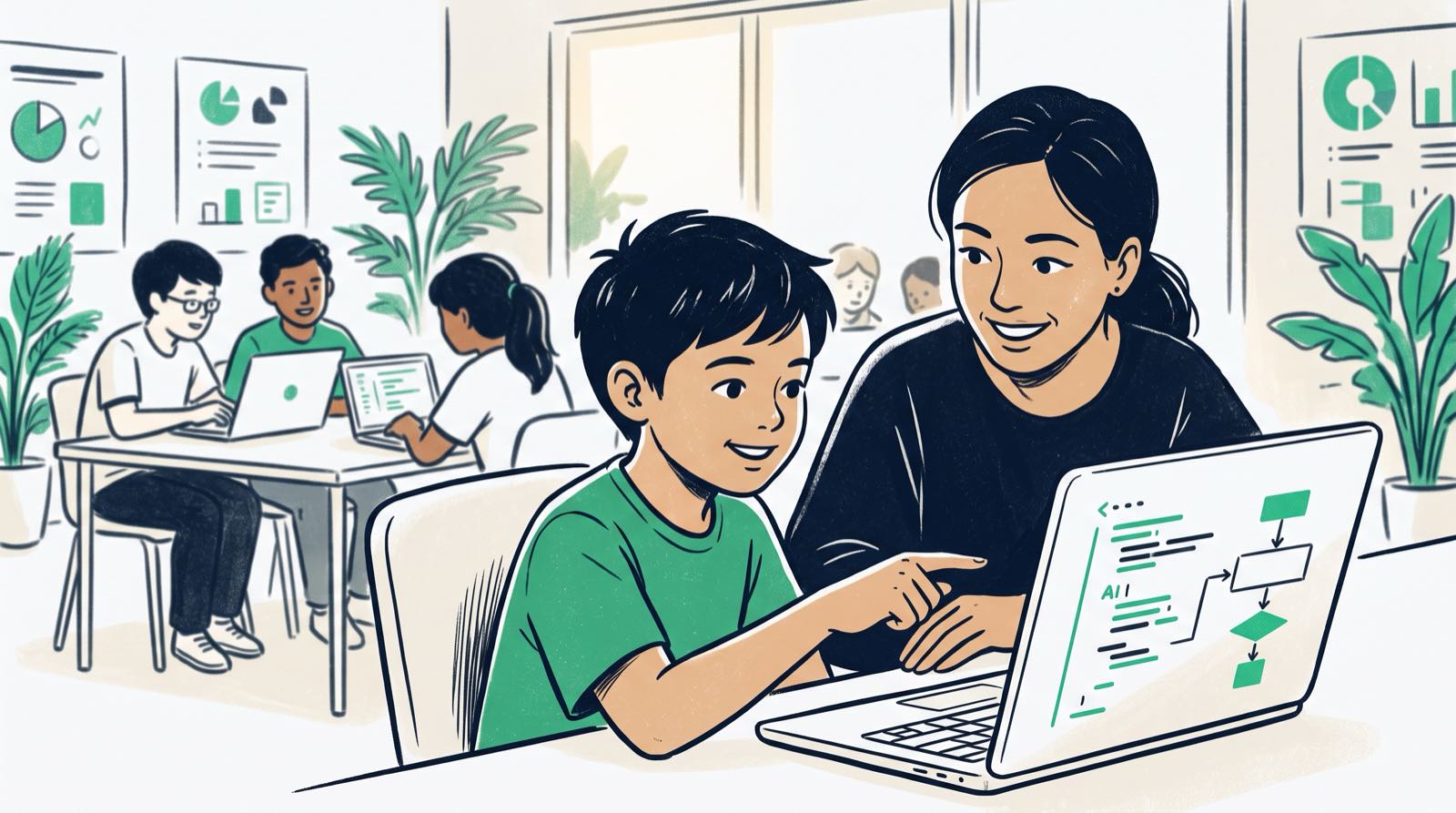
Picking a coding class for your child in Malaysia used to take an afternoon. Parents in Kuala Lumpur or Penang found a centre nearby, checked whether it taught block coding like Scratch or text coding like Python, and booked whichever weekend slot didn't clash with tuition.
That calculation no longer holds in 2026. Generative AI tools write working code in seconds. National digital initiatives in Malaysia have introduced over 2.1 million students to basic digital tools through public-private partnerships like MDEC's #mydigitalmaker movement [1]. At state level, Penang's RM6 million Coding For All programme has put hardware and software into dozens of local schools [8].
Basic coding awareness is now widespread, so the question parents face has moved on. It is no longer whether a child should learn to code. It is how coding gets taught once AI can produce the syntax on demand.
A centre still running a 2018 curriculum will cost your child time. What works now is a shift away from memorising syntax and towards directing intelligent tools, understanding the mathematics underneath, and shipping real projects.
Below: how to evaluate coding and AI programmes across Malaysia, what to ask when you visit a centre, the red flags worth walking away from, and how flexible access models help families juggle school workloads.
Key Takeaways
| Evaluation Criteria | Traditional Coding Centre (2018 Model) | AI-Era Tech School (2026 Model) |
|---|---|---|
| Primary Curriculum Focus | Syntax memorisation and drag-and-drop blocks | AI prompting, computational thinking, and project building |
| Path to Real Text Code | 2 to 3 years of Scratch before starting Python | Accelerated transition to Python using AI coding assistants |
| Math Integration | Disconnected from coding or presented as separate tuition | Applied mathematics built directly into project logic |
| Teaching Methodology | One-size-fits-all group lectures | Personalised progression guided by AI tutors and human mentors |
| Schedule Flexibility | Fixed weekly time slots with forfeited missed classes | Flexible attendance options across weekdays, weekends, and intensives |
| Output Expectations | Following step-by-step tutorial worksheets | Developing functional software, artificial intelligence models, or games |
Table of Contents
- The 2026 Shift: Coding-Only vs AI-Era Education
- What Changed: How AI Tools Accelerate Real Code
- The Scratch Trap: Why Modern Kids Progress Faster
- 7 Questions Every Malaysian Parent Must Ask
- Major Red Flags in Local Coding Centres
- Learning Delivery: Fixed Class Times vs Flexible Access
- On-Campus or Live Online: Navigating the Traffic Dilemma
- What to Expect from a Real Free Trial Session
- How Kidocode Teaches: AI, Math, and Free Coding
- Campus Locations in Kuala Lumpur and Penang
- Parent Decision Checklist
- Frequently Asked Questions
- References
The 2026 Shift: Coding-Only vs AI-Era Education
Ten years ago, learning to code meant memorising commands, brackets and semi-colons. Centres drilled the mechanics of writing syntax. One misplaced character and the program broke, which is how a lot of children decided they weren't "good at computers".
AI models now generate that syntax instantly. Computer scientist Simon Peyton Jones describes programming as "powerful knowledge" that teaches structured thinking superior to common sense, while noting that AI tools work as productivity co-pilots rather than replacements for human agency [5].
Teaching syntax alone in 2026 is roughly like drilling long division by hand and never showing the child a problem worth solving.
flowchart LR
    A[Traditional Model] --> B(Memorise Syntax)
    B --> C(Debug Typos)
    C --> D(Slow Project Build)

    E[AI-Era Model] --> F(Define Problem & Logic)
    F --> G(Prompt AI Assistant)
    G --> H(Review & Refine Code)
    H --> I(Deploy Functional Project)
Writing lines of code is only part of the job now. Children also need to direct AI systems safely, structure complicated logic, and judge whether what the AI produced is correct and secure.
So when you evaluate centres, look for programmes that pull together AI literacy, applied mathematics, and practical technology tracks. Coding itself has become public knowledge. The value sits in computational thinking, logic, and turning an idea into something that runs.
What Changed: How AI Tools Accelerate Real Code
Before generative AI, teaching a young child Python or JavaScript meant months of typing practice first. Children aged 7 to 10 wrestled with the keyboard and the syntax rules long before they could build anything they cared about.
AI coding assistants removed that bottleneck. The assistant behaves like an interactive partner: a nine-year-old can describe the logic of a game in plain language, read the Python that comes back, and start adjusting the parameters.
Three things change as a result:
- Focus shifts to logic: Children spend their time thinking about how a system should behave instead of hunting for a missing comma.
- Immediate feedback: When code breaks, the child asks an AI tutor to explain the error in plain terms and the understanding lands while the problem is still fresh.
- Earlier access to professional tools: Students leave visual drag-and-drop interfaces for real text-based programming far sooner than used to be realistic.
None of this means syntax gets skipped. It gets absorbed through exposure and correction while the child works on something real, which is why engagement holds up.
The Scratch Trap: Why Modern Kids Progress Faster
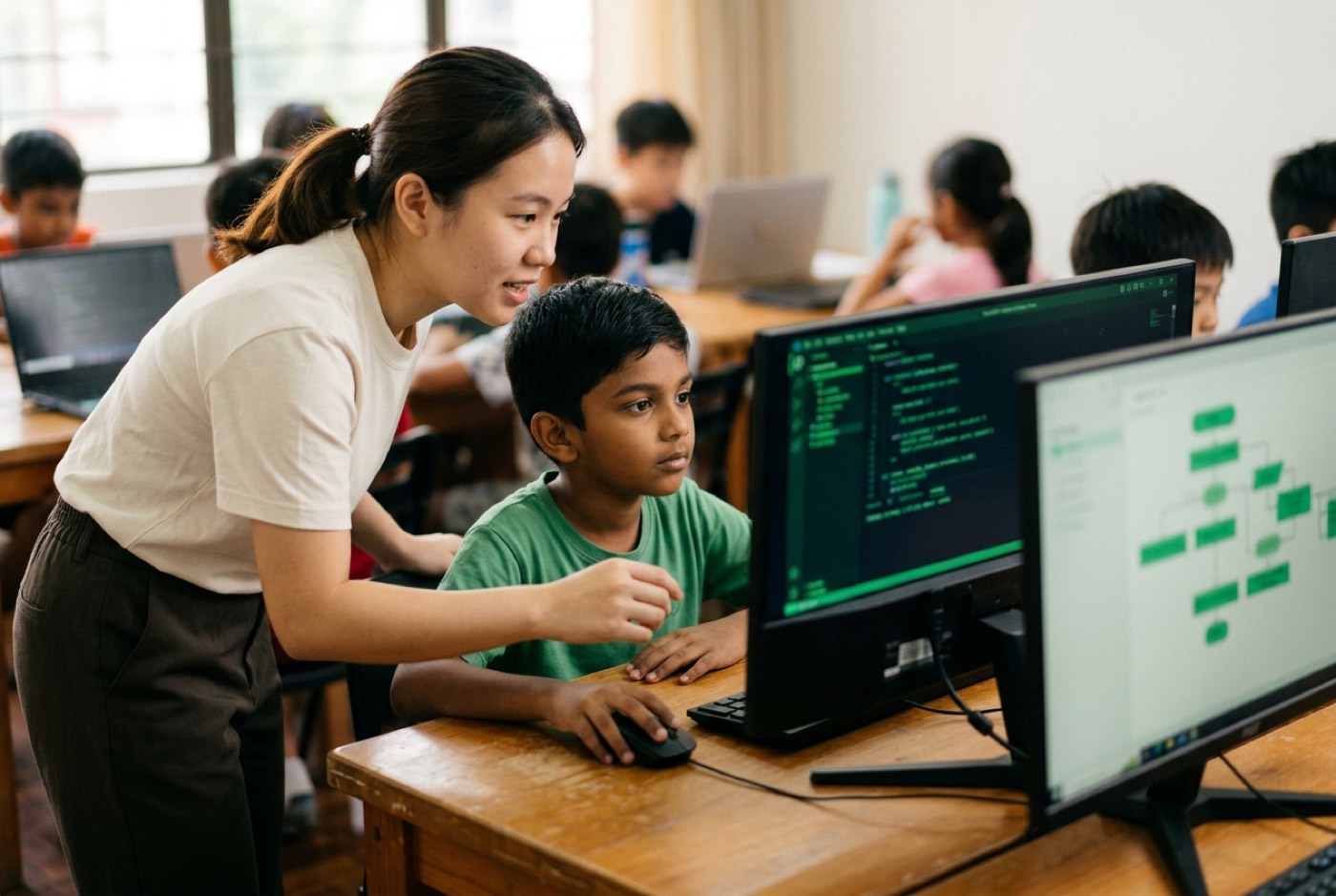
Visual programming tools like Scratch still earn their place with children aged 5 to 7. Studies published in the Pertanika Journal of Social Sciences & Humanities show that gamified and visual coding activities build early spatial and logical reasoning in young learners [6]%20Jun.%202024/03%20JSSH-8924-2023.pdf).
Parking a 10- or 11-year-old on drag-and-drop blocks for two or three years is a different matter, and it's a common structural flaw in traditional coding schools. Long visual coding ladders usually exist because the curriculum has no proper bridge into text coding.
Consider what these children do at home. An 8- to 12-year-old may spend hours inside Roblox or Minecraft. Asking that same child to stay excited about nudging cartoon sprites around a 2D grid for years is a losing proposition.
Give them Lua inside Roblox Studio, or Python scripts written with an AI assistant beside them, and the mood changes. They stop consuming screens and start building them. Our breakdown on Scratch vs Python covers how children move between visual and text environments without falling off a cliff.
7 Questions Every Malaysian Parent Must Ask
Before you enrol your child or sign anything, put these seven operational questions to the management:
-
What concrete artefact will my child build in their very first week? Why it matters: Theory-heavy centres keep children in front of slides for weeks. A project-first centre sends your child home from session one with a working game, an interactive script, or a simple AI prompt structure.
-
How does your curriculum incorporate generative AI tools? Why it matters: A centre that bans AI outright is preparing your child for the past. Look for responsible, safe AI direction and prompt engineering on the syllabus.
-
How do you connect coding concepts to school mathematics? Why it matters: Data from the Khazanah Research Institute highlights that 65% of 15-year-old Malaysian students find mathematics difficult, contributing to drops in national assessment scores [2]. Coding should reinforce school maths by putting algebra, geometry and probability to work inside game engines and AI algorithms.
-
Is attendance restricted to a fixed weekly slot, or can we adjust times around school exams and holidays? Why it matters: Malaysian school schedules are heavy. Fixed weekly slots often mean forfeiting paid sessions during exam weeks or family trips.
-
What is the background and training of the instructors? Why it matters: Ask whether instructors are trained to guide individual project inquiry or simply read from a standardised tutorial script.
-
Can I view recent projects completed independently by students of my child's age? Why it matters: Actual student work shows you what the curriculum produces. Marketing materials show you what the marketing team produces.
-
How do you evaluate and track my child's progress over time? Why it matters: Clear progress tracking tells you which concepts have stuck and where your child still needs mentor support.
For more on setting criteria before you choose an academy, read our guide on 5 important criteria when picking coding classes.
Major Red Flags in Local Coding Centres
Visiting centres in Kuala Lumpur, Petaling Jaya or Penang, watch for these:
- Strict "No AI" policies: Treating AI tools as cheating throws away the chance to teach children how to use them safely and critically.
- Rigid drag-and-drop extensions: Students over 9 kept exclusively on block platforms, with no visible roadmap into text-based coding.
- Forfeited session policies: Missed sessions due to illness, school assignments or travel that cannot be rescheduled.
- Tutorial reproduction: Every student in the room building the identical project line by line, with no room for customisation or independent problem-solving.
- Lack of parental visibility: Centres that won't let parents observe a trial class or look through student project showcases.
Research from the World Bank indicates that employers across Malaysia consistently face shortages of candidates who combine technical capabilities with practical problem-solving skills [3]. Copying code off a whiteboard builds none of the independent problem-solving those employers are hunting for.
Learning Delivery: Fixed Class Times vs Flexible Access
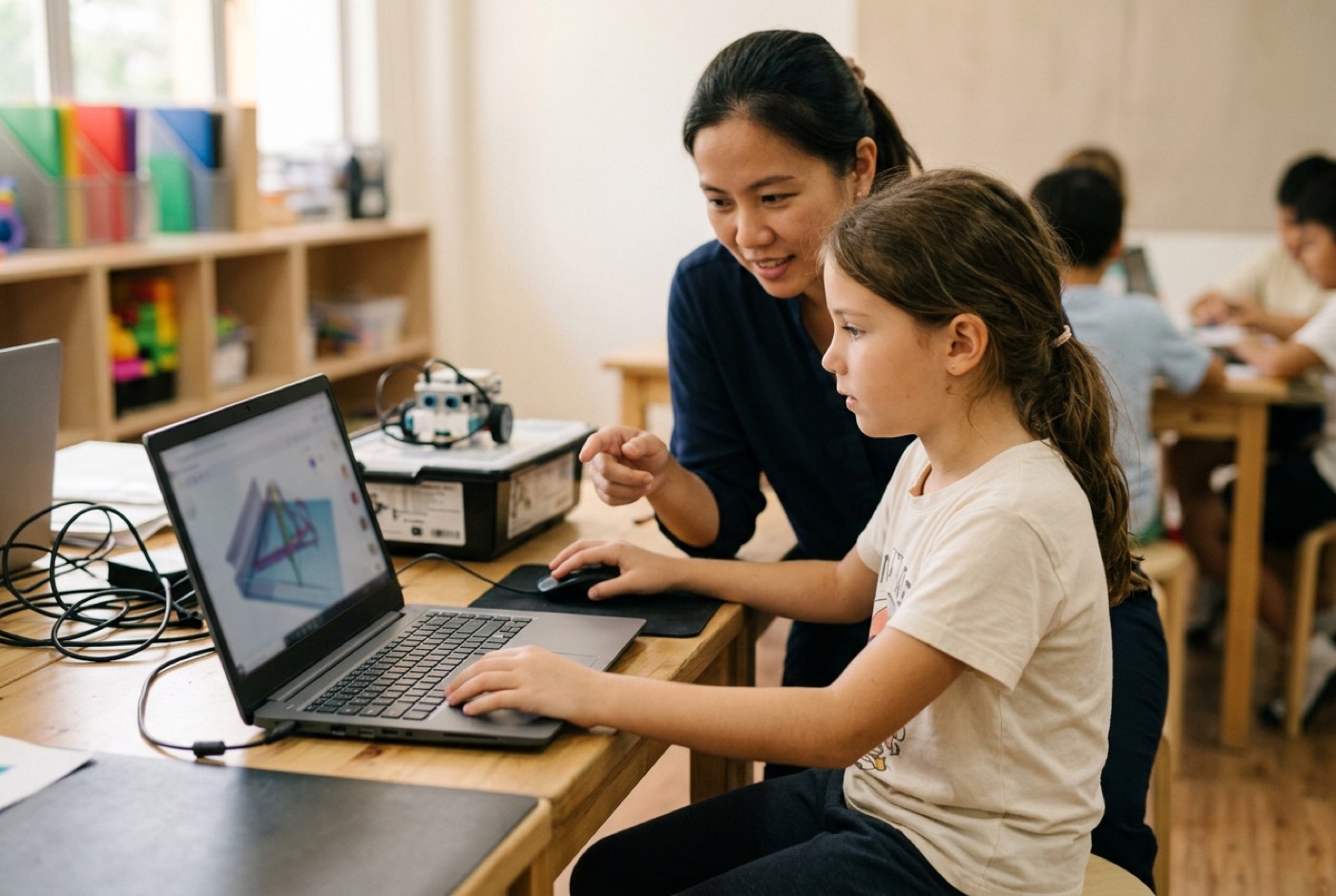
Scheduling pressure is one of the main reasons Malaysian children drop extracurricular activities. Between homework, tuition and family commitments, one more fixed weekly obligation is often the thing that breaks.
Look closely at how a centre structures its learning hours.
1. Fixed Weekly Slots
Your child is assigned a specific class, say Saturdays at 10:00 AM. Fall sick or have a school event, and that lesson is usually gone. There's a second problem too: a child who grasps a concept quickly still has to wait for the rest of the group.
2. Flexible Credit or Session Banks
Flexible time-access systems work differently. Parents buy a block of sessions or hours and schedule them around whatever the family week looks like.
In a quiet school week, a child might come twice. During exams, classes pause entirely and no credits burn. Over the school holidays, students can run intensive blocks and cover ground fast.
Learning stays consistent across the year without becoming another source of household stress. Our article on adaptive learning models explains how personalised scheduling fits into the wider system.
On-Campus or Live Online: Navigating the Traffic Dilemma
Klang Valley and Penang parents know the traffic maths. Forty-five minutes from Shah Alam, Kajang or Bangi to a campus in Mont Kiara or Petaling Jaya, for a one-hour class, rarely adds up.
Choosing a learning format
| On-Campus Class | Live Online Class |
|---|---|
| Hands-on hardware and robotics | Zero commute time |
| Social interaction with peers | Learning from the home environment |
| Direct physical mentor access | Camera-on interactive sessions |
| Recommended for ages 5 to 8 | Ideal for busy schedules and teens |
Two factors decide it for most families:
- Children aged 5 to 8: Physical campus sessions usually win. Younger children get more out of tangible hardware, physical interaction and face-to-face guidance from mentors.
- Children aged 9 to 18: Live online works just as well as on-campus, as long as classes are interactive, camera-on, and led by live instructors rather than pre-recorded video.
Evaluation data from Durham University and the Raspberry Pi Foundation shows that structured computing programmes build independent learning confidence (effect size +0.49) and resilience (effect size +0.24) across primary and secondary students [4]. Those gains hold whether the teaching happens in person or in a live interactive digital space.
If the commute is the obstacle, start online. If your child needs hardware in their hands or closer supervision, pick the campus nearest home.
What to Expect from a Real Free Trial Session
A trial should genuinely test two things: your child's interest, and the centre's teaching. Fifteen minutes of presentation followed by a sales pitch tests neither.
Expect a trial to include:
- Up to 2 hours of hands-on work: Enough time to settle in, learn a core concept, and apply it.
- Building a real artefact: A functional game, a simple AI application, or a computational model, finished within the session.
- Parent observation: Both parents welcome in the room, watching how mentors interact with students and how concepts get explained.
- Student demonstration: Your child presents what they built and talks through the logic in their own words.
If the centre won't let you watch, or can't show you what your child built, keep looking. You can see how a structured trial runs in what kids learn in a trial class, or book one directly on our trial class page.
How Kidocode Teaches: AI, Math, and Free Coding
Kidocode is Malaysia's coding and AI school for kids aged 5 to 18, operating across Kuala Lumpur, Penang, and live online. We make kids AI-savvy, end math-hate, and turn students into digital builders.
Three pillars hold the approach together:
flowchart TD
    SubGraph1[The Kidocode Three-Pillar Membership]

    A[Pillar 1: AI to Survive] --- B[Directing AI models safely, prompt engineering, and digital literacy]
    C[Pillar 2: Math to Think] --- D[Same international syllabus, opposite delivery: learning math by building]
    E[Pillar 3: Tech to Build] --- F[Six practical tracks: Python, Web, Mobile, Game, Electronics, 3D]

    SubGraph1 --- A
    SubGraph1 --- C
    SubGraph1 --- E
1. AI School First
We teach children to direct artificial intelligence models responsibly and safely. Rather than banning AI, we show students how to run AI assistants as co-pilots for problem-solving, logical reasoning and software development. Our guide to AI literacy vs coding skills explains why early exposure matters.
2. Math Through Builds
Repetitive worksheets and test-focused memorisation put a lot of children off mathematics early. At Kidocode we follow international math standards (IGCSE, Cambridge, US Common Core) and deliver the syllabus through project construction instead.
A child who needs trigonometry to work out projectile angles in a game, or probability to train an AI model, stops treating maths as an abstract burden and starts treating it as a tool. Math anxiety typically fades within two to four weeks. Our math pillar page goes into the detail.
3. Coding Bundled Free
With AI co-pilots everywhere, coding syntax has become public knowledge. Computational thinking and structural logic are what still carry weight.
So coding instruction is bundled free across our learning tracks. Students work through six practical tracks: Python, Web Development, Mobile Development, Game Development, Electronics, and 3D Modelling. See how the subjects fit together on our coding is free overview.
Kidocode was founded in 2014 in Solaris Mont Kiara by computer scientist and AI researcher Hossein Tohidi, known to students and parents as Unclecode. He created Crawl4AI, an open-source AI web crawler with over 12 million downloads used by Fortune 500 companies. Across 11 years, Kidocode has taught over 9,500 active students and holds a 4.6-star rating from 177 parent reviews on Google.
Campus Locations in Kuala Lumpur and Penang
Kidocode runs five physical campuses across Malaysia plus a fully equivalent live online programme. When you get in touch, pick the branch closest to home:
- Kuala Lumpur Flagship: Solaris Mont Kiara, KL (default campus for Klang Valley trial sessions).
- Petaling Jaya Campus: Sunway Nexis, Kota Damansara, PJ.
- Penang Island Campus: Q2 Waterfront, Bayan Lepas (default campus for Penang trial sessions).
- Penang Island (Secondary): Vantage, Tanjung Tokong (regular scheduled classes).
- Penang Mainland Campus: Icon City, Bukit Mertajam.
Families further out, or those who simply prefer home, get camera-on live online sessions with dedicated mentors. More on campus setups on our branches page.
Parent Decision Checklist
Take this with you when you visit any coding or AI academy. Print it or screenshot it.
Parent Evaluation Checklist for Tech & AI Schools
- Curriculum relevance: Does the centre teach modern AI tools alongside standard coding concepts?
- First-session output: Will your child complete a working digital project in session one?
- Math integration: Is school-aligned mathematics built into the coding projects?
- Progression timeline: Is there a clear roadmap from visual blocks (Scratch) to text languages (Python) within 6 to 12 months?
- Schedule flexibility: Can missed sessions be rescheduled without penalty or credit loss?
- Instructor ratio: Are mentors available to guide individual problem-solving during class?
- Parental access: Are parents permitted to observe trial classes and review project code?
- Trial quality: Does the trial offer up to 2 hours of hands-on building rather than a sales pitch?
Printable Parent Decision Planner
Kidocode parent evaluation worksheet
- Explained the underlying logic
- Followed a script blindly
- Yes, active AI direction
- No, AI tools are banned
Designed, ready to print and sign. We email it to you together with a 5% discount on your next registration.
Frequently Asked Questions
What is the best age for a child to start learning coding and AI?
Children as young as 5 can start on computational thinking through structured, gamified activities. What matters is matching the tools to the developmental stage. Ages 5 to 7 do best with visual platforms and physical hardware; ages 8 to 18 move quickly into real text-based coding and AI direction.
Will AI make learning to code obsolete for children?
No. AI automates the writing of routine syntax, but it cannot define the problem, structure complicated logic, or verify that something is safe. Directing AI co-pilots demands strong computational thinking and logical reasoning. AI doesn't replace coders; it lets AI-savvy students build bigger, more complex applications faster.
How does coding help children who struggle with school mathematics?
Traditional maths instruction leans on memorising formulas for written exams, which frustrates a lot of children. Put angles, variables, coordinates and logic to work building a video game or training an AI model, and the abstractions turn into tools. Students see the result immediately, confusion clears, and confidence in school maths follows.
What is the difference between block-based coding and text-based coding?
Block-based coding such as Scratch uses visual snap-together blocks to teach basic logic with no syntax errors, which suits ages 5 to 7. Text-based coding such as Python, JavaScript or Lua means writing the real instructions professional software engineers write. AI tools now help students cross from blocks to text far earlier than traditional methods allowed.
What hardware or equipment does my child need to start?
On campus at Kidocode, all hardware, computers and software tools are provided. For live online classes, your child needs a computer (laptop or desktop) with a stable internet connection, a working webcam, and a mouse.
How can I evaluate if a coding class is worth the investment?
Judge the programme by what your child builds independently, not by the certificate on the wall. Ask to see functional games, web applications or AI projects your child made. If they can explain the logic behind their own creation and tackle problems with confidence, you're getting real value. Our how we teach page lays out the full approach.
References
- Malaysia Digital Economy Corporation (MDEC), #mydigitalmaker Movement Overview
- Khazanah Research Institute, Strengthening STEM Foundations in Primary Education to Reach the 60:40 Goal (2024)
- The World Bank, Improving Early Education Essential to Improve Skills in Malaysia (2024)
- Raspberry Pi Foundation & Durham University, Code Club Evaluation Summary Report (2024)
- Computing at School / BCS, Why We Must Still Teach Our Children to Code (Simon Peyton Jones, 2023)
- Pertanika Journal of Social Sciences & Humanities, Design Concepts of Gamification and Unplugged Coding Tools for Early Childhood Education (2024)%20Jun.%202024/03%20JSSH-8924-2023.pdf)
- American Academy of Pediatrics, Digital Ecosystems, Children, and Adolescents Policy Statement (2026)
- Penang STEM / Penang Monthly, Teaching Children to Code in Penang