

Most evenings it comes down to the same standoff at the bedroom door. Your child is on a screen again, you have asked twice already, and somewhere between the second reminder and the rising edge in your voice, you start to wonder whether you are the only parent losing this particular fight. You are not. The trouble is that the question almost every parent asks in that doorway, how much screen time is too much?, turns out to be the wrong one, and asking it keeps families from the answer they actually need.
A more useful question is quieter and a little harder to answer: what is the screen doing to my child's mind in this specific hour? Two children can spend the same ninety minutes on identical laptops and walk away with completely different evenings. One has been fed; the other has been building. The hours on the timer cannot tell those two apart, which is precisely why the timer has been failing you.
The research that moved the goalposts
For years the standard advice was a number, a daily limit you policed and felt guilty about whenever you let it slip. Then the evidence caught up with what many parents already suspected. In 2019, a meta-analysis published in JAMA Pediatrics pooled 68 studies covering more than 200,000 children, and its conclusion was unusually clean: the harms we associate with screens, shortened attention, weaker self-control, disrupted sleep, clustered almost entirely around passive, entertainment-driven use. Children whose screen time was mostly interactive and creative showed no meaningful cognitive gap against their low-screen peers.
The American Academy of Pediatrics drew the obvious lesson. Its more recent guidance has stepped back from rigid hourly caps toward a quality-first framework, not because screens are harmless, but because counting hours measures the wrong thing. A blanket limit treats a child editing a video and a child doom-scrolling as the same problem. They are not the same problem, and pretending otherwise is why the limit never quite worked.
One device, two completely different machines
The reason comes down to how the brain is being paid. Passive screen time, short-form video, autoplay, the endless feed, runs on a fast dopamine loop: stimulation arrives, the brain wants more, and more is always one thumb-flick away. The reward never has to be earned, so the threshold for what counts as interesting quietly climbs. This is why a child who has spent two hours in that loop finds a book or a blank page genuinely unbearable afterwards. It isn't laziness; their reward system has been recalibrated to expect something faster.
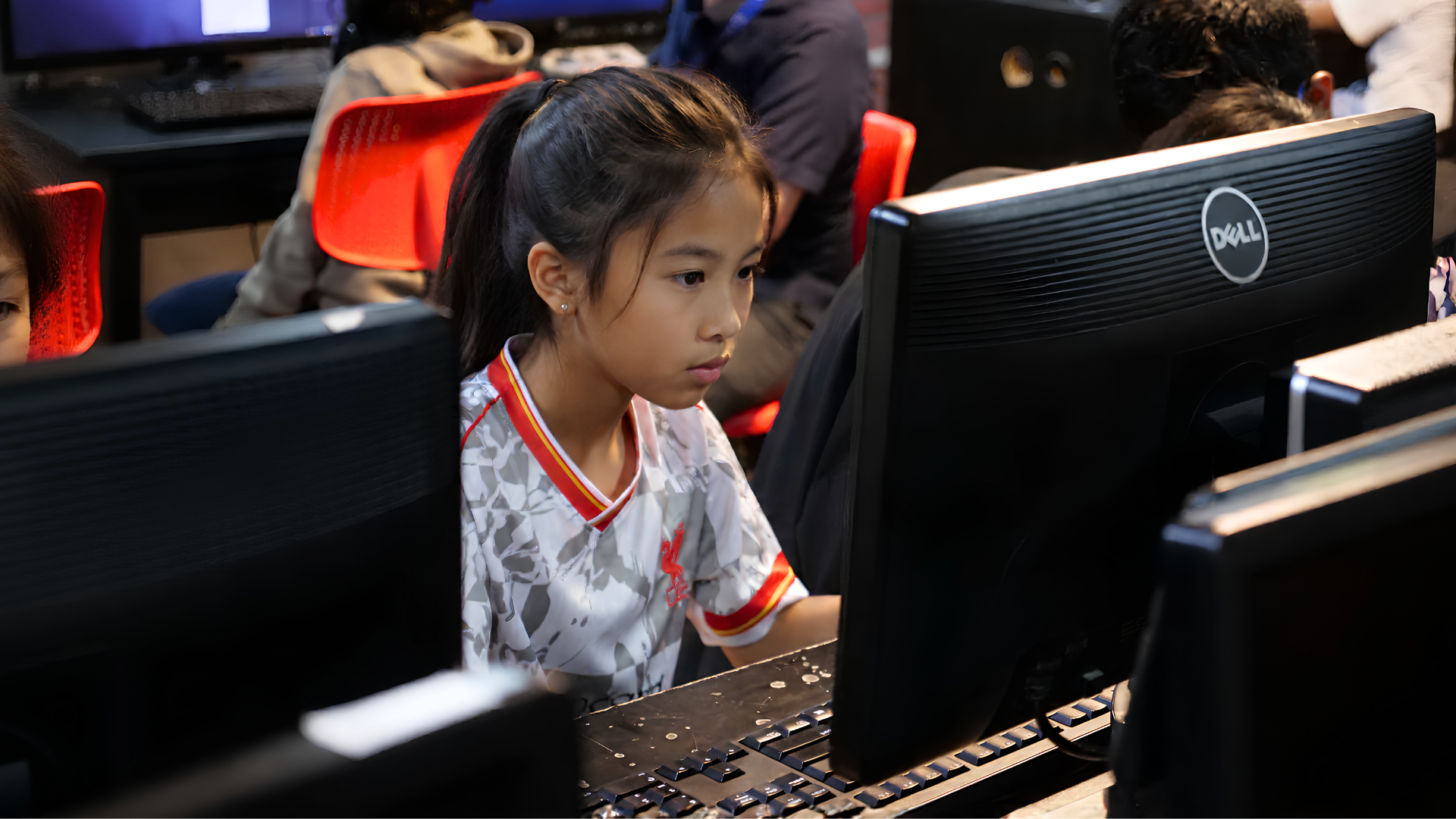
Active screen time pays out in the opposite order. When a child writes a program and finally gets it to run, designs something and watches it work, the reward lands after the effort rather than before it. The same chemical, reached by the harder road, builds patience instead of eroding it. The glow on the face is identical from the doorway. What is happening behind it could hardly be more different.
The trap that looks like the exception
Here is where well-meaning parents get caught. Not everything interactive is active. A great deal of what feels engaging, Roblox reward chests, social likes, loot boxes, is engineered to trigger the same fast loop as passive video, only with a button to press. Tapping is not creating. A child collecting an in-game reward is being played by the design; a child writing the code that generates that reward is doing something else entirely. No screen-time app can tell the two apart, only the child's output can.
The part most advice leaves out
Most parenting guidance skips the uncomfortable bit, so let me say it plainly: your child's fear of missing out is real, and it is not silly. When the whole class is talking about a game, a clip, a meme, and your child has no idea what anyone means, that is a genuine social cost, not a wholesome sacrifice to celebrate. Passive content is not the enemy here. Its dominance is.
That distinction points to a fix that is far easier to live with than a ban. Try a simple ratio: one hour of real creating or learning, then twenty minutes of whatever they actually want, a game, a show, the group chat. The downtime is earned and bounded rather than forbidden, and it stops being a battleground. Children who work in that order tend to come back to the screen with something to show, instead of simply emerging from it.
The right version of this rule changes with age. A seven-year-old needs you beside them and the building kept short, the habit matters more than the output. A thirteen-year-old needs the opposite: you step back, the rule becomes theirs to keep, and the only question left is what they made.
What children actually build
All of which leads to the single most useful thing you can change tomorrow. Retire the question how long were you on it? and replace it with what did you make today? Once children have real tools, the answers have a way of surprising the parents who expected a shrug.
A nine-year-old builds a piano practice tracker after his mother threatens to cancel lessons; it logs the date, the pieces, and the minutes, and he makes it because he is tired of arguing about whether he had practised. A twelve-year-old carrying Mandarin homework on top of his regular schoolwork at a Chinese primary school writes a flashcard app to drill himself on characters, then quietly passes it to three classmates who use it before tests. Another, fourteen, builds a planner that reshuffles her revision during the fasting month, when the family's evenings move around and her usual study routine falls apart.
The clearest example of why this matters is a sixteen-year-old who trains a study chatbot on her own Biology notes for the nights she is at tuition while her group revises without her. She wrote the backend with the Tech she had learned, connected it using what she understood about AI, and held the whole thing together with the Math underneath. None of these are showcase projects entered into a competition. They are ordinary solutions to real problems, made by children who happened to have the tools and the habit of reaching for them.
Balance is the whole point
No parent should feel guilty about twenty minutes of Roblox, and no child should be the only one in the room who doesn't get the joke. The argument was never elimination; it is sequence, making sure the building comes before the consuming, not the other way around. Create before consume is a rule you can hold in your head and apply tonight, without an app, a contract, or a fight.
The pattern is the same every time: children who build things end up relating to screens differently, not because anyone lectured them, but because they have felt the difference between making something and being fed. That difference is hard to describe and easy to recognise once you watch it happen.
Turn the screen into a workshop
At Kidocode, that shift from consuming to building is the whole point. In our Tech and AI programmes, children aged 5 to 18 make the things most kids only scroll past, a game, an app, a working AI tool, so the screen stops being a feed and starts being a workshop.
The simplest way to see the difference is to watch it happen. A free trial class lets your child build one real thing in an afternoon, on campus or online.