


You walk past the dining table and glance at the laptop screen. Your child types one sentence into a text box, and four tidy paragraphs appear. The assignment was a history essay, or a science summary, or a page of math word problems. You ask whether that is ChatGPT. The tab closes. "Everyone in my class uses it."
Most parents feel two things at once in that moment. Something is being skipped, and it looks like cheating. At the same time, AI tools are now part of the working world your child is heading into, and a blanket ban may simply leave them less prepared than their classmates.
This playbook is meant to settle that argument in your own household. It covers what the research says about how teenagers actually use AI, why anti-cheating rules and detection software keep failing, the difference between handing your thinking to a chatbot and using one to sharpen it, and the prompts and rules that put the mental work back on your child.
Key Takeaways
| Topic | The Common Misconception | What Research and Reality Show | Actionable Parent Step |
|---|---|---|---|
| Prevalence | "Only a few tech-savvy kids use AI for school." | Over half of teenagers use AI chatbots for schoolwork and research [1]. | Assume your child has access and establish clear household guidelines. |
| Parent Perception | "I would know if my child was using ChatGPT." | 64% of US teens report using chatbots, but only 51% of parents think their teen does [1]. | Move from monitoring to open dialogue about how AI is used. |
| AI Detection | "Software detectors can accurately catch AI cheating." | AI detectors are unreliable and heavily biased against non-native English writers [4]. | Stop relying on AI detection software to police homework. |
| Impact on Thinking | "Using AI automatically makes kids lazy thinkers." | AI lowers mental effort, but outcomes depend on whether kids delegate work or engage strategically [7]. | Teach children "tutor prompts" that force them to do the final thinking. |
| School Rules | "Schools have clear, enforced AI policies." | Policy enforcement varies widely across schools, leaving parents to set firm home rules [5]. | Establish a formal household AI agreement based on your child's age. |
Table of Contents
- The Reality: Your Child is Already Using AI for Schoolwork
- Cheating vs. Tool Use: The Line Between Offloading and Engagement
- Three Usage Patterns: Copy-Paste, Tutor Mode, and Builder Mode
- How Malaysian Schools and Global Policy Are Handling AI Right Now
- Why AI Detectors Fail (And Why Punishing Kids Backfires)
- How to Spot AI-Written Homework Without Playing Police
- 5 Prompts That Make AI Work Harder for Your Child, Not Easier
- The Family AI Agreement: Rules by Age Group
- Printable Family AI Contract
- Beyond Homework: What True 'AI-Savvy' Looks Like
- How Kidocode Teaches Kids to Master AI, Math, and Tech
- Book a Free Hands-On Trial at Kidocode
- Frequently Asked Questions
- References
The Reality: Your Child is Already Using AI for Schoolwork
If you suspect your child is using ChatGPT, Claude, or Gemini for schoolwork, you are almost certainly right. Pew Research Center data collected between September and October 2025 found that 54% of US teenagers aged 13 to 17 have used AI chatbots for help with schoolwork, and 57% use them to look up information [1]. Broken down by task, 48% use AI to research a topic, 43% to solve math problems, and 35% to edit their writing [1].
The same study exposes a gap between what teenagers do and what their parents believe. 64% of teenagers reported using AI chatbots in some form, while only 51% of parents thought their teen used them, and about 30% of parents said they simply were not sure [1]. Around four in ten parents had never once discussed AI chatbots with their teenager [1].
Malaysian figures point the same way. A study at Universiti Teknikal Malaysia Melaka (UTeM) found 87.2% of undergraduates were familiar with ChatGPT, and 60.5% said generative AI reduces their academic workload [3]. Younger children are being introduced to the topic through government channels too: the National AI Office's (NAIO) Ethical AI for Kids guide teaches ideas such as algorithmic fairness to children aged 6 to 9 [2].
So AI is not a niche habit among the computer science crowd anymore. It sits in the homework routine of ordinary students in Kuala Lumpur, Penang, and everywhere in between, which makes an outright ban unenforceable. The useful question is narrower: how do you keep your child from handing over the thinking?
Cheating vs. Tool Use: The Line Between Offloading and Engagement
Whether your child's AI use counts as cheating depends on what is happening in their head while they type.
Educational psychologists call it cognitive offloading when a learner leans on an external tool, physical or digital, to cut the mental effort a task demands. A study published by the Stanford SCALE Initiative compared students completing an argumentative writing task with and without ChatGPT [6]. Students in the ChatGPT group scored significantly lower on cognitive engagement than those working unassisted, which suggests that generative AI slides easily into excessive offloading when nobody structures its use [6].
Offloading itself is not the villain here. A calculator takes over arithmetic so a secondary school student can concentrate on calculus. A word processor takes over handwriting so a student can concentrate on structure. What matters is whether the tool replaces the core thinking or props it up.
A controlled experiment published in Cognition, Brain, Behavior asked young adults to identify logical fallacies with and without ChatGPT [7]. Participants using AI reported significantly lower mental effort and scored higher on accuracy, but the quality of what they learned tracked how they used the tool [7]. Some delegated completely and let the AI stand in for their own critical thinking. Others engaged selectively and strategically, treating the AI as scaffolding while keeping analytical oversight themselves [7].
flowchart TD
    A[Homework Task Assigned] --> B{How does the student use AI?}
    B -->|Complete Delegation| C[Copy-Paste Prompt]
    C --> D[AI Generates Final Answer]
    D --> E[Zero Mental Effort / Cognitive Decline]

    B -->|Strategic Engagement| F[Prompt for Explanation / Structure]
    F --> G[AI Provides Scaffolding or Feedback]
    G --> H[Student Reviews, Edits, and Writes Final Output]
    H --> I[High Task Performance & Active Learning]
Cheating starts when the student hands over the core cognitive work and copies an answer whose steps they could not reproduce. Legitimate tool use looks different: the AI explains a stubborn concept, quizzes the student, or suggests a structure, while the student still does the writing, the analysis, and the fact-checking.
Three Usage Patterns: Copy-Paste, Tutor Mode, and Builder Mode
In our trial sessions at Kidocode, children tend to fall into one of three habits with AI models. Knowing which one your child has picked up tells you what to do next.
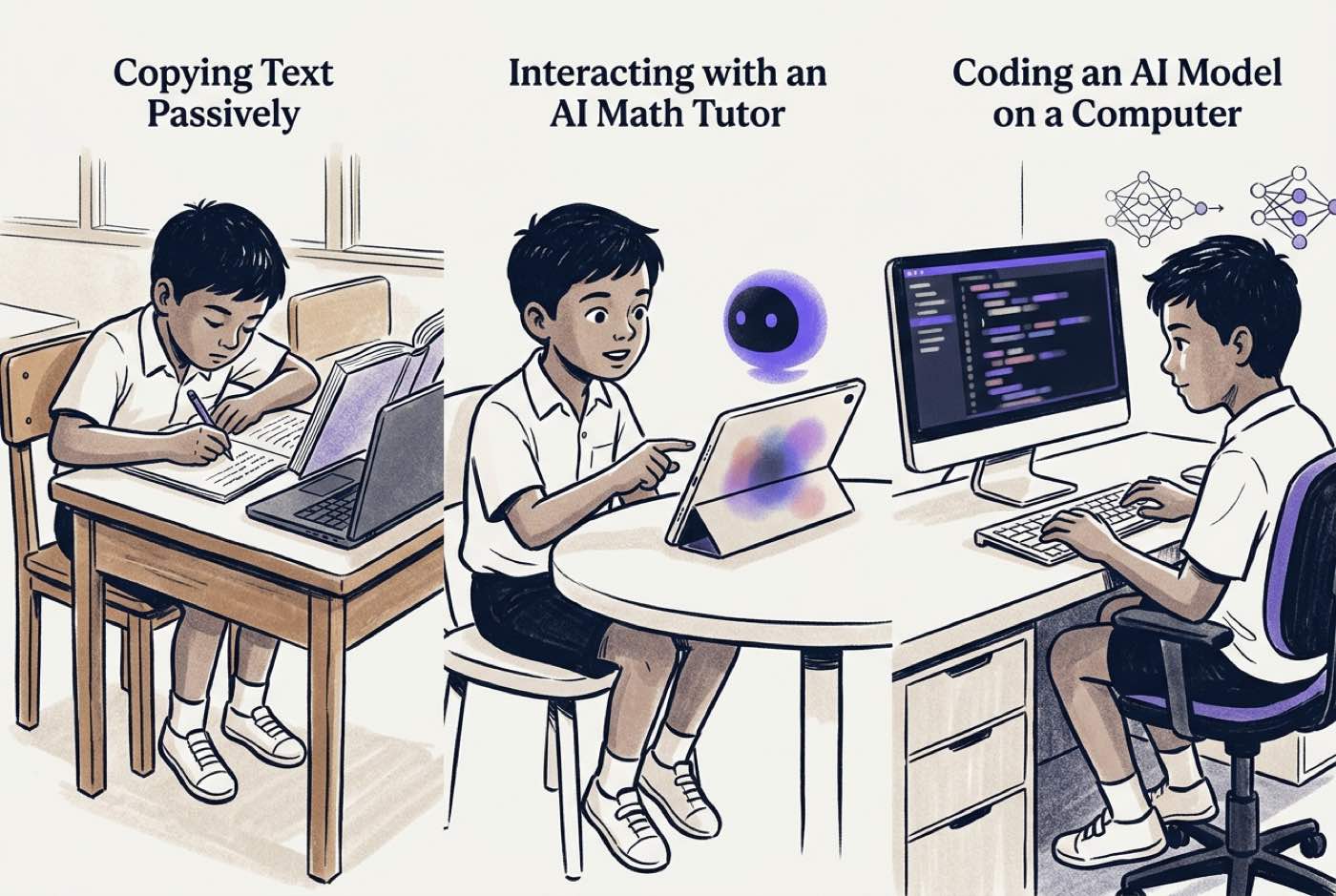
Level 1: Copy-Paste Mode (Passive Delegation)
The child feeds the AI the homework question word for word ("Write a 300-word essay on the Malacca Sultanate") and drops the output straight into Google Docs or Microsoft Word.
- Mental effort: Near zero.
- Educational value: None. The topic teaches them nothing; the only lesson learned is that tasks can be bypassed.
- Parent verdict: Academic dishonesty. Stop it immediately.
Level 2: Tutor Mode (Active Scaffolding)
The child treats the AI as a private tutor on call. Rather than requesting answers, they ask it to explain a formula, unpack a historical event, or critique a draft they wrote themselves ("I wrote this paragraph about photosynthesis. Are my scientific terms correct, and where can I improve my transitions?").
- Mental effort: Moderate to high.
- Educational value: High. Authorship stays with the child, feedback arrives instantly, and revision becomes a habit.
- Parent verdict: Recommended academic practice.
Level 3: Builder Mode (Computational Thinking)
The child stops chatting with AI and starts building with it: generating Python scripts with code assistance, wiring up game mechanics in Roblox or Unity, assembling custom datasets, shipping interactive applications.
- Mental effort: Very high.
- Educational value: Exceptional. Prompt mechanics, logic design, debugging, and computational thinking all get exercised.
- Parent verdict: The ultimate goal of modern digital literacy.
| Feature | Level 1: Copy-Paste Mode | Level 2: Tutor Mode | Level 3: Builder Mode |
|---|---|---|---|
| Primary Action | Asking for direct answers | Asking for explanations and feedback | Prompting AI to write code or logic for projects |
| Who Does the Work? | The AI model entirely | The student, guided by AI feedback | The student, directing the AI engine |
| Retention Rate | Very low | High | Excellent |
| Long-Term Impact | Cognitive decline and academic risk | Improved independent learning | Technical literacy and problem-solving skills |
| Parent Action | Prohibit and reframe | Encourage with prompt rules | Support through structured AI classes |
For more on how building with technology turns passive consumption into mastery, read our analysis on using AI versus building with AI.
How Malaysian Schools and Global Policy Are Handling AI Right Now
Parents keep asking us why school guidance on AI is so muddled. The short answer: education systems cannot revise policy as fast as these tools ship updates.
UNESCO published its global Guidance for Generative AI in Education and Research in September 2023 and refreshed the strategic framework in early 2026 [5]. Its assessment was blunt: generative models are released faster than national regulators can respond, so schools are left without shared validation standards [5]. UNESCO recommended enforcing age limits on independent platform use, paired with age-appropriate human-agent validation frameworks [5].
Malaysian schools are moving at different speeds:
- IGCSE and International Curricula: Many international schools in Kuala Lumpur and Penang allow AI for background research and outlining, as long as every AI interaction is cited in the bibliography. Submitting unedited AI text still draws penalties under academic integrity codes.
- KSSR / KSSM National Schools: Government schools have started folding digital literacy into national programmes, with bodies such as AI Malaysia Berhad coordinating ecosystem-level goals [2]. What happens inside any given classroom still depends largely on the individual teacher.
Since the rules shift from one classroom to the next, the school cannot be your only source of boundaries. A consistent standard at home gives your child something stable to work from, whatever their teacher decides this term.
Why AI Detectors Fail (And Why Punishing Kids Backfires)
The reflex, once you suspect an essay came from a chatbot, is to paste it into a free AI detector. Resist it.
Researchers at Stanford University tested seven commercial AI detection algorithms against writing samples from US eighth-graders and from non-native English speakers sitting the Test of English as a Foreign Language (TOEFL) [4].
The numbers:
- The detectors handled US native writing with high accuracy, yet falsely classified 61.22% of essays by non-native English students as AI-generated [4].
- 97% of the non-native TOEFL essays were flagged as AI-generated by at least one detector [4].
- 19% were wrongly flagged by all seven detectors at once [4].
The bias traces back to how the software measures text. Detectors rely on "perplexity," a metric reflecting vocabulary complexity, sentence variation, and grammatical predictability [4]. Non-native English writers, and young students still growing their vocabulary, tend to write in predictable grammatical patterns with lower lexical diversity. The software reads that regularity as machine output [4].
In a country where many students write in their second or third language, that failure mode is dangerous. A false accusation built on flawed software costs you your child's trust and teaches them to hide their AI use instead of talking about it.
How to Spot AI-Written Homework Without Playing Police
You do not need detector software. Carelessly prompted language models leave fingerprints in the writing itself:
- Over-polished vocabulary shifts: Phrases like furthermore, it is crucial to consider, in conclusion, or a testament to appear in a paragraph that otherwise sounds nothing like how your child talks or writes.
- Symmetrical paragraph construction: Every body paragraph runs to the same length and follows the same shape: thesis sentence, two generic examples, neat summary line.
- Vague, non-specific examples: Without local context to draw on, generative AI reaches for generalities. An essay on Malaysian geography mentions "lush rainforests and vibrant cities" and never names a state, a river, or a park.
- Lack of personal stance: The text stays studiously neutral, weighing "on the one hand" against "on the other hand" and never landing on an argument.
When you spot these markers, skip the raised voice and the punishment. Sit beside your child, point at one paragraph, and ask three questions:
- "Can you explain what this specific sentence means in your own words?"
- "Why did you choose this argument over another one?"
- "What source gave you this specific fact?"
A child who wrote or genuinely edited the text answers without effort. A child who pasted it will stumble over their own vocabulary. Treat that as the lesson about owning what you submit, rather than as a verdict.
For a deeper dive into ethical AI usage and misinformation safety, review our guide on AI ethics and safety for young learners.
5 Prompts That Make AI Work Harder for Your Child, Not Easier
Copy-paste cheating dies when the prompt changes. Teach your child these five, and ChatGPT stops being an answer machine and starts behaving like a demanding coach.
1. The Socratic math tutor
"I am trying to solve this math problem: [Insert Problem]. Do not give me the answer or solve it for me. Ask me one guiding question at a time to help me figure out the next step myself."
2. The critical essay editor
"Read this paragraph I wrote: [Insert Text]. Point out three places where my argument is weak or where I need to provide stronger evidence. Do not rewrite the paragraph for me."
3. The concept checker
"I am studying [Topic, e.g., Newton's Laws of Motion]. Ask me 5 progressive multiple-choice questions to test my understanding. Wait for my answer after each question before telling me if I am right."
4. The step-by-step breakdown
"Explain the historical causes of [Event, e.g., the Malacca Sultanate's rise] using simple language suitable for an 11-year-old. Use bullet points and focus on the cause-and-effect chain, not just dates."
5. The analogy generator
"I do not understand how [Complex Concept, e.g., API calls / cell mitochondria] works. Give me three real-world analogies using everyday items to explain how it functions."
Constraints such as "Do not give me the answer" or "Ask me questions one at a time" flip the workload back onto the student. The AI supplies scaffolding; the thinking stays at home.
To help your child master advanced prompting techniques across various subjects, explore our guide on mastering prompt engineering for kids.
The Family AI Agreement: Rules by Age Group
Rules have to match the child in front of you. An 8-year-old needs a parent watching the screen. A 16-year-old grinding through IGCSE or SPM preparation needs ethical boundaries and a verification habit.

Ages 5 to 8 (Foundational Literacy)
- Platform access: Co-piloted use only. No independent accounts.
- Permitted uses: Interactive storytelling, generating creative drawing ideas, asking curious "why" questions about science and nature.
- Prohibited uses: Any independent typing or searching without a parent present.
- Focus: Building early awareness that AI is a tool made by people, with fairness and fact-checking introduced as early childhood AI frameworks suggest [2].
Ages 9 to 12 (Scaffolded Learning)
- Platform access: Shared household account on a family screen.
- Permitted uses: Explaining difficult homework concepts, checking spelling and grammar, generating project ideas, interactive quiz preparation.
- Prohibited uses: Direct copy-pasting of text, generating full essays or stories for school submissions.
- Focus: Moving screen time from watching to making. For strategies on balancing digital activities, see our guide on screen time versus coding time.
Ages 13 to 18 (Academic Autonomy & Ethical Mastery)
- Platform access: Personal student account with full transparency.
- Permitted uses: Essay outline generation, code debugging, logical critique, research synthesis, complex problem breakdown.
- Prohibited uses: Submitting AI-generated prose as original work, uploading private personal data or confidential school documents.
- Focus: Getting ready for university-level work by attributing AI use openly, checking primary sources twice, and using AI for technical development.
Printable Family AI Contract
Use this agreement to set the household rules in writing. Read each point with your child, tick the boxes together, and keep the signed sheet near their study area.
- Rule 1: Transparency First. I will always tell my parents or teachers if I used an AI tool to help with a homework assignment.
- Rule 2: No Direct Copy-Pasting. I will never copy text generated by AI and paste it directly into my school assignments as my own writing.
- Rule 3: Verify All Facts. I understand that AI models frequently make mistakes or invent information (hallucinations). I promise to verify every fact, statistic, and quote with an official textbook or reputable website.
- Rule 4: Keep Personal Data Private. I will never type my full name, home address, school name, phone number, or private passwords into any AI platform.
Designed, ready to print and sign. We email it to you together with a 5% discount on your next registration.
Beyond Homework: What True 'AI-Savvy' Looks Like
Parents ask us how to prepare their children for the future, and our answer usually disappoints them at first: typing prompts into a chatbot is the bottom rung of digital literacy, not the ladder.
A teenager who can get ChatGPT to produce essay answers has a trick that works until the next assignment. A teenager who understands how large language models function, writes clean Python to automate a task, structures a database, and builds an original AI application has something employers will pay for.
| Stage | What it looks like in practice |
|---|---|
| Passive consumer | Types questions into ChatGPT to copy homework |
| Active learner | Uses AI as a Socratic tutor to master math and science |
| AI-savvy builder | Builds custom AI models, codes apps, and solves real problems |
Real AI literacy moves a child from consuming digital products to making them. Children who reach that point stop worrying that AI will make their skills obsolete; they learn to steer these engines, pulling together mathematical logic, computational thinking, and software architecture to build things that work.
How Kidocode Teaches Kids to Master AI, Math, and Tech
At Kidocode, AI is neither a threat to education nor a homework shortcut. We treat it as a foundational literacy skill and teach it alongside deep mathematical thinking and hands-on technology tracks.
We are Malaysia's specialized AI school for children aged 5 to 18. Across our flagship campus in Solaris Mont Kiara, Sunway Nexis in Kota Damansara, our Penang centers (Q2 Waterfront, Tanjung Tokong, and Icon City), and our live interactive online classes, the learning experience rests on three pillars:
- AI Pillar First: Students learn how AI models work from the inside out, covering prompt architecture, algorithmic fairness, model training, and ethical direction, so safety and literacy develop together.
- Math Through Builds: Parents often arrive telling us their child hates math. Our experience says the child is fine and the memorization-based teaching was broken. We follow international standards (including IGCSE, Cambridge, and US Common Core), but the syllabus gets delivered through building. Kids use math to program game physics, calculate AI probability, and construct 3D geometry, and math aversion usually breaks in 2 to 4 weeks.
- Tech and Coding Bundled Free: Other centers sell basic coding as a premium standalone subject. Kidocode bundles it free across six tracks: Python, Web Development, Mobile Apps, Game Development, Electronics, and 3D Modeling. Coding syntax is public knowledge now; computational thinking is the thing we actually teach.
Our educational framework was established by our founder, Hossein Tohidi, known to students and parents as Unclecode, a computer scientist and AI researcher who created Crawl4AI, an open-source web scraping engine used by Fortune 500 companies globally.
Whether your child is 7 and starting with logical puzzles or 15 and eyeing a computer science degree, our personalized approach ends every session with something tangible your child built. Explore our specialized tracks across our AI program, our Math framework, and our Tech tracks.
Book a Free Hands-On Trial at Kidocode
The fastest way to judge how your child responds to structured, hands-on tech education is to watch it happen.
Parents and students can book a free trial session at any of our physical centers or through our live, camera-on online classes:
- Hands-On Experience: Up to 2 hours in which your child builds a real, working project in AI, math, or coding.
- Both Parents Welcome: Bring both parents. Watch the teaching method, and see how your child handles complex material when it arrives as a project instead of a lecture.
- Zero Pressure: No sales pitch, no obligation. Judge it by your child's engagement.
Pick your nearest location (Solaris Mont Kiara, Sunway Nexis PJ, Q2 Waterfront Penang, Icon City, or Live Online) and reserve a slot:
Book Your Free 2-Hour Trial Class at Kidocode
Frequently Asked Questions
Is using ChatGPT for homework considered cheating in Malaysian schools?
It depends on how the tool is used and your school's policy. Copying text directly from an AI generator and submitting it as original work counts as academic dishonesty across Malaysian primary, secondary, and international schools. Using AI to explain concepts, generate revision quizzes, or check grammar is increasingly accepted as valid study scaffolding, provided the final work reflects the student's own thinking.
Can teachers tell if a student used ChatGPT for an assignment?
Yes, experienced teachers spot unedited AI writing easily. The output tends to carry over-polished vocabulary, predictable paragraph structures, no personal voice, and vague general statements. A teacher who already knows a student's writing style will also notice sudden shifts in vocabulary and tone.
Should I ban my child from using AI entirely at home?
Bans rarely work and usually push the behaviour underground, where no guidance reaches it. Setting clear household rules through a Family AI Agreement works better: teach your child to use AI as an interactive tutor, and make copy-pasting raw output into school submissions a firm no.
At what age should children start learning about AI?
Children can start on foundational AI concepts as early as age 5 to 8 through guided, age-appropriate activities built around logic, fairness, and safety, as national educational frameworks recommend [2]. Between ages 9 and 12, structured prompting and computational thinking help them shift from passive screen consumers into active builders.
How does Kidocode teach AI differently from standard coding tuition?
Kidocode is an AI-first school that combines artificial intelligence, international math standards, and computational tech tracks in a single membership framework. Instead of syntax memorization or entry-level drag-and-drop tools alone, students aged 5 to 18 learn to direct AI models, build real Python applications, solve mathematical problems through practical projects, and master computational logic.
References
- Pew Research Center, Teens and AI (February 2026)
- National AI Office (NAIO) Malaysia, Ethical AI for Kids Teaching Guide
- Universiti Teknikal Malaysia Melaka (UTeM), Exploring ChatGPT Awareness and Perceptions Among Students (January 2025)
- Stanford Institute for Human-Centered AI (HAI), AI Detectors Biased Against Non-Native English Writers (May 2023)
- UNESCO, Guidance for Generative AI in Education and Research (January 2026 Update)
- Stanford SCALE Initiative, Evidence of Cognitive Engagement Decline in AI-Assisted Writing Tasks (June 2025)
- PubMed / Cognition, Brain, Behavior, Cognitive Offloading and Strategic Engagement in AI-Assisted Tasks (June 2026)