

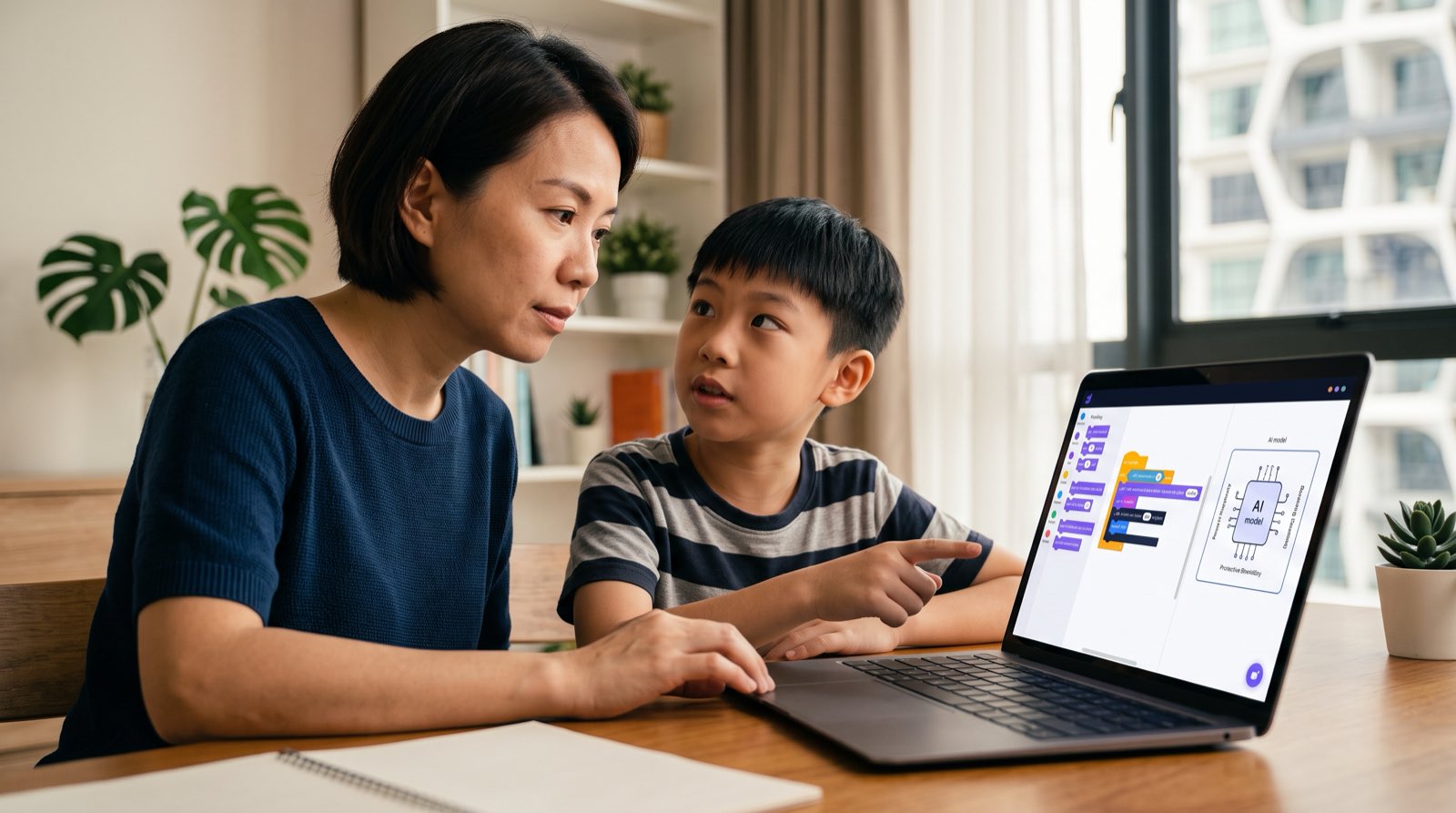
Artificial intelligence stopped being a university research topic and turned up inside search engines, homework apps and social feeds. Parents in Kuala Lumpur, Petaling Jaya and Penang now watch primary and secondary school children ask chatbots for homework answers, read generative search summaries and play with image generators before dinner. So the question comes up at kitchen tables across the country: is AI safe for kids, or are we handing young minds a machine that quietly feeds them wrong facts, easy shortcuts and risks nobody is checking?
Most families swing towards one of two responses. Some lock everything down. Others hand over the tablet and hope for the best. Both leave the child unprotected. Locking down access is barely feasible when 94% of Malaysian adolescents aged 12 to 17 go online every day [5]. Handing over the tablet leaves a child exposed to hallucinated facts, emotional dependency and habits that quietly replace learning.
Speaking at the 2025 ASEAN ICT Forum in Kuala Lumpur, Deputy Prime Minister Datuk Seri Dr Ahmad Zahid Hamidi framed government policy as empowering children to move through technology safely and confidently rather than disconnecting them from it [7]. That framing is the useful one for parents too. Safe AI use comes from critical thinking, verification habits and real computational literacy, so that your child stays in charge of the tool.
Contents
- Key Takeaways for Parents
- The Parent's Dilemma: Risk, Convenience, and AI Adoption
- Misinformation and Hallucinations: The Factuality Problem
- The Cheating Conundrum: Shortcut vs Scaffolding
- Emotional AI Companions and Synthetic Harms
- The Visibility Gap: What Kids Do vs What Parents See
- Why Blanket Bans Fail: The Path to Critical Literacy
- Framework: Passive AI Consumer vs Active AI Builder
- How Kidocode Teaches Ethical, Safe, and Creative AI Use
- Action Plan: Establishing Household AI Guardrails
- Printable AI Safety & Accountability Contract for Families
- Frequently Asked Questions
- References
Key Takeaways for Parents
| Area of Concern | Real-World Risk Level | What Empirical Data Shows | The Practical Family Solution |
|---|---|---|---|
| Misinformation & Hallucinations | High for unverified search and research | Red-teaming audits found search AI gave inconsistent historical facts 43% of the time [4]. | Teach children verification habits; treat AI outputs as drafts requiring cross-referencing against primary sources. |
| Homework Cheating | Moderate to High without ground rules | 54% of US teens use chatbots for schoolwork [2], while overall cheating rates remain stable [3]. | Set clear rules: use AI to explain concepts and structure ideas, never to copy finished essays or solve assignments directly. |
| Emotional Dependency | High when marketed as trusted companions | 12% of teens turn to chatbots for emotional support or advice [2], risking unmonitored advice [6]. | Establish firm boundaries: AI is a software tool, not a friend, confidant, or emotional support system. |
| Parental Oversight Gap | High across most households | 64% of teens report using AI chatbots, but only about 50% of parents realise their children do [2]. | Maintain open conversations, co-pilot initial AI exploration, and move from passive monitoring to active project review. |
| Child Safety & Exploitation | Severe risk in unregulated environments | AI-generated child abuse content grew substantially globally [1],[5]. | Use safe, supervised platforms; enforce strict data privacy rules (never upload personal photos, names, or locations). |
The Parent's Dilemma: Risk, Convenience, and AI Adoption
The same tools that give a child a patient tutor at 10pm also give them synthetic media, confident-sounding falsehoods and a habit of asking software before thinking. Parents are being asked to weigh both at once, usually without much warning.
Policy bodies are wrestling with the same tension. In December 2025, UNICEF published Version 3.0 of its policy guidance on AI for children, setting out 10 core requirements grounded in the UN Convention on the Rights of the Child [1]. The update was prompted by how quickly generative tools and AI companions spread. It points to genuine gains for learning alongside serious risks: contaminated datasets, non-consensual synthetic imagery and commercial profiling nobody is checking [1].
flowchart TD
    A[Child Meets AI Tool] --> B{How is the AI Used?}
    B -->|Passive Consumption| C[Copies AI Answers / Believes Hallucinations]
    B -->|Guided Literacy| D[Queries AI as an Assistant / Verifies Outputs]
    C --> E[Loss of Critical Thinking & Privacy Risks]
    D --> F[Builds Conceptual Understanding & Safe Habits]
Malaysia shows the gap between access and protection clearly. Adolescent connectivity sits at 94% [5], yet the reporting channels built for online safety go largely unused. The Disrupting Harm Malaysia study found that around 4% of Malaysian adolescents aged 12 to 17 experienced online exploitation or abuse, while only 3% of school children said they would seek help through official reporting channels [3].
Left to work it out alone, children take the easiest route available. They trust the text on screen, paste generated paragraphs into homework and type personal details into systems that log everything. Fixing that starts with knowing where each risk actually comes from.
Misinformation and Hallucinations: The Factuality Problem
The problem children hit most often is hallucination. Large language models (LLMs) are not looking up verified facts in a database; they are predicting which words are statistically likely to come next. Ask a chatbot about a Malaysian historical event or a physics question, and it will produce fluent, confident sentences that may be wrong from beginning to end.
Product testing bears this out. A mid-2026 red-teaming audit by the Common Sense Media Youth AI Safety Institute, covering 2,624 interactions, rated Google Search's generative features (AI Overview and AI Mode) as "Unacceptable Risk" for children and teens [4].
Three findings from that audit matter most for young learners:
- Historical Inconsistency: Across 278 prompts examining historical facts, 43% of repeated, identical queries returned materially different responses [4].
- Unverified Sources: An audit of over 2,100 citations generated by search AI tools found that 29% originated from user-generated platforms without editorial accountability, while only 30% came from high-quality authoritative sources [4].
- Inconsistent Safety Guardrails: Across mental health crisis prompts, embedded search AI provided appropriate crisis resources in only 58% of moments, dropping to roughly 50% for passive or indirect statements [4].
A child who treats AI as an authority absorbs its errors without noticing. For a secondary student revising history or science for SPM or IGCSE from unverified search summaries, the damage shows up months later, built into the foundations.
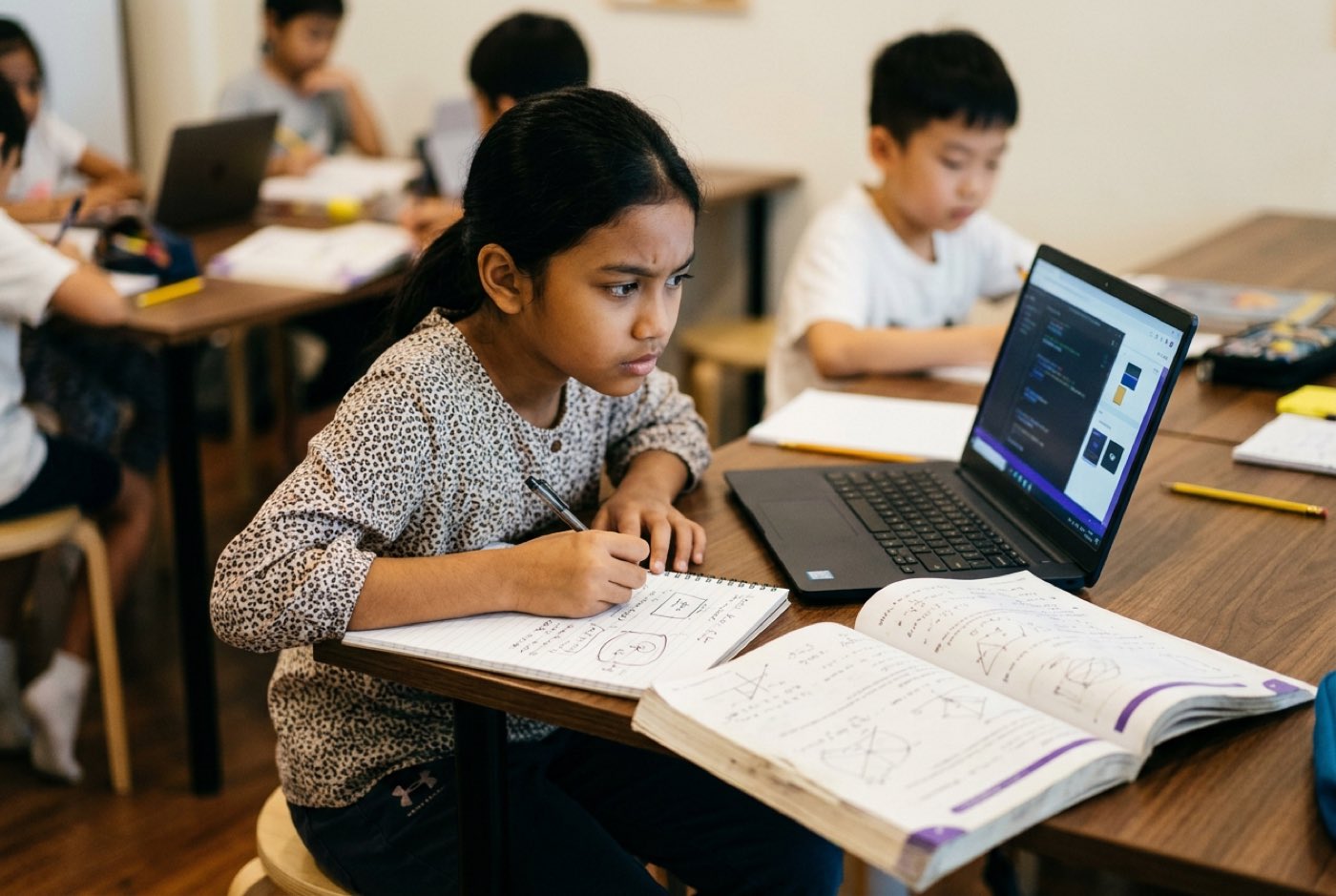 At Kidocode, students hear one rule in their first session: AI models do not think; they calculate probability. Once a child grasps that the model is an engine producing likely text from its training data, the aura of the oracle disappears. Every output becomes a hypothesis to check against a primary source, a textbook or a mathematical proof.
The Cheating Conundrum: Shortcut vs Scaffolding
Academic dishonesty is what parents and teachers raise first. A February 2026 national survey by the Pew Research Center found that 54% of US teenagers aged 13 to 17 use AI chatbots for help with schoolwork [2],[8]. Broken down by task: 48% use AI for research, 43% to solve math problems and 35% to edit or revise text [8].
Among the teenagers surveyed, 59% believe AI-assisted cheating happens regularly at their school [2]. The measured picture is less dramatic. Research published in Computers & Education by Challenge Success, an affiliate of the Stanford Graduate School of Education, found that self-reported student cheating rates stayed relatively stable after tools like ChatGPT went public [3].
That same study found most high school students consider producing an entire paper or assignment with a chatbot unallowable [3]. What they do endorse is scaffolding: brainstorming essay outlines, getting a difficult assignment started, having a hard mathematical concept explained again in different words [3].
So the problem is rarely a child who wants to cheat. It is homework that grades mechanical output instead of understanding. A student who lets AI write the whole essay skips the cognitive struggle that would have built their analytical thinking in the first place.
For a detailed parent framework on managing daily homework interactions, read our guide on what parents should do when a child uses ChatGPT for homework.
The Math Parallel
Mathematics makes the difference between shortcut and scaffolding obvious. A student copies a step-by-step solution from a chatbot onto the worksheet and collects full marks. Then an unseen problem appears in an IGCSE or KSSR paper, and the reasoning that should have been built simply is not there.
Take a quadratic describing a projectile path:
The unguided student copies and moves on. The trained student asks the AI to walk through the factorization:
Then they check that time and identify seconds as the physically valid answer. The AI explained the structure; the child did the evaluating.
Emotional AI Companions and Synthetic Harms
Past accuracy and academic honesty sits a quieter risk: attachment. Voice synthesis, conversational memory and humanlike avatars are designed to make software feel like company, and young users respond to that design.
Pew Research Center data shows 16% of teenagers use AI chatbots for casual conversation, and 12% turn to them for emotional support or advice [2],[8]. Reports from the 5Rights Foundation and allied civil society groups warn that general-purpose chatbots marketed as companions or confidants create acute risks for child development and mental health, because they have no human empathy, no professional boundaries and no child safety safeguards [6].
Generation of synthetic media is the other side of it. Common Sense Media's testing showed that once safety prompts were circumvented, commercial generative search features handed over actionable instructions for making deepfakes and cloning voices [4]. Globally, the Internet Watch Foundation reported a 26,000% increase in AI-generated child sexual abuse material during 2025 alone [5].
Watching from a distance is not enough against numbers like these. Children need three technical facts stated plainly:
- AI has no emotions, feelings, or moral consciousness. It generates statistical text sequences mimicking empathy based on training text.
- AI systems retain data. Information, images, or personal disclosures shared with commercial chatbots can end up in model training logs or server databases.
- Synthetic manipulation carries real legal and ethical consequences. Creating or sharing altered images of classmates is a severe privacy violation and a breach of digital safety laws.
The Visibility Gap: What Kids Do vs What Parents See
Malaysian families run into a second problem before they even get to the rules: parents often do not know the tools are being used.
| Measure | Share of respondents |
|---|---|
| Teens who report using AI chatbots | 64% |
| Parents who realise their teen uses them | ~50% |
Pew Research Center data shows that while 64% of teenagers report using AI chatbots, only about half of parents realise their teenager uses these tools [2].
The gap opens because AI now lives inside ordinary apps, search bars and browser extensions. Glance at your child's screen and you see something that looks like a search engine or a messaging window; the chatbot writing complete answers is not labelled as one.
| Measure | Share of teens |
|---|---|
| Have heard of AI chatbots | 95% |
| Feel highly confident using them effectively and safely | 26% |
More than 90% of teenagers have heard of AI chatbots, yet only 26% feel highly confident using them effectively and safely [2]. Daily use paired with low confidence means children are handling powerful software without a working sense of its limitations, safety settings or biases.
Parents who react to that discovery with sudden surveillance or a total device ban usually just relocate the usage: school devices, a friend's phone, an account nobody is watching.
Why Blanket Bans Fail: The Path to Critical Literacy
Hallucinated facts, cheating and privacy leaks push plenty of parents towards banning AI at home. Three things get in the way:
- Ubiquitous Integration: AI is built into major search engines, productivity suites, word processors, and educational portals used by Malaysian schools. Banning AI entirely means disconnecting a child from basic digital infrastructure.
- Evasion and Secrecy: Unilateral restrictions cause children to bypass age-verification checks or use adult accounts in secret [5]. When issues arise (such as encountering inappropriate outputs or hallucinated data), children who fear punishment will not seek parental guidance.
- Skill Deprivation: AI literacy is becoming an essential future competence. Children who learn to direct AI safely gain a substantial learning accelerator, while those forbidden from touching it fall behind in digital problem-solving.
The better question is not how to block your child from AI, but how to teach them to direct it critically, check what it claims and build real things with it.
To understand how technical literacy differs from basic tool usage, explore our guide on AI literacy versus coding skills for kids.
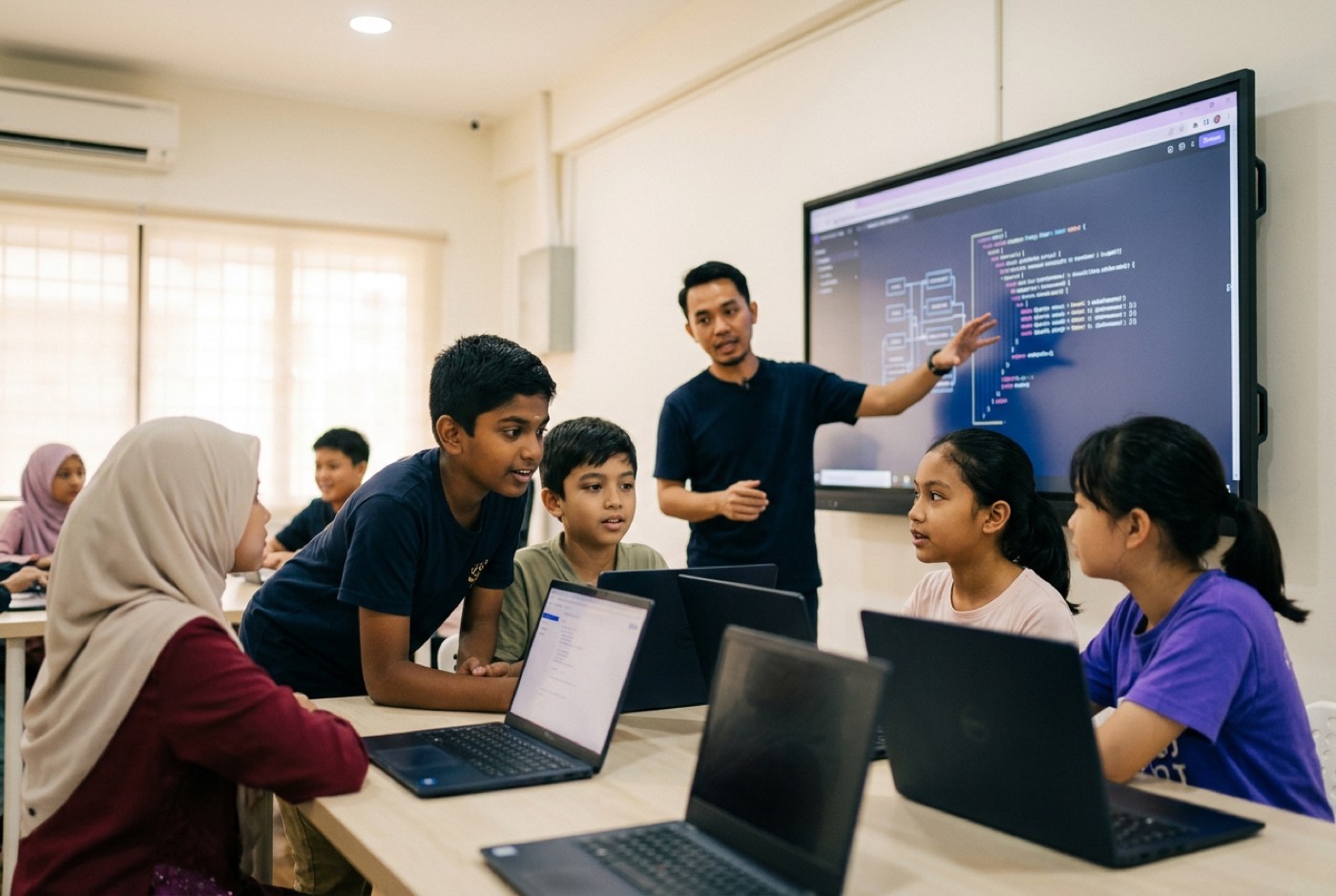
Framework: Passive AI Consumer vs Active AI Builder
One distinction helps parents judge what they are watching: is the child a Passive AI Consumer or an Active AI Builder?
| Dimension | Passive AI Consumer (High Risk) | Active AI Builder (Low Risk, High Growth) |
|---|---|---|
| Primary Interaction | Asking a chatbot to write essays or generate complete homework answers. | Prompting AI to explain complex concepts, debug code, or brainstorm project ideas. |
| Verification Habit | Accepts AI text outputs as factual truth without checking external sources. | Cross-checks claims against textbooks, documentation, and empirical math proofs. |
| Understanding of AI | Views AI as a magic, intelligent entity that "knows" answers. | Understands AI as a statistical language model trained on pattern recognition. |
| Privacy Awareness | Inputs personal details, full names, school names, and private photos into prompts. | Uses anonymous identifiers; keeps personal data out of public prompts. |
| Educational Outcome | Stagnation of critical thinking and loss of fundamental problem-solving skills. | Accelerated learning, early entry into real text coding, and deep computational thinking. |
| Long-Term Mindset | Reliant on automated outputs generated by external systems. | Capable of directing AI assistants to construct software, games, and web applications. |
Moving a child from the left column to the right takes structured guidance. Once children see how AI systems are built, trained and fine-tuned, the mystery drains out of them. Responses stop being pronouncements and start being outputs to inspect, test and refine.
How Kidocode Teaches Ethical, Safe, and Creative AI Use
Kidocode is Malaysia's coding and AI school for kids aged 5 to 18, and our approach is AI-first. Across our flagship campus in Solaris Mont Kiara, Sunway Nexis in Petaling Jaya, our three Penang centers (Q2 Waterfront in Bayan Lepas, Tanjung Tokong, and Icon City in Bukit Mertajam), and our live online classrooms, we do not treat coding as syntax to memorise. Coding comes bundled free in our curriculum because pure syntax is now public knowledge. What we teach is computational thinking and AI direction.
Three things shape how our students learn to build responsibly.
1. AI Literacy and Safety Co-Equal from Day One
Children learn how large language models work under the hood: how prompts get processed, why hallucinations happen, how bias enters a training dataset. Safety is not a list of abstract rules read out at the start of term. Prompt safety, data privacy and ethical boundaries get taught inside the project a student is actually building.
2. Math Through Builds with a Personalised AI Tutor
Parents often arrive telling us their child struggles with math or hates it. Our position is clear: the child is fine; traditional memorize-and-test teaching was broken. We deliver the exact same international standards (IGCSE, Cambridge, US Common Core), but in reverse: kids learn math by using it to build.
Each child works with a personalized AI tutor that adapts to their pace and gives instant feedback without judgment. Use coordinate geometry to move a sprite in Python, or vectors to calculate game physics, and math-hate usually ends within 2 to 4 weeks.
3. Accelerated Entry into Real Text Coding
Traditional computer science programs keep kids on visual drag-and-drop blocks like Scratch for years. Visual blocks work well for early engagement (ages 5 to 7), but AI coding assistants let students aged 8 and above reach real text-based coding (Python, JavaScript, HTML/CSS) far sooner than old curricula assumed.
The assistant absorbs mechanical syntax errors so the student's attention stays on algorithm design, logic flow and architecture.
To see how learning to build with AI compares to merely using commercial chatbots, read our breakdown on using AI versus building with AI.
For parents comparing local enrichment programs in KL or Penang, our detailed guide on how to choose an AI class for kids provides clear evaluation criteria.
Action Plan: Establishing Household AI Guardrails
Here is what you can put in place at home this week.
Step 1: Establish the "Three-Pass Verification Rule"
No AI-generated factual claim goes into schoolwork untouched. Every output clears three checks first:
- Pass 1 (Logic Check): Does this answer make logical sense based on what you already know?
- Pass 2 (Source Check): Can you find this exact fact in a textbook or reputable online reference site?
- Pass 3 (Voice Check): Is this written in your own words and at your own level of understanding?
Step 2: Separate AI Assistance from Final Homework Output
Draw the line where the work starts being produced for the child:
- Allowed: Using AI to explain a difficult concept, suggest an essay outline, create practice math problems, or debug error messages in a computer script.
- Not Allowed: Asking AI to write a paragraph, complete an entire essay, or output completed math worksheets for direct submission.
Step 3: Enforce Strict Prompt Data Hygiene
Go over these privacy rules with your child regularly:
- Never enter real names, phone numbers, home addresses, or school names into an AI prompt.
- Never upload photos of family members, classmates, or school uniforms to online image generators or vision models.
- Treat every prompt as public information that may be stored on external servers.
Step 4: Shift Screen Time from Consumption to Creation
If your child spends hours on Roblox or scrolling video feeds, put a different offer on the table. Ask them: "What if the hours you spend playing games were spent building your own game using AI tools?" The mindset shift from media consumer to software creator often starts with that one question.
Printable AI Safety & Accountability Contract for Families
Print this contract, review each item together with your child, check the boxes, and keep it near your child's primary study desk.
- Rule 1: We treat AI as an assistant, not an oracle. I will never take an AI response as automatic truth. I promise to verify factual claims using textbooks, official websites, or teacher guidance.
- Rule 2: We use AI for understanding, not shortcuts. I will use AI to help explain hard concepts, structure outlines, or find code errors. I will never copy and paste AI-generated text directly into my school assignments.
- Rule 3: We protect our personal data. I will never input my full name, age, home address, school name, phone number, passwords, or personal photos into any AI prompt or app.
- Rule 4: We respect emotional boundaries. I understand that AI chatbots are software programs without real feelings or consciousness. I will turn to my parents, teachers, or trusted adults when I need personal advice or emotional support.
Designed, ready to print and sign. We email it to you together with a 5% discount on your next registration.
Frequently Asked Questions
Is my child too young to learn about AI?
Age matters less than the teaching approach. As our founder Unclecode puts it, the moment a child can play a game on a tablet or mobile device is the moment they can start learning how to build one. For ages 5 to 7, that means visual logic blocks and physical electronics. For ages 8 to 18, it moves into prompt engineering, Python and directing AI software development tools.
Will relying on AI make my child lazy or stop them from thinking?
If a child uses AI as a passive shortcut to produce finished homework, yes, critical thinking erodes. Used as a builder's tool, to debug code, explain a proof or test a hypothesis, it speeds cognitive growth up. What decides the outcome is whether the child is receiving outputs or directing the software.
How does Kidocode protect children's data privacy during AI classes?
All student activity happens inside secure, supervised learning platforms. Students work with curated development environments and open-source models, such as Crawl4AI, created by our founder Unclecode, where personal data, contact information and private identifiers are never exposed to public model training sets. Data hygiene is part of every lesson rather than a separate briefing.
How is learning AI at Kidocode different from a standard tuition centre or coding bootcamp?
We are neither. Tuition centres run on repetitive worksheets and rote learning. Coding bootcamps teach rigid syntax that dates quickly. Kidocode is an AI-first technology and math school: computational thinking, mathematical logic learned through building, and safe direction of AI systems. Coding syntax comes bundled free across all six of our tech tracks (Python, Web, Mobile, Game, Electronics, 3D).
What happens during a Kidocode free trial class?
The free trial runs up to 2 hours and is entirely hands-on. Your child works directly with our trainers to build a real project in AI, math or tech. Both parents are welcome to sit in, whether in person at one of our five campuses (Solaris Mont Kiara, Sunway Nexis PJ, Q2 Waterfront Bayan Lepas, Tanjung Tokong, or Icon City Bukit Mertajam) or online in a live, camera-on session. There is no payment and no obligation. Book a session at kidocode.com/trial-class.
References
- UNICEF. Policy Guidance on AI for Children (Version 3.0). December 2025. Available from: https://www.unicef.org/innocenti/reports/policy-guidance-ai-children
- Pew Research Center. How Teens Use and View AI. Colleen McClain, Monica Anderson, Olivia Sidoti, and William Bishop. February 24, 2026. Available from: https://www.pewresearch.org/internet/2026/02/24/how-teens-use-and-view-ai/
- Challenge Success (Stanford Graduate School of Education affiliate). AI & Cheating Study. December 1, 2024. Available from: https://www.challengesuccess.org/ai-cheating/
- Common Sense Media Youth AI Safety Institute. Google Search AI Risk Assessment. Updated July 14, 2026. Available from: https://institute.commonsensemedia.org/risk-assessments/google-search
- UNICEF Malaysia. Beyond Age-Based Restrictions. Selvi Supramaniam. June 26, 2026. Available from: https://www.unicef.org/malaysia/stories/beyond-age-based-restrictions
- 5Rights Foundation et al. Joint Statement on AI Governance and Children's Rights. July 2026. Available from: https://5rightsfoundation.com/wp-content/uploads/2026/07/AI-J.-Statement-English.pdf
- UNICEF Malaysia. ASEAN Unites to Build Safer Digital Spaces for Every Child. November 18, 2025. Available from: https://www.unicef.org/malaysia/press-releases/asean-unites-build-safer-digital-spaces-every-child
- Education Week. Are Teens Just Using AI to Cheat? Well, Not Quite, If You Ask Them. Arianna Prothero. March 03, 2026 (updated April 13, 2026). Available from: https://www.edweek.org/technology/are-teens-just-using-ai-to-cheat-well-not-quite-if-you-ask-them/2026/03