

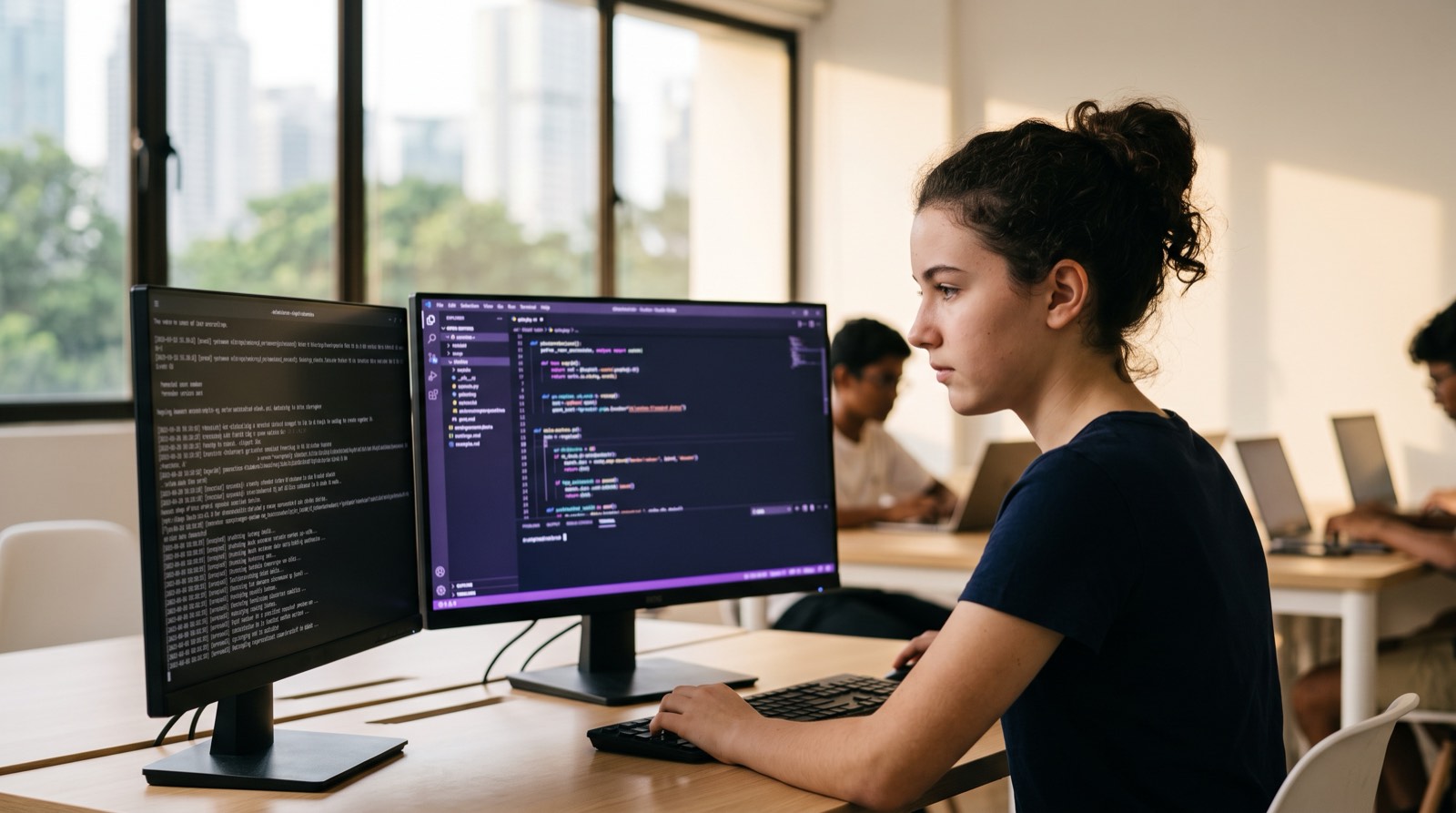
Parents of Form 4, Form 5, and IGCSE students bring me the same worry, whether they are sitting across from me at our Solaris Mont Kiara flagship campus or messaging our team in Penang. Their 15, 16, or 17-year-old has never written a line of code. They read headlines about tech prodigies, watch younger children build block games, and assume the boat has sailed.
It has not. A teenager who starts at 16 arrives with cognitive, mathematical, and analytical equipment that a 9-year-old does not have. With today's AI tools, a focused teenager can cover in months the syntax ground that used to take five years.
What follows is why the teen years are a good entry point rather than a late one, how AI assistants remove the tedious friction that used to define beginner coding, and how a student can build a serious portfolio while carrying SPM, IGCSE, or A-Level commitments.
Key Takeaways
| Topic | The Traditional View | The AI-Era Reality for Teens |
|---|---|---|
| Starting Age | Early childhood (ages 7 to 9) is necessary to build typing and logic habits. | Teens learn faster due to developed abstract reasoning, algebra, and logic. |
| Learning Curve | Months spent memorising syntax rules, brackets, and block-coding interfaces. | AI coding assistants absorb syntax overhead, allowing immediate text coding in Python. |
| Project Output | Simple toy projects, basic animations, and simple arcade games. | Full-stack web applications, AI models, data automation scripts, and working tools. |
| Academic Fit | Fixed weekly tuition slots that compete directly with SPM or IGCSE exams. | Flexible, project-based sessions tailored around exam cycles and holiday blocks. |
| University Value | Certificate of completion for basic coding courses. | Published GitHub repositories, live deployed projects, and demonstrated AI literacy. |
Table of Contents
- Why Parents Ask "Is 16 Too Late?"
- The Teen Advantage: Why 16 Is an Ideal Age to Start
- Why Starting at Scratch Is the Wrong Move for a Teen
- The AI Accelerator: Skipping Years of Syntax Frustration
- Bridging the Mindset Gap: From Consumer to Builder
- Portfolio Over Certificates: What Universities and Employers Look For
- When Your Teen Says "I Am Not Interested in Tech"
- Balancing Academic Workload Around SPM and IGCSE
- Three Realistic 6-Month Plans for Teenagers
- The Kidocode Approach to Teen AI and Tech Literacy
- What Your Teen's First Session Looks Like
- Next Steps for Parents
- Frequently Asked Questions
- References
Why Parents Ask "Is 16 Too Late?"
The fear comes from two places. One is the media's appetite for childhood prodigy stories. The other is an older educational model that treats computer science like a classical instrument: miss the window at age six, and you will never play well.
Parents who visit us usually raise the same practical points. The secondary school workload is heavy. SPM or IGCSE papers are close. The child has no prior exposure and types slowly. In trial sessions, parents often tell us their teenager already feels buried under school assignments and tuition, which makes adding a technical skill sound unrealistic.
National research points to a different problem. In a study published by the Tech For Good Institute in collaboration with MDEC, Malaysian youth highlighted a significant gap between classroom education and industry expectations in rapidly evolving fields such as AI, fintech, and product design [1].
Parents read that gap as proof their teen is behind. The premise underneath it, that computer science needs a decade-long runway, no longer holds. Sixteen is a strategic entry point.

The Teen Advantage: Why 16 Is an Ideal Age to Start
A 7-year-old has to build spatial awareness and motor skills before foundational logic makes sense. A 16-year-old walks in with the mental architecture already in place.
- Established Mathematics Foundation: A Form 4 or IGCSE student already works with variables, functions, Cartesian coordinate systems, and basic logic (). Variables and conditional logic in code are a change of notation, not a new concept.
- Abstract Problem Decomposition: Teenagers can reason about systems. They grasp how user logins work, how databases store information, and why data security matters.
- Clear Goal Orientation: Younger children need gamified feedback every few minutes. Teenagers usually arrive with a specific target, a portfolio site, a tool for the family business, data analysis for a school club, a stronger university application.
Young people across the region are already prioritising this. According to a Junior Achievement Institute study reported by ProductNation, 98% of surveyed Malaysian youth expressed a desire for their education to provide greater real-world operational exposure, and digital skills ranked as their top career priority over the next 10 to 15 years [2].
That appetite for real application is exactly why teens absorb practical computing concepts far more readily than early primary students do.
flowchart TD
    A[Teen Cognitive Advantage] --> B[Existing Math & Algebra Knowledge]
    A --> C[Abstract Systems Thinking]
    A --> D[Clear Career & University Intent]

    B --> E[Accelerated Syntax Learning]
    C --> F[Real Architectural Design]
    D --> G[High Project Completion Rate]

    E --> H[Working Production Project in 6-12 Months]
    F --> H
    G --> H
Why Starting at Scratch Is the Wrong Move for a Teen
When parents finally enrol their 16-year-old in tech classes, many land in a beginner track designed for 8-year-olds, built entirely around visual block tools like Scratch.
Scratch does its job well with primary school children learning sequential execution, loops, and events. Hand the same drag-and-drop interface to a 16-year-old and you usually get a shrug. The software reads as a toy. The teenager feels patronised and walks away deciding that coding is childish.
Nobody needs six months of dragging yellow and blue blocks to learn what a conditional statement does. Teens need real text-based tools:
- Python for data processing, scripting, and machine learning models.
- HTML, CSS, and JavaScript for visual web applications.
- SQL for database management and structural data storage.
- VS Code and Git for professional software development workflows.
If you want to see how the learning ladder changes across age bands, read our guide on what AI-savvy looks like at ages 8, 12, and 16.
The AI Accelerator: Skipping Years of Syntax Frustration
The hardest part of learning to code used to be syntax. Missing semicolons. Unmatched brackets. Indentation errors with cryptic messages. Beginners spent up to 80% of their time fighting the compiler instead of thinking about how their program should be structured.
AI has moved that burden off the student. Large language models and coding assistants carry the syntactic load, so a teenager starting today does not have to memorise every library command before building something that works. The skill being learned shifts to directing models, debugging logic, and orchestrating systems.
| Phase | Traditional Learning Path | AI-Accelerated Teen Path |
|---|---|---|
| Phase 1 | Syntax memorisation (months 1–12) | System design and AI prompting (month 1) |
| Phase 2 | Debugging syntax (months 12–24) | Live code review (months 2–3) |
| Phase 3 | Simple exercises (months 24–36) | Real build (months 4–6) |
The research backs this up. A study published in Information and Learning Sciences found that 77% of surveyed programming students used large language models frequently, with 56% stating that AI tools directly increased their learning motivation [3]. In the same study, 86% of students used AI for instant code debugging, and 54.5% reported taking on more complex or creative projects than they would have attempted alone [3].
The study also found that AI tools give students a non-judgmental environment where they can ask foundational questions without fear of looking foolish [3]. For a self-conscious 16-year-old who thinks everyone else started earlier, that matters more than any curriculum feature.
For more on how modern tools reshape foundational skills, see our article on why every kid should learn coding with AI tools.
Bridging the Mindset Gap: From Consumer to Builder
Most 16-year-olds live inside digital media. Short-form video feeds, multiplayer games, web apps all day. Very few have any idea what runs underneath.
Our job as educators is not to police screen time. It is to convert passive consumption into active engineering. I often put the question to parents this way: what if the hours your teenager spends inside other people's software became hours spent building their own?
The shift shows up quickly:
- Instead of just playing a game, they analyse collision physics: .
- Instead of using a social platform, they understand backend database structures and API endpoints.
- Instead of treating AI as a black box that writes school essays, they learn prompt engineering, fine-tuning, and model integration.
A global study by the World Economic Forum expects AI to transform operational practices for nearly 90% of businesses by 2030 [4]. Meanwhile, nearly half of students feel unprepared for an AI-enabled workplace, and 58% report having insufficient AI knowledge [4].
Teaching a teenager to direct AI tools toward building real software closes that gap directly. We unpack the distinction further in our analysis of AI literacy versus basic coding skills.

Portfolio Over Certificates: What Universities and Employers Look For
A paper certificate confirming that a student finished a 10-hour introductory course carries almost no weight with university admissions officers or industry recruiters. Admissions panels at top Malaysian private universities and international institutions want evidence: problem-solving ability, initiative, technical execution.
A public GitHub profile with three working projects beats a dozen course certificates.
The demand data is worth reading closely. The Malaysia Digital Economy Corporation (MDEC) reported 92,324 digital job vacancies in Q3 2024 alone, with Data Engineer titles expanding rapidly [5]. Half of the industries showing high demand for digital talent sit outside the tech sector entirely, banking, insurance, manufacturing, healthcare [5].
So whether your teenager is headed for computer science, business, medicine, law, or engineering, a verified portfolio of digital projects sets them apart.
| Candidate Profile | Portfolio Contents | University Admissions Impact |
|---|---|---|
| Traditional Applicant | Standard SPM/IGCSE results, basic school club certificates. | Baseline applicant, indistinguishable from thousands of peers. |
| Certificate Collector | Printed completion certificates from multiple online platforms. | Shows interest, but demonstrates zero verified build capability. |
| Teen Builder (Kidocode) | Live deployed web application, GitHub repository with clean code, custom fine-tuned AI tool. | High impact: demonstrates independent initiative, computational thinking, and modern technical literacy. |
For a fuller breakdown of portfolio strategy for higher education, read our dedicated piece on using coding and AI for university admissions in Malaysia.
When Your Teen Says "I Am Not Interested in Tech"
Plenty of parents tell us their 15 to 18-year-old has "no interest in computer science." Nine times out of ten, what the teenager is rejecting is an image: command-line calculators, textbook exercises, dry theory.
The way in is the domain hook. Programming is not a subject that sits on its own shelf. It multiplies whatever the teen already cares about.
| Teenager's Existing Passion | First Build That Hooks Them |
|---|---|
| Sports | A player analytics tool |
| Music | An audio synthesiser app |
| Business | An e-commerce automation tool |
All three routes end in the same place: real tech and AI competence, arrived at through something the student actually wanted to make.
- If they love gaming: Move them from playing to scripting custom mechanics in Roblox Studio or Unity using C# and Python.
- If they care about sports: Show them how to scrape Premier League or NBA statistics using Python to build predictive match models.
- If they enjoy art or graphic design: Introduce generative AI models, SVG canvas scripting, and front-end user experience design.
- If they are business-minded: Teach them to set up automated workflow agents, scrape market data, or deploy automated micro-services. Our guide on launching AI-based businesses goes deeper here.
Balancing Academic Workload Around SPM and IGCSE
Timing is the objection we hear most in consultations. "My son is preparing for SPM in Form 5." "My daughter has IGCSE mocks coming up, she has no time."
Fair enough, if tech education is run like rigid school tuition with heavy homework. It should not be. Digital education for teens has to bend around the exam calendar.
Here is how families manage it during exam years:
- Flexible Session Logistics: Instead of a fixed weekly slot, teens draw on flexible training hours. Hours can be paused or reduced during heavy exam prep months and spent in intensive building blocks over the school holidays.
- Replacing Unproductive Screen Time: The average Malaysian teen loses several hours a day to passive smartphone use. Moving two to three of those hours a week into structured project work takes nothing away from study time.
- Academic Synergy: Computing strengthens logical thinking, structured writing, and mathematical comprehension. A student who thinks computationally reads SPM or IGCSE Mathematics and Physics word problems with more clarity.
MDEC's talent data also shows how concentrated demand is: Kuala Lumpur holds 58% and Penang holds 11% of active digital talent profiles [5]. Preparing a teenager in these regions during secondary school means they enter tertiary education already workforce-ready.
Three Realistic 6-Month Plans for Teenagers
Teenagers arrive from very different starting points. Here are three structured 6-month pathways matched to common profiles.
Option A: The Exam-Year Teen (SPM / IGCSE Focus)
- Goal: Build solid tech literacy and one strong portfolio project without compromising school grades.
- Pillar Focus: AI tools + Python foundations.
- Schedule: 1 flexible live session per week (1.5 to 2 hours) + holiday intensive building.
- Month 1-2: Master AI prompt engineering, learn basic Python syntax and data structures using AI tutors.
- Month 3-4: Build a targeted desktop script or web utility that automates a real task (e.g., a study schedule generator or subject flashcard engine).
- Month 5-6: Package the script into a clean web interface and publish code to GitHub.
Option B: The Gap-Year / Pre-University Teen (A-Levels / Foundation)
- Goal: Develop full-stack execution capability and deploy production software.
- Pillar Focus: Web Development + Applied AI APIs + Cloud Deployment.
- Schedule: 2 to 3 live sessions per week + self-directed studio builds.
- Month 1-2: Master HTML5, CSS3, modern JavaScript, and responsive design principles.
- Month 3-4: Connect web front-ends to OpenAI or Anthropic APIs to create interactive AI-driven tools.
- Month 5-6: Learn database integration (SQL/NoSQL), user authentication, and deploy live applications on Vercel or Render.
Option C: The Teen Who Already Codes (Self-Taught / Hobbyist)
- Goal: Elevate unguided hobby coding into professional system architecture and AI engineering.
- Pillar Focus: Machine Learning Fundamentals + Advanced System Design.
- Schedule: 2 sessions per week + open-source contribution mentorship.
- Month 1-2: Audit existing self-taught habits, transition from basic scripts to clean object-oriented architecture.
- Month 3-4: Learn data analysis pipelines with Pandas, NumPy, and basic machine learning model training.
- Month 5-6: Build and fine-tune an AI model or contribute a verified pull request to an open-source project.
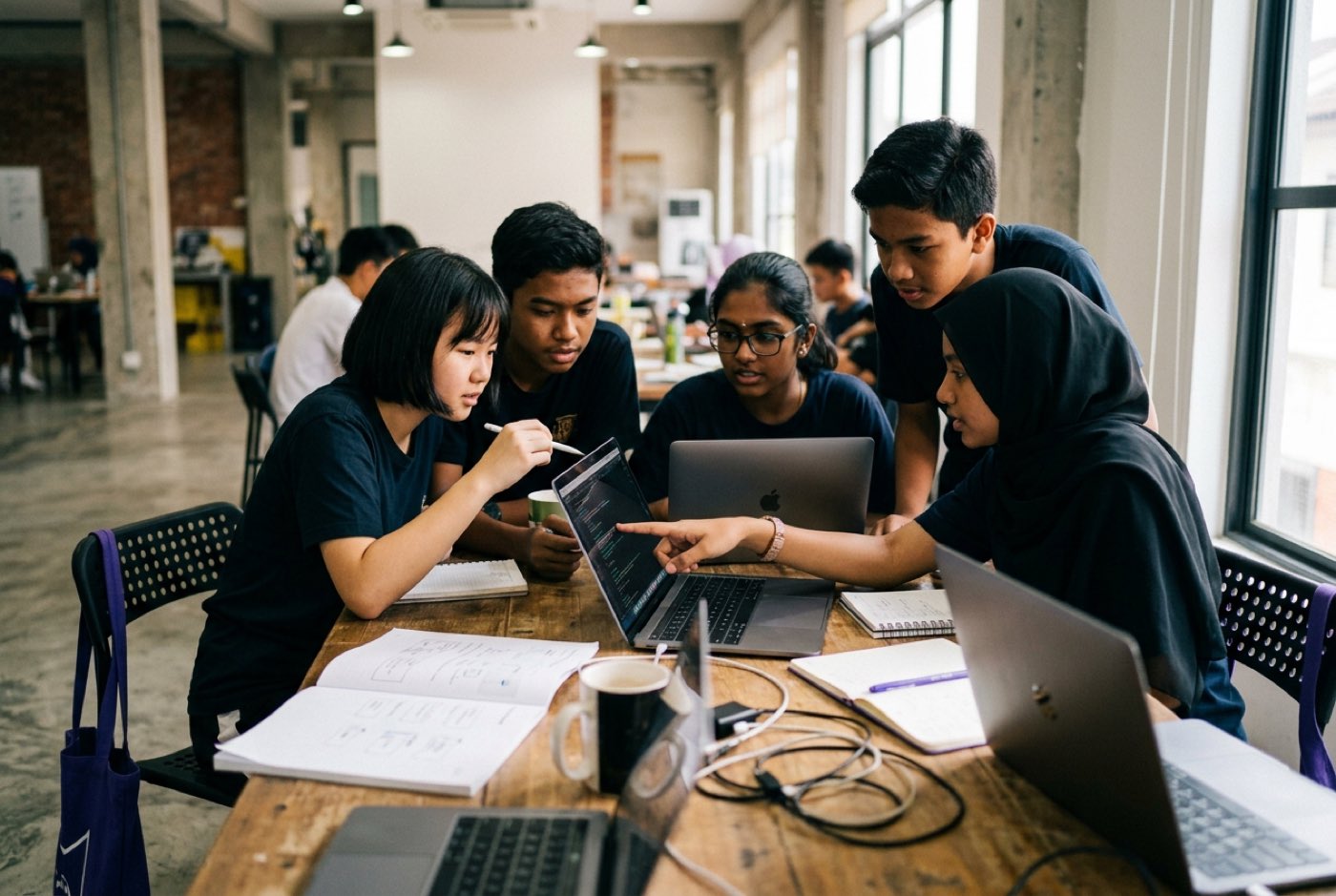
The Kidocode Approach to Teen AI and Tech Literacy
We do not treat teenagers as oversized primary students, and we do not run classes like a tuition centre. Kidocode is an AI school first, supported by deep mathematical thinking and practical software build tracks.
Three pillars sit inside one student membership:
- AI School First: Teenagers learn to direct AI systems responsibly, safely, and effectively. Rather than treating AI as a shortcut for homework, students work on prompt engineering, API integration, and model evaluation, so they end up directing the technology.
- Math Through Builds: We end math aversion by delivering the same concepts found in international syllabuses (IGCSE, Cambridge, SPM) through construction. A teenager who stalls on abstract coordinate geometry in a textbook gets it the moment they programme a 3D environment or game engine. Each student has a personalised AI tutor so concepts land without frustration.
- Tech & Coding Bundled Free: Our six specialised technology tracks (Python, Web Development, Mobile Apps, Game Development, Electronics, and 3D Modeling) come bundled into the membership. Raw syntax is public knowledge now. What we actually teach is computational thinking and architectural design.
I built this framework on decades of computer science research and open-source engineering work. When I developed Crawl4AI, which has passed 12 million downloads and runs in production pipelines at Fortune 500 companies, the principles were the same ones we teach here: direct system design, clean execution, and using modern AI capabilities to solve hard problems efficiently. That is the builder mindset our teenage students pick up.
We run five physical campuses in Malaysia:
- Klang Valley: Our flagship HQ at Solaris Mont Kiara (Solaris Dutamas) and Sunway Nexis in Kota Damansara.
- Penang: Q2 Waterfront (Bayan Lepas), Vantage Tanjung Tokong, and Icon City (Bukit Mertajam).
- Live Online Campus: A camera-on interactive virtual environment for students across Malaysia and internationally.
Parents who want the full picture of our structure can review our /how-we-teach page.
What Your Teen's First Session Looks Like
Parents want to know what actually happens when a 16-year-old walks in. No baby exercises, no visual block tests, no passive lectures.
Whether the session runs at our Mont Kiara flagship, our Q2 Waterfront campus in Penang, or online, it moves like this:
- Goal Discovery: The trainer talks through the teen's interests, academic roadmap, and current tech exposure.
- Immediate Build Setup: The teen opens a professional development environment alongside our specialised AI assistant interface.
- First Functional Project: Inside the first 90 minutes, the teenager writes real Python or web code, works with an AI model, and deploys a working micro-project to a live browser screen.
- Parent Demo: At the end, parents come in to watch their teenager demonstrate what they built.
You can book a hands-on trial session for your teenager on our free trial registration page.
Next Steps for Parents
If you are weighing whether your teenager is ready to start, run through the checklist below.
Printable Teen Tech & AI Readiness Checklist
To compare membership options and structured training plans, visit our pricing transparency directory.
- Hardware Verification: Does your teen have access to a functional laptop (Windows, Mac, or Chromebook) with a working web browser and internet connection?
- Interest Mapping: Have you identified at least one domain your teen naturally spends time on (e.g., gaming, sports statistics, digital art, social media, or business ideas)?
- Time Audit: Can your teen commit 1.5 to 3 hours per week by replacing passive screen time, without impacting their core SPM, IGCSE, or A-Level revision?
- Mindset Shift: Have you discussed with your teen that learning tech with AI is about directing tools to solve real problems, not memorising dry syntax rules?
Designed, ready to print and sign. We email it to you together with a 5% discount on your next registration.
Frequently Asked Questions
Is 16 too late to learn coding if my child has zero prior experience?
No, 16 is an ideal age to start. Teenagers possess developed mathematical logic, abstract reasoning skills, and clear goal orientation. With AI coding assistants handling syntax errors, a teenager with zero prior experience can build functional Python and web applications within a few months.
Will coding classes interfere with SPM, IGCSE, or A-Level exam preparation?
Not when structured flexibly. At Kidocode, session hours are flexible and can be adjusted around school exam timetables. Learning computational logic and AI problem-solving also reinforces mathematical and analytical performance in secondary school subjects.
How does learning with AI assistants differ from using ChatGPT to cheat on homework?
Cheating occurs when a student uses AI to generate answers passively without understanding the output. In our structured curriculum, teenagers use AI as a real-time pair programmer. They write system prompts, review generated code line by line, debug logic errors, and take full ownership of the final software architecture [6].
Does my teenager need a high-end gaming laptop to start learning AI and coding?
No. Most modern web development, Python scripting, and AI model interactions take place in cloud environments or lightweight text editors. Any standard laptop running Windows, macOS, or ChromeOS with a stable internet connection is fully sufficient.
What career pathways open up for teens who master AI and tech early?
Beyond traditional software engineering, digital competence is in high demand across finance, data engineering, marketing, healthcare, and engineering. Industry data shows that 50% of high-demand digital roles in Malaysia originate in non-technology sectors [5]. Structured youth apprenticeship programmes such as Malaysia's K-Youth initiative also report 90% graduate employment within 3 months across AI, data science, and software tracks [7].
Should my teenager start with physical classes or live online sessions?
Both formats provide an identical curriculum and live trainer interaction. If you live near our campuses in Mont Kiara, Kota Damansara, Bayan Lepas, Tanjung Tokong, or Bukit Mertajam, physical classes offer an excellent studio atmosphere. If travel time during busy school weeks is difficult, our camera-on live online programme delivers full equivalency.
References
- Tech For Good Institute, From Digital Users to Digital Changemakers: Malaysian Youth's Vision for an Inclusive Digital Future (2025)
- ProductNation / Junior Achievement Institute, Shaping Tomorrow's Workforce: Asia Pacific Youth Insights (2026)
- Emerald Publishing (Information and Learning Sciences), Programming education and learner motivation in the age of large language models (2024)
- World Economic Forum, Closing the Digital Skills Gap: Youth Skills Day Insights (2025)
- Malaysia Digital Economy Corporation (MDEC), Digital Talent Snapshot Q3 2024 (2024)
- arXiv, Conversational Programming and AI-Augmented Learning in Computer Science Education (2025)
- TalentLabs, K-Youth Development Programme 2025 Overview (2025)