


Ask a ten-year-old in Kuala Lumpur or Penang whether they use artificial intelligence and you will usually get a demonstration instead of an answer: a browser tab with ChatGPT or Gemini already open, an essay draft appearing in seconds, an image generated on request, a homework question answered before you finish reading it. Survey data gathered across ten countries shows children adopting artificial intelligence more than three times faster than adults [1]. At least 20 million children globally have interacted with AI systems, and 13 million use these platforms directly for schoolwork and learning [1].
Opening a chat box and pasting the result into a Google document is not AI literacy. That is passive consumer behaviour.
There is a cost to it, too. When a student leans on AI to produce answers without following the reasoning, cognitive offloading kicks in. A report from the University of Technology Sydney warns that outsourcing mental effort to automated tools risks short-circuiting the cognitive work needed to build foundational knowledge and critical thinking [2]. One controlled trial with high school students working through maths practice problems captured the trade-off neatly: students using ChatGPT got 48% more problems right while the tool was in front of them, then scored 17% lower on the follow-up concept test than classmates who had worked without it [3].
Real AI literacy points the other way. It turns a child from a passive AI consumer into an active AI director: someone who understands roughly how model outputs are produced, catches hallucinations and bias, aims AI tools at multi-step problems, and eventually builds original applications with them.
What follows is a benchmark parents can actually use. It sets out what an AI-savvy child does across four developmental age bands: 5 to 8, 9 to 12, 13 to 15, and 16 to 18.
Key Takeaways
| Age Band | Core AI Role | Passive Consumer Behaviour | Active AI Director Capability |
|---|---|---|---|
| Ages 5–8 | Pattern Spotter | Plays with AI filters or voice tools as magic | Explains that machines learn from examples and spots visual classification errors |
| Ages 9–12 | Logic Architect | Copies ChatGPT homework answers verbatim | Breaks complex prompts into structured rules, cross-checks facts, and trains custom block classifiers |
| Ages 13–15 | Systems Debugger | Uses AI to write entire scripts without reading them | Directs AI coding assistants, audits logic errors, inspects data pipelines, and fixes Python bugs |
| Ages 16–18 | Model Evaluator | Prompts basic text generators for standard essays | Selects and compares API architectures, evaluates token trade-offs, and builds deployed AI software |
Table of Contents
- Two Myths: Why Prompt Tricks and Fast Typing Do Not Equal AI Literacy
- Age 5–8 (Early Primary): The Pattern Spotter and Rule Builder
- Age 9–12 (Upper Primary): The Logic Architect and Prompt Evaluator
- Age 13–15 (Lower Secondary): The Systems Debugger and AI Co-Developer
- Age 16–18 (Upper Secondary / Pre-U): The Builder and Model Evaluator
- The AI Capability Progression Ladder
- The Dinner Table Test: 4 Questions You Can Ask Tonight
- Comparison: Passive Consumer vs Active AI Director
- Where Mathematics Sits Underneath Every AI Stage
- How Kidocode Teaches AI Capabilities
- Actionable Home Benchmark Plan & Printable Checklist
- Frequently Asked Questions (FAQ)
- References
Two Myths: Why Prompt Tricks and Fast Typing Do Not Equal AI Literacy
Two ideas get in the way before the age bands make any sense.
Myth 1: Memorising "Magic Prompts" Makes a Child Advanced
Social media is full of lists of secret prompts. Copying rigid templates teaches nothing about computational thinking. The AI literacy framework developed by the OECD and the European Commission defines the skill as a package of knowledge, technical ability and critical attitudes [4], not a phrasebook. A child working from memorised templates stalls the moment the model shifts its output or fails outright. A child who can decompose a problem into system context, explicit constraints and step-by-step logic simply writes a new prompt.
Myth 2: High Typing Speed or Computer Usage Signals AI Competence
Fast typing and confident tablet navigation show motor familiarity. They say nothing about digital capability. Regional research in Southeast Asia points the same way: digital access is expanding quickly, but access on its own does not produce functional technology skills [5]. A Thailand national study tracked digital access across 400,000 students and found only 18,000 active users engaging in educational digital activities, devices without structured guidance produce consumption, not skill [5].
Malaysia has started to formalise the difference. The Ministry of Education issued Professional Circular No. 2 of 2026 introducing national AI Literacy Guidelines (Panduan Literasi Kecerdasan Buatan KPM) to set structured standards across schools [6]. Those standards sit alongside international work such as the NSF-funded AI4K12 initiative, which organises AI learning into progression charts across primary and secondary grade bands [7].
So what does any of that look like at the kitchen table? Four age bands, one at a time. For a broader comparison between basic operational skills and systematic thinking, read our guide on AI literacy vs coding skills for kids.
Age 5–8 (Early Primary): The Pattern Spotter and Rule Builder
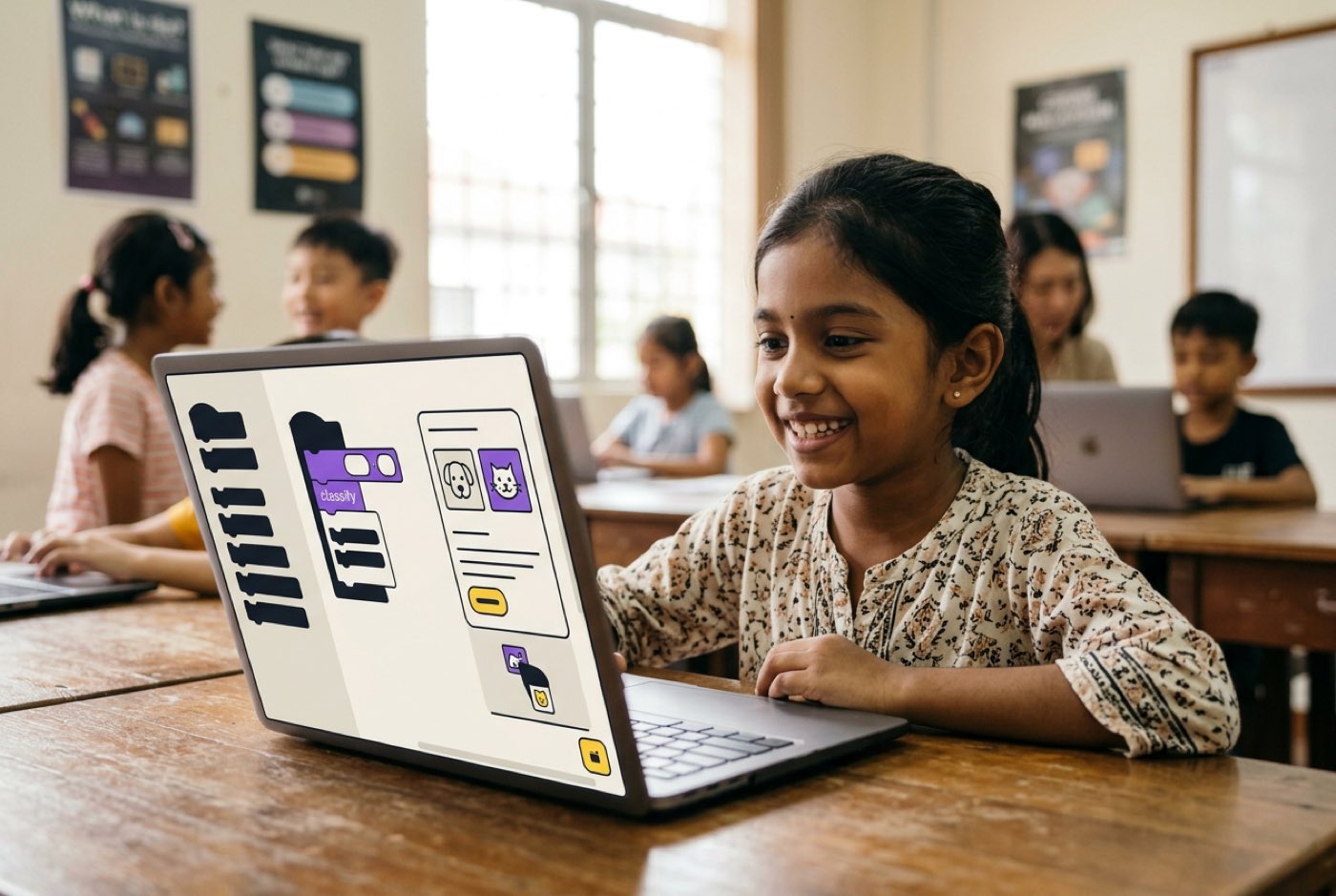
Between ages 5 and 8 (Standard 1 to Standard 2 in the Malaysian curriculum), children meet AI through visual, auditory and play-based interfaces. Nobody is teaching them matrix algebra or syntax here. The job at this age is simpler and more important: take the magic out of the machine.
What the AI Consumer Does at Age 5–8
The screen is a magic mirror. The child talks to a voice assistant, watches a face filter warp their features, plays a game that reacts to them, and never wonders why any of it happens.
What the AI-Savvy Director Does at Age 5–8
A seven-year-old who is genuinely AI-savvy holds three ideas:
- Inputs, Rules, and Outputs: Computers have no feelings and no consciousness. The machine takes an input, a picture, a voice command, matches it against patterns it was trained on, and produces an output.
- Training Data Concept: An image recognition system knows a cat because someone showed it thousands of cat pictures.
- Spotting Classification Errors: When a face filter slips or a voice assistant mishears a word, the child says why the pattern failed instead of thumping the tablet.
Concrete Project Example
Rather than only playing games, a seven-year-old builds a trainable sorting machine using ScratchJr or Scratch blocks with a webcam. They train a visual model on ten pictures of a red apple and ten of a green banana, then program a sprite to say "Healthy Fruit!" for the apple and "Sweet Snack!" for the banana. Hold up a yellow lemon, watch the machine call it a banana, and the child works out the cause: the training set never contained a yellow round object.
For parents exploring early childhood learning paths, our overview of what age kids should start coding provides additional developmental context.
Age 9–12 (Upper Primary): The Logic Architect and Prompt Evaluator
By 9 to 12 (Standard 3 to Standard 6, or Years 5 to 7 in international schools), reading comprehension and logical structure are strong enough for a child to judge information rather than swallow it.
What the AI Consumer Does at Age 9–12
Assigned a science project on solar energy, the passive consumer opens ChatGPT, types "write my science report on solar panels", copies the paragraph without reading it and pastes it into the homework file. Hallucinated facts and wrong dates go in untouched.
What the AI-Savvy Director Does at Age 9–12
An eleven-year-old director treats the tool as a junior assistant whose work needs checking and direction. Three habits mark the difference:
- Structured Task Decomposition: A broad assignment gets split into specific component queries, for example, "Explain photovoltaic cell energy transfer using three bullet points suitable for a Primary 5 science presentation".
- Fact Verification and Grounding: Claims from a large language model get cross-referenced against trusted textbooks or educational web databases before they go anywhere near the report.
- Training Custom Machine Learning Models: Custom classification tools get built in beginner-friendly drag-and-drop machine learning environments.
Concrete Project Example
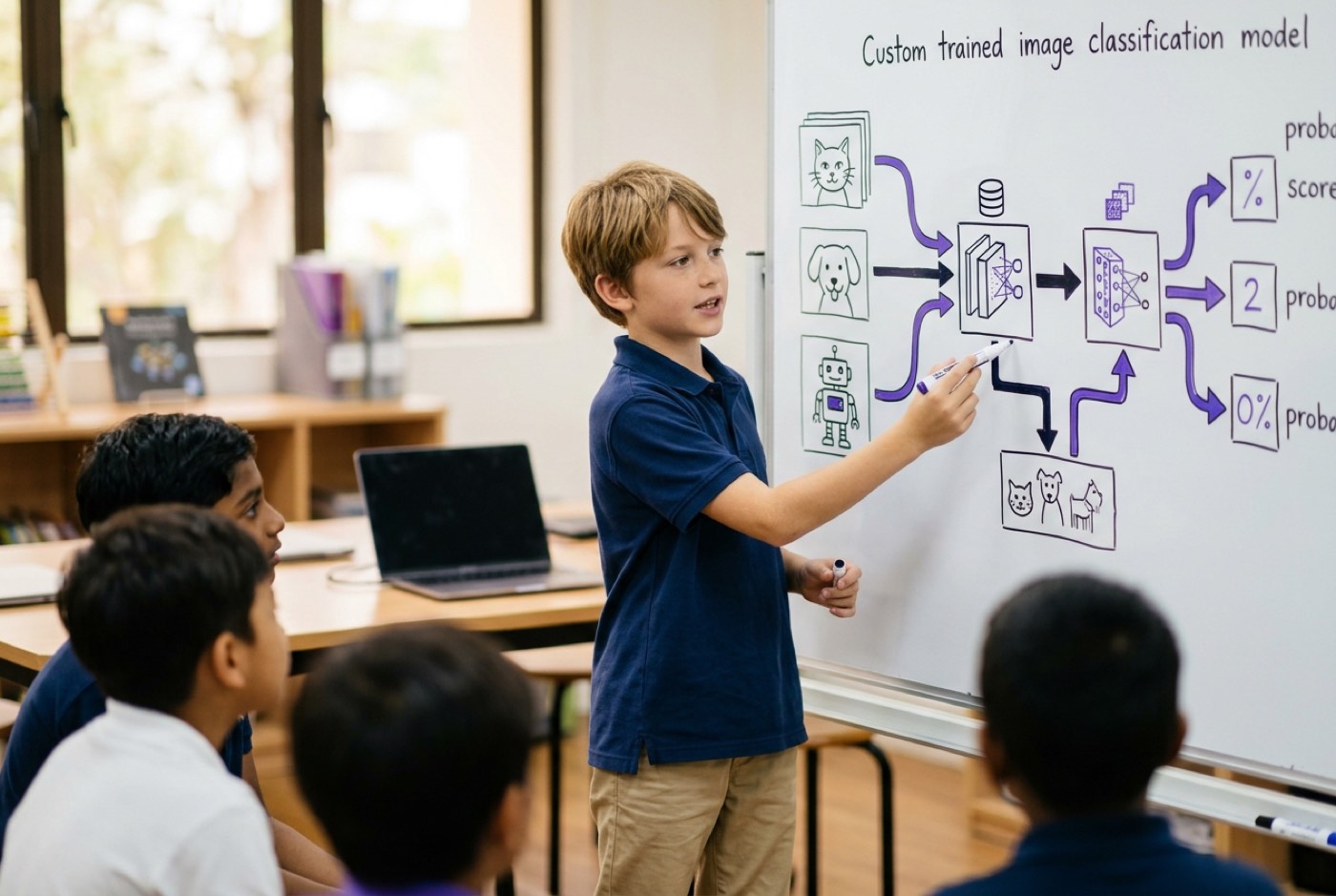
An eleven-year-old builds a smart recycling sorter in Scratch or Roblox. Using machine learning block extensions, they train a custom vision model on thirty photos of paper waste, plastic bottles and aluminium cans, then write conditional logic to drive a virtual sorting arm from the model's confidence score:
Anything below 85% confidence goes to a manual inspection bin. Ask the child why the threshold exists and they can tell you what happens in real-world automation when a machine acts on a guess.
If your child is currently using AI tools for school assignments, review our playbook on what parents should do when a child uses ChatGPT for homework.
Age 13–15 (Lower Secondary): The Systems Debugger and AI Co-Developer
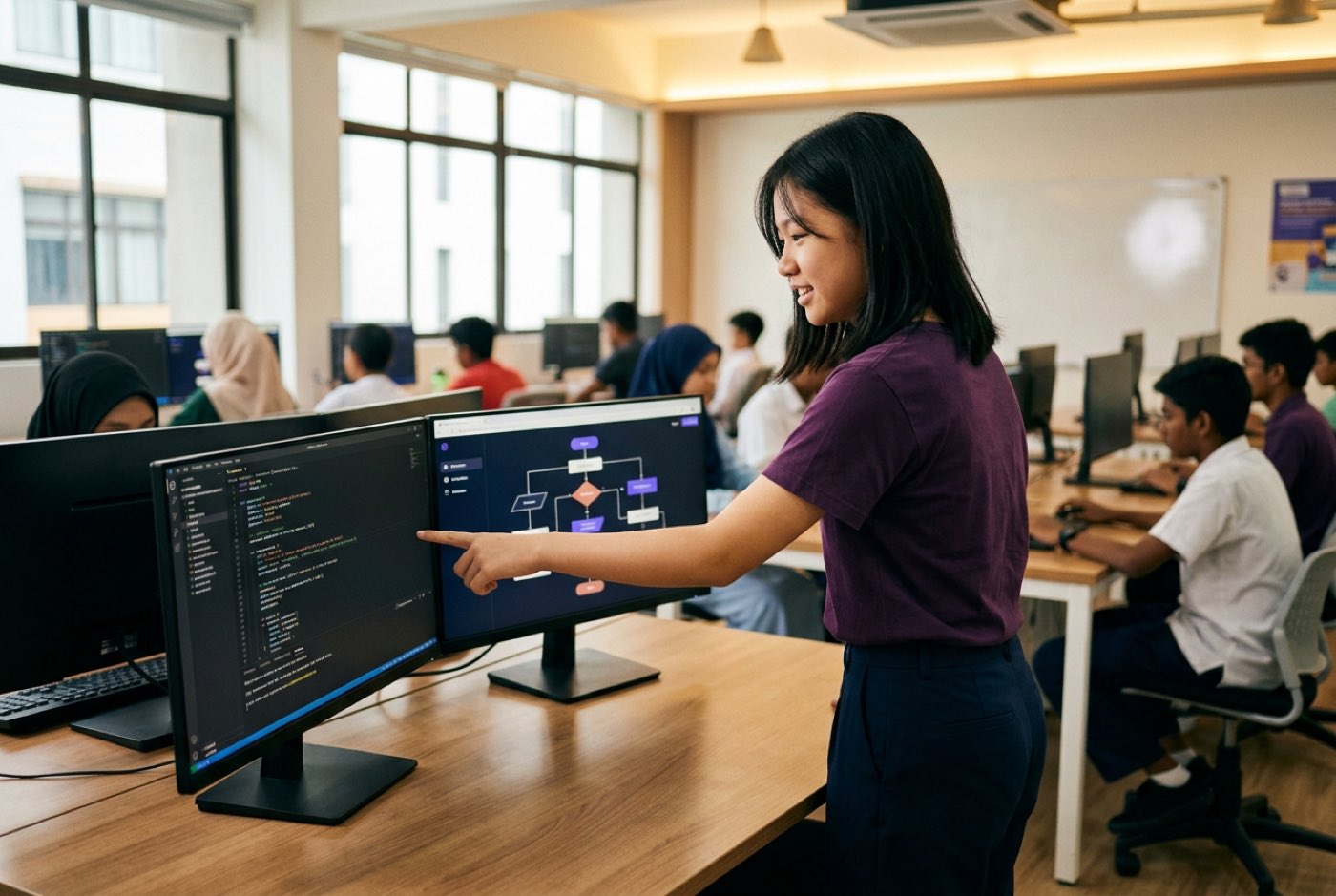
Between 13 and 15 (Form 1 to Form 3, or Years 8 to 10), students move from visual blocks to text-based languages such as Python and JavaScript. This is the stage where AI either accelerates a learner or quietly freezes them in place.
What the AI Consumer Does at Age 13–15
Asked to write a Python script that calculates compound interest, the passive student prompts a model for the whole file and pastes it into the editor. The first error message ends the project, because they cannot read the syntax or explain the flow of the program they just submitted.
What the AI-Savvy Director Does at Age 13–15
A fourteen-year-old director runs the AI as an automated pair programmer, with a working grasp of code structure, variable scope, loops and functions. Three capabilities show up consistently:
- Code Auditing and Execution: Boilerplate comes from an AI coding assistant, then gets read line by line for syntax errors, inefficient loops and security holes.
- Error Log Analysis: When a program crashes, they read the stack trace, form a specific hypothesis, and ask the AI for a targeted fix instead of demanding a blind rewrite.
- Understanding Data Pipelines: They know how clean data preparation shapes model outcomes, including training data splits and basic algorithmic bias.
Concrete Project Example
A fourteen-year-old builds an automated weather forecast dashboard in Python, pulling daily temperature and rainfall from a free weather API. They ask an AI coding assistant to draft a plotting function with the matplotlib library. Then the API returns missing data points, the script dies with a KeyError, and the interesting part begins: the student traces the missing data handling flaw, adds a try-except validation block, and logs a clean fallback message.
To understand how text coding transitions happen smoothly, read our analysis on Scratch vs Python for young learners as well as our overview on using AI vs building with AI.
Age 16–18 (Upper Secondary / Pre-U): The Builder and Model Evaluator
At 16 to 18 (Form 4, Form 5, A-Levels or IB Diploma), students have the mathematical foundation and conceptual maturity to build full-stack applications and to evaluate machine learning performance systematically.
What the AI Consumer Does at Age 16–18
The passive student uses general-purpose chat models to write essays, spin up study notes and answer multiple-choice questions. They stay end-users of software other people built.
What the AI-Savvy Director Does at Age 16–18
A seventeen-year-old director works like a software architect and systems evaluator:
- Architecting Full-Stack Applications: Frontend interfaces, backend database storage and external AI model APIs get combined into working digital products.
- Model Evaluation and Trade-off Analysis: Open-source and proprietary models get compared on latency, token costs, memory footprints and contextual accuracy.
- Retrieval-Augmented Generation (RAG): Custom knowledge bases get built by feeding document embeddings into vector databases, so the model can query specific reference material instead of inventing it.
Concrete Project Example
A Form 5 student builds a localised revision study bot for SPM Physics. Textbook chapters become document embeddings stored in a local vector index. When a user asks about Snell's Law, the application retrieves the exact textbook context block and passes it to an LLM API with a hard instruction: "Answer using only the provided context block. Cite the page number."
Then comes the part most hobby projects skip. The student benchmarks the bot across fifty test queries, measuring accuracy, response latency and operational API cost.
The AI Capability Progression Ladder
The diagram below tracks how a child's interaction with artificial intelligence evolves from pattern identification at age 5 to full application development at age 18.
timeline
    title AI Capability Progression Across Ages 5 to 18
    Age 5 to 8 : Pattern Spotter : Explains input and output : Identifies model errors
    Age 9 to 12 : Logic Architect : Structures multi-step prompts : Trains block classifiers
    Age 13 to 15 : Systems Debugger : Audits AI code output : Fixes Python pipeline errors
    Age 16 to 18 : Model Evaluator : Builds full stack apps : Evaluates API trade offs
The Dinner Table Test: 4 Questions You Can Ask Tonight
You do not need a computer science degree to work out which side of the line your child is on. Pick the question for their age band and ask it over dinner tonight.
Question for Ages 5–8
"When YouTube or Netflix suggests a video to you, how does the computer know what you like?"
- Consumer Answer: "The tablet is smart and knows what I want."
- Director Answer: "The computer saved the videos I watched before, matched them with patterns from other kids, and guessed what I would click next."
Question for Ages 9–12
"If ChatGPT gives you an answer for your science or history homework, how do you know if it is telling the truth?"
- Consumer Answer: "It is always right because it is a supercomputer."
- Director Answer: "It predicts words based on internet text, so it can make mistakes. I check the facts against my school textbook or a trusted website."
Question for Ages 13–15
"If an AI assistant writes a Python code script for you and it crashes with an error, what do you do?"
- Consumer Answer: "I copy the whole code back in and tell it to fix it."
- Director Answer: "I read the error log line in the terminal, check where the variable failed, and tell the AI specifically which function needs updating."
Question for Ages 16–18
"If you were building an AI mobile app for students, how would you prevent it from making up fake answers?"
- Consumer Answer: "I would tell the AI in the prompt to be accurate."
- Director Answer: "I would build a retrieval system using embedded textbook data so the model is constrained to retrieve verified information from specified sources."
Comparison: Passive Consumer vs Active AI Director
Same tasks, two very different sets of behaviour:
| Learning Scenario | Passive AI Consumer | Active AI Director |
|---|---|---|
| Writing an Essay | Prompts for a full draft, copies the entire output, and submits without editing. | Uses AI to generate counter-arguments, outlines main ideas, and writes the final text independently. |
| Learning to Code | Pastes AI-generated code snippets without understanding syntax or function logic. | Prompts for small modular functions, reviews every line, and debugs logic errors manually. |
| Researching a Topic | Accepts the first paragraph produced by a conversational tool as absolute truth. | Asks the tool for primary sources, verifies claims against external databases, and checks for bias. |
| Math Problem Solving | Asks AI for the final answer and writes down the numerical output without steps. | Uses AI as a step-by-step tutor to clarify concept rules, then solves practice problems on paper. |
| Creative Game Design | Plays pre-built games or generates random AI graphics without custom rules. | Trains custom image or audio classification models to control unique character actions in game code. |
Where Mathematics Sits Underneath Every AI Stage
Parents often ask why mathematics keeps coming up in an AI conversation. Because artificial intelligence is applied mathematics: probability, linear algebra, statistics and formal logic doing the work behind the interface.
When a child struggles with school maths, the child is rarely the problem. Traditional settings tend to serve maths as abstract memorisation and repeated worksheets, with no visible use for any of it.
At Kidocode we start from a different assumption: the child is fine, the teaching method was broken. Learn mathematics while building something real and the formulas stop being decoration, they become the tools that make the thing work.
Here is where maths sits underneath each stage:
-
Pattern Recognition (Ages 5–8): Simple classification models rely on basic sorting, counting and set logic.
-
Confidence Scores (Ages 9–12): Machine learning classifiers output probabilities between 0 and 1. Setting a confidence threshold means applying percentages and probability:
-
Coordinate Systems and Spatial Distance (Ages 13–15): Image detection and Nearest Neighbour classification measure spatial distance using the Pythagorean theorem:
-
Vector Embeddings and Data Representation (Ages 16–18): Large language models store word meanings as multi-dimensional vector coordinates, so understanding retrieval means understanding basic linear algebra.
Once a formula is what keeps a student's own game running smoothly or their own model accurate, the maths-hate tends to evaporate. Students following the Malaysian KSSR/SPM syllabus, IGCSE or Cambridge curricula start treating school maths as a building tool rather than a chore.
To read more about how constructivist build-first learning compares with traditional tutoring, see our article on math tuition vs learning math by building.
How Kidocode Teaches AI Capabilities
Kidocode is Malaysia's coding and AI school for kids aged 5 to 18, with flagship campuses in Kuala Lumpur (Solaris Mont Kiara, Sunway Nexis PJ) and Penang (Q2 Waterfront Bayan Lepas, Vantage Tanjung Tokong, Icon City Bukit Mertajam), plus interactive live online classes.
Three commitments shape how we teach:
- AI School First: Children learn to direct AI tools safely, critically and creatively, with safety and ethics treated as equal in weight to technical command.
- Math Through Builds: We deliver the standard international maths syllabus (IGCSE, Cambridge, US Common Core, SPM-aligned logic) in reverse. Students build real applications first and meet the underlying concepts where they are actually needed. Each child works with a personalised AI tutor to master concepts at their own pace.
- Coding Bundled Free: Coding knowledge has become public knowledge, so our coding tracks (Python, Web, Mobile, Game Development, Electronics, 3D Modelling) come bundled into the membership. Computational thinking is the skill we are really teaching.
Our academic direction is led by computer scientist and AI researcher Hossein Tohidi, known to students as Unclecode. He created Crawl4AI, an open-source web scraping engine with over 12 million downloads and 76,000+ GitHub stars, used by Fortune 500 engineering teams worldwide.
Sessions are project-first rather than lecture-first. Every class ends with an artifact the child built themselves.
Parents who want to watch their child work with AI concepts directly can book a free hands-on trial session of up to two hours, at any physical campus or online, through our trial class booking page.
Actionable Home Benchmark Plan & Printable Checklist
You can audit your child's current AI literacy at home in three steps:
- Observe an Unassisted Session: Sit quietly beside your child while they finish a school assignment or personal project on a device. Watch whether they copy text straight across or push back on the output and refine their queries.
- Conduct the Dinner Table Test: Ask the age-appropriate question from this article and listen for whether they can describe what the machine is doing.
- Review the Benchmark Checklist: Tick off the capabilities your child has shown more than once.
-
Ages 5–8 Capabilities
- Can state that computers follow rules and patterns created by human data
Designed, ready to print and sign. We email it to you together with a 5% discount on your next registration.
Frequently Asked Questions (FAQ)
Is my five-year-old child too young to start learning about AI?
Not if the teaching matches the child. For ages 5 to 8, everything is visual, interactive and play-based, using block tools like ScratchJr. Nobody is writing raw text code or studying complex mathematics at that age. They pick up pattern recognition, input-output logic and computational thinking by building.
Will AI make coding obsolete before my child grows up?
Coding is not going away, but the job has changed shape. Generative AI absorbs the repetitive syntax work, which leaves architecture, logic, data flow and problem design to the human. With AI coding assistants, children reach real text-based Python faster than they used to through traditional teaching paths. Directing those tools and auditing what they produce is the core technical literacy of this era.
How does Kidocode's approach align with Malaysian school syllabi like KSSR or SPM?
Our curriculum covers the mathematical reasoning, logic and computational concepts embedded in national KSSR/SPM standards as well as international syllabi such as IGCSE and Cambridge. The difference is delivery. Schools present maths as abstract paper exercises; Kidocode students meet the same concepts while building games, electronics and AI software.
Does my child need prior coding or technical experience to join a class?
No. Every student is assessed during the initial trial session and given an individualised learning trajectory based on age, current skill level and personal interests.
What is the difference between an AI consumer and an AI director?
A consumer uses AI applications as a shortcut, copying outputs without checking accuracy or logic. A director understands how the models work, designs structured prompts, audits generated code, checks claims against ground truth, and builds custom applications that solve real problems.
References
- Malay Mail / Bernama / UNICEF. Children adopting AI more than three times faster than adults, UNICEF data shows. Published July 1, 2026. Source: https://www.malaymail.com/news/life/2026/07/01/unicef-children-adopting-ai-more-than-three-times-faster-than-adults/225877
- Lodge, J. M., & Loble, L. Artificial intelligence, cognitive offloading, and implications for education. University of Technology Sydney / Figshare. Published March 8, 2026. Source: https://figshare.uts.edu.au/articles/report/Artificial_intelligence_cognitive_offloading_and_implications_for_education/31302475
- Jose, B., Cherian, J., Verghis, A. M., Varghise, S. M., Mumthas, S., & Joseph, S. The cognitive paradox of generative AI in education. Frontiers in Psychology / PMC. Published April 14, 2025. Source: https://pmc.ncbi.nlm.nih.gov/articles/PMC12036037/
- OECD and European Commission. Empowering learners for the age of AI: A common framework for AI literacy. OECD Publishing. Published June 18, 2026. Source: https://www.oecd.org/en/publications/empowering-learners-for-the-age-of-ai_65cd27d4-en.html
- EdTech Hub. AI in education across Southeast Asia: What's working on the ground. Published March 30, 2026. Source: https://edtechhub.org/2026/03/30/ai-in-education-across-southeast-asia-whats-working-on-the-ground/
- Ministry of Education Malaysia (KPM). Surat Pekeliling Ikhtisas KPM Bil. 2 Tahun 2026: Panduan Literasi Kecerdasan Buatan (AI) KPM. Published 2026. Source: https://www.moe.gov.my/surat-pekeliling-ikhtisas-kpm-ai
- AI4K12 Initiative. Grade band progression charts for K-12 AI education. National Science Foundation / AI4K12. Source: https://ai4k12.org/gradeband-progression-charts/
- Jamaluddin, F., Jamaluddin, A. H., Jamaluddin, F., & Jamaluddin, F. Artificial intelligence integration in Malaysian education: Policy analysis and implementation. arXiv preprint. Published 2025. Source: https://arxiv.org/html/2509.21858v1