

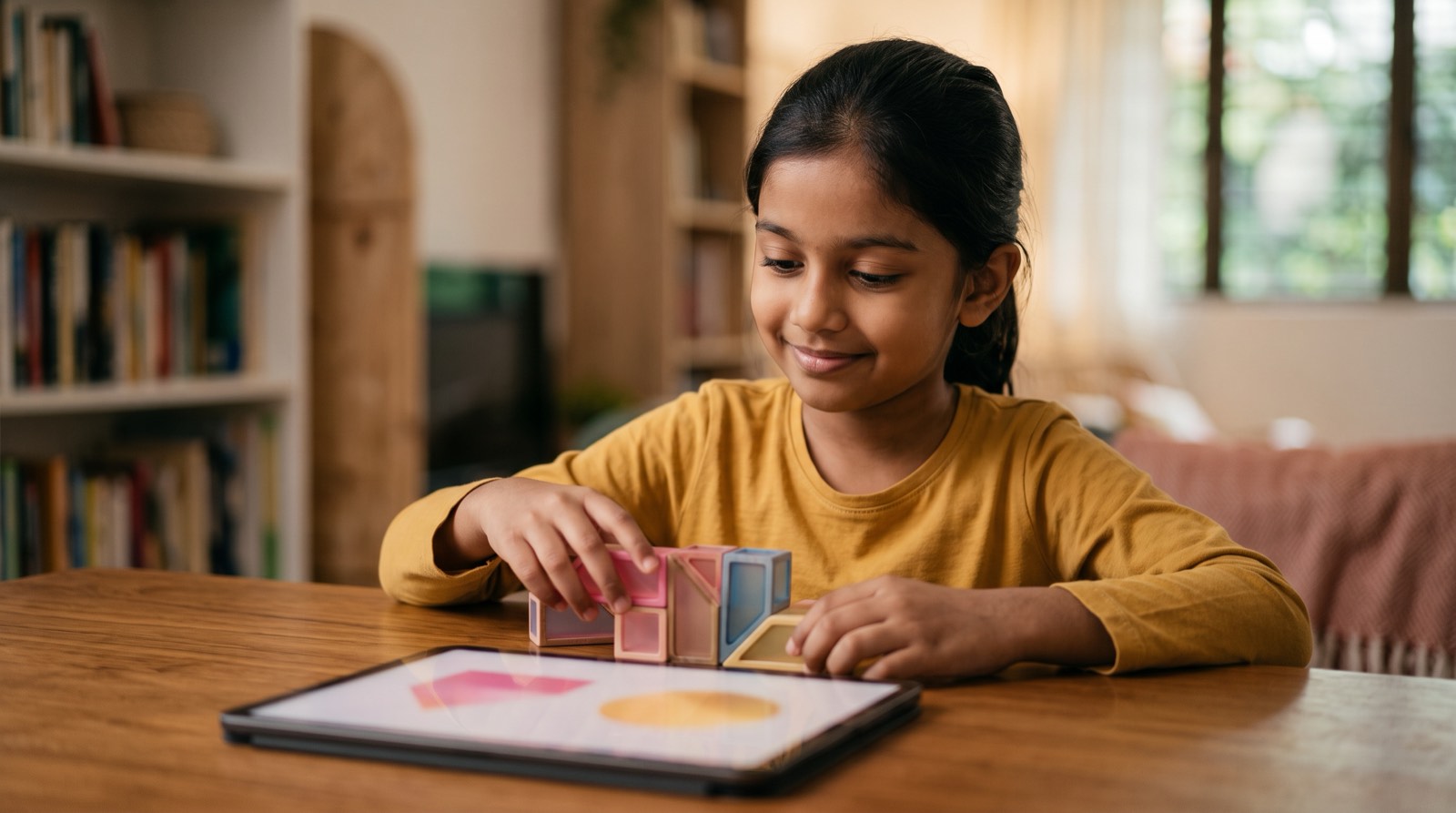
Saturday in Kuala Lumpur, Petaling Jaya and Penang runs to a script. School pickup, a crawl through peak-hour traffic, drop-off at a shoplot for two hours of math tuition. You buy the assessment books. You hire the tutor someone recommended in the parents' WhatsApp group. You keep your voice gentle at the dining table. Then Sunday evening comes, the homework folder appears, and the same tension settles over the house. Your child sighs, slides down in the chair, and says they hate math.
The child in that chair is not the problem. In Malaysia, private supplementary tutoring is the reflex response to a bad report card, and for many families it works fine. But a child who does not understand why a method works will not be rescued by two more hours of the same worksheets. Memorising steps you cannot explain is what created the frustration in the first place.
What follows: why conventional tuition so rarely cures math-hate, what the research says about how children actually build mathematical understanding, and what tends to happen in the first two to four weeks when a child starts learning math by building things, games, physics, AI models, instead of by drilling.
Table of Contents
- The Pattern Every Malaysian Parent Recognises
- Why Rote Practice and Worksheet Drilling Fail to Cure Math Anxiety
- "The Kid Is Fine, the Teaching Was Not": A Constructivist Reframe
- What 'Learning Math by Building' Actually Looks Like in Practice
- Connecting Built Projects to School Syllabi: IGCSE, Cambridge, and KSSR
- How to Spot the Difference Between Tuition and Build-Based Learning
- Six Diagnostic Questions to Ask Any Learning Centre Before Enrolling
- The Role of Personalised AI Tutors: Safe, Embarrassment-Free Exploration
- How Kidocode Approaches Math-Hate: Three Pillars in One Membership
- Realistic Timelines: What Changes First When a Child Starts Building
- Action Plan and Decision Checklist for Parents
- Frequently Asked Questions
- References
Key Takeaways
| Subject Dimension | Traditional Math Tuition | Build-Based Learning (Kidocode Approach) |
|---|---|---|
| Core Delivery Method | Rote memorisation, formula drills, assessment books | Project construction, game physics, AI logic |
| Primary Learner Role | Passive receiver answering paper exercises | Active builder creating software and models |
| Error Perception | Red marks on paper, loss of marks, test fear | Debugging opportunity, parameter adjustment |
| Syllabus Coverage | Covers IGCSE / KSSR via exam paper repetition | Covers IGCSE / KSSR by applying identical concepts |
| AI Integration | None, or restricted as a cheating tool | Personalised AI tutor providing step-by-step guidance |
| Typical Emotional Outcome | Continued reliance on tutor, lingering math anxiety | Autonomous problem-solving, math-hate ending in 2-4 weeks |
The Pattern Every Malaysian Parent Recognises
Low marks in school mathematics usually trigger a quantitative response at home: add hours. One tuition session a week isn't moving the needle, so the family adds a second, or books a private tutor for one-to-one coaching.
The global private supplementary tutoring industry was estimated at US288 billion by 2030 [3]. In Malaysia, tutoring is woven into ordinary family life. A study of secondary school students across Penang, Perak and Johor found that the perceived rigidity of the formal school system, together with social influence, was a primary driver pushing students towards private tutorial learning [6]. A qualitative investigation among Form Four students in Kuching, Sarawak, went further: every participant believed private tutoring was necessary for academic success, yet a third of tutoring users said they had been forced into extra classes by parents or teachers, and complained that the added workload cost them rest and personal interests [5].
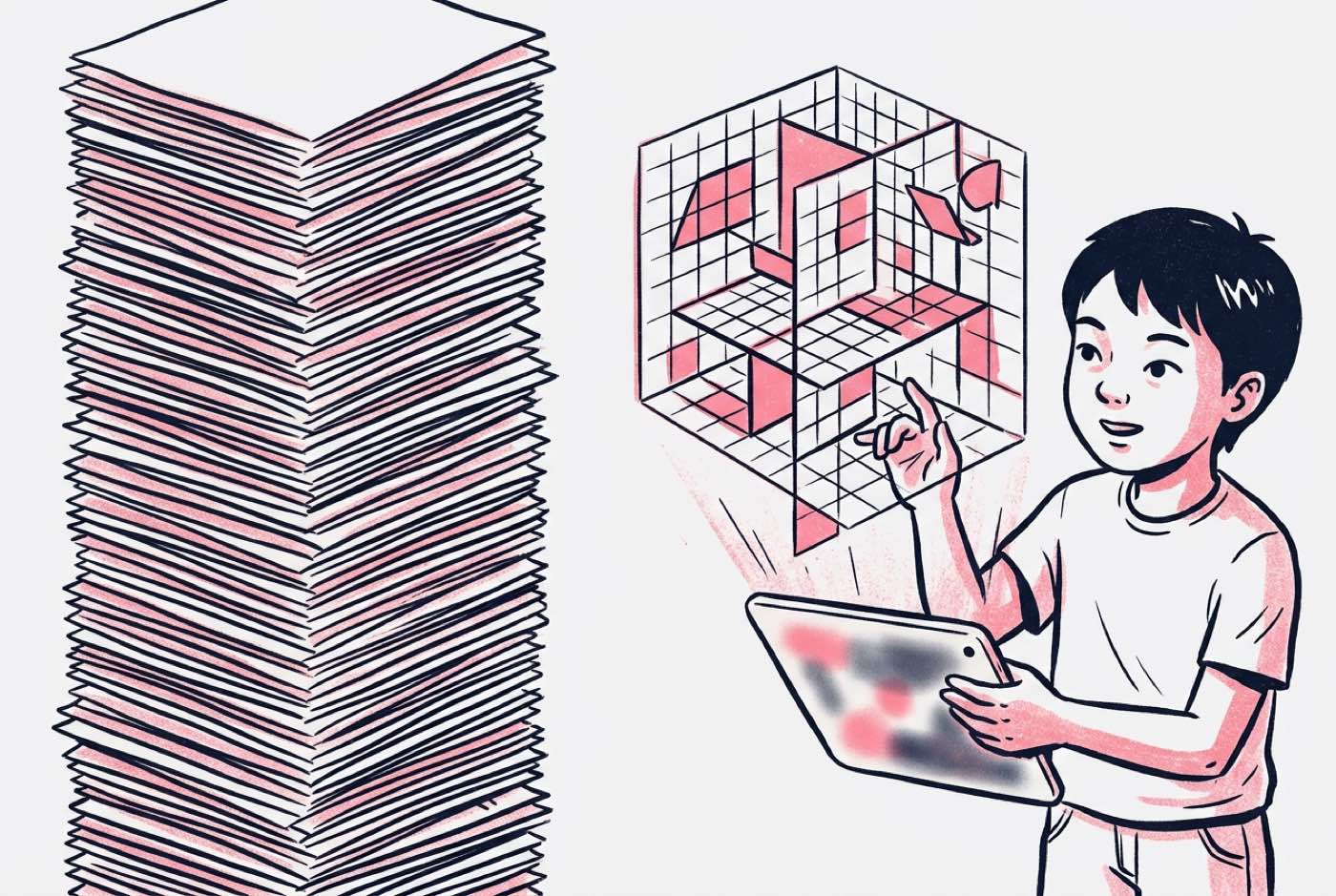
The result is a treadmill. Six to eight hours at a school desk, then two hours at a tuition desk, working near-identical worksheets under different lighting. Nothing about the method has changed, only the volume. When the marks stay flat, parents feel financially drained and children conclude they are stupid.
Why Rote Practice and Worksheet Drilling Fail to Cure Math Anxiety
The problem is rarely effort, from either the tutor or the student. It is a mismatch between how children build understanding of abstract ideas and how most tuition centres deliver instruction.
Classroom teaching and supplementary tuition both lean hard on abstract symbol manipulation. A ten-year-old is shown , or asked to find the slope of a line on a printed Cartesian grid, with no physical anchor for any of it. Children with strong abstract reasoning cope with this. For a large share of learners, starting at the abstract level is cognitive overload from the first minute.
The national indicators show the strain. In the OECD Programme for International Student Assessment (PISA) 2022, Malaysian 15-year-olds recorded a mean mathematics score of 409 points, a drop of 31 to 32 points from the 2018 assessment [1] [2]. Economic researchers at the Institute of Strategic & International Studies (ISIS) Malaysia put that decline at roughly 1.6 years of lost learning in mathematics [4]. Only 41% of Malaysian students reached baseline mathematics proficiency (Level 2), and 1% reached top-tier performance (Level 5 or 6) [1].
The loop that produces math anxiety is easy to trace:
- An abstract formula is introduced.
- The steps are memorised by rote.
- Worksheets are drilled under time pressure.
- A novel problem appears, and one of two things happens: the formula won't come back, which feeds anxiety and avoidance; or the formula is applied blindly, which leaves the underlying concept untouched.
- Either way, the next lesson starts again at step one.
Piling on more practice papers reinforces the threat response rather than dissolving it. The brain learns to associate numbers with judgment, stopwatches and public mistakes. Tutors often respond by delivering the same explanation more slowly, but an abstract rule said slowly is still abstract.
Some students also have specific neurological learning differences. Academic literature puts global dyscalculia prevalence between 3% and 6.5%, and Malaysian pilot studies indicate rates of 3.47% to 5.5% among primary school pupils [8]. For those pupils, and for the many mainstream learners who think visually or kinetically, paper-and-pencil drilling is an artificial barrier standing between them and the mathematics.
"The Kid Is Fine, the Teaching Was Not": A Constructivist Reframe
At Kidocode our starting premise about mathematical difficulty is blunt: the child is fine, the teaching method was not.
Parents watching a child struggle in school maths often conclude that the child lacks a "math brain". Those same children routinely run sophisticated logic elsewhere. A nine-year-old managing inventory, resource trading and spatial navigation inside Minecraft is doing continuous computational and mathematical work, calculating ratios, estimating distances, weighing probabilities, optimising geometry. They don't file it under "maths" because it is embedded in a goal they care about.
Educational psychology has mapped this route from concrete experience to abstract symbol for decades. The Concrete-Pictorial-Abstract (CPA) model, grounded in Jerome Bruner's constructivist theory, holds that conceptual understanding forms most reliably when learners handle physical or interactive models first, then move to visual diagrams, and only then to algebraic notation. In experimental research on mathematical understanding, primary students taught through concrete visual strategies showed statistically significant gains in conceptual grasp and mathematical representation over control groups given conventional symbolic instruction [7].
Build a digital artefact around the mathematics and the boundary between theory and use disappears. The child stops asking "why do I need this?" because the answer is on the screen in front of them: without this function, the character does not jump properly.
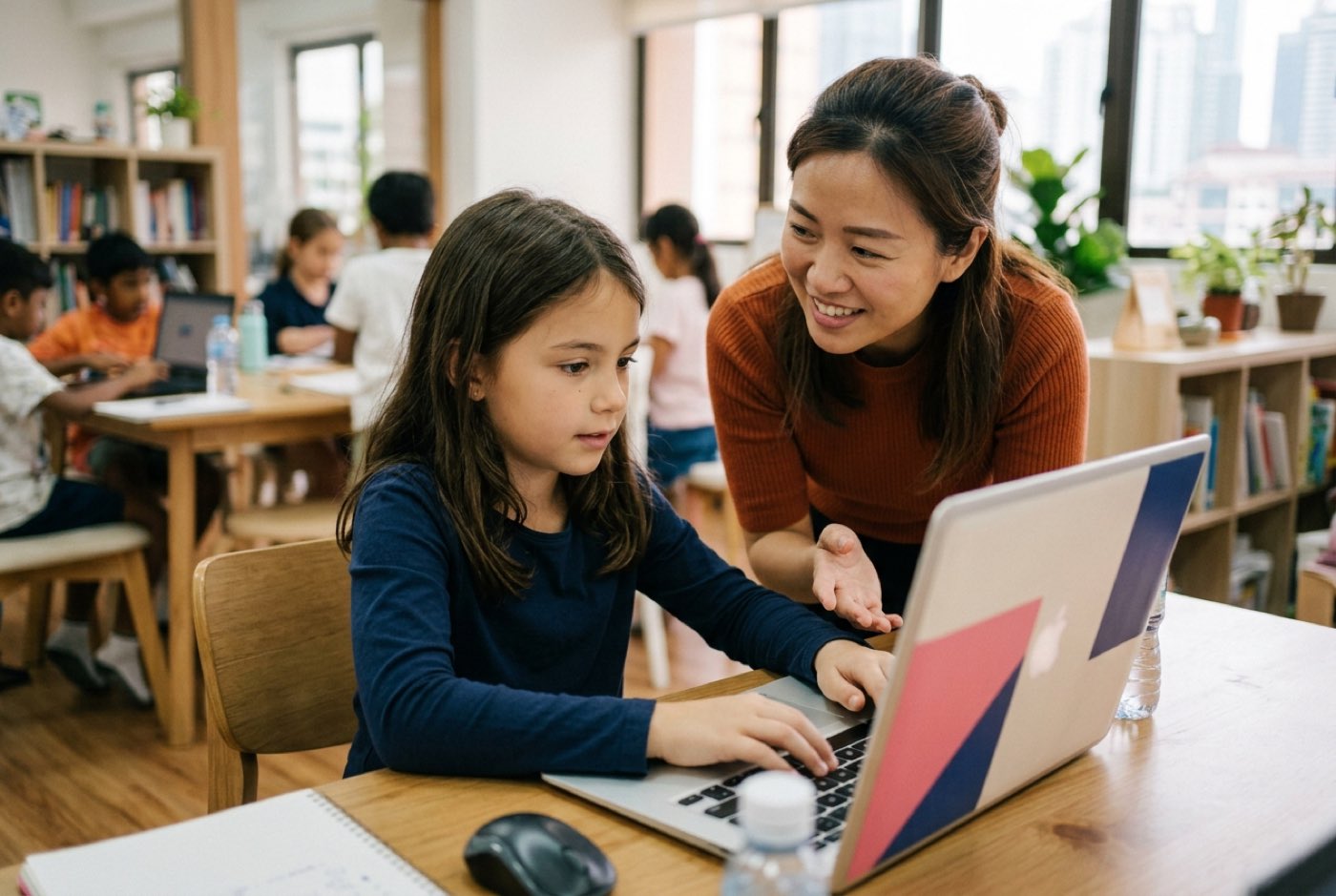
What 'Learning Math by Building' Actually Looks Like in Practice
Three examples of how concepts straight out of the school curriculum turn into construction projects:
1. Cartesian Coordinates and Spatial Vectors through Game Environments
In a tuition centre, a Form 1 or Form 2 student sits with a ruler and graph paper plotting coordinates. At Kidocode, the same student meets coordinates while programming camera angles or character movement in 2D and 3D game engines.
- The Concept: Positive and negative integers, 2D coordinates , 3D spatial vectors .
- The Build: A world in Roblox or Scratch where an object has to track and follow a player. Move left, decreases. Jump, increases.
- The Result: The student ends up with an intuitive visual model of coordinate space. Nothing was memorised; the rules were felt as directional forces in a space the student controlled.
2. Trigonometry and Angles through Projectile Physics
Trigonometric ratios (, , ) are a reliable source of panic for secondary students heading into IGCSE or SPM.
- The Concept: Right-angled triangles, sine and cosine functions, angle resolution.
- The Build: An archery game or space shooter in Python using a library such as Pygame. Working out where a cannonball lands from launch angle and velocity forces the student to split the speed vector into horizontal and vertical components with sine and cosine.
- The Result: Sine and cosine stop being mysterious buttons on a scientific calculator and become the tools that make a projectile arc across the screen convincingly.
3. Probability and Data Analysis in Artificial Intelligence Models
Statistics and probability usually arrive as dry sums about coloured marbles in bags and rolls of a die.
- The Concept: Probability distributions, percentage weights, data classification.
- The Build: Training a basic machine learning model to recognise hand gestures or classify text sentiment, then adjusting training-data confidence thresholds and analysing error distributions.
- The Result: The student watches probability decide whether an AI assistant understands a command correctly, which makes the statistics immediate rather than theoretical.
For more on how computational tasks build foundational thinking skills, read our analysis on computational thinking for young learners.
Connecting Built Projects to School Syllabi: IGCSE, Cambridge, and KSSR
The first worry most parents raise about an alternative to tuition is coverage: will this line up with KSSR, SPM, IGCSE or Cambridge International requirements?
Build-based learning does not replace those syllabi. It delivers the same mathematical standards from the other direction.
| Syllabus Subject Area | Traditional Tuition Approach | Build-Based Project Application |
|---|---|---|
| Algebra & Equations | Solve 20 linear equations on paper for | Variable calculation to adjust game jump height or speed |
| Geometry & Angles | Measure static angles with a protractor | Programming turning angles for autonomous robot navigation |
| Ratios & Proportions | Complete ratio conversion tables | Scaling game assets, sprite sizes, and screen resolution |
| Probability & Statistics | Calculate theoretical dice odds | Training AI models and testing dataset classification rates |
| Functions & Graphs | Plot quadratic curves manually on graph paper | Manipulating physics gravity curves and parabolic movement |
Learn a concept by using it in a project and the brain files it as working knowledge rather than exam-week storage. Three months later, when the same formula turns up on a test paper, the student isn't hunting for a memorised trick. They picture the code or the model they built, rebuild the logic in their head, and write the answer down.
Parents curious about where mathematical logic meets digital literacy can explore our guide on learning mathematics through technology.
How to Spot the Difference Between Tuition and Build-Based Learning
"Interactive learning" and "STEM enrichment" appear on a lot of signboards. Plenty of centres using those phrases have simply swapped paper worksheets for PDFs on tablets, leaving the rote method underneath untouched.
Three questions separate the two models:
| Traditional Tuition Model | Build-Based Model | |
|---|---|---|
| What is the focus? | Exam technique and repetition | Project construction and problem solving |
| What are the tools? | Assessment books and practice papers | Code engines, AI models and logic tools |
| What is the goal? | Short-term formula retention | Deep conceptual mastery and application |
Six Diagnostic Questions to Ask Any Learning Centre Before Enrolling
Marketing copy in the Klang Valley and Penang tends to sound the same; every centre says learning should be engaging. These six questions get past that, and the answers you hear will tell you which model you are dealing with.
-
"What will my child physically create by the end of today's session?"
- Traditional Tuition Answer: "They will complete Chapter 4 worksheets on fractions."
- Build-Based Answer: "They will code a working balancing mechanism that calculates fraction ratios to keep a bridge stable."
-
"How do your instructors handle a child who gets an answer completely wrong?"
- Traditional Tuition Answer: "We mark it red, show them the correct formula, and have them re-do the line."
- Build-Based Answer: "We ask them to run their code or model, observe where it fails, and adjust the mathematical parameters until it works."
-
"Does your curriculum follow standard international mathematics frameworks?"
- Red Flag: "No, we don't follow any school syllabus, we just do fun activities."
- Correct Answer: "Yes, our projects map directly to concepts in IGCSE, Cambridge, and Common Core, but we introduce them through practical construction."
-
"How do you incorporate Artificial Intelligence into your learning environment?"
- Red Flag: "We don't allow AI because students use it to cheat on homework."
- Correct Answer: "Every student works alongside a personalised AI tutor that answers their questions in real time without giving away final answers."
-
"Is coding taught as an isolated subject or integrated with thinking skills?"
- Correct Perspective: Coding syntax is increasingly automated. The value sits in using computational thinking and mathematical logic to direct the technology.
-
"Can both parents attend the initial trial session to see how the child learns?"
- Red Flag: "No, parents must wait outside or leave the premises."
- Build-Based Answer: "Yes, both parents are encouraged to observe the full hands-on session to watch their child build a working project from scratch."
The Role of Personalised AI Tutors: Safe, Embarrassment-Free Exploration
A large and under-discussed driver of math anxiety is social shame. A teacher asks a question in a room of twenty. The confused child weighs two bad options: put a hand up and look foolish in front of friends, or stay quiet and stay lost.
Tuition shrinks the room but keeps the dynamic. A child who needs a concept explained five different ways picks up on the sigh, the glance at the clock, the tightening patience.
This is where a personalised AI tutor changes the arithmetic of asking. Inside Kidocode's learning environment, every child has one trained specifically to guide mathematical discovery:
- Zero Embarrassment: A child can ask "why does this negative sign flip?" twenty times, twenty different ways. The AI tutor answers each time, rephrasing the explanation, with no judgment and no fatigue.
- Adaptive Levelling: If a twelve-year-old is stuck on algebraic ratios because of a gap in fractions left over from age nine, the AI tutor spots the gap and runs a micro-lesson on fractions with concrete examples before returning to the main task.
- Socratic Guidance: The tutor is calibrated not to hand over answers. It asks questions that lead the child to find the mathematical error themselves.
To understand how personalised software adapts to student needs, read our article on adaptive learning systems for children.
How Kidocode Approaches Math-Hate: Three Pillars in One Membership
Kidocode is Malaysia's coding and AI school for children aged 5 to 18, with physical campuses in the Klang Valley (Solaris Mont Kiara flagship, Sunway Nexis in Kota Damansara) and Penang (Q2 Waterfront in Bayan Lepas, Vantage in Tanjung Tokong, and Icon City in Bukit Mertajam), plus a live camera-on online programme.
We are neither a tuition centre nor a coding bootcamp. One membership carries three connected pillars:
- AI First: Children learn to direct artificial intelligence tools safely and effectively. Instead of consuming AI output passively, they learn how machine learning algorithms work and how to prompt them for help with hard problems.
- Math to Think: We take the mathematical concepts already sitting in Cambridge, IGCSE and national syllabi and deliver them through constructivist project building. Children who build games, simulate physics and train algorithms typically shed math-hate within two to four weeks.
- Tech to Build: Coding comes bundled free with every membership, because syntax is now public knowledge. What we teach is computational thinking, across six specialised tracks: Python, Web Development, Mobile Apps, Game Development, Electronics and 3D Modelling.
Our approach comes from our founder, Hossein Tohidi, known to students as Unclecode, a computer scientist, AI researcher and creator of Crawl4AI, an open-source web-crawling project with over 76,000 GitHub stars used by technology teams worldwide. His method has not shifted in years: strip out the artificial academic abstraction, and let young people build the technology themselves.
To learn more about our broader curriculum philosophy, visit our overview on how we teach at Kidocode.
Realistic Timelines: What Changes First When a Child Starts Building
Parents used to tuition want to know how fast they will see something. Here is the honest sequence of what shifts when a child moves from drilling to building.
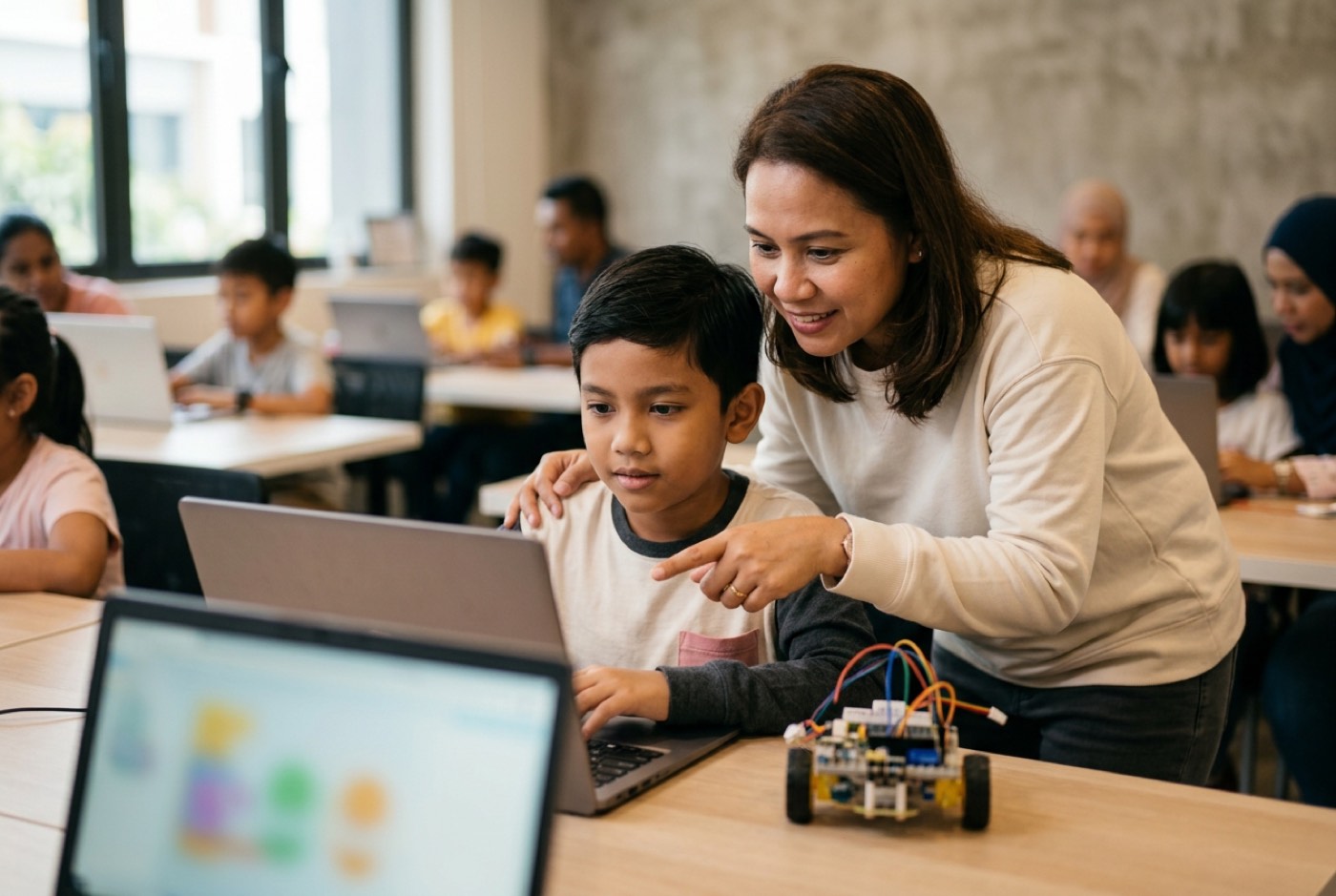
- Weeks 1 to 2, Attitude shift. The first change is emotional. The defensive wall around maths starts to come down, and friction at homework time drops. Instead of complaining, your child pulls you over to show a working game or digital model they made in session.
- Weeks 3 to 4, Effort and persistence. They will now spend thirty or forty minutes chasing a bug without throwing down the pencil. A mistake stops being a red mark and becomes a logic error that can be fixed by changing a variable. Math-hate generally ends in this window.
- Weeks 5 to 8, Conceptual connections. Project mechanics start linking back to schoolwork. When the school teacher introduces Cartesian coordinates or algebraic substitution, the child recognises it from their own builds.
- Beyond week 8, Autonomous confidence. Grades rise as a by-product of understanding rather than as the product of exam tricks, and self-driven inquiry takes over.
We do not promise a grade jump in week one, because understanding takes time to settle. Take the fear out of numbers first and the marks follow.
Parents interested in how gamified environments foster persistence can read our analysis on learning through Roblox and interactive platforms.
Action Plan and Decision Checklist for Parents
If the tuition you are paying for is producing tears rather than understanding, here is a four-step plan you can start this week.
- Audit your current tuition hours. Count the total hours per week your child spends sitting passively in tuition. Then ask your child privately which of those hours genuinely help and which feel like punishment.
- Shift screen time from consumption to creation. If your child spends hours on games on an iPad or PC, don't fight the screen across the board. Use the interest: "What if the four hours you spend playing Roblox became four hours building your own game?"
- Test the concrete-to-abstract shift at home. During homework, swap the symbolic rule for something visible. Draw the problem as a game grid, or build it with physical blocks, before anyone writes an equation.
- Book a hands-on practical trial. Watch how your child reacts to a maths concept delivered as a build. You can book an up-to-two-hour free trial at any Kidocode campus or online via our trial booking page.
Home Educational Strategy Planner
Use this printable checklist to evaluate your current academic routine and guide your transition toward build-based learning:
-
Step 1: Conduct a Tuition Audit
- List all current weekly tuition subjects, costs, and hours.
- Note down your child's emotional state before and after each session.
- Identify subjects where worksheet drilling has yielded zero improvement over 3 months.
-
Step 2: Evaluate Learning Style Signals
- Does your child struggle with pure formulas but excel at visual/spatial tasks?
- Does your child show high focus when building physical Lego models or playing sandbox video games?
- Does your child shut down when handed timed practice papers?
-
Step 3: Test Build-Based Framing
- Reframe a current math homework topic as a practical building challenge.
- Use interactive visual models rather than abstract formula memorisation.
- Praise debugging persistence rather than getting the correct answer on the first attempt.
-
Step 4: Schedule a Diagnostic Build Session
- Visit a Kidocode campus (Solaris Mont Kiara, Sunway Nexis, Q2 Waterfront, Tanjung Tokong, or Icon City) or select an online live session.
- Ensure both parents attend to observe how your child responds to hands-on problem solving.
- Review the physical artifact your child builds during the session.
To explore options for trial sessions and campus locations, explore our branches page.
Frequently Asked Questions
What if my child is already good at math in school?
Strong students gain plenty from build-based learning. In a standard classroom, the reward for being good at maths is usually finishing theoretical worksheets faster than everyone else. Applying that same knowledge to game physics, 3D spatial geometry and AI logic models teaches them how to convert abstract knowledge into working software.
Is my child too young to learn math through building and code?
It is never too early, as long as the method matches the child's developmental age. As Unclecode puts it: the moment your child can play a game on a mobile device is the moment they can start building one. For ages 5 to 8, we use visual block building and concrete spatial challenges. From 9 to 18, students move into text-based Python, web engineering and AI development.
Will learning math through building help with exam results like IGCSE or SPM?
Yes. Exams test whether a student can apply mathematical logic to a problem. Tuition tends to drill question formats; building establishes the concept underneath. A student who understands quadratic functions or geometry because they constructed something with them finds the exam questions readable.
How does Kidocode's math pillar differ from standard tuition centres?
Tuition centres run on passive instruction, memorisation and practice papers. Kidocode is an AI and tech school where maths is taught constructivistically through project creation. Every child has a personalised AI tutor, works on real projects, and moves at their own pace. Coding is bundled free within our memberships rather than sold as an expensive standalone add-on.
What happens during the free trial class?
The trial is an up-to-two-hour hands-on session, available at our five physical campuses (Solaris Mont Kiara, Sunway Nexis, Q2 Waterfront, Tanjung Tokong and Icon City) or live online. Your child works directly with our trainers to build a real project in AI, maths or tech. Both parents are invited to sit in, watch how their child learns, and ask whatever they want about the curriculum. You can reserve a spot on our free trial registration page.
To review our complete membership structure, visit our official pricing details page.
References
-
OECD (2023). PISA 2022 Results (Volume I and II): Country Notes - Malaysia. OECD Publishing. Available at: https://www.oecd.org/en/publications/pisa-2022-results-volume-i-and-ii-country-notes_ed6fbcc5-en/malaysia_1dbe2061-en.html
-
Kementerian Pendidikan Malaysia (2023). Laporan Awal Pencapaian Malaysia dalam PISA 2022. Bahagian Perancangan dan Penyelidikan Dasar Pendidikan (BPPDP). Available at: https://www.moe.gov.my/storage/files/shares/Lain-lain/PISA/laporan-awal-pencapaian-malaysia-pisa-2022.pdf
-
UNESCO (2025). What you need to know about private supplementary tutoring. UNESCO Newsroom Article. Available at: https://www.unesco.org/en/articles/what-you-need-know-about-private-supplementary-tutoring
-
Azahar, S., & Cheng, C. (2024). Understanding Malaysia's decline in PISA scores. ISIS Policy Brief, Institute of Strategic & International Studies Malaysia. Available at: https://www.isis.org.my/wp-content/uploads/2024/07/Understanding-Malaysias-decline-in-PISA-scores.pdf
-
Loi, J. C. H., Badiozaman, I. F. A., Thielking, M., Wyatt, S., & Quinn, S. (2024). Students' perceptions of shadow education in Sarawak, Malaysia. Educational Studies, 51(5). Available at: https://www.tandfonline.com/doi/full/10.1080/03055698.2024.2405815
-
Jayaraman, K., Koon, S. S., & Annamalai, N. (2019). Factors influencing secondary school students' favoring of private tutorial learning in Malaysia. Malaysian Journal of Learning and Instruction, 16(2). Available at: https://files.eric.ed.gov/fulltext/EJ1238786.pdf
-
Purwadi, I. M. A., Sudiarta, I. G. P., & Suparta, I. N. (2019). The effect of Concrete-Pictorial-Abstract (CPA) strategy on mathematical conceptual understanding. International Journal of Instruction, 12(1). Available at: https://www.e-iji.net/dosyalar/iji_2019_1_71.pdf
-
Aquil, M. A. I., & Ariffin, M. M. (2020). Dyscalculia awareness and diagnostic gaps in primary education in Malaysia. Journal of Educational and Social Research, 10(6). Available at: https://www.richtmann.org/journal/index.php/jesr/article/download/12273/11870/44372