

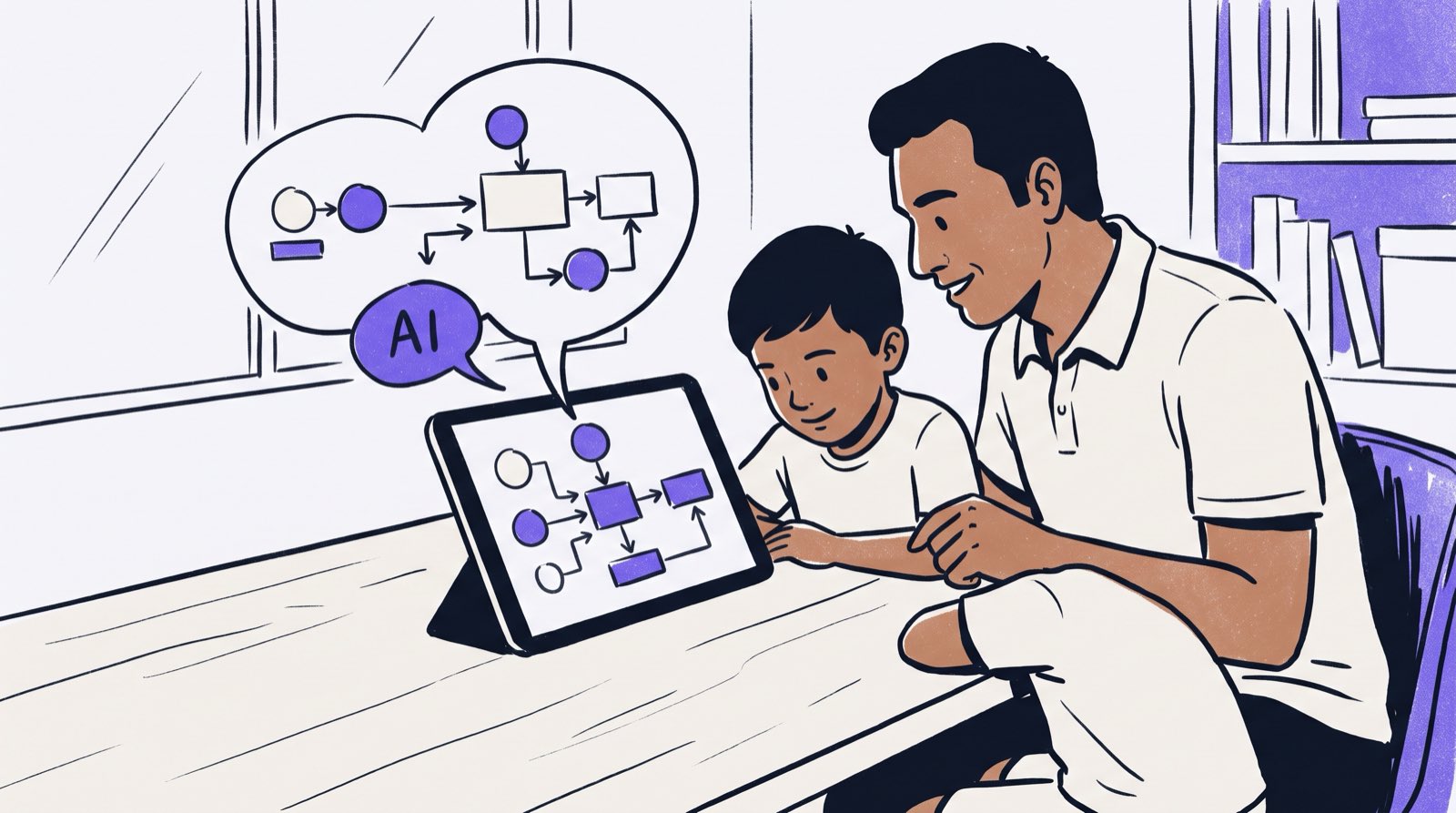
Ask ten people about artificial intelligence and you will get headlines instead of answers. Personalised tutors that will fix education. Vanishing jobs. Deepfakes. Kids glued to screens. None of that tells a parent in Malaysia what to actually do on a Tuesday night when their twelve-year-old is using a chatbot to finish a history assignment.
We speak with hundreds of parents each month at our Kuala Lumpur and Penang campuses. Almost none of them are computer scientists, and they do not need to be. What helps is a plain description of what AI is, where it already touches their child's day, and what a reasonable next step looks like at home.
Key Takeaways
| Topic | Core Concept | Parent Action |
|---|---|---|
| Definition | AI is software that learns patterns from data to make predictions or generate content, rather than following rigid pre-written instructions. | Tell your child plainly that AI is a tool trained on examples, not a mind that knows things. |
| Current Adoption | Children pick up AI tools faster than adults, mostly for schoolwork, creative projects, and everyday questions. | Move from policing access to coaching how your child directs and checks what the tool produces. |
| School Landscape | Ministry guidelines in Malaysia now cover AI literacy, but classroom practice is behind the pace of adoption. | Add practical computational thinking and build projects alongside the national curriculum. |
| The 3 Pillars | Readiness rests on three things: AI literacy to direct systems, maths to understand them, and tech skills to build. | Treat coding as the bundled language, maths as the thinking engine, and AI direction as the primary literacy. |
| Actionable Next Step | Children who build their own AI applications develop critical evaluation skills and digital independence. | Test your child's interest with a hands-on project rather than a lecture about the future. |
Table of Contents
- What Is Artificial Intelligence? (Stripping Away the Hype)
- How Does AI Actually Work? The Three Core Building Blocks
- Traditional Software vs Machine Learning vs Generative AI
- Why AI Is Already Part of Your Child's Daily Life
- The Malaysian Context: MOE Guidance and Educational Transformation
- The Three Pillars of AI Literacy: AI, Math, and Tech
- Progression by Age: What AI Literacy Looks Like from 5 to 18
- From Consumer to Builder: How Kidocode Teaches Artificial Intelligence
- Action Plan: 4 Steps to Guide Your Child's AI Journey at Home
- Experience It Hands-On: Free Trial Class at Kidocode
- Frequently Asked Questions
- References
What Is Artificial Intelligence? (Stripping Away the Hype)
Artificial intelligence describes computer systems built to handle tasks that used to require a person: recognising speech, spotting objects in photos, translating languages, working through maths problems, writing text, drawing pictures.
The easiest way in is to compare it with ordinary software. For decades, a program worked like a recipe. A human wrote the steps. To calculate a student's grade, the code ran a fixed formula such as , or a chain of if/else conditions. Feed it something the rules did not anticipate and it broke.
AI reverses the arrangement. Nobody hand-writes every rule. The software reads through a large body of data, finds mathematical patterns inside it, and derives its own statistical rules from what it saw. Show it something new and it applies those patterns to guess an answer or produce a response.
So when we explain artificial intelligence for kids, we start by saying what it is not. It is not alive. It has no consciousness and no feelings. It is a pattern-matching engine, very good at spotting correlations across millions of examples in seconds, and completely dependent on the data it was given and the person telling it what to do.

How Does AI Actually Work? The Three Core Building Blocks
Three stages cover almost everything a child needs to grasp: data, training, prediction.
- Data (the learning material): A model knows nothing at the start. It learns from examples. To get a system to recognise a cat, you do not write a description of ears and whiskers. You show it thousands of cat photos.
- Training (finding patterns): The algorithm works through that data looking for what repeats. Underneath, it is calculating conditional probabilities, working out how often certain features appear together. Pixel groupings get weighed against each other in much the same spirit as basic probability models weigh outcomes, as in .
- Prediction (generating outputs): A trained model receives something it has never seen, a new photo or a typed prompt, matches it against its internal statistical map, and returns its best guess.
That mechanism helps explain how quickly these tools reached young people. A 2026 global statement by UNICEF drawing on surveys across ten countries estimated that at least 20 million internet-using children aged 12 to 17 have used AI technologies, with children adopting AI tools at rates more than three times faster than adults [1]. More than 13 million of them turn to AI specifically for learning and homework [1].
Numbers in this region run higher. A 2024 survey conducted by Samsung across five Southeast Asian markets, Malaysia included, found nearly 9 in 10 youths aged 13 to 24 using AI tools in their daily routines, with 60% reaching them through a phone [2].
Once a child understands that the answer on screen is a probability, not a fact, their attitude changes. A calculated guess can be wrong. It can invent citations. It can carry whatever bias sat in the training data. Children who know that ask better follow-up questions.
Traditional Software vs Machine Learning vs Generative AI
Parents often want the difference between the programs they grew up with, the machine learning that quietly runs their bank account, and tools like ChatGPT or Midjourney. The table sets out how each works and what role your child plays.
| Feature | Traditional Software | Machine Learning | Generative AI |
|---|---|---|---|
| Primary Mechanism | Explicit, human-written rules and conditional logic | Statistical pattern recognition trained on tabular/image data | Deep learning transformer models trained on massive text/multimedia datasets |
| Input Format | Rigid inputs (e.g. form fields, button clicks, specific values) | Structured data, images, or numerical feature sets | Natural language prompts, image inputs, or audio instructions |
| Output Type | Fixed calculation or predetermined display change | Classification, score, ranking, or quantitative prediction | Original text, computer code, images, audio, or video generation |
| Typical Household Example | Scientific calculator app, desktop file manager, clock | Email spam filter, bank fraud detection, facial recognition unlock | Conversational AI tutors, image generators, automated code assistants |
| Child's Role | Passive user following pre-designed menu paths | Data provider whose activity trains external algorithms | Active director prompting systems, evaluating outputs, and iterating designs |
Read down the last row and the direction becomes obvious. Software used to wait for a button press. Now it reads open-ended human language and writes something back.
Why AI Is Already Part of Your Child's Daily Life
Your child may never have opened a chatbot. AI still shapes what they watch, play, and search for.
- Video recommendation algorithms: YouTube and TikTok track viewing history, pause times, and scroll speed, then predict which clip keeps a child watching longest and rebuild the feed on the spot.
- Gaming environments: Roblox and Minecraft lean on smart software for non-player character pathfinding, physics engines, and cheat detection.
- Search and assistance tools: Search engines and smart speakers use natural language processing to interpret casual phrasing, translate, and finish typed queries.
- Homework and creative work: In the 2024 Samsung Southeast Asian Youth Survey, the top daily uses of AI among youths aged 13 to 24 were learning (78%), creative pursuits (56%), and staying informed (38%) [2].
Screen time comes up at nearly every trial session. Parents watch their child disappear into a feed for an evening and assume the device is the problem.
We suggest a different measurement. Four hours of short-form video trains a child to consume. Four hours spent working out how a recommendation engine ranks clips, or building a custom Roblox game with Python and some AI assistance, uses the same screen and the same clock to entirely different effect. Track what the child produced, not how long the screen was on.
The Malaysian Context: MOE Guidance and Educational Transformation
This is now national policy, not just a market trend.
In August 2026, the Ministry of Education Malaysia (KPM) issued Professional Circular Letter No. 2 of 2026, launching the official MOE AI Literacy Guidance Book (Panduan Literasi Kecerdasan Buatan KPM) to set nationwide frameworks for AI literacy in schools [3]. It sits alongside the National Artificial Intelligence Roadmap and the Digital Education Policy, both aimed at preparing a workforce for digital transformation [4], [5].
Parents and teachers are on board. A 2025 study published in the Innovative Teaching and Learning Journal surveyed 267 participants across Malaysian educational communities and found more than 90% agreed schools should teach AI skills [6].
Policy moves faster than timetables, though. Systematic reviews of the Malaysian landscape point to exam-oriented schedules, uneven infrastructure, and thin teacher training time as the practical bottlenecks [5].
There are household risks too. UNESCO's global guidance on generative AI warns that unsupervised use leaves student data exposed and argues for age-appropriate rules around what children put into these platforms [7]. Regional research on Southeast Asian families adds another wrinkle: when children race far ahead of their parents technically and nobody structures the gap, conversation at home tends to thin out into logistics [8].
Copy-pasting from a chat window is not the skill that protects a child here. Judging a source, catching a false claim, and knowing the ethics of what they are using is [7]. For household boundaries in more detail, read our guide on ethics in AI for children.
The Three Pillars of AI Literacy: AI, Math, and Tech
Plenty of centres teach coding as a subject on its own, syntax line by line, disconnected from anything. Others run AI classes where students type prompts into an image generator and go home.
We build on three pillars instead, because AI does not stand up without maths underneath it and engineering around it.
| Stage | AI Literacy Focus | Maths and Logic | Build Skills |
|---|---|---|---|
| Ages 5 to 8 | Basic pattern games | Unplugged sequencing | Visual logic blocks |
| Ages 9 to 12 | Guided AI prompting | Roblox physics mechanics | Intro Python scripts |
| Ages 13 to 18 | Custom AI model building | Advanced Python engineering | Full stack projects |
Pillar 1: AI (Directing and Controlling Systems)
Directing intelligent software is the literacy that matters most right now, so it leads. Students learn to write precise prompts, read outputs sceptically, catch hallucinations, and set their own safety limits. The framing we use with them: AI is a tireless assistant you brief and then audit, not a shortcut around the assignment.
Pillar 2: Math (The Underlying Logic Engine)
"My child hates maths" comes up constantly. After thousands of students, our read is that the child is usually fine and the delivery was the problem. Memorising formulas for an exam is a reliable way to kill interest.
Maths is the language AI is written in. Neural networks run on matrix multiplication, coordinate geometry, logic trees, and probability. A child programming 3D character movement is doing geometry whether or not anyone calls it that. A child tuning a prediction model is doing probability. Every student also gets a personalised AI tutor and works at their own pace. Two to four weeks of building real projects is usually enough for the hesitation to go. More on our approach to learning math through building.
Pillar 3: Tech (Building the Infrastructure)
Coding has changed. AI assistants write baseline syntax in seconds, which means memorising syntax is no longer worth much. That knowledge is public now.
We bundle coding free across every package because the actual lesson is computational thinking: breaking a problem into parts, designing an architecture, debugging, structuring logic. Six tracks sit under Tech: Python, Web Development, Mobile Apps, Game Development, Electronics, and 3D Modeling. Here is why coding is bundled free at Kidocode.
Progression by Age: What AI Literacy Looks Like from 5 to 18
A five-year-old and a sixteen-year-old share a device and nothing else. Teaching artificial intelligence for kids means matching the work to the stage.
Ages 5–8: Visual Logic and Foundational Patterns
Early primary children should not be typing syntax or staring at a code editor. The work is sequential logic, spatial orientation, and pattern recognition.
- Tools Used: ScratchJr, Scratch visual blocks, physical electronic kits, and unplugged algorithmic games.
- Core AI Concepts: Inputs and outputs, spotting visual patterns, and the idea that machines follow an exact order.
- Sample Project: An interactive animated story where characters react to user choices or colour sensor inputs.
Ages 9–12: Applied Logic, AI Prompting, and Scripting
Upper primary and early secondary students read well and want to make things. This is the point where visual logic meets typed commands and AI assistants.
- Tools Used: Scratch to Python transitions, Roblox Studio (Lua), Minecraft modding engines, block-based AI trainers, and basic large language model prompt tools.
- Core AI Concepts: How to structure a prompt, training a simple image classifier, recognising algorithmic bias, and using AI to debug their own code.
- Sample Project: A custom Roblox obstacle course where an AI assistant drafts baseline scripts while the student debugs the physics and designs the mechanics.
Ages 13–18: Text Engineering, Custom Models, and Production Systems
Teenagers can work with professional tooling and the mathematics behind it.
- Tools Used: Pure Python, VS Code, Git repositories, web stacks (HTML/CSS/JavaScript), API integrations, tensor libraries, and open-source AI frameworks.
- Core AI Concepts: Natural language processing pipelines, data preprocessing, neural network layers, API connections, and full-stack deployment.
- Sample Project: A web application wiring a custom Python backend to an AI API, analysing local environmental data or running study tools, deployed live.
For developmental markers bracket by bracket, read our parent guide on what AI-savvy looks like at ages 8, 12, and 16.
From Consumer to Builder: How Kidocode Teaches Artificial Intelligence
Kidocode opened in 2014 at Solaris Mont Kiara, Kuala Lumpur. Eleven years and more than 9,500 students later, we hold a 4.6-star rating from 177 parent reviews on Google and were voted the #1 coding class for kids in KL and Selangor by Tallypress.
The methodology came from our founder, Hossein Tohidi, known to students and parents as Unclecode. He is a computer scientist and AI researcher, and the creator of Crawl4AI, an open-source web scraping engine with over 76,000 GitHub stars and 12 million downloads, used inside Fortune 500 AI pipelines. His premise for the school was straightforward: children learn software by building software, not by watching someone explain it.
 What that looks like week to week, and how it differs from a tuition centre or a holiday bootcamp:
- AI-first mindset: Kids learn to direct AI tools well and safely. We treat AI assistance as a productivity skill, not contraband.
- Project-first methodology: Every session ends with something that runs. A working game, a deployed page, an image recognition tool. Your child leaves with an artefact each time.
- Personalised AI tutoring: Each child moves at their own speed with a personal AI tutor tracking progress and a trainer coaching alongside it. Fast learners are not held back; students who need longer are not rushed.
- Flexible hybrid delivery: Attend in Klang Valley (Solaris Mont Kiara flagship, Sunway Nexis in Kota Damansara) or Penang (Q2 Waterfront in Bayan Lepas, Vantage Tanjung Tokong, Icon City in Bukit Mertajam), or join live camera-on online sessions from anywhere.
For a fuller picture of how the curriculum is structured, see how we teach at Kidocode.
Action Plan: 4 Steps to Guide Your Child's AI Journey at Home
None of this requires an engineering degree. Four steps you can start this week.
Step 1: Conduct an AI Household Audit Together
Sit with your child and go through the apps on their device. Work out together which ones are making predictions. Ask open questions:
- Why do you think YouTube picked this video next?
- How does the camera find your face that fast?
- Where does this chat assistant get its answers?
The point is to move software out of the category of magic and into the category of something people built.
Step 2: Enforce the "Verification Rule" for Homework
If your child uses AI for school research, set one rule and hold it: never copy an AI output without checking it independently.
Ask them to verify at least two specific facts or working steps against an outside source, a textbook or a reputable academic site. If the tool is starting to replace their thinking rather than support it, read our guide on what parents should do when kids use ChatGPT for homework.
Step 3: Shift from Text Prompts to System Building
Push past prompting. Instead of asking an AI to "write a story about a dragon," ask your child to build a small interactive program where the reader's choices change where the dragon goes.
Scratch is a good starting point; Python is the next step after it. If you are weighing up different approaches, read our breakdown on using AI versus building with AI.
Step 4: Schedule a Hands-On Evaluation Session
Watch what happens when your child is asked to build something instead of watch something. Give them a structured challenge at home, or book a trial session where a trainer can read their computational thinking, maths baseline, and how they focus.
Printable AI Household Agreement & Evaluation Checklist
Print this and stick it near the family workstation.
- Data Safety Agreement: We never type real full names, home addresses, phone numbers, or private school details into any public AI text box or online chat window.
- The Two-Source Verification Check: For any school project or fact query answered by an AI tool, we verify at least two independent facts using an official textbook, library book, or verified educational website.
- The "Explain It Back" Test: If an AI assistant helps explain a complex topic or debug a maths line, the student must explain the logic back to a parent or trainer in their own words without looking at the screen.
- Creation vs Consumption Ratio: For every hour spent passively watching algorithmic video feeds or playing pre-made games, at least 30 minutes must be dedicated to active building, coding, or visual designing.
Designed, ready to print and sign. We email it to you together with a 5% discount on your next registration.
Experience It Hands-On: Free Trial Class at Kidocode
Reading about AI only goes so far. The quickest way to find out whether your child enjoys building with it is to hand them a project.
Parents and children aged 5 to 18 are welcome at a Free Trial Class, at any campus or live online.
- Duration: Up to 2 hours of hands-on exploration.
- What Your Child Does: Builds a real, working project in AI, maths, or coding with a trainer alongside them.
- What Parents Do: Both parents are welcome to attend. You will see how your child learns, watch the teaching method up close, and get a straight assessment of their computational thinking style.
- Zero Pressure: No payment, no sales pitch, no obligation to enrol.
- Locations: Solaris Mont Kiara (KL flagship), Sunway Nexis (PJ), Q2 Waterfront (Penang), or live camera-on online.
Book a slot on our Free Trial Class Booking Page.
Frequently Asked Questions
Is artificial intelligence for kids too difficult for primary school students?
Not if the format fits the age. Children aged 5 to 8 do not start with typed code or abstract algebra. They start with visual block programming, spatial logic puzzles, and pattern games. Matched to the right stage, primary students pick up genuinely complex computational ideas while building games they want to play.
Will AI make learning to code obsolete?
No, but it changes which coding skills are worth having. AI assistants generate baseline syntax quickly. They do not break a messy problem into solvable parts, design a system, or track down why something fails in production. Coding today is less about remembering commands and more about computational thinking, structured logic, and briefing AI tools well.
How does Kidocode fix math-hate using AI?
Most children who struggle with maths do not dislike maths; they dislike memorise-and-test. We follow international standards (IGCSE, Cambridge, US Common Core) but deliver the syllabus through software builds. Students use maths to control game physics, set visual coordinates, and calculate AI probabilities. With a personalised AI tutor adapting to their pace, most get past the hesitation in two to four weeks.
Is coding really included for free at Kidocode?
Yes. Coding syntax is public knowledge now. Since our mission is making kids AI-savvy and strengthening their mathematical logic, coding comes bundled free across all six technology tracks (Python, Web, Mobile Apps, Game Development, Electronics, and 3D Modeling). You pay for the membership platform and the coaching.
What happens if my family lives far from Mont Kiara or Penang?
Our live online programme runs the same curriculum, the same trainers, and the same project builds as the campuses. Students join from across Malaysia, Singapore, the UK, and elsewhere through camera-on sessions. Parents can sit in on the online trial class from home.
References
- UNICEF. Children are adopting AI technologies more than three times faster than adults. Official press release reporting on Disrupting Harm Phase 2 survey data across 10 countries, published 29 June 2026. Available from: https://www.unicef.org/press-releases/children-are-adopting-ai-technologies-more-three-times-faster-adults
- Samsung Electronics Co., Ltd. Samsung Insights: Youths in Southeast Asia Are High Adopters of AI. Corporate news release reporting on 2024 Southeast Asian Youth Survey (N = 884 across 5 countries), published 25 April 2025. Available from: https://news.samsung.com/my/samsung-insights-youths-in-southeast-asia-are-high-adopters-of-ai
- Ministry of Education Malaysia (KPM). Surat Pekeliling Ikhtisas KPM Bil. 2 Tahun 2026: Panduan Literasi Kecerdasan Buatan (AI) Kementerian Pendidikan. Official circular publication page, updated 18 August 2026. Available from: https://www.moe.gov.my/surat-pekeliling-ikhtisas-kpm-ai
- Malaysian Investment Development Authority (MIDA). AI in Education: Driving Malaysia's Future-Ready Workforce. Official government publication, published 3 September 2025. Available from: https://www.mida.gov.my/ai-in-education-driving-malaysias-future-ready-workforce/
- Jamaluddin, F., Jamaluddin, A. H., Jamaluddin, F., & Jamaluddin, F. Malaysia's AI-Driven Education Landscape: Policies, Applications, and Comparative Analysis. arXiv / Stanford SCALE Initiative repository, published September 2025. Available from: https://scale.stanford.edu/ai/repository/malaysias-ai-driven-education-landscape-policies-applications-and-comparative
- Cheah, E., Guo, A. Q., Zaini, N. H., Scott, N. S., Wang, F. L., & Kew, S. N. Perceptions and Impact of Artificial Intelligence in Educational Ecosystems. Innovative Teaching and Learning Journal (Penerbit UTM Press), 2025; 9(1): 12-25, published 7 June 2025. Available from: https://itlj.utm.my/index.php/itlj/article/view/177
- UNESCO (Miao, F., & Holmes, W.). Guidance for generative AI in education and research. UNESCO policy guidance summary, published 7 September 2023, updated 16 January 2026. Available from: https://www.unesco.org/en/articles/guidance-generative-ai-education-and-research
- Farisal, U. The Impact of AI on Family Communication: A Narrative Review on Children's Respect for Parents in Developing Southeast Asia. Jurnal Parenting dan Anak, published 30 January 2025. Available from: https://www.researchgate.net/publication/389680341_The_Impact_of_AI_on_Family_Communication_A_Narrative_Review_on_Children's_Respect_for_Parents_in_Developing_Southeast_Asia