

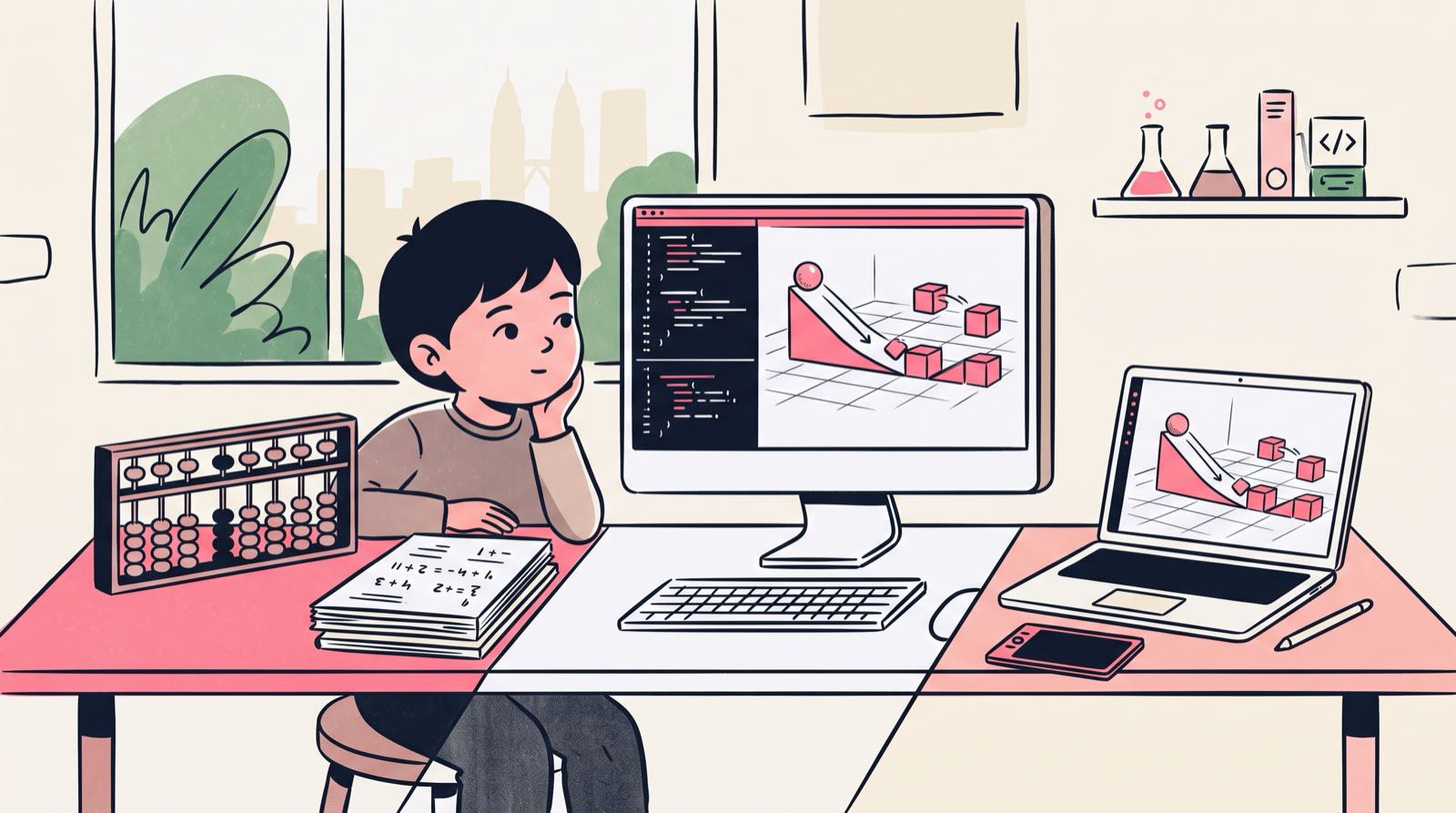
The same conversation happens almost every week, either at our flagship campus in Solaris Mont Kiara or in the chat window of a live online trial class. A child is slipping in school math, or has started fighting about homework every evening. So the family does what families in Petaling Jaya, Subang and Penang do: they sign up for daily worksheet drills, or for abacus mental arithmetic.
Six months later, sometimes a year, the child can multiply large numbers in seconds and still goes blank at the first word problem on the exam paper. The parent sitting across from me wants to know how that is possible after hundreds of days of practice.
Our earlier guide on why traditional math tuition fails looked at exam-drilling centres and why they rarely fix math anxiety. Here I want to zoom out and put the three categories Malaysian parents actually pay for side by side: repetitive drill franchises, speed-focused mental arithmetic, and constructivist application, which is what we mean by learning math by building.
None of the three is a scam. Each was designed to solve a particular problem, and each does that job. The useful question is what a method trains, and where its ceiling sits.
Key Takeaways
| Metric / Dimension | Repetitive Drill (Kumon-Style) | Speed & Visualization (Abacus) | Application (Math by Building) |
|---|---|---|---|
| Primary Mechanism | Daily self-paced paper worksheets | Bead manipulation moving to mental soroban | Project creation (game physics, AI logic) |
| Core Skill Trained | Procedural accuracy, speed, habit | Calculation speed, visuospatial working memory | Structural reasoning, modeling, problem transfer |
| Primary Strengths | Fluency in basic arithmetic operations | Rapid numerical calculation without calculators | Conceptual deep-understanding, zero math anxiety |
| Main Limitations | Low engagement, minimal transfer to problem solving | Lack of conceptual transfer to abstract higher algebra | Requires structured project guidance and AI tools |
| Target Age Range | Ages 4 to 12 | Ages 5 to 10 | Ages 5 to 18 |
| Syllabus Connection | Pre-requisite arithmetic foundation | Early numerical mechanics | Direct alignment with Cambridge, IGCSE, Common Core |
Table of Contents
- The Math Crossroads Every Malaysian Parent Reaches
- The Three Math Enrichment Categories in Malaysia
- Category 1: The Repetitive Drill Method (Kumon-Style Worksheets)
- Category 2: Rapid Calculation and Visuospatial Processing (Abacus and Mental Arithmetic)
- Category 3: Constructivist Application (Math by Building Real Systems)
- Comprehensive Comparison: Drill vs Speed vs Application
- The Transfer Test: Why Speed and Worksheet Mastery Fail in Unseen Scenarios
- Why Mechanical Methods Work Until Primary 4 and Then Hit a Ceiling
- What Math by Building Looks Like in Practice
- Syllabus Alignment: Cambridge, IGCSE, and Common Core Through Creation
- Transition Strategy: A 3-Month Plan for Parents Currently Enrolled in Drill Classes
- How to Evaluate Your Child in a Free Hands-On Build Session
- Printable Math Enrichment Decision Matrix & Checklist
- Frequently Asked Questions
- References
The Math Crossroads Every Malaysian Parent Reaches
The numbers behind that weekly conversation are not comforting. In the OECD PISA 2022 evaluation, Malaysian 15-year-olds averaged 409 points in mathematics against an OECD average of 472 [1]. Only 41% reached baseline Level 2 proficiency, versus 69% across OECD member nations, and top performers at Level 5 or 6 made up roughly 1% of our students [1]. The Institute of Strategic & International Studies (ISIS) Malaysia put the post-pandemic damage at an estimated 1.6 years of mathematics schooling lost [2].
graph TD
    A[Child Struggles or Needs Math Advancement] --> B{Parent Selects Intervention}
    B --> C[Drill Worksheets]
    B --> D[Abacus Mental Arithmetic]
    B --> E[Math by Building]
    C --> F[High Operational Speed / Low Reasoning Transfer]
    D --> G[Rapid Visuospatial Calculation / Abstract Wall at Age 10]
    E --> H[Conceptual Understanding & Real Problem Solving]
No wonder parents reach for extra support. Shadow education and private enrichment are now simply part of growing up in Malaysia [3]. The risk is that a child who is struggling gets placed in the wrong category of extra class, and the extra hours make the anxiety worse instead of better.

The Three Math Enrichment Categories in Malaysia
Walk through any mall in Klang Valley and read the signboards. Almost everything on offer falls into one of three buckets.
- Repetitive Drill Franchises: Paper-based, self-paced individual learning where students complete daily worksheets focusing on computational repetition.
- Speed & Visualization Programmes: Abacus-based mental calculation (AMC) and mental arithmetic classes using physical bead manipulation that transitions to imaginary mental soroban visualization.
- Application & Constructivist Programmes: Build-based environments where students apply mathematical concepts (geometry, variables, vectors, probability) directly inside software projects, game mechanics, and AI systems.
Three different theories of how learning happens. Here is how each one plays out.
Category 1: The Repetitive Drill Method (Kumon-Style Worksheets)
The drill method, exemplified globally by Kumon, rests on one premise: confidence in math comes from procedural mastery and a daily study habit. A child takes a short diagnostic, starts at a level where they score perfectly, and moves forward through thousands of micro-step paper worksheets.
The research on this is not thin, and it is not negative. A large quantitative study tracking 30,849 students across 230 learning centres found early enrolment in Kumon significantly correlated with advanced grade placement, with 43.2% of students working at least six months ahead of their school grade after nine months of consistent study [4]. A randomized controlled trial run by the JICA Research Institute with primary school students found that an eight-month Kumon intervention lifted speed-adjusted cognitive mathematics test performance by 1.50 to 2.64 standard deviations against control groups [5].
Read the same JICA evaluation to the end, though, and the boundary appears. Computational speed and test-taking accuracy improved dramatically. Broader non-cognitive problem-solving measures showed no robust overall impact [5].
That matches what I see in trial sessions. Worksheets do build discipline and arithmetic speed in a young learner. But because every operation sits stripped of context on the page, many children end up learning to recognise the template rather than the relationship underneath it.
Category 2: Rapid Calculation and Visuospatial Processing (Abacus and Mental Arithmetic)
Soroban mental arithmetic centres have been part of the Malaysian landscape for decades. Children learn to turn numbers into bead configurations. Later the physical abacus is taken away, and the calculation happens on a mental image of the frame.
This is not a party trick. Neuroimaging shows that abacus-based mental calculation (AMC) genuinely recruits different machinery. A review in Frontiers in Neuroscience reported that expert AMC users activate bilateral frontal-parietal visuospatial networks while calculating, where non-experts lean on language-related left-hemisphere networks [6]. The payoff shows up in mental calculation, numerical magnitude processing and visuospatial working memory [6].
graph LR
    A[Physical Abacus Beads] --> B[Visual Soroban Image in Memory]
    B --> C[Bilateral Frontal-Parietal Neural Activation]
    C --> D[Extreme Mental Calculation Speed]
    D -. Missing Link .-> E[Abstract Word Problem Translation]
The same review is careful about the limits. Under randomized longitudinal designs with active control groups, AMC training produced no far-transfer gains to fluid intelligence or abstract mathematical reasoning beyond placebo effects [6].
Put that in classroom terms. An abacus-trained child handles 348 + 572 + 191 in seconds, no pencil, no calculator. Hand the same child a Form 1 or Form 2 algebra question that requires building an equation out of a sentence, and the mental soroban has nothing to offer. Execution is fast. Deciding which calculation to run is a different skill entirely.
Category 3: Constructivist Application (Math by Building Real Systems)
Constructivist application runs the usual sequence backwards. Rather than learn an abstract rule, drill twenty exercises and meet an application problem on page 50, the student starts with something to build.
Say the goal is a 2D platformer, a 3D simulation, or an AI image filter. The math is not scheduled for later; it is needed in the next five minutes:
- To make a game character jump naturally, the student must implement gravity using quadratic acceleration ().
- To calculate collision detection between two moving objects, the student must apply the Pythagorean theorem ().
- To create an AI model that predicts outcomes, the student must handle arrays, probabilities, and coordinate normalization.
There is developmental evidence for starting even earlier than a keyboard. A study in Child Development found that 3-year-olds' spatial block assembly skills predicted concurrent mathematics performance independent of general language capability [7]. Assembling structures, physical or digital, gives numbers something to be about.
The shift I care about is the one in attitude. Once a child is building a game or an AI tool, math stops being arbitrary rules to survive on a test paper and becomes the physics of a world they own.
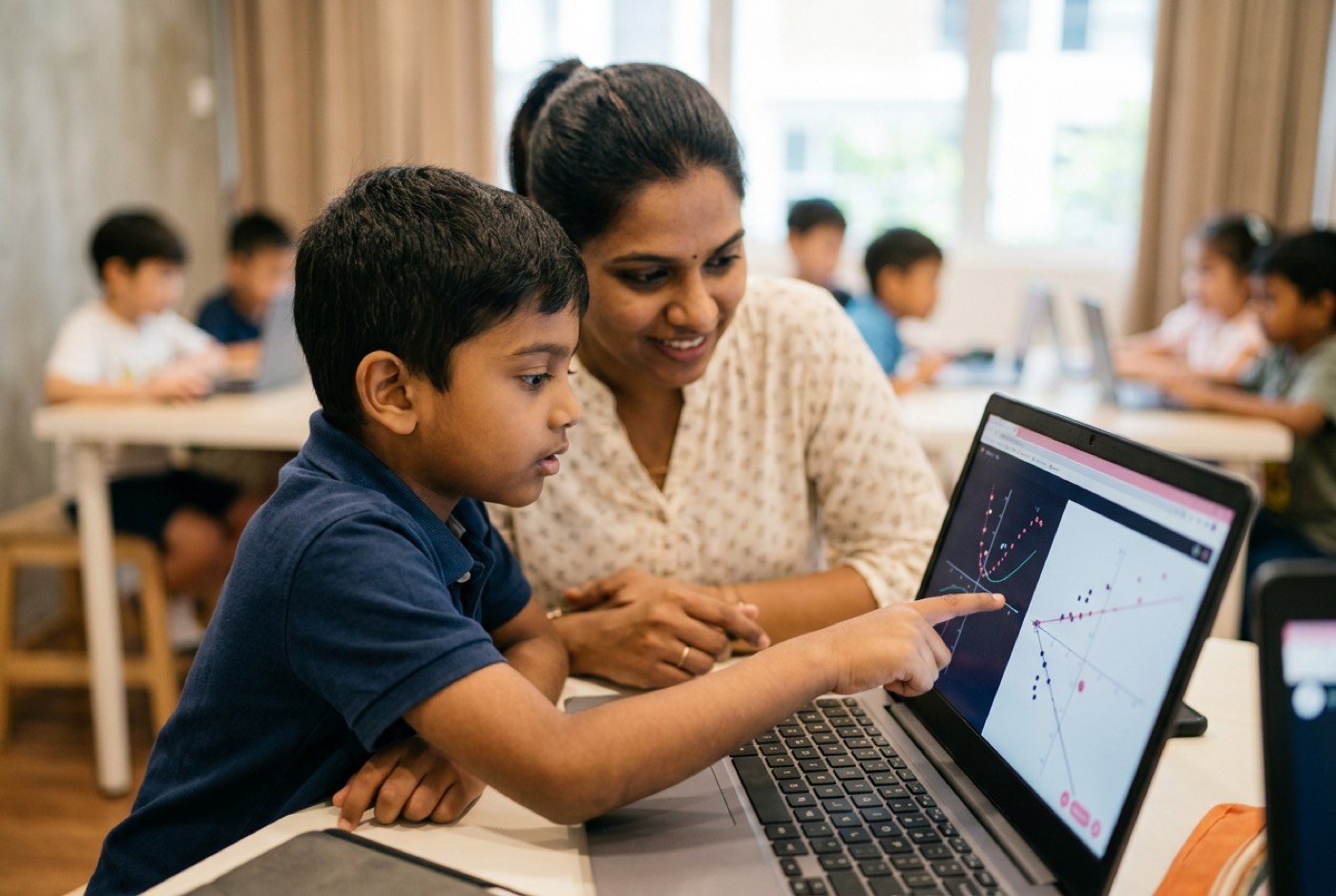
Comprehensive Comparison: Drill vs Speed vs Application
Here are the three categories laid out across the dimensions parents ask about most.
| Dimension | Category 1: Repetitive Drill | Category 2: Abacus / Speed | Category 3: Math by Building |
|---|---|---|---|
| Core Learning Theory | Behaviorist habit formation & repetition | Visuospatial cognitive training | Constructivist application & discovery |
| Parent Cost & Structure | Lower entry cost, daily worksheets | Weekly classes, practice home drills | Integrated membership model (view pricing details) |
| Weekly Time Commitment | 15-20 mins daily at home + 2 centre visits | 1-2 hours weekly + daily practice | Flexible 1-3 sessions weekly (how we teach) |
| Child Engagement Style | Low (can feel transactional or tedious) | High early on (gamified speed challenges) | Very High (project-driven ownership) |
| Spatial & Conceptual Skills | Minimal spatial training | Strong visuospatial working memory | High spatial assembly & architectural reasoning |
| Higher Level Algebra Fit | Weak (formulaic execution only) | Very Weak (bead visualization ends at algebra) | Strong (variables, functions, vectors mastered early) |
| Anxiety Reduction | Low (error correction can induce stress) | Moderate (speed pressure affects some kids) | High (error is reframed as software debugging) |
The Transfer Test: Why Speed and Worksheet Mastery Fail in Unseen Scenarios
Every learning system eventually gets judged on one thing: transfer. Can the child take a concept from class and use it on a problem nobody prepared them for?
Learning psychology splits this in two. "Near transfer" means applying a skill to a task that looks like the training format, such as fifty vertical addition problems on a worksheet or a column of sums on a soroban. "Far transfer" means meeting an unfamiliar scenario, seeing the mathematical structure hiding inside it, and solving it.
Mechanical approaches run into three walls here:
- Format Dependence: A child drilled purely on standard worksheets can fail a question that uses the identical operation but presents it as a diagram or a sentence.
- Loss of Context: Detach numbers from the real world long enough and a child loses their sense of scale. They will write down an answer that is off by an order of magnitude and never flinch, because their attention was on executing the rule.
- Execution vs Direction: Drills teach execution, meaning how to multiply. Higher math and computer science demand direction, meaning knowing what to calculate and why.
Building software closes that gap in an unusual way: the code checks the reasoning instantly. Get an angle vector wrong and the game object flies off in the wrong direction, on screen, in front of the child. No red pen, no waiting for marked homework. The creation itself reports the error, and the child debugs the math because they want the thing to work.
Why Mechanical Methods Work Until Primary 4 and Then Hit a Ceiling
In the early primary years, Standard 1 to Standard 3 locally, Years 1 to 4 in international curricula, school math is mostly arithmetic: addition, subtraction, times tables, basic division.
Drill and abacus methods look excellent here, and they often are. A child who has done thousands of arithmetic repetitions is faster than the classmates, scores well on straightforward quizzes, and picks up real academic confidence along the way.
Then Standard 4 arrives, around ages 9 to 10, and the syllabus changes shape.
| Stage | Curriculum focus | What it demands from the child |
|---|---|---|
| Standard 1-3 | Computational: addition, subtraction, multiplication, division | Speed and accuracy of execution |
| Standard 4 onwards | Conceptual: fractions, ratios, variables, coordinate geometry, algebra | Relational and structural reasoning |
Memorised steps stop covering the ground:
- Fractions require an understanding of proportional reasoning and part-to-whole relationships.
- Ratios require relational thinking across dimensions.
- Word problems require translating narrative statements into algebraic equations.
- Coordinate geometry requires linking spatial location with numerical ordered pairs.
A child whose whole foundation is calculation speed usually shows a sharp drop right at this transition. They try to run arithmetic procedures on algebraic ideas, the procedures do not fit, and the confusion turns into math anxiety. This has nothing to do with how bright the child is. Drilling trains execution speed, and the curriculum has just started asking for reasoning.
What Math by Building Looks Like in Practice
Abstract arguments about pedagogy are easy to make. Below are three core topics as they actually get taught, traditional version against build version.
graph TD
    SubGraph1[Traditional Method] --> A[Memorize Coordinate Rules: x, y]
    A --> B[Fill Worksheet Grids]

    SubGraph2[Math by Building] --> C[Create Game Map Grid]
    C --> D[Map Sprite Position: x, y]
    D --> E[Apply Vector Math for Movement]

    B -. Comparison .-> E
Scenario A: Coordinate Geometry
- Traditional Approach: The student sees an - Cartesian plane on a whiteboard, hears that is horizontal and is vertical, then plots ten static points on grid paper.
- Math by Building Approach: In our tech track projects, a student creates a 2D game environment. To position a character on screen, they set
player.x = 200andplayer.y = 150. To make the character move right, they increasex. To jump, they manipulatey. When they add a second player for multi-player mode, they calculate distance using absolute differences (, ). Coordinate geometry stops being a graph-drawing chore and becomes the map they use to control behaviour.
Scenario B: Variables and Algebra
- Traditional Approach: The teacher writes on the board, explains the rule for shifting constants across the equal sign, and sets twenty similar equations for homework.
- Math by Building Approach: A student builds a health bar and score system for an interactive game. They declare a variable
playerHealth = 100. When a collision occurs,playerHealth = playerHealth - damage. To adjust difficulty dynamically, they create a multiplier:score = enemiesDefeated * difficultyLevel. The letter turns into a container that holds values and changes over time. Algebra is something running in front of them, not a rule to accept on trust.
Scenario C: Probability and Statistics
- Traditional Approach: The student learns the formula and works out the odds of drawing red marbles from a bag on a worksheet.
- Math by Building Approach: While learning about artificial intelligence for kids, a student builds an AI model that classifies images or text. They watch the model report its confidence (85% chance the image is a cat, 15% chance it is a dog). They tweak threshold values, look at how their dataset is distributed, and see what happens to accuracy when the sample size changes. Probability becomes the steering wheel for an intelligent system.

Syllabus Alignment: Cambridge, IGCSE, and Common Core Through Creation
The question I get right after the demo is always the same: will time spent on games, electronics and AI models cost my child marks in SPM, IGCSE or Cambridge exams?
Fair question. The answer sits in a distinction people rarely make explicit. A syllabus specifies what concepts a child must know. It does not specify that those concepts have to arrive via a textbook.
At Kidocode, our math curriculum follows international standards, including Cambridge Lower Secondary, IGCSE Mathematics, and US Common Core standards. The required topics all get covered. The order is what changes.
| Path | Step 1 | Step 2 | Step 3 |
|---|---|---|---|
| Traditional | Abstract rule | Worksheet practice | Theoretical problem |
| Build-based | Real system goal | Math concept needed | Mastery via code |
Because computational thinking underpins modern mathematics [8], students who write software pick up the core topics as a by-product of shipping projects:
- Functions and Mapping: Mastered through inputs, parameter passing, and return values in Python programming.
- Matrices and Transformation: Mastered through 3D object manipulation, scaling, rotation, and translation in 3D modeling and game engines.
- Logic and Boolean Algebra: Mastered through conditional logic operators (
IF,AND,OR,NOT) in algorithm design.
So when one of these turns up on an IGCSE or SPM paper, the student is not digging for a memorised formula. They are remembering the week they had to get that exact piece of math right or the project would not run.
One more thing worth stating plainly: coding is bundled free across all our programmes. Syntax is public knowledge now, freely available to anyone with a browser. What we charge for, and what we actually teach, is computational thinking and mathematical reasoning.
Transition Strategy: A 3-Month Plan for Parents Currently Enrolled in Drill Classes
If your child sits in a Kumon-style or abacus class right now, do not cancel it tomorrow. A phased switch lets you test your child's conceptual understanding while keeping the study routine you have already paid for in habit terms.
graph LR
    M1[Month 1: Observe & Identify] --> M2[Month 2: Introduce Build Experience]
    M2 --> M3[Month 3: Evaluate & Reallocate]
Month 1: Observe and Audit Unseen Transfer
- Keep your child's current schedule intact.
- Take a single word problem or practical problem involving concepts from their current drill level (for example, proportional reasoning or fraction division).
- Present the question without showing the standard worksheet layout or formula steps.
- Watch how your child approaches the problem. Do they attempt to understand the problem's structure, or do they immediately ask "Which formula should I use?"
- Note whether your child displays signs of math anxiety when presented with an unfamiliar format.
Month 2: Introduce Constructivist Application Alongside Existing Drills
- Introduce build-based learning alongside their current schedule.
- Book a free hands-on trial session at a local campus or online to let your child experience learning math through real software creation.
- Observe how your child responds to learning math through software projects. Pay attention to whether their curiosity returns when mathematical concepts are applied to game physics or AI logic.
- Compare their focus and engagement during worksheet sessions versus build sessions.
Month 3: Evaluate and Reallocate Learning Hours
- Review your child's progress across both environments after 30 to 60 days.
- If your child demonstrates improved conceptual understanding, reduced homework anxiety, and greater independence in problem solving, reallocate their weekly study hours toward build-based application.
- Transition fully to project-first learning, using AI-guided personalised math tutoring to address specific school curriculum gaps without returning to repetitive paper worksheets.
How to Evaluate Your Child in a Free Hands-On Build Session
You should not have to decide this on the strength of a brochure or an argument in a blog post, including this one. Watch your child build something real for two hours and you will know.
At Kidocode, we offer an up-to-2-hour hands-on free trial class at our physical campuses in Klang Valley (Solaris Mont Kiara, Sunway Nexis PJ) and Penang (Q2 Waterfront, Vantage Tanjung Tokong, Icon City BM), as well as through our camera-on live online programme.
Both parents are welcome to sit in while the child builds a project from scratch. Three things are worth watching for:
- Diagnostic Without Stress: Our trainers and Cubie, our personalised AI tutor, assess your child's mathematical logic and computational thinking through interactive problem solving rather than a paper exam.
- Immediate Project Output: Within two hours, your child builds an active game, physics simulation, or AI model, applying mathematical logic directly inside their project.
- Observing the Reframe: You will watch your child use variables, coordinates, or logic gates without complaining about mathematics.
In our experience, math-hate fades within two to four weeks once children stop grinding drills and start using math as a tool for something they care about.
To see how your child reacts to this, book a free trial class at your nearest campus or online.
Printable Math Enrichment Decision Matrix & Checklist
Work through this before you renew any enrichment programme.
-
Step 1: Conduct the Transfer Test
- Take a mathematical concept your child recently learned (e.g., ratios, fractions, coordinates).
- Present it as a real-world story problem or visual diagram (not a standard worksheet).
- Observe: Does your child attempt to reason through the structure, or freeze looking for a formula?
-
Step 2: Check for Signs of Mechanical Ceiling
- Is your child in Standard 4 / Year 5 or higher?
Designed, ready to print and sign. We email it to you together with a 5% discount on your next registration.
Frequently Asked Questions
Is Kumon good for a child struggling with math in Malaysia?
Kumon does a solid job on daily study habits, arithmetic fluency and computational speed. If the struggle is with word problems, conceptual understanding or anxiety, more drilling usually adds frustration rather than removing it, because the drilling is not aimed at that problem. Application-based learning goes after the root cause by putting mathematical concepts inside visual, real-world software projects.
What is the difference between abacus mental arithmetic and math by building?
Abacus mental arithmetic trains visuospatial calculation speed, letting a child run arithmetic sums in their head against a mental image of the soroban. Math by building trains structural reasoning, logic, geometry, algebra and physics by putting those concepts to work inside software development, robotics and AI projects. One makes calculation fast. The other makes problem solving and transfer possible.
Will learning math through building help my child in school exams like SPM or IGCSE?
Yes. IGCSE and SPM test conceptual understanding, algebraic manipulation and the ability to turn words into equations, not raw arithmetic speed. Students who build real software projects meet variables, functions, coordinate geometry, vectors and probability in working form. When those same ideas appear in an exam word problem, they read as familiar rather than abstract.
My child claims they hate math. Can this approach really change their attitude?
Most children who say they hate math are describing something narrower: repetitive memorisation and a feedback loop that only ever tells them what they got wrong. Reframe math as the machinery behind video games, digital graphics and AI systems, and the engagement usually returns on its own. Across our trial sessions and regular classes, we see math anxiety drop within two to four weeks once students are applying math to projects they chose.
At what age should a child start learning math by building?
Age 5 is a reasonable starting point for foundational computational thinking and visual math. For ages 5 to 7, we work with physical spatial assembly and visual block environments. From 8 to 18, students move into text-based coding in Python, 3D physics engines and advanced AI development [9]. Our guide on what age kids should start learning code and AI breaks down the entry points in more detail.
References
- Organisation for Economic Co-operation and Development (OECD). (2022). PISA 2022 Results: Malaysia Country Profile. OECD Publishing. https://gpseducation.oecd.org/CountryProfile?primaryCountry=MYS&treshold=5&topic=PI
- Azahar, S., & Cheng, C. (2024). Understanding Malaysia's Decline in PISA Scores. ISIS Malaysia Policy Brief. Institute of Strategic & International Studies Malaysia. https://www.isis.org.my/wp-content/uploads/2024/07/Understanding-Malaysias-decline-in-PISA-scores.pdf
- Loi, J. C. H., Badiozaman, I. F. A., Thielking, M., Wyatt, S., & Quinn, S. (2024). Shadow education in Malaysia: Perceptions and lifestyle impacts among secondary students. Educational Studies. https://www.tandfonline.com/doi/full/10.1080/03055698.2024.2405815
- Orcos, L., Hernández-Carrera, R. M., Espigares, M. J., & Magreñán, Á. A. (2019). The Kumon Method: Its Importance in the Improvement on the Teaching and Learning of Mathematics. Mathematics, 7(1), 104. https://www.researchgate.net/publication/330521380_The_Kumon_Method_Its_Importance_in_the_Improvement_on_the_Teaching_and_Learning_of_Mathematics_from_the_First_Levels_of_Early_Childhood_and_Primary_Education
- Sawada, Y., Mahmud, M., Seki, M., Le, A., & Kawarazaki, H. (2017). Individualized Self-Learning Program for Basic Mathematics: Evidence from an RCT in Bangladesh (JICA-RI Working Paper No. 156). JICA Research Institute. https://www.jica.go.jp/jica-ri/ja/publication/workingpaper/l75nbg00000g3k2y-att/JICA-RI_WP_No.156.pdf
- Wang, C. (2020). Abacus-based mental calculation training and cognitive development: A systematic review of behavioral and neuroimaging evidence. Frontiers in Neuroscience, 14, 913. https://www.frontiersin.org/journals/neuroscience/articles/10.3389/fnins.2020.00913/full
- Verdine, B. N., Golinkoff, R. M., Hirsh-Pasek, K., Newcombe, N. S., Filipowicz, A. T., & Chang, A. (2014). Deconstructing building blocks: Preschoolers' spatial assembly performance relates to early mathematical skills. Child Development, 85(3), 1062-1076. https://pmc.ncbi.nlm.nih.gov/articles/PMC3962809/