


Parents rarely ask the question directly. They mention, somewhere in the middle of a conversation about class schedules, that their child has dyslexia or ADHD, or that focus has been "a bit of an issue" at school. What they want to know is whether this will turn into one more place where their child feels slow, corrected, and misunderstood.
Malaysian classrooms ask a lot of children who process text differently. Much of the school day goes into decoding words, copying notes off a whiteboard, and sitting still through explanations that arrive only in speech and print. Department of Statistics Malaysia data records 299,128 registered individuals with learning disabilities in 2024, representing 37.1 percent of all registered persons with disabilities [1]. National practice guidelines estimate that dyslexia affects between 4 and 8 percent of school-aged children in Malaysia [2].
Put one of these children into a well-structured coding and AI session and the picture usually changes fast. The same child who cannot stay with a 20-minute English worksheet will spend 90 minutes building a game or directing an AI model, and will be annoyed when the session ends.
Nothing about the child changed. The delivery did.
This guide covers why computational building suits neurodivergent learners, how AI assistants remove barriers that used to stop dyslexic kids cold, and what Malaysian parents should look for when choosing a technical learning environment.
Key Takeaways
| Dimension | Traditional School / Homework | Visual Coding & AI Studio |
|---|---|---|
| Primary Interaction | Reading heavy text, writing, memorising formulas | Visual logic, drag-and-drop, spatial construction |
| Feedback Loop | Delayed (marked days later by a teacher) | Instant (the code runs or fails immediately) |
| Role of Reading / Syntax | Heavy penalty for spelling or grammar mistakes | Bypassed via visual blocks and conversational AI prompts |
| Executive Function Burden | High (organising binder, remembering multi-step written tasks) | Supported (chunked visual tasks, clear step-by-step builds) |
| Dopamine & Engagement | Low (passive listening, repetitive drills) | High (active creation, immediate visual results) |
Table of Contents
- The Strengths Reframe: Pattern Spotting and Spatial Logic
- Block-Based and Visual Learning vs Text-Heavy Classrooms
- How AI Assistants Remove the Spelling and Syntax Penalty
- Why 90 Minutes of Building Holds Attention When Homework Fails
- Evaluating Learning Environments for Neurodivergent Students
- Six Questions Every Malaysian Parent Should Ask a Centre
- ADHD-Specific Classroom Dynamics: What Works
- Realistic Progress Expectations: Month 1 to Month 6
- How Kidocode Accommodates Dyslexic and ADHD Learners
- How to Run a Trial Session as a Genuine Test
- Printable Learning Profile Screener for Parents
- Frequently Asked Questions
- References
The Strengths Reframe: Pattern Spotting and Spatial Logic
Dyslexia is a difficulty with decoding written text, phonological processing and rapid naming. ADHD involves executive function variation, working memory challenges and a focus pattern that swings towards novelty.
Less discussed in school settings is what tends to sit alongside those difficulties. Dyslexic children are often strong in spatial reasoning, pattern recognition and big-picture systems thinking. Children with ADHD frequently bring high creativity, quick problem-solving when the task is interactive, and long stretches of hyperfocus once something grabs them.
School makes reading and writing the gate to every subject. A child who processes text slowly is marked down in science, history and mathematics alike, even when the ideas underneath are perfectly clear to them.
Programming flips that arrangement. Computer science runs on logic, sequence, structure and system design. Code has no opinion about handwriting or spelling speed. It rewards a mind that can picture how parts fit into a whole, spot a repeating pattern, and follow a cause-and-effect chain from one end to the other.
Take away the wall of text and the neurodivergent child in the room is often the first to see how the algorithm works.
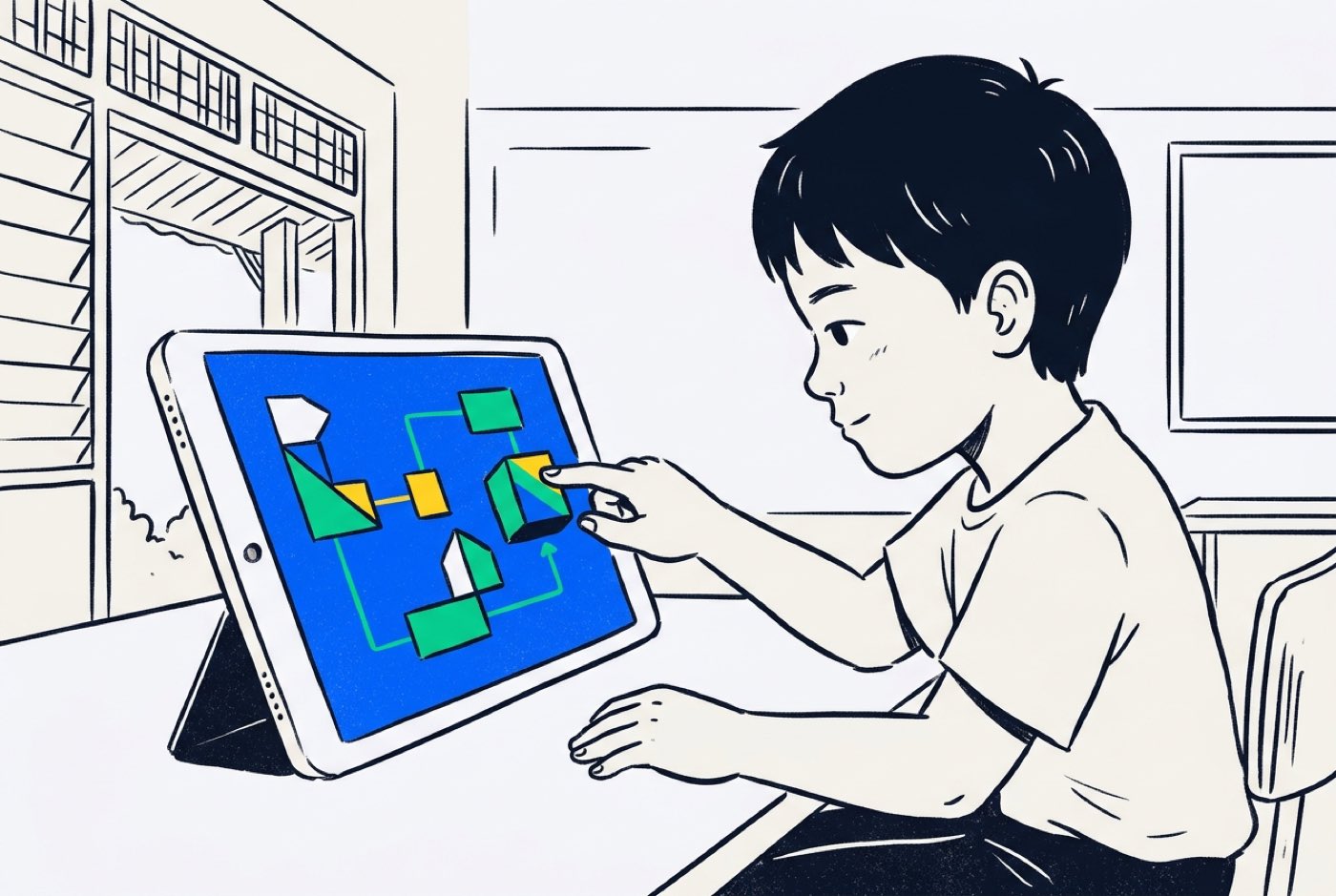
Block-Based and Visual Learning vs Text-Heavy Classrooms
For a dyslexic seven- or eight-year-old, a blank text editor and a syntax rulebook feel a lot like a reading test. One misplaced bracket, one missing semicolon, one misspelled variable name, and the program dies.
Visual block environments such as Scratch, or node-based robotics software, take that barrier away. Children assemble logic out of colour-coded blocks that snap together like digital Lego instead of typing syntax.
- Colour coding: Control structures (if-then loops) are one colour, variables another, motion commands a third. A child with reading difficulties can identify what a block does at a glance, without reading every word on it.
- Physical shape constraints: Blocks are shaped so only valid structures fit together. A conditional block will not slot into a space meant for a variable, so a whole category of syntax error never happens.
- Immediate spatial execution: The logic runs beside the stage window. Attach a block that moves a character 10 steps and the character moves, right then.
Peer-reviewed research published in the Journal of Intelligence examined the impact of visual block coding on children with cognitive and executive function challenges [5]. The study demonstrated a 100 percent program completion rate, significant gains in coding competence, and positive transfer effects to nonverbal planning abilities and cognitive flexibility [5].
Clinical syntheses on youth media usage point in a similar direction: passive, unstructured screen time such as endless video scrolling can worsen inattention, while interactive and cognitively demanding digital activities deliver real cognitive benefits [3]. The American Academy of Pediatrics and child psychology research support the same distinction, noting that structured digital creation builds problem-solving skills and executive function [4].
That line matters when you sit down to set screen rules at home. Passive entertainment drains focus; interactive building trains it. For more on structuring screen habits, see our guide on screen time versus coding time.
How AI Assistants Remove the Spelling and Syntax Penalty
Artificial intelligence has changed the learning path for kids with learning difficulties more than any classroom reform of the past decade.
The jump from visual blocks to text coding used to be where dyslexic learners stalled. Python and JavaScript demanded precise typing, correct spelling and a head full of memorised syntax rules, and many children who had been thriving in Scratch simply stopped there.
A study at a UK university looked at students with ADHD working in professional code editors such as Visual Studio Code. Cluttered interfaces, unexpected pop-up notifications and rigid error messages produced intense cognitive overload [6]. The students consistently blamed their own intelligence rather than the interface design, saying they felt overwhelmed by syntax errors [6].
AI coding assistants change that equation.
With a conversational AI built into the learning platform, a child no longer has to recall exact syntax or spell variable names correctly. They describe what they want in plain language or by voice:
"I want my character to jump higher when the spacebar is pressed, but only if they are touching the floor."
The assistant interprets the logic, produces the Python or JavaScript, and explains what each part does. The child reads or listens to the explanation, runs the code, and adjusts the numbers until the behaviour is right.
| Layer | What it owns | What it passes on |
|---|---|---|
| The child (dyslexic learner) | Logic, architecture, intent, judgement about whether the result is correct | Natural language or spoken instruction |
| AI coding assistant | Spelling, syntax, formatting, error handling | Executable text code |
| Running application | Execution | Instant visual feedback and a finished project |
Putting AI in the middle removes the spelling and typing penalty. The child stays in the driver's seat as architect and logical thinker while the AI works as a mechanical scribe. Neurodivergent children can now build genuine text-based software years earlier than any traditional curriculum path allowed.
For more on guiding your child's interaction with these tools, read our playbook on kids using ChatGPT for homework.
Why 90 Minutes of Building Holds Attention When Homework Fails
At trial sessions, parents tell us their child cannot stay with homework for a quarter of an hour, then ask, with obvious scepticism, how the same child is meant to last 90 minutes in a coding class.
The answer sits in dopamine and feedback timing.
School homework is a low-dopamine, delayed-reward task. The child fills a page of equations or drafts an essay, hands it in, and hears about it days later. Holding attention on a reward that far away takes enormous effort from a brain with executive function differences.
Coding pays out immediately. Write a line, snap in a block, and the result appears on screen.
- Hypothesis: "If I change this velocity variable from 5 to 15, my rocket will clear the asteroid."
- Action: The child changes the parameter and clicks Run.
- Instant feedback: The rocket clears the obstacle, or crashes into it.
- Iterative refinement: "It cleared it, but it went off the top edge. Let me try 11."
The loop keeps producing fresh data. The brain forms a guess, tests it, gets an unambiguous answer, and forms the next guess. That is why a child who cannot survive a lecture can look almost unrecognisable during a project build. They are not fighting the environment any more; the environment feeds information back the way their brain wants it.

Evaluating Learning Environments for Neurodivergent Students
Plenty of computer classes are wrong for children with learning differences. A coding school built on slides, long lectures and silent typing drills will reproduce, hour for hour, the frustration the child already lives with at school.
Here is how the main models compare on the structural points that matter:
| Feature | Legacy Computer Class | Standard Franchise Coding | Neuro-Inclusive AI & Tech Studio |
|---|---|---|---|
| Teaching Method | Slide-based lectures, uniform pace | Fixed worksheets, follow-the-leader | Project-first, personalised pacing |
| Interface Entry | Text-first (typing syntax early) | Pure block-coding (stuck on Scratch) | Visual blocks bridging to AI-assisted text |
| Syntax Philosophy | Memorise syntax, penalise errors | Ignore text coding completely | AI handles syntax; child directs logic |
| Class Dynamic | Large groups (15-20 students) | Fixed group step-by-step | Small ratio, individual mentor tracks |
| Math Integration | Abstract worksheet exercises | Minimal math focus | Math taught by building game mechanics |
| Focus Support | Sit still, silent environment | Rigid time blocks | Movement-friendly, micro-milestone goals |
Six Questions Every Malaysian Parent Should Ask a Centre
Before you enrol a child with dyslexia, ADHD or focus challenges in any technical programme, put these six questions to the centre management and listen carefully to the answers.
1. "How do you handle a child who reads text slowly or struggles with spelling?"
If the answer is that everyone reads off a shared whiteboard and copies code line by line, leave. A neuro-inclusive centre will have visual block environments, screen readers, image-based project guides and conversational AI tools ready to route around reading obstacles.
2. "Is the curriculum step-locked, or does it adapt to my child's pace?"
Children with ADHD work in bursts. Hyperfocused, they may clear three concepts in a day; the following week they may need a slower, heavily visual approach to one. A rigid grade-level curriculum forces the child into a fixed box. The curriculum should bend to the child.
3. "What happens when my child gets stuck or loses focus during a session?"
Ask whether trainers are trained to re-engage a child through micro-milestones, or whether the standard response is "try harder". Good mentors reset focus by cutting the current problem into a smaller visual chunk, or by stepping away from the screen to talk the logic through on a whiteboard.
4. "How do you teach text coding without overwhelming students with syntax errors?"
Look for centres that have integrated AI tools into text coding rather than banning them. The centre should treat AI as an assistant that cuts syntax fatigue so the child can spend their attention on architecture and computational thinking.
5. "How is mathematics handled if my child currently hates school math?"
Many dyslexic children carry serious math anxiety from years of multi-step written calculation. Ask whether math is delivered as drills or as application. Used to calculate collision boundaries, scale 3D graphics or program game physics, math has an obvious purpose and none of the testing dread.
6. "What is your student-to-trainer ratio, and can parents observe sessions?"
Children with attention differences need close mentor feedback to avoid frustration loops. Look for low ratios, ideally one mentor to three to five students, and an open-door policy so you can watch how your child actually engages.
ADHD-Specific Classroom Dynamics: What Works
An effective space for a child with ADHD needs specific structural choices. Across thousands of sessions, four factors separate constant distraction from deep work.
1. Micro-Milestones Over Long Projects
"Build a complete platformer game" is an instruction that shuts an ADHD brain down. The finish line is invisible and the first step is unclear.
Break the same project into 10-minute milestones:
- Milestone 1: Make the character move left and right.
- Milestone 2: Add gravity so the character falls to the floor.
- Milestone 3: Create one platform to jump onto.
Each one gives a clean stopping point, a small win, and an obvious next move.
2. Physical Movement as Focus Support
Two hours motionless in a chair works against a hyperactive learner. A child who fidgets or stands while coding is usually using movement to hold their attention steady.
A supportive studio allows flexible seating, standing desks, and short breaks where the child can walk over to a whiteboard, sketch out the logic and come back to the screen.
3. High Mentor-to-Student Ratio
When a neurodivergent child hits a bug, patience runs out quickly. Fifteen minutes waiting for a busy teacher to reach their desk is long enough for frustration to set in and attention to go elsewhere.
A low ratio means a mentor catches the frustration early, asks a question that nudges the child towards their own fix, and keeps the momentum going.
4. Directing AI as an Active Learning Strategy
Directing an AI model is not the same as being handed an answer. The child has to judge whether the output matches what they meant:
"The AI gave me code for a double jump, but my character is floating in the air. What instruction did I forget to give it?"
That question turns the child from consumer into director, which is where the cognitive work lives.
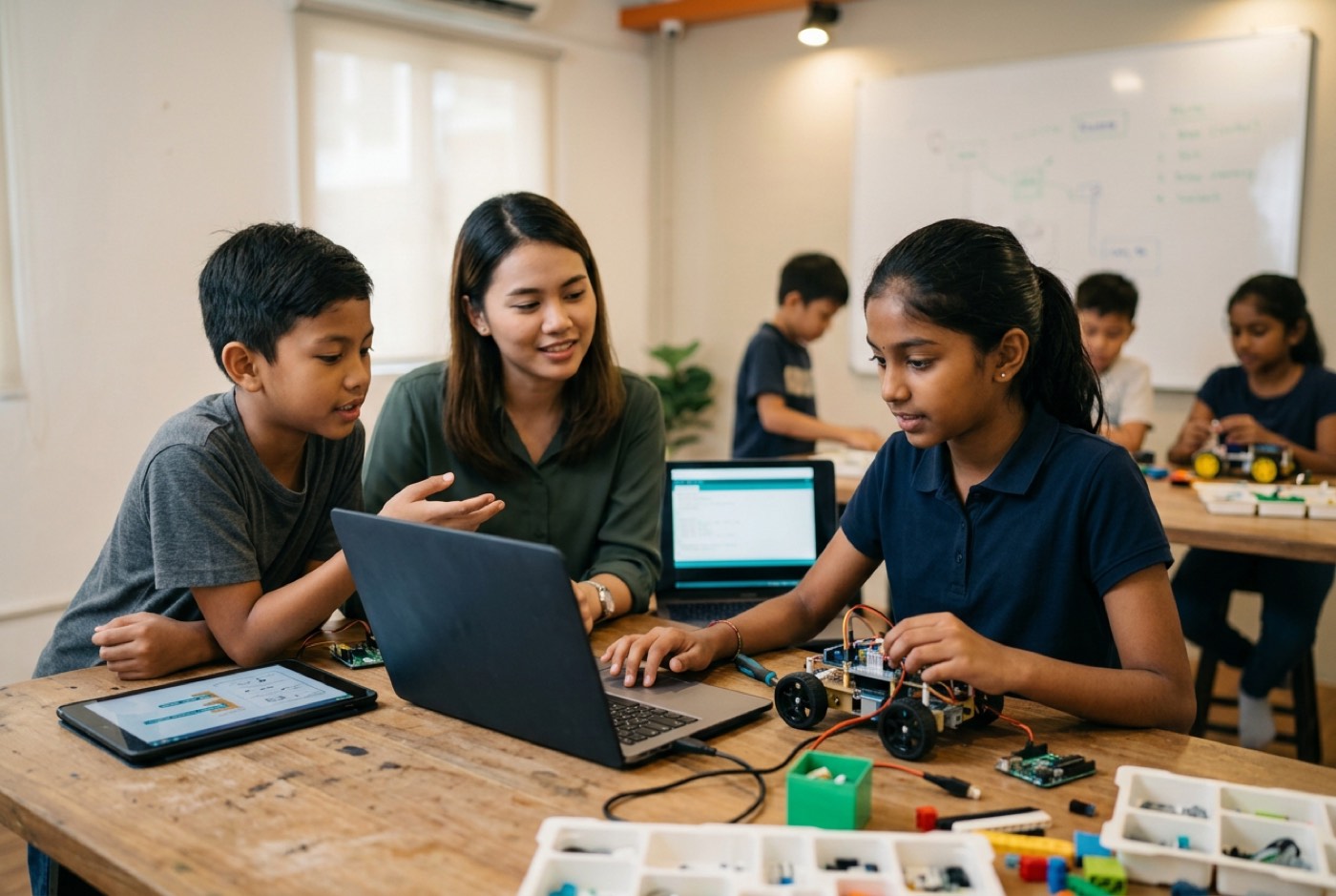
Realistic Progress Expectations: Month 1 to Month 6
Parents want to know what reasonable progress looks like. For a neurodivergent child, measure computational confidence, logic mastery and self-advocacy. Memorised syntax tells you almost nothing.
timeline
    title Student Learning Roadmap
    Month 1 : Visual drag-and-drop logic : Instant feedback loops : Rebuilding confidence
    Month 3 : Multi-step problem decomposition : AI-assisted text coding : First custom project build
    Month 6 : Independent project design : Applied math in physics & art : Self-directed debugging
Month 1: Rebuilding Confidence and Visual Logic
- Primary goal: Getting past the internal script that says "I'm bad at this".
- Activities: Assembling visual blocks in Scratch or simple game engines. Loops, conditions, event triggers.
- Milestone: The child finishes a small interactive project on their own and sees that they can make technology do what they want.
Month 3: Problem Decomposition and AI-Assisted Text
- Primary goal: Splitting complex problems into manageable steps and moving towards text concepts.
- Activities: Basic Python or web logic with an AI tutor handling syntax. Using coordinates, angles and variables to control game elements.
- Milestone: The child explains their project logic to you in computational terms: decomposition, conditional logic, variables.
Month 6: Independent Architecture and Project Ownership
- Primary goal: Independent creation and active problem-solving.
- Activities: Custom projects such as a 3D environment, an AI chatbot or a more complex game. Debugging their own logic when it breaks.
- Milestone: The child hits a bug, uses AI or visual tracing to locate the error, and fixes it without giving up or falling apart.
For a closer look at core logic milestones, read our foundational piece on computational thinking for young learners.
How Kidocode Accommodates Dyslexic and ADHD Learners
At Kidocode we do not treat dyslexia, ADHD or focus differences as deficits waiting to be cured. They are learning profiles, and they do well when the tools, delivery and environment suit them.
Eleven years and more than 9,500 students have shaped a philosophy built on three pillars:
- AI School First: We teach children to direct artificial intelligence safely and effectively. AI works as a personal assistant that removes spelling, typing and syntax barriers, so a child's ideas are not capped by their reading speed.
- Math Through Building: We deal with math anxiety by teaching mathematics through real builds. Instead of paper worksheets, kids use geometry, algebra and physics to create 3D worlds, program game mechanics and build AI models. We follow international math standards (IGCSE, Cambridge, US Common Core) and deliver the syllabus through construction rather than rote memorisation.
- Tech & Coding: Six tracks (Python, Web Development, Mobile Apps, Game Development, Electronics and 3D Design). Coding comes free in every package, because coding knowledge is now public domain. What we actually teach is computational thinking and creative problem-solving.
The environment itself is built for neurodivergent profiles:
- Personalised AI tutor plus human mentors: Every child works with an interactive AI tutor (Cubie) under the guidance of experienced human mentors. The tutor adjusts its explanations to the child's speed and will re-explain a concept in a different visual form as many times as needed, without a hint of impatience.
- Zero lecture slides: No passive whiteboard sessions. Every class is hands-on and project-first from the first minute.
- Flexible pacing: Students follow individual pathways. A child with ADHD who hyperfocuses on game development can push ahead through advanced logic instead of waiting for the class, and take extra visual time on the abstract parts.
- Proven track record: Rated 4.6 stars across 177 verified parent reviews. Our method has helped hundreds of neurodivergent children across Malaysia find their footing again.
Our founder, Hossein Tohidi, known to students as Unclecode, is a computer scientist, AI researcher and creator of open-source projects used globally, including Crawl4AI with over 76,000 GitHub stars. His vision for Kidocode is straightforward: technology should let every child build, whatever labels school has handed them.
We run five physical campuses across Malaysia:
- Klang Valley: Solaris Mont Kiara (HQ flagship) and Sunway Nexis (Kota Damansara, Petaling Jaya).
- Penang: Q2 Waterfront (Bayan Lepas), Vantage (Tanjung Tokong), and Icon City (Bukit Mertajam).
- Online: Live, interactive, camera-on classes accessible globally for families who prefer learning from home.
To see how our studio framework compares with general special-needs programmes, read our overview on supporting kids with special learning needs.
How to Run a Trial Session as a Genuine Test
Diagnostic reports and forum advice will only take you so far. If you want to know whether coding and AI suit your child, watch your child do it.
Kidocode runs an interactive free trial class of up to 2 hours at all physical branches (Mont Kiara, Sunway Nexis PJ, Q2 Waterfront Penang, Vantage Tanjung Tokong, Icon City Bukit Mertajam) and live online.
The trial is built as a real test for you as much as for your child:
- Hands-on building: Your child builds an actual project in AI, math or tech during the session. No presentation to sit through.
- Both parents welcome: Come together, sit beside your child, and watch how they respond to the visual environment and the AI tools.
- Zero pressure: No sales pitch, no obligation. It is an assessment of fit.
While it runs, watch your child rather than the screen. Note their posture, their willingness to try something without being told, how they react the first time the code does not work, and how they sound when they show you what they made.
You can book a free trial session directly at kidocode.com/trial-class.
Printable Learning Profile Screener for Parents
Use this checklist to record what you notice before, during and after your child's technical trial session.
- Baseline reading load: Does the environment lean on text slides, or can concepts be grasped through visual icons and spatial demonstration?
- Feedback frequency: Does the child see the result of their action immediately, or wait for verbal instruction?
- Spelling and syntax penalty: Can the child express logic through visual blocks or AI voice and text prompts without getting stuck on spelling?
- Executive function support: Are tasks broken into clear visual steps (micro-milestones) rather than broad instructions?
Designed, ready to print and sign. We email it to you together with a 5% discount on your next registration.
Frequently Asked Questions
Will my child with dyslexia struggle with text-based programming languages like Python?
Introduced through traditional typing drills, yes: syntax errors will be a constant source of frustration. Paired with visual drag-and-drop tools or AI coding assistants, the syntax barrier goes away. The child directs the logic in natural language and the AI handles formatting and spelling, which lets dyslexic students master text-based Python logic without reading speed holding them back.
Can a child with severe ADHD sit through a 90-minute coding session?
Yes, as long as the session is project-first and interactive. What defeats children with ADHD is passive, low-dopamine work such as listening to lectures or filling in worksheets. Coding returns a visual result for every action taken. That constant loop, plus small mentor-to-student ratios and micro-milestone goals, holds attention well.
Is coding too abstract for a primary school student who struggles with school math?
School math often arrives as abstract formulas on paper, which is exactly what triggers anxiety in kids with learning differences. Coding makes it concrete. Using angles to rotate a character, coordinates () to position an object, or variables to calculate a score turns math into a tool for building something real. Most children who struggle on paper pick up the underlying concepts quickly once they are applied in code.
Should I wait until my child's reading or focus improves at school before starting coding?
No. Holding back hands-on building until school performance improves usually costs the child more academic confidence. For many neurodivergent kids, a coding and AI class is the one place where success is immediate, and that rebuilds the self-worth that text-heavy classrooms wore down. Confidence gained in computational thinking tends to spread into other subjects.
Does screen time in a coding class worsen my child's ADHD symptoms?
Research separates passive screen consumption, such as watching videos or scrolling social media, from active digital creation. Passive use can worsen inattention. Interactive, cognitively demanding tasks such as building software, directing AI or designing 3D models support executive function and problem-solving skills [3] [4].
References
- Department of Statistics Malaysia (DOSM). Person with Disability Statistics Malaysia 2024. Published December 11, 2025. https://www.dosm.gov.my/portal-main/release-content/person-with-disability-statistics-malaysia-2024
- Dzulkifli, M. A. Intellectual and Learning Disabilities in Malaysia. IntechOpen, 2023. https://www.intechopen.com/chapters/88360
- Winter, H., & O'Neill, J. Screen time and ADHD in children and adolescents: A narrative review. Clinical Child Psychology and Psychiatry, 2026. https://pubmed.ncbi.nlm.nih.gov/41237171/
- Martinelli, K. Screens and Neurodivergent Kids. Child Mind Institute, 2026. https://childmind.org/article/screens-and-neurodivergent-kids/
- Arfé, B., delle Fave, M. E., Montuori, C., Ronconi, L., Carbone, S., & Colombatti, R. Computational Thinking and Coding Intervention for Children with Executive Dysfunction. Journal of Intelligence, MDPI, 2026. https://www.mdpi.com/2079-3200/14/4/55
- Halpin, L., Benachour, P., Hall, T., Houghton, A., & Winter, E. Usability Barriers in IDE Layouts for Students with ADHD. arXiv preprint, 2025. https://arxiv.org/html/2506.10598v1