

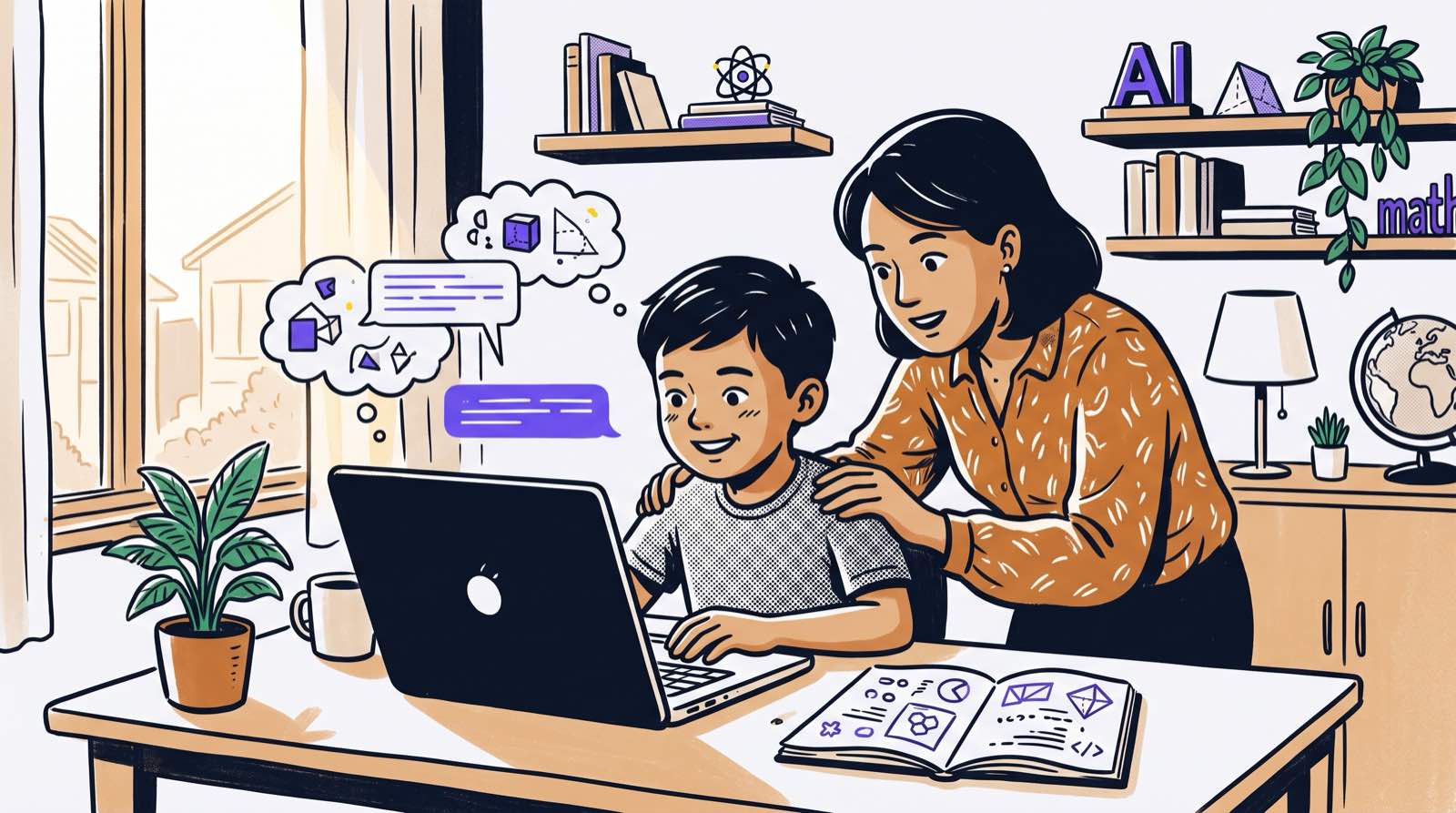
Look at the desk where your child does homework tonight. In most homes across Kuala Lumpur, Petaling Jaya, or Penang, there is a good chance ChatGPT, Claude, or Google Gemini is open in a browser tab beside the textbook. Artificial intelligence is no longer a novelty confined to a computer lab. For primary and secondary students across Malaysia, it has become part of the weekday evening routine.
The hard part for parents is knowing what is happening behind that screen. Is your child using the model to unpack a geometry concept they missed in class, or pasting a question into the prompt box and copying the answer onto their assignment sheet? If it is the second one, how do you step in without banning the software and pushing the habit out of sight?
This guide looks at what peer-reviewed studies and survey datasets show about how children use generative AI, where passive reliance ends and active learning begins, and what home rules actually hold up.
Large language models have changed the way we interact with technology. Tools like ChatGPT and Google Bard are capable of understanding and generating human-like text, making them invaluable in various applications, from writing assistance to customer service. At Kidocode, we teach students how these models work and how to use them effectively, fostering a deep understanding of AI technology.
| Metric or Focus Area | What Research and Data Show | What Parents Should Implement |
|---|---|---|
| Daily Youth Adoption | Young people adopt AI tools at over three times the rate of adults [1]. 64% of U.S. teens report using AI chatbots, while only 54% of parents realise it [2]. | Maintain open home dialogue. 49% of surveyed youth report never having a conversation with parents about AI safety [3]. |
| Homework and Cognitive Offloading | Unguided AI use reduces cognitive engagement and deep strategic thinking in writing tasks [4]. Guided use improves structural organization and concept retention [5]. | Reframe AI from an answer key into a Socratic tutor. Require children to explain AI outputs back to you in their own words. |
| Safety and Fact Verification | Only 49.8% of surveyed high-achieving Malaysian students trust ChatGPT accuracy [6]. 33% of global youth worry about AI misinformation [1]. | Teach mandatory verification. Never allow children to submit personal identity details or treat chatbots as emotional confidants [3]. |
| Mathematics and Coding Build | AI tools allow children to bypass mechanical syntax barriers and enter real text-based coding and math application earlier [7]. | Transition focus from memorising syntax to directing logic, computational thinking, and project building. |
Table of Contents
- The Reality of Youth AI Usage in 2026
- Passive Consumption versus Active Co-Creation
- The Four Everyday AI Use Cases for Students
- Understanding Cognitive Offloading and Mental Engagement
- Using AI for Socratic Math and Logic Coaching
- How AI Coding Assistants Accelerate Real Text-Based Programming
- Navigating AI Safety and Verification in Malaysia
- Age-Appropriate AI Progression from Ages 5 to 18
- How Kidocode Builds AI-Savvy Thinkers and Builders
- Practical Home AI Framework for Families
- Frequently Asked Questions
- References
The Reality of Youth AI Usage in 2026
Young people are picking up AI tools at more than three times the speed of adults [1]. Across ten surveyed nations, an estimated 20 million children regularly use AI systems to look things up, get homework support, or follow personal interests [1].
Digital access among Malaysian secondary students is close to universal. UNICEF Malaysia data shows that 94 percent of adolescents aged 12 to 17 access the internet, most of them daily [8].
timeline
    title Youth AI Progression Stages
    Ages 5 to 8 : Prompt voice AI : Explore interactive stories
    Ages 9 to 12 : Socratic math helper : Build Roblox physics
    Ages 13 to 18 : Directed code generation : Verify AI outputs
There is a persistent gap between what children do online and what their parents see. In a national Pew Research Center study of U.S. teens aged 13 to 17 and their parents, 64 percent of teenagers said they used AI chatbots, while only 54 percent of parents believed their child did [2]. Among those teens, 57 percent used chatbots to search for information, 54 percent asked for help with schoolwork, and 59 percent said students at their school regularly used AI to cheat on assignments [2].
Local academic data points the same way. A study in the Journal of Informatics and Web Engineering surveyed high-achieving university students in Malaysia and found 82.9 percent leaned on ChatGPT to understand complex academic topics, while 73.2 percent used it directly to prepare assignments [6].
Formal instruction in safe and critical AI use has not kept pace with any of this. A national census by Common Sense Media and SSRS covering 1,204 youth aged 9 to 17 found that 75 percent reported school rules about what AI use was prohibited, but only slightly more than half had been taught how to use AI safely [3]. Nearly half said they had never discussed AI safety with a parent at home [3].
Passive Consumption versus Active Co-Creation
Whether your child will interact with artificial intelligence is settled. The open question is how that interaction happens, and it comes down to mental agency: is the child directing the tool to deepen their thinking, or letting the model do the thinking instead?
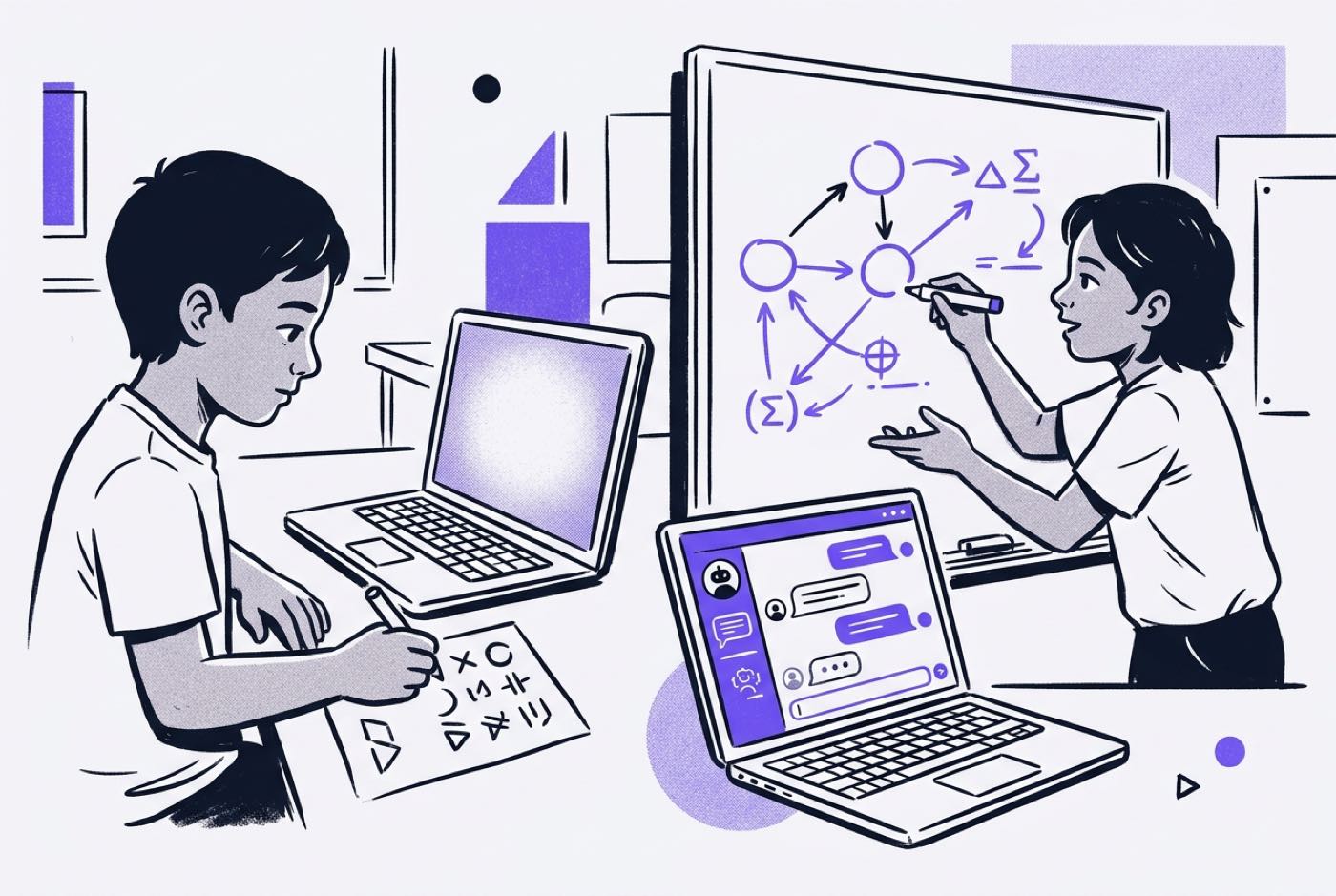 A student using AI passively treats the language model as an answer dispenser. They ask for a finished paragraph, copy it without reading it closely, and submit it. Nothing about that sequence involves processing concepts, structuring an argument, or holding onto knowledge past the deadline.
Active co-creation puts the student in charge. The child asks the model to brainstorm alternative project angles, explain an unfamiliar term, debug a line of code, or quiz them on historical events. The mental work stays inside the child's head; the AI answers, prompts, and pushes back.
| Usage Dimension | Passive AI Consumption | Active AI Co-Creation |
|---|---|---|
| Primary Intent | Complete tasks rapidly with minimal effort. | Understand core mechanics and build original work. |
| Student Action | Copying raw model text into schoolwork. | Prompting AI to explain, critique, or debug. |
| Cognitive Engagement | Low mental processing and superficial recall [4]. | Deep evaluation, verification, and logical framing [5]. |
| Output Ownership | Generic, unverified text generated by AI. | Original student creation guided by AI feedback. |
| Long-Term Trajectory | Dependency on tools and vulnerability during unassisted tests. | Mastery of prompt engineering, logic, and computational thinking. |
The Four Everyday AI Use Cases for Students
Children use generative AI in four recognisable ways during a normal week. Knowing which is which lets parents set different expectations for each.
1. Information Retrieval and Homework Assistance
The most common reason a young person opens a chatbot is to ask a question [7]. When a student hits a difficult concept in science or humanities homework, a prompt can break the explanation into plainer language. Research from the Harvard Graduate School of Education notes that interactive AI tools which ask conversational questions can improve story comprehension and vocabulary in young learners [7].
Used unguided for essay generation, though, the result splits: the submitted assignment may look polished, but whether the student retains the subject matter without AI remains unproven [7]. If you notice your child using AI for homework, start with how to use ChatGPT for homework without cheating.
2. Mathematics and Logic Problem-Solving
Rather than treating math as a stack of isolated textbook exercises, students can ask a language model for step-by-step Socratic hints. When a child is stuck on a word problem, an AI tutor can restate the question or point at the underlying logic without handing over the final number. That matches our methodology at Kidocode: math sticks when students apply it to solve real problems instead of memorising formulas for tests.
3. Coding, Game Development, and Software Building
Traditional computer science education used to strand young learners on syntax mechanics, a missing bracket, a misspelled command. AI coding assistants take on syntax generation, which frees children to work on architecture, computational thinking, and software logic. A child can ask an assistant to generate a basic script structure for a 2D game in Python, then change the parameters, refine the game loop, and add features of their own.
4. Informal Conversational and Personal Advice
A smaller share of young people use chatbots for casual conversation or personal guidance. Pew Research Center data shows 16 percent of U.S. teens have used chatbots for casual conversation, and 12 percent have sought emotional advice or support [2]. A global report cited by Free Malaysia Today estimates that over two million children across ten countries have used AI for personal advice [1].
This is where parents need firm boundaries. Large language models have no consciousness, no lived experience, and no real empathy [7]. Common Sense Media and other youth safety organisations state plainly that AI companionship is unsafe for minors under age 18 [3].
Understanding Cognitive Offloading and Mental Engagement
One psychological risk sits underneath most unguided AI use: cognitive offloading. It happens when a learner hands mental processing to an external tool and skips the internal effort that builds lasting memory.
Researchers at Stanford University's SCALE Initiative ran a randomized controlled trial with students completing argumentative writing tasks with and without ChatGPT assistance [4]. The Cognitive Engagement Scale (CES-AI) measured mental effort, attention span, deep processing, and strategic thinking [4]. Students in the AI-assisted group showed significantly lower cognitive engagement than the control group [4]. Without any pedagogical intervention, automated text generation pulls mental involvement down [4].
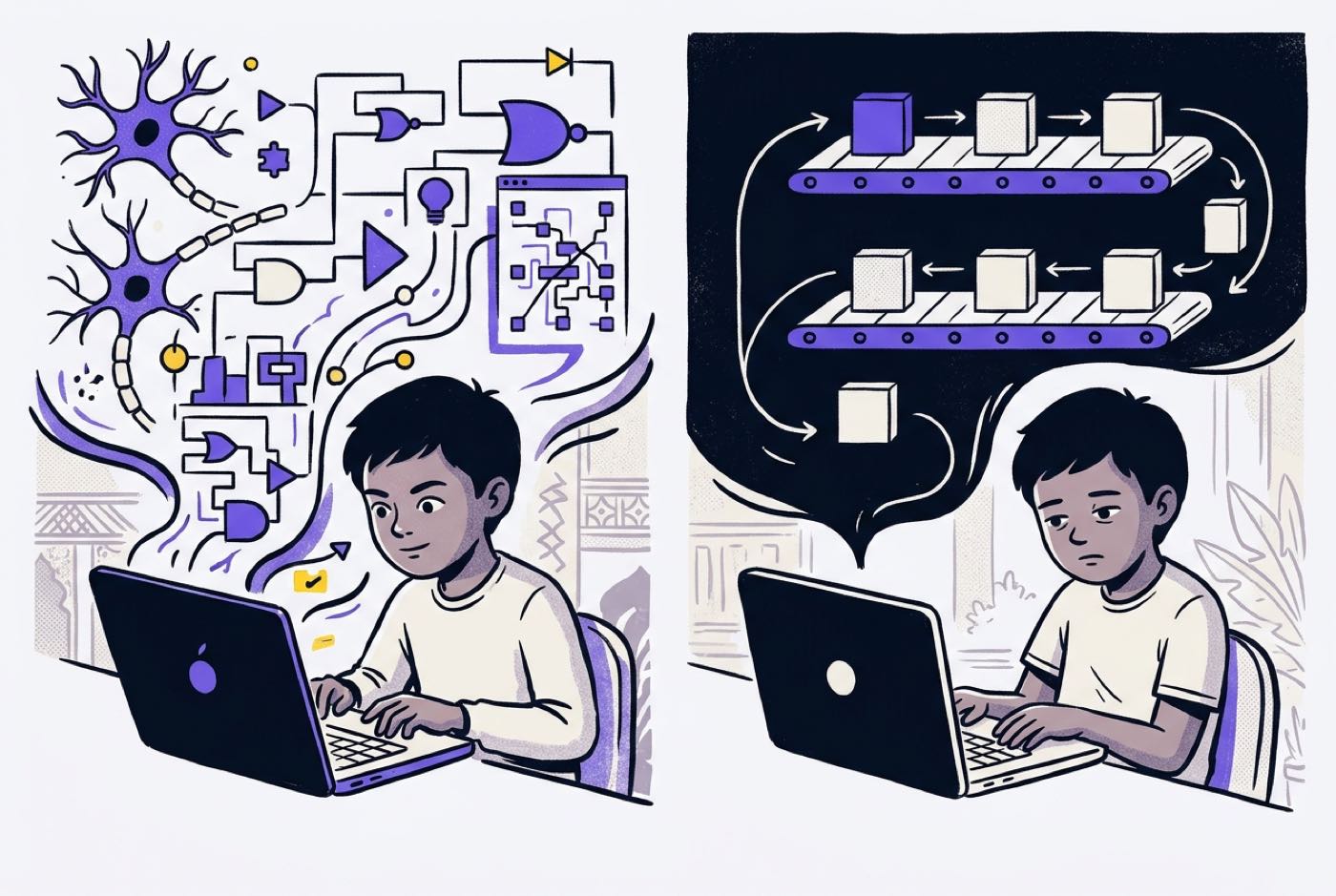 Structure the integration, and the outcome changes. A peer-reviewed study in the International Journal of Research and Innovation in Social Science followed Form Two secondary school students in Hulu Selangor, Malaysia, who used ChatGPT during guided Malay language writing sessions [5].
After three teacher-guided sessions, the 120 participating students showed positive overall perceptions () and reported that the guided framework helped them grasp literary elements and organise their ideas [5]. The researchers also flagged what happened without guidance: overreliance, unverified acceptance of generated claims, and trouble interpreting deeper contextual meaning [5].
The tool itself is neutral. Structured guidance or unmonitored freedom decides the outcome.
Using AI for Socratic Math and Logic Coaching
Mathematics causes more friction at home than any other subject. When a child says they hate math, the problem is rarely cognitive capability. Usually it traces back to delivery, rote memorisation and repetitive worksheets in place of practical application.
Our math reframe at Kidocode is short: the child is fine, the teaching was flawed. We align our curriculum with recognised international standards including IGCSE, Cambridge, and US Common Core, and deliver it constructively: kids learn math by building real projects.
A language model makes a strong Socratic math coach if the prompt is written well. Take a secondary student working on quadratic equations or projectile trajectories in physics. Ask the model for the answer and learning stops. Ask it Socratically and it becomes an interactive tutor.
For example, when calculating the horizontal trajectory of an object launched in a game environment with initial velocity , launch angle , and time , the student meets this physics relationship:
Instead of asking the AI to compute , the student can prompt:
"I am building a game where a cannon fires a projectile. Explain how cosine affects the horizontal distance step-by-step, and ask me a question after each step to test my understanding."
Now the exchange is a dialogue. The student has to follow the mathematical logic, answer the tutor's questions, and apply the concept inside their own game script. If you want to test your child's conceptual understanding at home, our guide on math tuition versus learning math by building has more approaches.
How AI Coding Assistants Accelerate Real Text-Based Programming
Early computer science education has long followed a fixed sequence: years of block-based visual tools like Scratch, then a move to text-based languages like Python or JavaScript. Block coding does introduce basic logic loops, but it holds back older children who want to build working software.
AI coding assistants break that sequence. By absorbing syntax friction, they let children reach real text-based coding far earlier than the traditional ladder allows.
| Stage | Traditional Coding Ladder | AI-Accelerated Pathway |
|---|---|---|
| First | Scratch (Years 1–3) | Logic and design prompting |
| Second | Basic Python syntax | AI syntax draft |
| Third | Delayed building | Real text build |
In an AI-accelerated environment, the student works as system architect. The child defines the program requirements, outlines the data structure, and directs the assistant to draft boilerplate code. Then the child reviews that code, debugs errors, changes variables, and tests the output.
The educational focus moves from syntax memorisation to computational thinking, decomposition, pattern recognition, abstraction, and algorithmic design, which are the skills required to direct intelligent tools at all. Reading the distinction between using AI and building with AI helps parents check whether their child is developing real technical literacy or just screen familiarity.
Because software development knowledge is now widely accessible through AI models, we bundle coding tuition at no extra cost within our membership plans. What we teach is the computational logic and the strategic direction behind it.
Navigating AI Safety and Verification in Malaysia
Daily AI use raises three practical questions for parents: data privacy, content verification, and what Malaysian regulation actually covers.
Young people are aware of the risks. A UNICEF global study found one-third of surveyed children worry about AI being used to spread misinformation or run scams, while 25 percent fear unauthorised manipulation of their personal images through deepfakes [1].
Regulators have moved as well. In June 2026, the Malaysian Communications and Multimedia Commission began enforcing the Child Protection Code and Risk Mitigation Code under the Online Safety Act 2025 [3]. Licensed digital platforms must now implement age verification and follow "child safety by design" principles [3].
Regulation still does not replace what happens at the kitchen table. Among high-achieving Malaysian students, 80.5 percent considered ChatGPT beneficial for their academic work, yet fewer than half, 49.8 percent, trusted the accuracy of its outputs [6]. Another 73.4 percent acknowledged the risk of academic misuse [6].
 Three home rules should be non-negotiable:
- Zero Personal Data Sharing: Children must never type full names, addresses, school names, phone numbers, or identification details into prompt windows.
- Mandatory Fact Verification: Every factual claim, historical date, or mathematical result from an AI model gets cross-checked against a trusted textbook or verified educational site.
- No Emotional Dependency: Chatbot responses never substitute for real human relationships, family conversation, or professional guidance [3].
Age-Appropriate AI Progression from Ages 5 to 18
Developmental readiness decides how a child should be working with AI. A 6-year-old needs a completely different approach from a 15-year-old preparing for national exams.
Ages 5 to 8: Voice Interaction and Conceptual Play
Early primary students learn foundations, not prompt-writing. Children this age work with voice-activated tools and structured visual software.
- Focus: Learning that digital systems follow explicit human instructions.
- Engagement Layer: Interactive story generation, simple logic puzzles, and entry-level Scratch building.
- Parental Role: Co-pilot. Parents sit beside the child and ask questions like, "Why do you think the computer gave that answer?"
Ages 9 to 12: Guided Socratic Tutors and Game Creation
Upper primary students read and type well enough to prompt text models on their own.
- Focus: Moving from passive entertainment to active creation. Reframe screen time: "What if the hours spent playing Roblox became hours spent building your own game?"
- Engagement Layer: Using AI as a Socratic math helper, generating game logic in Python or Roblox Lua, and creating digital artwork.
- Parental Role: Supervisor. Parents review prompt logs periodically and check that fact-checking rules are being followed.
Ages 13 to 18: System Architecture, Advanced Logic, and Verification
Secondary students carry heavier academic loads under KSSR, IGCSE, or A-Level syllabi.
- Focus: Prompt engineering, verifying model outputs, and applying computational thinking across multi-disciplinary projects.
- Engagement Layer: Developing web applications, training custom machine learning models, and solving complex physics or mathematical problems.
- Parental Role: Evaluator. Parents hold regular discussions about ethical AI use, data privacy, and academic integrity.
For a fuller breakdown of developmental milestones, see our guide on what AI-savvy looks like at ages 8, 12, and 16.
How Kidocode Builds AI-Savvy Thinkers and Builders
Kidocode opened in 2014 at Solaris Mont Kiara, Kuala Lumpur. Over eleven years, our teachers have taught over 9,500 students across Malaysia. We now run five physical campuses, Solaris Mont Kiara (HQ Flagship) and Sunway Nexis in PJ, plus Q2 Waterfront, Tanjung Tokong, and Icon City in Penang, alongside our live online program. Independent editorial coverage by Tallypress named Kidocode the #1 coding class for kids in KL and Selangor.
One membership covers three pillars:
- AI to Survive: Teaching children to direct artificial intelligence effectively, with safety and critical evaluation weighted equally.
- Math to Think: Ending math anxiety by teaching international syllabus concepts through constructivist project builds and personalised AI tutoring.
- Tech to Build: Six technical tracks, Python, Web Development, Mobile Development, Game Design, Electronics, and 3D Modelling.
Our founder, Hossein Tohidi (known to students and parents as Unclecode), designs the curriculum architecture. A computer scientist and AI researcher, he created Crawl4AI, an open-source web-crawling engine with over 76,000 GitHub stars and more than 12 million downloads, running in production at Fortune 500 enterprises.
We are not a tuition centre or a short-term coding bootcamp. We do not drill students for exam marks; grades improve as a side effect of understanding the material. Every student works with a personalised AI tutor that adapts to their pace, so no child is left behind or held back by a classroom average.
To see how it works, families can book a free trial class. The trial runs up to two hours hands-on, and your child builds a real project in AI, math, or technology. Both parents are welcome to attend, with zero payment required and no sales pressure.
Practical Home AI Framework for Families
Clear house rules head off arguments about devices and keep AI on the educational side of the ledger. Use the checklist below to set expectations with your child.
Printable Home AI Agreement Checklist
- Establish Open Discussion: Agree to discuss AI tool usage openly without fear of immediate device bans or confiscation.
- Enforce the Socratic Prompting Rule: Require your child to ask AI tools for explanations, hints, and step-by-step guidance rather than direct answers.
- Activate Personal Data Protection: Verify that your child never inputs full names, school details, home addresses, or phone numbers into prompt fields.
- Implement Mandatory Fact-Checking: Require your child to verify every AI-generated factual claim against at least one trusted secondary source (e.g., textbook, reference site).
Designed, ready to print and sign. We email it to you together with a 5% discount on your next registration.
Frequently Asked Questions
Is my child too young to start learning about AI at age 5?
No. What matters is the teaching method, not the birthday. Once a child can play a game on a tablet, they can start learning how that game works. For ages 5 to 8, we use voice interactions, visual logic, and interactive problem-solving, which introduce computational thinking well before any text coding.
Will AI render learning to code obsolete for children?
AI coding assistants speed up the work; they do not do the thinking. A model can generate syntax quickly, but someone still has to define the project logic, judge the output, and fix the bugs. Learning to direct these tools is itself the core technical literacy of this era.
How does learning math through building differ from traditional math tuition?
Traditional math tuition runs on repetitive worksheets and formula memorisation aimed at tests. At Kidocode we teach the same international standards (IGCSE, Cambridge, US Common Core) in reverse: children apply the concepts to build real projects such as physics engines, games, and AI applications. This constructivist approach clears math anxiety within two to four weeks.
What should I do if I suspect my child is copying homework directly from ChatGPT?
Skip the immediate ban, it usually just moves the behaviour out of sight. Sit down with your child and ask them to explain the submitted work in their own words. Then introduce the Socratic prompting rule together, showing them how to make the model explain a difficult concept step-by-step instead of producing a finished answer.
What happens during the free trial class at Kidocode?
The free trial runs up to two hours hands-on at any of our five physical campuses (Solaris Mont Kiara, Sunway Nexis PJ, Q2 Waterfront, Tanjung Tokong, or Icon City) or through our camera-on live online format. Your child works with an instructor to build a real project in AI, math, or coding. Both parents are invited to attend, observe the teaching, and ask questions, with zero payment required and no high-pressure pitch.
References
- Free Malaysia Today, Children are using AI far more than adults: are we ready? (July 6, 2026)
- Pew Research Center, How Teens Use and View AI (February 24, 2026)
- SSRS / Common Sense Media, The Common Sense Media Census: AI Use by Tweens and Teens (June 8, 2026)
- Stanford SCALE Initiative, ChatGPT produces more lazy thinkers: Evidence of cognitive engagement decline (June 2025)
- International Journal of Research and Innovation in Social Science, Use of ChatGPT among Form Two Students in a Secondary School in Hulu Selangor: A Survey Method (November 27, 2025)
- Journal of Informatics and Web Engineering, Academic Use and Perceptions of ChatGPT Among High-Achieving Students in Higher Education (June 14, 2025)
- Harvard Graduate School of Education, Impact of AI on Children's Development (October 2, 2024)
- UNICEF Malaysia, Beyond age-based restrictions: Protecting children online in Malaysia (June 26, 2026)