

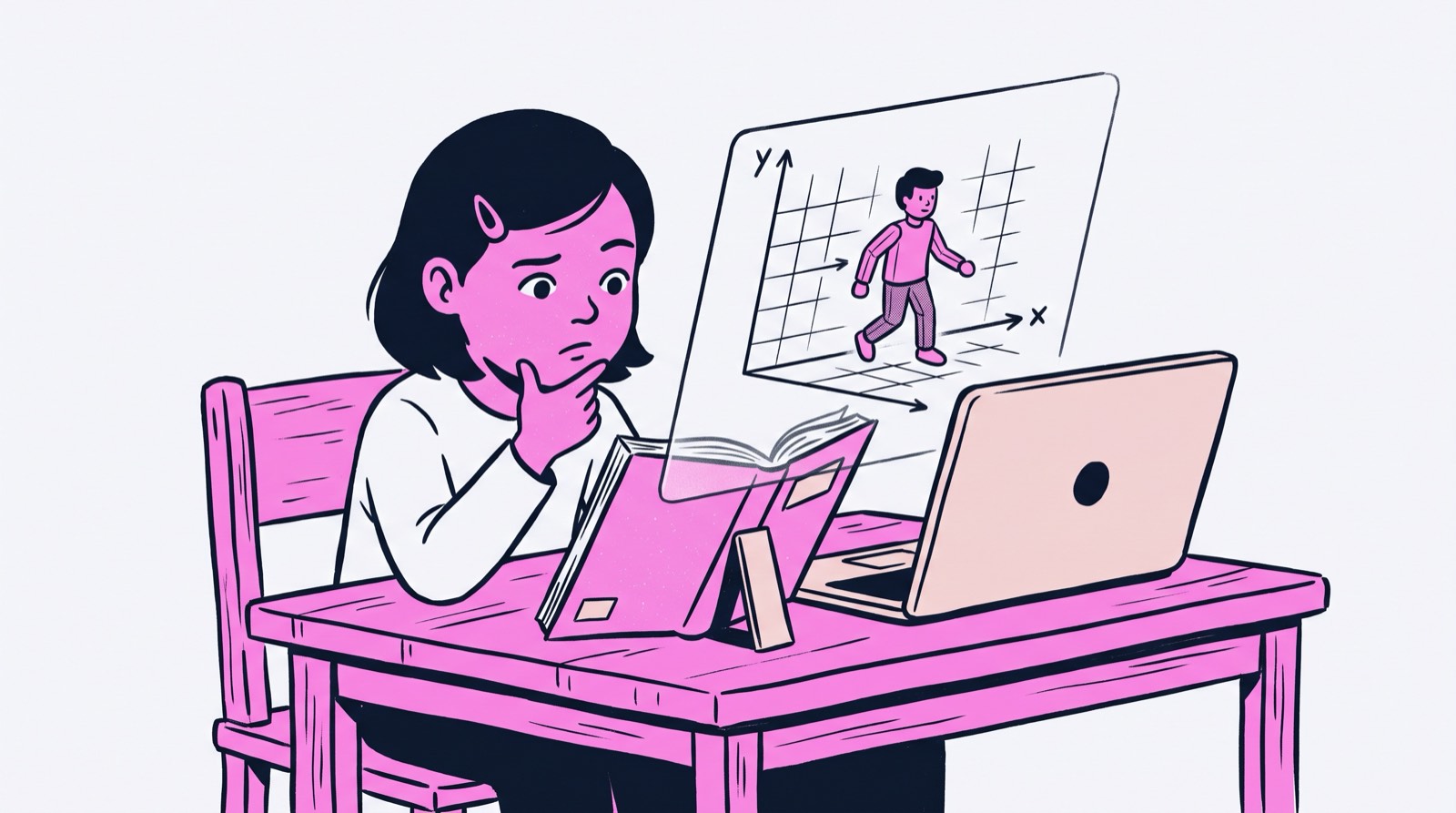
The story arrives in my inbox in almost identical form, several times a term. In Primary 2 or Primary 3 the child was fine. Better than fine, actually: homework took twenty minutes, the arithmetic was clean, the report card gave nobody anything to worry about. Then somewhere between Standard 4 and Form 1 the whole thing came apart. Homework turned into an hour of arguing and sometimes crying. The A slid to a C, then to a pass. And the parent writes to ask whether the child has lost focus, or whether some ceiling on numerical ability has quietly been reached.
Neither, usually. The child is fine. What broke was the delivery method.
Somewhere in that stretch of school, mathematics changes character. It stops rewarding careful arithmetic and starts demanding abstract reasoning. A child who spent three years memorising procedural steps, without ever building an intuition for how numbers behave, walks into that change with the wrong toolkit. Abstract math then feels like a language whose alphabet gets swapped out every fortnight.
What follows is why the drop-off clusters where it does in Malaysian schools, the signs you can catch at home months before an exam paper tells you, and what to do about it before "I'm bad at maths" hardens into an identity.
Key Takeaways
| Metric or Concept | What it Means for Your Child | Actionable Next Step |
|---|---|---|
| The Transition Cliff | Math shifts from concrete counting (Standard 1–3) to abstract logic (Standard 4–Form 1). | Audit whether your child understands concepts or just memorises steps. |
| PISA & TIMSS Benchmarks | International assessments show two-thirds of math test items require application and reasoning, not simple calculation [3]. | Shift home practice from repetitive drills to applied problem-solving. |
| The Word Problem Gap | Textbook analysis reveals primary word problems are often distributed unsystematically, leaving kids unprepared for multi-step reasoning [5]. | Use visual models and real builds to bridge text to mathematical logic. |
| Constructivist Fix | Kids learn abstract concepts 4 times faster when using them as building tools (e.g., game physics or AI variables). | Reframe math as the engine that builds digital projects rather than paper tests. |
Table of Contents
- The Hidden Drop-off: When Math Stops Being Counting
- 5 Warning Signs Your Child Is Falling Off the Math Cliff
- The 3 Specific Math Cliffs: Fractions, Algebra, and Coordinates
- Why Bright Children Fall: Abstraction Without a Reason to Care
- A 10-Minute Home Diagnostic: 3 Questions per Cliff
- What to Do First (And Why Worksheets Make Math Anxiety Worse)
- How Building Closes Each Cliff: Math as an Engine
- Talking to Your Child About Being "Bad at Math"
- How International Standards Map to Your Child's Progress
- The Kidocode Approach: Ending Math-Hate in 2 to 4 Weeks
- Actionable Parent Guide & Diagnostic Checklist
- Frequently Asked Questions
- References
The Hidden Drop-off: When Math Stops Being Counting
Under the Malaysian KSSR framework, maths in Standard 1 to Standard 3 stays physical and operational. Groups of apples get added. Pocket money gets subtracted. Times tables get memorised. A child with a good memory can score very well here without ever thinking hard about what the operations mean, because the rules are mechanical and the numbers sit still.
Around Standard 4, at age ten, the demand changes, and it keeps changing through Form 1. Symbols replace numbers. One-step arithmetic becomes multi-step logic. The skill being tested is no longer computation.
You can see the scale of that transition in national assessment data. A 2024 World Bank report on Malaysian education found that 15-year-old Malaysian students lag behind regional aspirational peers in mathematics, reading and science [1]. OECD PISA 2022 results put Malaysian 15-year-olds below the OECD average across literacy domains, with a systemic drop in performance [2] [6].
flowchart TD
    A[Standard 1-3: Concrete Arithmetic] --> B[Standard 4-6: Abstract Concepts]
    B --> C[Form 1: Symbolic Algebra & Geometry]
    A -. Memory works here .-> D[High Marks]
    B -. Memory fails here .-> E[Math Anxiety & Mark Drop]
    C -. Applied logic required .-> E
    E --> F[Reframe: Math by Building]
    F --> G[Understanding & Recovery]
Children who were never shown the visual logic underneath the numbers get stranded at exactly this point. Their brains handle mathematics perfectly well. What fails is memorisation, the one strategy that carried them for three years.
5 Warning Signs Your Child Is Falling Off the Math Cliff
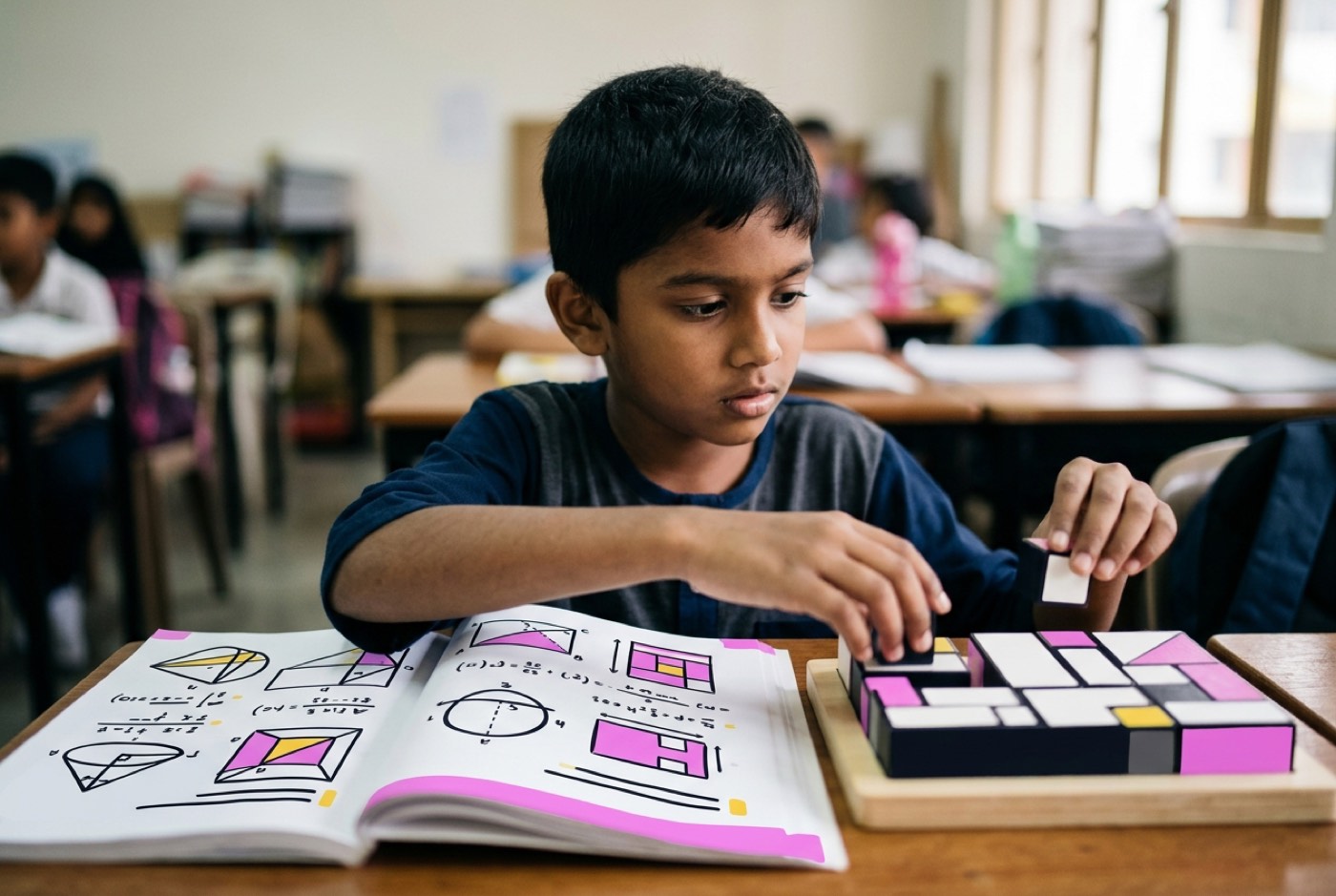
Most parents find out about the gap when a paper comes home marked in red. The behaviour at the kitchen table gives it away months earlier, if you know what you are looking at. Catching it there means you are dealing with a missing concept rather than a hardened belief.
1. Answers Are Written Without Working Steps
Ask how they got there and you get "I just guessed" or "I did it in my head," with no explanation available afterwards. That is pattern matching or recall doing the work, not an understood sequence of operations.
2. Immediate Paralysis on Word Problems
Your child can do on a clean worksheet without blinking, then freezes at three sentences about how many boxes are needed to ship 270 books. Research on Malaysian primary school textbooks shows word problem categories distributed unsystematically across the early grade levels, which leaves students underprepared for non-routine formats [5].
3. The "I'm Just Not a Math Person" Statement
Of all five, this one worries me most. Once a child pins failure on who they are rather than on a concept they missed, effort starts to look risky, and withdrawing becomes the cheapest way to protect self-esteem.
4. Excessive Copying of Worked Examples
Homework involves a lot of flipping back to a sample question and matching its format line for line. Change the numbers slightly, or reverse the question, and you hear that the topic was never taught.
5. Postponing Math Homework Until Late at Night
Maths that consistently gets pushed to the last slot of the evening is avoidance, and avoidance comes from frustration rather than laziness. Our full breakdown of these early signals goes deeper: 7 signs your child is memorising math instead of understanding it.
The 3 Specific Math Cliffs: Fractions, Algebra, and Coordinates
The drop-off is not spread evenly across the syllabus. It bunches up at three points where concrete thinking runs out of road.
| Where primary maths leaves the child | The cliff | What the next stage actually requires |
|---|---|---|
| Concrete arithmetic | Fractions and ratio | Visual, proportional logic |
| Procedural steps | Basic algebra | Variables that change state |
| Flat drawings | Coordinates | Spatial mapping |
Cliff 1: Fractions and Ratios to Proportions
In early primary, a number is a count of things: 3 apples, 5 cars. Fractions break that intuition, because a bigger denominator now means a smaller value ( is smaller than ). By Standard 4 and Standard 5, fractions are being handled alongside ratios and percentages.
A study of Malaysian primary school mathematics textbooks found that problem-solving items make up 44.5% of mixed operations exercises in Year 5 textbooks, which asks students to move fluidly between fractions, ratios and real situations [4]. A child who reads a fraction as one number written over another, rather than as a relationship between quantities, will hit a wall in algebra later.
Cliff 2: Arithmetic to Basic Algebra
For six or seven years, the equals sign has meant "work out the answer now." is an instruction to write . Then Form 1 arrives and uses the same symbol to mean balance between two sides.
That is a genuine conceptual jump, and it catches thousands of Malaysian teens every year. The is not a box waiting to be filled in; it is a quantity that can take different values. With no visual or practical model for what a variable does, algebra reduces to obeying rules for no visible reason.
Cliff 3: Shapes to Coordinate Geometry
Lower primary geometry is descriptive work: name the triangle, measure the line, find the perimeter. By Standard 6 and Form 1, shapes live on an and Cartesian plane, and students have to map positions, work with slopes and follow transformations.
Presented only as static diagrams in a textbook, coordinate space is hard to hold in the head.
Why Bright Children Fall: Abstraction Without a Reason to Care
The children who hit this hardest are often the strong ones. In Standard 1 to Standard 3, a bright child absorbs formulas and teacher demonstrations quickly, passes on recall alone, and never has cause to build an internal model of anything.
International assessment frameworks show why that eventually stops working. TIMSS 2019 splits its mathematics cognitive domains into Knowing, Applying and Reasoning. At 8th-grade level, roughly Form 2, about two-thirds of the framework goes to applying concepts and reasoning [3].
| TIMSS cognitive domain (Grade 8 Math) | Share of framework |
|---|---|
| Knowing (facts and procedures) | 35% |
| Applying (solving routine problems) | 40% |
| Reasoning (non-routine and complex problems) | 25% |
Memory alone cannot carry two-thirds of a paper like that. The mark drops, the child panics, and the conclusion they reach is that they have somehow become less clever than they were.
Underneath the mechanics there is a motivation problem too. We ask children to push abstract symbols around for years without once showing them what the symbols do. Ask a Standard 5 student why they are multiplying fractions and the honest answer is "to pass the exam." Concepts with no function attached are exhausting to hold on to.
A 10-Minute Home Diagnostic: 3 Questions per Cliff
You do not need a maths degree to find out whether your child is memorising or understanding. Sit down for ten minutes with these three questions, one per cliff, and pay attention to the route they take rather than the number they land on.
Diagnostic 1: The Fraction Reality Check
Ask: "If you have of a pizza and I give you of the same pizza, do you have more than half or less than half of a pizza?"
- Memoriser approach: Reaches for paper, hunts for a common denominator, cross-multiplies, gets tangled in the steps, and loses the pizza entirely.
- Conceptual approach: Pictures as a bit under half, adds , and says: "It makes exactly half."
Diagnostic 2: The Variable Balance Check
Write down . Ask: "Can be equal to 12?"
- Memoriser approach: "No, because the total is 10 and 12 is bigger than 10." (They are assuming has to be positive, because primary arithmetic almost never used negative values.)
- Conceptual approach: "Yes, if is ."
Diagnostic 3: The Coordinate Direction Check
Draw a simple cross ( and axis) on a piece of paper and put a dot in the top-left quadrant. Ask: "Is the number for this dot positive or negative?"
- Memoriser approach: Pauses, tries to recall the textbook rule about which quadrant is which, guesses.
- Conceptual approach: Points left of the centre line: "Negative, because moving left on the horizontal axis means going below zero."
A struggle on any of these is not bad news. It tells you precisely where the bridge broke. To check the wider picture against grade level, work through our year-by-year guide: is my child behind in math? A year-by-year home check.
What to Do First (And Why Worksheets Make Math Anxiety Worse)
The reflex, once the marks slip, is more of the same medicine. Extra assessment books. A home tutor running drill sheets. A place at the tuition centre down the road.
For a child who is already anxious about maths, that reflex tends to make things worse.
The Worksheet Trap
Fifty fraction questions do not manufacture an understanding of fractions in a child who lacks one. They manufacture fatigue, and they confirm the suspicion that maths is a punishment made of repetitive, meaningless steps.
| Traditional Remediation (Worksheets) | Constructivist Remediation (Building) |
|---|---|
| Focuses on repetitive procedure and drill. | Focuses on using the concept to solve a goal. |
| Errors feel like personal academic failures. | Errors feel like code bugs that need fixing. |
| Isolates math from practical applications. | Connects math directly to software, games, and AI. |
| Increases anxiety for struggling learners. | Reduces anxiety through active experimentation. |
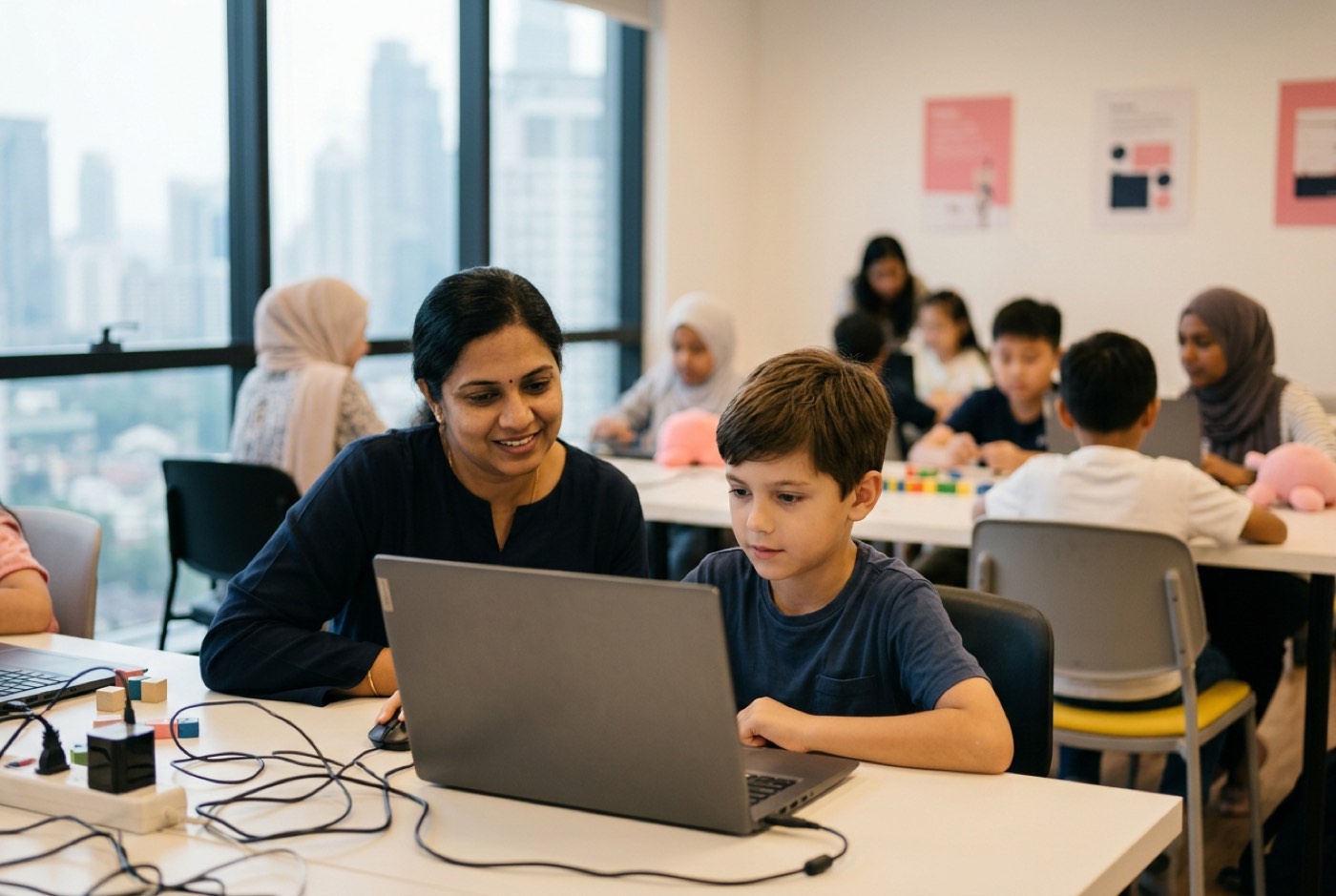
So the first move is not more paper. It is to stop treating maths as a pencil-and-paper memory test at all. Maths is a language for describing how systems behave, and the fastest way back in is to hand the child a system where a concept produces something they can see happen.
How Building Closes Each Cliff: Math as an Engine
At Kidocode we teach maths through constructivism: kids build software, game physics engines and AI models. Use a concept to make something move on a screen and the symbol stops being decorative.
Take the three cliffs one at a time.
1. Algebra as the Control Knob of a Game
Nobody writes on paper here. A ten-year-old building a game in Python wants to control how high the character jumps.
# The player's vertical position updates based on gravity and initial velocity
player_y = player_y + (jump_velocity * time) - (0.5 * gravity * (time ** 2))
Now jump_velocity and gravity are not mysterious letters in an exam question. They are knobs. Change one and the character falls faster or clears the platform. Algebra becomes the steering of a world the child owns.
2. Coordinates as Game World Geography
Building a 2D or 3D game means positioning sprites, tracking hitboxes and measuring distances between objects.
- To place an obstacle at the centre of the screen, they set .
- To move a spaceship to the left, they decrease .
- To detect a collision, they use the distance formula that comes out of the Pythagorean theorem:
The first time a 12-year-old watches their own collision code fire at the right moment, coordinate geometry stops being textbook theory. It is the thing that makes the game work.
3. Ratios and Probability as AI Logic
Kids building simple machine learning models or balancing a game economy end up working with proportions and probability whether they planned to or not. An AI vision script returns a confidence score somewhere between and , which is to .
Working out why counts as high confidence gives decimals, fractions and percentages a job to do. For a fuller comparison of the two approaches, see our guide on math tuition vs learning math by building in Malaysia.
Talking to Your Child About Being "Bad at Math"
What you say at the kitchen table decides how long your child keeps trying. The most common well-meant mistake is "It's okay, I was bad at maths too in school." It is meant as comfort, and it lands as confirmation that maths ability is inherited and the case is closed.
Here is phrasing that works better, drawn from what we have watched succeed with thousands of students.
Scenario 1: Your Child Says "I Hate Math"
- Avoid saying: "You have to like it because it is important for your SPM exams."
- Say instead: "You do not hate math. You hate feeling stuck on confusing worksheets, and that makes complete sense. The kid is fine; the way it was explained just didn't fit how your brain works. Let's find a way to build something with it instead."
Scenario 2: Your Child Gets an Answer Wrong
- Avoid saying: "No, that is wrong, look at step 3 again."
- Say instead: "Your logic worked really well up to here. What did the number do when you changed that step? Let's run it like a simulator and see where it shifted."
Scenario 3: Your Child Asks "Why Do I Need to Learn This?"
- Avoid saying: "Because it is on the Form 1 syllabus."
- Say instead: "This specific math tool is what software engineers use to calculate game physics, how graphics cards render 3D lighting, and how AI models make predictions. Let's look at how it works inside a real project."
How International Standards Map to Your Child's Progress
Families here often juggle more than one framework at once: the national KSSR/KSSM curriculum, Cambridge IGCSE, US Common Core. It is a fair worry that changing how your child learns maths might leave a syllabus box unticked.
In practice the core concepts are shared. What differs between curricula is the packaging of the questions, not the mathematics inside them. All three route through the same competencies:
| Universal core competency | What it covers |
|---|---|
| Proportional reasoning | Ratios and fractions |
| Operational abstraction | Algebraic variables |
| Spatial transformation | Coordinate geometry |
| Logical deduction | Data and probability |
Our maths curriculum at Kidocode is built around exactly those. Whether the target is a national school assessment or an IGCSE paper, a child who understands abstract maths through building can apply it in whatever format the question arrives in. On how computational thinking sits underneath all of these frameworks, see our analysis of computational thinking: the skill behind coding.
The Kidocode Approach: Ending Math-Hate in 2 to 4 Weeks
Parents who walk into our centres in Solaris Mont Kiara or Sunway Nexis in Klang Valley, or our Penang campuses at Q2 Waterfront, Vantage Tanjung Tokong and Icon City, often say the same thing on the first visit: they were relieved to find something that is not another tuition centre.
Because we are not one. No stacks of paper drills, no coaching children to reproduce a mark scheme. Maths, AI and technology come as one integrated experience.
1. Personalized AI Tutor Per Child
Every child here works alongside a personalised AI tutoring system. When a student gets stuck on algebraic substitution in the middle of a project, the tutor does not hand over the answer. It isolates the missing concept, adjusts difficulty on the spot, and builds a visual micro-lesson around that specific gap.
2. Math Through Builds
Every abstract concept in the school syllabus is mapped to something the student constructs.
- Struggling with fractions? The student builds an inventory system for a game.
- Confused by linear equations? The student programs character acceleration vectors.
- Intimidated by geometry? The student renders 3D shapes using code.
3. Bundled Computational Thinking
Coding comes bundled into the membership because coding is applied computational thinking. Syntax knowledge is now everywhere and cheap; the part worth teaching is how to structure a problem so it can be solved logically.
I saw this plainly in my own open-source work. Building Crawl4AI, which has passed 12 million downloads globally, the hard part was never writing the syntax. It was structuring the mathematical logic, the data extraction pipelines and the spatial representations cleanly enough that the thing held together. That is the same architectural habit we hand to young learners.
Once children work out that maths gives them the power to build real software, the hatred usually fades inside two to four weeks.

Actionable Parent Guide & Diagnostic Checklist
If you think your child is on the Standard 4 to Form 1 cliff, work through this over the next 30 days.
- Step 1: Audit home homework habits. Observe whether your child is calculating answers conceptually or searching for formula shortcuts to copy.
- Step 2: Eliminate high-pressure drill sheets. Pause extra repetitive paper worksheets that trigger emotional shutdowns.
- Step 3: Run the 10-minute home diagnostic. Use the three conceptual challenges detailed earlier to pinpoint whether the gap lies in fractions, algebra, or spatial coordinates.
- Step 4: Connect math to visual utility. Show your child how the specific math topic they dread operates inside digital games, smartphone apps, or robotics.
- Step 5: Replace "I'm bad at math" language. Reframe struggles around missing teaching strategies rather than fixed personal ability.
- Step 6: Experience math by building. Book a hands-on session where your child can construct a real project using mathematical concepts.
Weekly Math Diagnostic Tracker
Child's name, grade or standard, and date at the top, then fill in one of these each week.
1. Concept diagnostic log, the specific topic causing friction this week (for example, fraction division or negative variables):
| Prompt | This week |
|---|---|
| Topic identified | |
| What the textbook asks | |
| Visual or real-world equivalent used to explain it |
2. Emotional response observation, anxiety level when starting maths tasks this week:
- High anxiety (refusal, tears, immediate avoidance)
- Moderate hesitation (needs heavy prompting, relies on sample answers)
- Calm engagement (willing to attempt non-routine steps)
3. Weekly breakthrough check:
- Child explained the "why" behind an answer without looking at sample steps.
- Child connected a math concept to a digital build, game mechanic, or real application.
- Child completed a multi-step problem without declaring they are "bad at math."
Leave a few lines under each week for notes and observations to carry into the next one.
Frequently Asked Questions
Why does my child score well on tuition tests but struggle in school exams?
A lot of neighbourhood centres drill students on past-year papers in their exact original format. Children get very good at recognising question structures from memory without grasping the principle underneath. Put a non-routine question in front of them, in a school exam or an international assessment, and the memorised steps have nothing to attach to.
Is my child too young to learn abstract math through coding?
No, as long as the tool matches their developmental stage. Children aged 5 to 8 work with visual block environments; older ones move on to Python and 3D engines. A child who can play a mobile game can learn to build one.
How is learning math through building different from standard tuition?
Tuition is built around paper drills, formula memorisation and test preparation. Building puts the child in the creator's seat, where maths concepts are the tools that control game physics, design graphics or train an AI model. That immediate visual feedback is what makes the abstract stick.
Can building math projects help children with learning differences like Dyslexia or ADHD?
Yes. Children with ADHD or dyslexia tend to struggle with dry, repetitive worksheets and do noticeably better with visual, fast-feedback loops. A digital build lets kinesthetic and visual learners poke at a mathematical idea and watch what happens. More detail in our guide on coding and math for kids with dyslexia or ADHD.
How soon can we expect math anxiety to decrease?
Moving from abstract paper drills to visual, project-based work usually shifts a child's view of maths within two to four weeks. The turning point is when they start treating a wrong answer as a bug to be found rather than proof of something about themselves.
How can we see this teaching method in action?
Book a free hands-on trial class. In a session of up to two hours, your child works directly with our trainers at one of our campuses in KL or Penang, or live online, and builds a working project from scratch using real mathematical and computational logic. Both parents are welcome to sit in and watch. Details and booking at our free trial class page.