

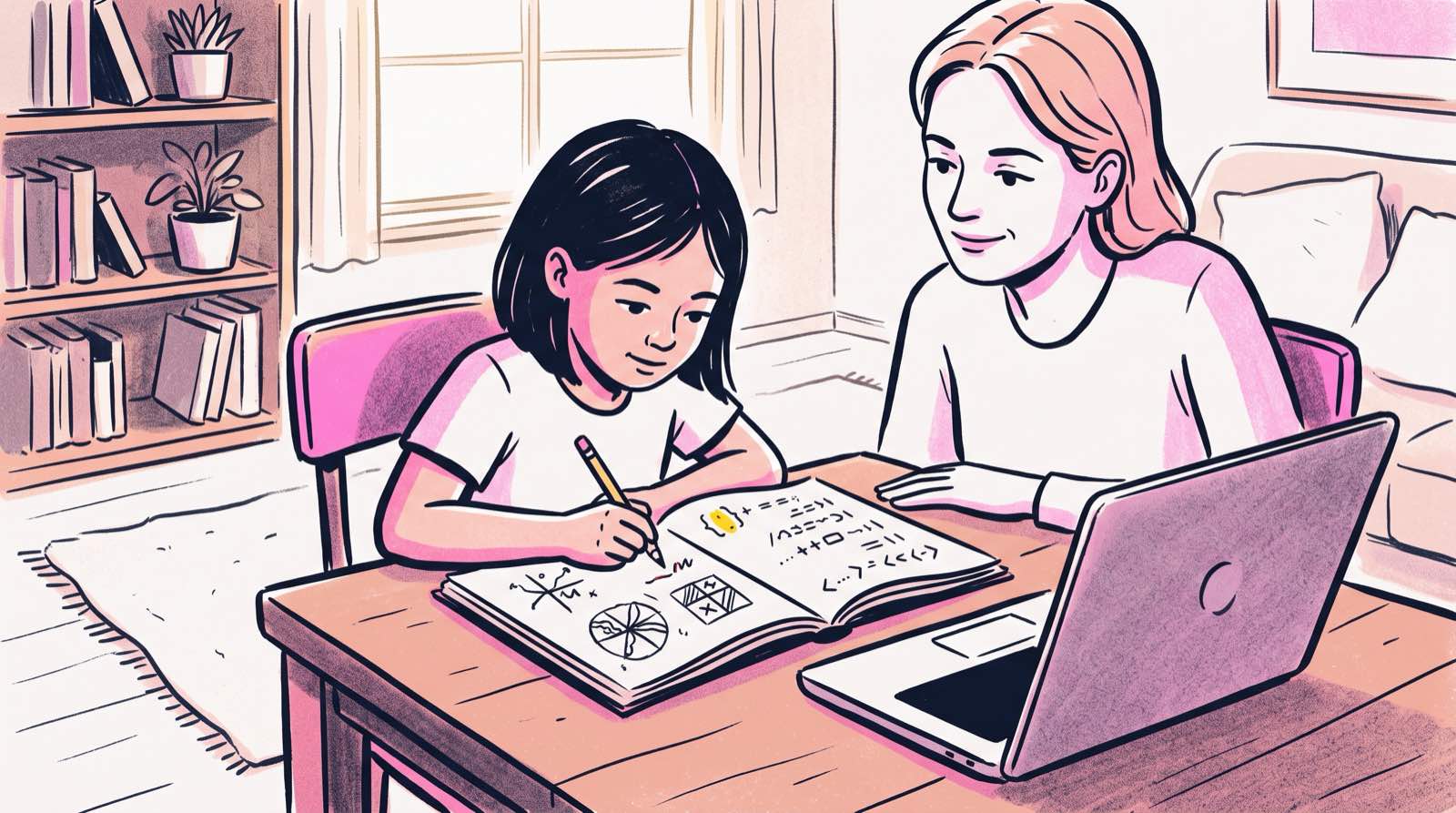
A 75% in Standard 3 looks fine on a report card. Two years later, the same child is stuck on word problems, hiding the homework file, and asking to skip tuition. Parents of secondary students describe an even sharper drop: a comfortable pass in Form 1, then a red mark in Form 3, seemingly out of nowhere.
The report card is a poor early-warning system. Term tests reward whatever was revised last week, which means a child can score respectably while the concept underneath quietly stays broken. What follows is a five-minute check you can run at your own kitchen table, for children aged 6 to 15 (Standard 1 to Form 4, or Year 1 to Year 10 in international curricula). It won't give you a grade. It will tell you whether you're looking at a careless slip, a genuine hole in the foundations, or a child who has simply stopped believing they can do math.
| Key Dimension | What School Marks Show | What the Home Benchmark Tests |
|---|---|---|
| Focus | Recency and formula memorisation | Deep conceptual retention and transfer |
| Diagnostic Power | Shows final score out of 100 | Pinpoints exact broken prerequisite concept |
| Parent Action | Signals when to worry after exams | Reveals immediate gaps before they compound |
| Child Experience | High-pressure timed test | Relaxed 5-minute verbal or practical conversation |
Table of Contents
- Why School Test Marks Hide Math Gaps in Malaysia
- How to Run the Home Benchmark Check (5 Minutes, No Pressure)
- The Year-by-Year Math Benchmark Check (Ages 6 to 15)
- Reading the Results: Cosmetic Mistake, Real Conceptual Gap, or Confidence Collapse?
- The Three Critical Gaps That Predict Later School Trouble
- Diagnostic Flowchart: From Assessment to Action
- What to Do in Each Case (Including When to Do Nothing)
- The Parent Script: How to Talk About Math Gaps Without Panic
- How Building Projects and AI Tutors Fix Mathematical Gaps
- Step-by-Step Action Plan for Home Math Audits
- Frequently Asked Questions
- References
Why School Test Marks Hide Math Gaps in Malaysia
Most school tests measure one thing well: whether a student can reproduce a method they practised last week. Three evenings of long-division worksheets will buy an 80% on Friday. If the child has no mental picture of place value behind those steps, the whole procedure evaporates by the next school holiday.
You can see the gap between recall and application in international data. In the OECD PISA 2022 results, 15-year-old Malaysian students recorded a mean mathematics score of 409 points, against an OECD average of 472 [1]. Only 41% of Malaysian students reached baseline Level 2 proficiency in mathematics, compared with 69% across OECD nations [2]. Level 2 is a modest bar, it means recognising that a simple everyday situation can be written mathematically, without anyone spelling out the steps first.
 Memorised steps hold up until the syllabus stops rewarding them. That moment usually arrives when primary arithmetic gives way to upper primary KBAT word problems, or when secondary algebra starts asking what the letters actually mean. The Ministry of Education Malaysia's TIMSS 2019 report assessed 9,637 Form 2 students across eTIMSS and paperTIMSS formats [3]. The longer trend is worth sitting with: Malaysian Form 2 TIMSS mathematics mean scores were 519 in 1999, 508 in 2003, 474 in 2007, 440 in 2011, 465 in 2015, and 461 in 2019 [4]. Two decades of drilling has not moved the needle on abstraction.
So you need your own instrument, something that tests understanding before the exam does.
How to Run the Home Benchmark Check (5 Minutes, No Pressure)
This cannot feel like a test. The moment a child senses stakes, working memory narrows and you get a false negative: a child who knows the concept but can't reach it. Research shows math anxiety directly slows the rate at which young children take on new mathematical content [5]. Among Malaysian 15-year-olds in PISA 2022, students with high math anxiety were 11.7 percentage points less likely to connect new material to what they already knew [1].
Four rules keep the check honest:
- Pick a neutral moment. Not during homework, not straight after a returned test paper, not when your child is tired. Sunday morning over breakfast is close to ideal.
- Talk, don't hand over paper. Ask it the way you'd ask a riddle. Coins, blocks, and food work better than a worksheet.
- Chase the explanation, not the speed. A right answer in two seconds tells you nothing on its own. Ask how they knew. The reasoning is the pass signal.
- Stop the second anxiety appears. If your child freezes or says "I don't know," let it go. Tell them it was just a puzzle you saw somewhere, note what happened, and move on with the day.
The Year-by-Year Math Benchmark Check (Ages 6 to 15)
Each row below gives the one concept that matters most at that age, from Standard 1 through Form 4 (IGCSE Years 1 to 10), the question to ask, and what a real pass sounds like.
| Age / Grade Level | The Core Essential Concept | The 5-Minute Home Check Question | The True Pass Signal |
|---|---|---|---|
| Age 6–7 (Standard 1 / Year 1) |
Number sense & place value decomposition | "If you have 14 sweets, how many groups of 10 can you make, and how many are left over?" | Instantly sees 14 as 1 ten and 4 ones without counting individually from 1 to 14. |
| Age 7–8 (Standard 2 / Year 2) |
Additive flexibility & bridging ten | "How would you solve in your head without counting on your fingers?" | Explains breaking 7 into , making , then adding 5 to get 15. |
| Age 8–9 (Standard 3 / Year 3) |
Multiplication as equal grouping | "If 4 children each bring 6 apples, how many apples are there altogether? Can you draw or build it?" | Explains as 4 groups of 6, rather than trying to count 24 individual items. |
| Age 9–10 (Standard 4 / Year 4) |
Fraction equivalence & spatial parts | "Which is bigger: of a pizza or of the same pizza? Why?" | Explains that dividing something into 3 larger pieces gives bigger slices than dividing into 4. |
| Age 10–11 (Standard 5 / Year 5) |
Decimals as fractional place values | "What is ? Is it or ?" | Correctly identifies and explains that is 5 tenths while is 5 hundredths. |
| Age 11–12 (Standard 6 / Year 6) |
Proportional reasoning & ratios | "If a recipe for 4 people needs 200g of flour, how much flour do you need for 6 people?" | Finds the unit rate () or uses scaling (). |
| Age 12–13 (Form 1 / Year 7) |
Negative numbers & number line directions | "Temperature is and drops by . What is the new temperature?" | Visualises moving left on a number line to reach without confusion. |
| Age 13–14 (Form 2 / Year 8) |
Algebra as generalized balance | "If , what is ? How do you know without guessing?" | Explains taking 4 away from both sides to keep balance, leaving , so . |
| Age 14–15 (Form 3 / Year 9) |
Linear relationships & rate of change | "A taxi charges RM 5 base fee plus RM 2 per km. Write an equation for total cost for km." | Writes and explains that 2 is the rate of change while 5 is the starting value. |
| Age 15–16 (Form 4 / Year 10) |
Functions as input-output rules | "If , what happens when input ?" | Correctly calculates , preserving negative sign multiplication rules. |
Reading the Results: Cosmetic Mistake, Real Conceptual Gap, or Confidence Collapse?
A stumble is not automatically a crisis, and treating it as one is how families end up paying for tuition hours they never needed. Failures on these questions come in three flavours.

- Cosmetic error. The concept is intact; the execution slipped. Think , or an answer given in the wrong unit.
- Real conceptual gap. The child can't say why the rule works. They lean on half-remembered tricks, "invert and multiply," with no idea what dividing a fraction means, and they come apart the moment the question is worded differently.
- Confidence collapse. The skill is there. The child shuts down before reading the question properly, because being wrong feels worse than not trying.
| Diagnostic Feature | Cosmetic Error | Real Conceptual Gap | Confidence Collapse |
|---|---|---|---|
| Child's Reaction | Spot-corrects self immediately when prompted: "Oh, wait, ." | Explains a wrong logic confidently or remains completely lost. | Sighs, puts head on desk, or says "Math is too hard for me." |
| Consistency | Gets 8 out of 10 similar problems right; errors are random. | Fails the core reasoning consistently across different contexts. | Solves complex problems easily when relaxed, but freezes on simple ones under observation. |
| Root Cause | Fatigue, rushing, or minor calculation slip. | Prerequisite mathematical model was never formed. | High math anxiety, past performance pressure, or exam trauma. |
| Primary Action | Do not re-teach. Teach self-checking habits. | Rebuild the missing foundational concept from concrete models. | Remove time pressure, rebuild confidence through low-stakes building projects. |
The Three Critical Gaps That Predict Later School Trouble
Across 9,500 students since 2014, we keep tracing secondary school math trouble back to the same three primary school concepts, each one waved through without real mastery.
Gap 1: Place Value and Number Decomposition (Ages 6 to 8)
Some children never stop seeing numbers as strings of digits. Quantity, tens, hundreds, none of it is in the picture, so mental calculation is off the table. Watch what your child does with . If they reach for vertical column subtraction and start borrowing across zeros, the internal model isn't there. A child who has it sees straight away that 98 sits 4 units below 102.
Fast forward to Form 2 and the same gap surfaces as an inability to collect like terms: becomes a guessing game.
Gap 2: Fractions and Multiplicative Thinking (Ages 9 to 11)
Fractions are the biggest wall in primary mathematics, in KSSR and in international curricula alike. A study in the Journal of School Psychology found that elementary students report significantly higher math anxiety on complex tasks than on simple ones [6]. That's not a coincidence, fractions are usually the first time numbers refuse to behave like the counting numbers a child has trusted for four years.
A child who says is bigger than because 8 beats 4 is doing something perfectly logical with the wrong logic: whole-number thinking applied to a proportional idea. Our guide on helping children who struggle with KBAT word problems shows how word problems drag these fraction gaps into the open.
Gap 3: Negative Numbers and Directional Scaling (Ages 12 to 14)
"Two negatives make a positive" survives contact with homework for about a week. Then turns up and the rule betrays them. Without a number line or a sense of direction and movement in the head, students hit a ceiling in linear equations, coordinate geometry, and later in physics vectors.
Diagnostic Flowchart: From Assessment to Action
Use this to get from what you observed to what you should actually do about it.
flowchart TD
    A[Run 5-Minute Home Check] --> B{Did child answer correctly?}
    B -- Yes --> C{Can they explain why?}
    C -- Yes --> D[Concept Solid: No action needed]
    C -- No --> E[Procedural Recall: Rebuild with visual models]
    B -- No --> F{Did child freeze or panic?}
    F -- Yes --> G[Confidence Issue: Remove pressure & build projects]
    F -- No --> H[Real Gap: Audit earlier prerequisite skills]
What to Do in Each Case (Including When to Do Nothing)
The diagnosis matters less than what you do next. Panic over a careless slip manufactures anxiety that wasn't there; ignoring a foundational hole lets it widen for years.
Case A: The Concept Is Solid (Do Nothing)
Clear reasoning, even if the arithmetic took a few extra seconds? Do nothing. No supplementary worksheets, no extra practice book "just to be safe." Drilling a child who already understands is the fastest route to a child who no longer cares.
Case B: The Error Is Cosmetic (Teach Checking Routines)
Rushing and slips don't need a tutor. They need habits:
- Estimate first. "Before you work it out, should the answer be bigger or smaller than 100?"
- Reverse the operation. Check subtraction with addition, division with multiplication.
- Circle the units. Centimetres or metres? Ringgit or sen? Make them mark what the question is asking for.
Case C: There Is a Real Conceptual Gap (Rebuild from Prerequisite Concrete Models)
Repeating the textbook rule louder won't help. Go back to the last point where the understanding held. A Standard 5 child who can't compare and doesn't need the cross-multiplication shortcut, they need folded paper, drawn bars, cut fruit, whatever makes the proportion visible. Rebuild from there.
If you're weighing traditional tuition against building-based math, our comparison on math tuition versus learning math by building lays out the difference.
Case D: Confidence Has Collapsed (Remove Timed Drills Entirely)
Stop the timed tests and flashcards. Today. Research shows that timing conditions, whether announced or not, raise anxiety when children work on complex tasks [6]. Move the math somewhere it isn't the point: designing a game level, programming a sensor simulation, anything where the numbers are a means to something the child wants.
The Parent Script: How to Talk About Math Gaps Without Panic
The first sentence out of your mouth decides whether your child leans in or closes the book. "Why don't you know this yet?" ends the conversation. So does "I was bad at math too", it hands them a permission slip.
Three scripts that work:
Script 1: When introducing the home check
Parent: "I saw an interesting puzzle online today and wanted to see how you would think through it. There is no mark, no timer, and no correct answer you have to get right away. Let us just figure out how it works together."
Script 2: When a conceptual gap appears
Parent: "Ah, I see what happened. Your brain used the addition rule on fractions, and honestly, that's a sensible move, it's what worked for whole numbers your whole life. Fractions play by different rules, more like slicing a pizza. Nothing wrong with you; the explanation just hasn't clicked yet. Let's draw it and see why."
Script 3: When the child gets frustrated or shuts down
Parent: "Let's stop here. You're not stuck because you're bad at math. You're stuck because we skipped a smaller piece earlier on. We can go back and pick it up whenever you feel like it."
How Building Projects and AI Tutors Fix Mathematical Gaps
Plenty of students walk into Kidocode announcing that they're "not a math person." Almost none of them are right. What they've actually met is a delivery model built on abstraction, memorisation, and testing.
We teach the same curriculum, aligned with IGCSE, Cambridge, and KSSR standards, but through construction: children use the math to build things.

1. Math Taught as a Building Tool
Set the coordinates for a character in Roblox and geometry stops being a diagram in a book. Tune the slope of a variable so a car in Python accelerates like a real car, and rate of change becomes something you can feel. The math is the engine; the game is the reason to care. More on this in why mathematics remains foundational in the age of AI.
2. Personalised AI Tutors for Every Child
No teacher with 30 students can pause algebra to rebuild place value for one child. That's not a criticism of teachers; it's arithmetic.
Every student in our classes works alongside a personalised AI tutor. Make a conceptual error while coding a physics engine and the tutor identifies the exact prerequisite that broke, then walks through it with interactive visuals, no sighing, no red pen, no waiting until Friday. Our guide to AI math tutors for kids in Malaysia goes into the mechanics.
3. Bundled Pillar Approach
Kidocode is an AI school first, with Math and Technology in one ecosystem for kids aged 5 to 18. We run five physical campuses, Solaris Mont Kiara, Sunway Nexis in Kota Damansara, Q2 Waterfront, Tanjung Tokong, and Icon City in Penang, plus live camera-on online classes.
Coding comes free in every package, for a simple reason: syntax is public knowledge now. The part worth teaching is computational thinking, the logic, the spatial reasoning, the mathematical structure sitting under the software. See how computational thinking transforms learning across every subject.
Step-by-Step Action Plan for Home Math Audits
Spread the audit over four weeks. Rushing it turns it back into a test.
-
Week 1: Run the 5-Minute Check
Pick a quiet morning. Ask the one benchmark question for your child's age from the table above, then stay quiet and let them explain. -
Week 2: Categorise the Error
Cosmetic slip, real conceptual gap, or confidence issue? The diagnostic table above sorts it. -
Week 3: Address the Prerequisite
For a conceptual gap, drop back a grade level. Rebuild with objects, diagrams, or something from real life, cooking, budgets, game scores. -
Week 4: Re-check Through Application
Have your child explain the concept back to you inside something they care about: a layout they're designing, a recipe they're scaling, stats for a game they play.
Printable Weekly Math Benchmark Checklist
- Week 1: Select a calm moment on the weekend and ask the age-specific benchmark question verbally.
- Week 1: Record whether your child answered with immediate reasoning, procedural guessing, or hesitation.
- Week 2: Use the diagnostic table to classify the response (Cosmetic Error, Real Conceptual Gap, or Confidence Collapse).
- Week 2: If a confidence issue is detected, pause timed drills and remove testing pressure immediately.
Designed, ready to print and sign. We email it to you together with a 5% discount on your next registration.
Frequently Asked Questions
How can I tell if my child is behind in math if their school report card says B or C?
Report cards blend submission, effort, and short-term test performance. A child can earn a B by memorising steps the night before and losing them within a fortnight. The five-minute home check ignores the score and goes straight for the explanation, which is where the truth is.
My child gets top marks in Kumon or mental arithmetic, but struggles with Standard 4 KBAT word problems. Are they behind?
Not in calculation. The gap is in translation. Mental arithmetic builds fast, accurate execution; KBAT problems ask the child to turn a written scenario into a mathematical model first. Work on visual representations and practical problem-solving. Our comparison on Kumon and abacus versus math by building covers this in detail.
Should I hire a math tutor immediately if my child fails a benchmark question?
No, sort the error first. Cosmetic errors call for self-checking habits. Confidence problems call for less pressure, not more practice. Tuition that runs the same textbook drills again tends to raise anxiety while leaving the actual gap untouched.
Is it too late to fix math gaps if my child is already in Form 2 or Form 3?
No. Math stacks, which is exactly why it's fixable. A secondary student floundering in algebra or trigonometry is usually missing something primary, fractions, negative numbers, place value. Repair that specific block and the upper secondary work starts making sense again, often faster than parents expect.
How does Kidocode fix math gaps differently from a tuition centre?
We're an AI school, not a tuition centre, and we don't drill past-year papers. Students work with personalised AI tutors on project-based challenges, using math to build real games, apps, and AI models. Gaps get addressed at each child's own pace, and the math becomes a tool they actually want to pick up.
References
- OECD. (2023). PISA 2022 Results: Country Notes - Malaysia. OECD Publishing. https://gpseducation.oecd.org/CountryProfile?primaryCountry=MYS&treshold=10&topic=PI
- OECD. (2023). PISA 2022 Results (Volume I and II): Malaysia Country Note. Official Publication. https://www.oecd.org/en/publications/pisa-2022-results-volume-i-and-ii-country-notes_ed6fbcc5-en/malaysia_1dbe2061-en.html
- Kementerian Pendidikan Malaysia. (2020). Laporan National TIMSS 2019: Pencapaian Murid Malaysia. Bahagian Perancangan dan Penyelidikan Dasar Pendidikan. https://www.scribd.com/document/656948222/BUKU-LAPORAN-TIMSS-2019
- Hashim, N. A., Yahya, F. H., Jamil, M. R. M., Daud, N. A. M., & Murtafiah, W. (2023). Analisis Keperluan Pembangunan Modul Pedagogi Berasaskan Teknologi Geometri 2D. Jurnal Pendidikan Sains dan Matematik Malaysia, 13(2), 45-58. https://ejournal.upsi.edu.my/index.php/JPSMM/article/download/8259/4671/40587
- Tomasetto, C., Morsanyi, K., Guardabassi, V., & O'Connor, P. A. (2020). Math anxiety interferes with learning novel mathematics contents in early elementary school. Journal of Educational Psychology, 113(2), 315-329. https://pure.qub.ac.uk/files/220429463/Tomasetto_Morsanyi_Guardabassi_O_Connor_2020.pdf
- Maki, K. E., Zaslofsky, A. F., Codding, R., & Woods, B. (2024). The impact of task difficulty and timing context on elementary students' self-reported math anxiety. Journal of School Psychology, 106, 101340. https://pubmed.ncbi.nlm.nih.gov/39251303/
Curious how your child responds when math becomes something they build with? Book a free trial class at Kidocode, five physical campuses across Klang Valley and Penang, or live camera-on online sessions.