

Move a child between an SMK running the Kurikulum Standard Sekolah Menengah (KSSM) and an international school running Cambridge IGCSE, and maths is usually the subject that cracks first.
The pattern is familiar to anyone who has sat through that first progress report. A student who topped the class in Form 2 or Form 3 KSSM mathematics lands in Term 1 of Cambridge IGCSE Extended and comes home with a C or a D. Going the other way produces its own version of the same shock: students arriving from international schools into national SPM streams get marked down for working steps their old teachers happily accepted.
Very little of this is about mathematical ability. The underlying mathematics is the same in both systems. What differs is what each system chooses to measure, how questions are worded, and which style of written communication earns marks.
Below: the structural differences between the two syllabi, a topic-by-topic map of what carries across, the specific places students bleed marks, and a transition plan you can run before the switch happens.
Key Takeaways
| Metric or Dimension | KSSM Secondary Mathematics | Cambridge IGCSE Mathematics (0580) |
|---|---|---|
| Primary Curriculum Focus | Content delivery and procedural execution | Competency development and practical application |
| Assessment Structure | Standardised procedural steps and formula application | Core (Grades C to G) and Extended (Grades A* to C) tiers |
| Language & Question Style | Direct instructions in Bahasa Malaysia or English | Multi-step word problems with real-world scenarios |
| Calculator Policy | Scientific calculator permitted across secondary papers | Paper 1 & 2 non-calculator; Paper 3 & 4 calculator required |
| Command Words | "Hitungkan" (Calculate), "Cari" (Find), "Selesaikan" (Solve) | "Show that", "Describe fully", "Explain why", "Derive" |
| Assessment Objectives | Memorisation and structured working alignment | AO1 (Techniques 40-50%), AO2 (Application/Analysis 50-60%) |
Table of Contents
- Why Strong KSSM Math Students Grade-Drop in Term 1 of IGCSE
- Same Topics, Different Demands: Command Words and Method Marks
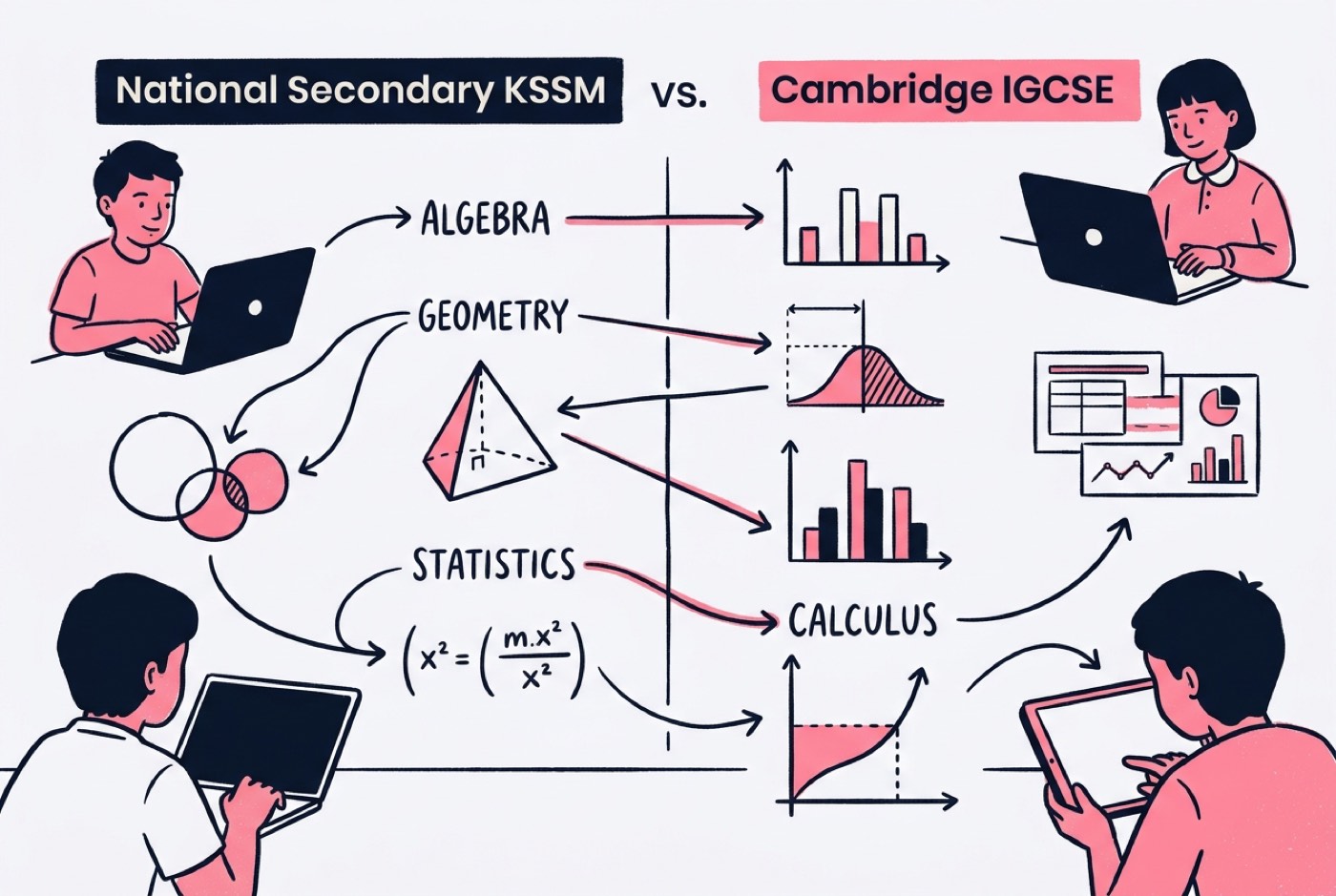
- Comprehensive Curriculum Mapping: What Transfers, What Is Renamed, and What Is New
- The Three Major Slip Points in the Switch
- The Reverse Switch: Moving from IGCSE to KSSM SPM Math
- The 8-Week Transition Roadmap Before the School Switch
- What NOT to Do: Common Mistakes Parents Make During Transition
- How Kidocode Builds Mathematical Thinking Without Endless Drills
- Parent Checklist: Your First Parent-Teacher Meeting After the Switch
- Frequently Asked Questions
- References
Why Strong KSSM Math Students Grade-Drop in Term 1 of IGCSE
International schooling in Malaysia keeps expanding. Enrolment reached roughly 111,185 students by mid-2024, an 11% rise over five years, and local Malaysian students make up about two-thirds of those places [1]. The same research on parental decision-making found that 90% of surveyed parents in international schools prefer English as the medium of instruction, against 30% in national schools [1].
Most parents expect maths to be the easy part of the move. Numbers are numbers. But comparisons of the two curricula describe KSSM as a content-delivery model and Cambridge IGCSE as a competency-development model [2], and that distinction shows up in every paper a student sits.
Under a content-delivery model, teaching and assessment track the prescribed syllabus. A student learns the routine for a topic block (linear equations, matrices, transformations) and is then tested on executing that routine cleanly.
Cambridge asks a different question: can you pull a mathematical structure out of unfamiliar text? An IGCSE paper rarely hands you an isolated equation and says "Solve for x." It gives you water flowing into a conical tank at a changing rate, or a currency transaction that crosses three countries, and leaves you to decide which tools apply before a single number gets written down.
So a KSSM-trained student with excellent calculation skills can stall in front of a 6-mark question simply because nothing on the page names the formula. The Term 1 drop is a gap in application strategy, not in mathematics.
Same Topics, Different Demands: Command Words and Method Marks
The clearest way to see the difference between Cambridge IGCSE Mathematics (Syllabus 0580) and KSSM Secondary Mathematics is to read their assessment objectives side by side.
Cambridge splits 0580 into two objectives [3]:
- AO1: Knowledge and understanding of mathematical techniques (40% to 50% of total assessment marks).
- AO2: Analyse, interpret and communicate mathematically (50% to 60% of total assessment marks).
KSSM textbooks do integrate Higher Order Thinking Skills (Kemahiran Berfikir Aras Tinggi, or KBAT), but day-to-day school assessments still lean harder on direct technique recall than on open-ended analysis.
Understanding IGCSE Command Words
Cambridge examiners use command words that dictate the shape of the answer, not just its content [3]. These are the three that catch KSSM students most often:
- "Show that...": The answer is already printed in the question. Write the final value and you score zero. The marks sit in the chain of reasoning that gets you from the given conditions to that result.
- "Describe fully the single transformation that maps shape A onto shape B": List two transformations (a reflection then a translation, say) and you score zero, even with the shape in the right place. The word "single" is doing real work, and the answer needs full technical wording: "Rotation, 90 degrees anti-clockwise, centre (1, -2)".
- "Give a reason for your answer": Standard in circle theorems and geometric proofs. The angle alone earns partial credit; full marks need the theorem stated properly, for example "angle at the centre is twice the angle at the circumference".
The Mechanics of Method Marks
Cambridge mark schemes use three mark types:
- M Marks (Method Marks): For applying a correct method. These survive a wrong final answer, as long as the method is written out where the examiner can see it.
- A Marks (Accuracy Marks): For numerical accuracy following a correct method. No M mark, no A mark.
- B Marks (Independent Marks): For correct answers or statements that stand on their own, with no method required.
KSSM schemes hand out marks for intermediate numerical steps fairly readily. IGCSE does not. A student who does two steps mentally, skips the structural formula line, and then fumbles one calculation can lose the M marks along with the answer. The habit to build is simple to state and hard to install: the paper is a record of your thinking, not a scratchpad.
Comprehensive Curriculum Mapping: What Transfers, What Is Renamed, and What Is New
This table maps KSSM Form 1 through Form 5 Mathematics against Cambridge IGCSE Mathematics 0580 (Core and Extended).
| Topic Category | KSSM Topic Name & Stage | Cambridge IGCSE 0580 Alignment | Key Structural Difference |
|---|---|---|---|
| Number & Pre-Algebra | Form 1-2: Ratios, Rates, Percentages, Index Numbers | Topic 1: Number (Core & Extended) | IGCSE includes compound interest formulas, reverse percentages, and upper/lower bounds calculations. |
| Algebraic Manipulation | Form 1-3: Algebraic Expressions, Linear Equations | Topic 2: Algebra & Sequences | IGCSE Extended includes completing the square, fractional equations, rearranging complex formulas, and functions . |
| Quadratic Equations | Form 4: Quadratic Functions and Equations | Topic 2: Algebra & Sequences | KSSM relies heavily on factorisation and standard quadratic formula. IGCSE Extended tests deriving turning points via completing the square. |
| Coordinate Geometry | Form 2: Coordinates; Form 4: Straight Lines | Topic 2: Algebra & Topic 3: Coordinate Geometry | IGCSE requires finding perpendicular bisectors, midpoints, and line lengths using coordinate distance formulas in problem contexts. |
| Trigonometry | Form 3: Sine, Cosine, Tangent; Form 4: Trigonometric Ratios | Topic 4: Geometry & Topic 5: Mensuration / Trigonometry | IGCSE Extended includes 3D trigonometry, non-right-angled triangle rules (Sine and Cosine rules), and bearing applications. |
| Transformations | Form 2 & Form 5: Transformations, Matrices | Topic 4: Geometry (Transformations) | KSSM covers matrix transformations in detail. IGCSE 0580 (from 2025 syllabus) focuses on vectors, translations, reflections, rotations, and enlargements without matrices [3]. |
| Probability & Statistics | Form 2: Data Handling; Form 4-5: Probability | Topic 6: Probability & Topic 7: Statistics | IGCSE Extended introduces cumulative frequency curves, percentiles, interquartile ranges, and tree diagrams with non-replacement. |
| Calculations & Tools | Form 1-5: Scientific calculator permitted throughout | Core & Extended: Non-calculator and Calculator papers | IGCSE enforces Paper 1 and Paper 2 as strictly non-calculator, testing mental estimation and exact fraction work [3]. |
The Three Major Slip Points in the Switch
Across thousands of diagnostic assessments and trial sessions with students around Malaysia, the same three areas keep surfacing.
1. Fractions, Bounds, and Non-Calculator Accuracy
Students in the national system pick up a scientific calculator early, often from Form 1, and never really put it down. Then they meet Paper 1 (Core) or Paper 2 (Extended), where calculators are banned outright [3].
That paper is not a basic arithmetic test. It is a number-sense test. What it asks for:
- Mixed-number fraction operations, done as fractions, with no detour through decimals.
- Estimation by significant figures, such as evaluating after rounding every term to 1 significant figure.
- Upper and Lower Bounds, a topic that simply does not appear in early KSSM. If a length is given as correct to 1 decimal place, its bounds are . Finding the minimum or maximum value of a combined quantity such as Speed = Distance / Time then means working out which bound goes on top and which goes underneath, which trips up even strong students the first few times.
2. Geometry Proof Language and Vector Notation
KSSM geometry generally pays for the correct number. IGCSE geometry pays for the number and the argument in roughly equal measure.
Circle theorems make this obvious. A single angle question inside a circle typically carries 3 or 4 marks. One goes to the figure; the rest depend on writing the official reasons word for word:
- "Angles in the same segment are equal."
- "The angle in a semicircle is a right angle ()."
- "Opposite angles of a cyclic quadrilateral add up to ."
Shorthand like "opposite angles circle" earns nothing under a Cambridge mark scheme, however clear it looks on the page.
Vector geometry works the same way. IGCSE Extended asks students to express displacement vectors in terms of given position vectors and , then prove three points are collinear. That means showing and saying out loud that is a common point. Leave the sentence out and the final marks go with it.
3. Statistics Vocabulary and Cumulative Frequency Curves
Statistics in KSSM Form 4 and Form 5 revolves around mean, mode, and standard deviation, usually through tabulated formulas or calculator functions.
IGCSE statistics puts most of its weight on graphs and what you can read off them:
- Cumulative Frequency Diagrams: Build the cumulative frequency table, plot at upper class boundaries rather than midpoints, join with a smooth curve, then read off the median, lower quartile (), upper quartile (), and interquartile range ().
- Histograms with Unequal Class Widths: KSSM secondary statistics sticks mostly to bar charts and equal class intervals. IGCSE varies the bar widths, which forces students to calculate and plot Frequency Density (). Plot raw frequency on the vertical axis and every plotting mark disappears at once.
The Reverse Switch: Moving from IGCSE to KSSM SPM Math
The KSSM-to-IGCSE move gets most of the attention, but plenty of Malaysian families go the other way. Students finish Year 9 or Year 10 in an international school and transfer into an SMK to sit SPM.
National figures put the 2023 SPM qualification rate at 93.50% [4]. Getting there from an international background comes with its own set of hurdles:
- Language and Terminology: Papers are sat mainly in Bahasa Malaysia, or under Dual Language Programme provisions where those exist. The vocabulary has to be relearned: "standard deviation" becomes sisihan piawai, "simultaneous equations" becomes persamaan serentak, and "bearing" stays bearing but arrives inside a Malay prompt.
- Rigid Presentation Formatting: SPM mark schemes can be strict about intermediate presentation in ways international students do not expect. Linear Law (Hukum Linear) is the classic example: converting a non-linear equation into linear form () requires a particular table layout and the exact graph scale the paper prescribes.
- Topics Present in KSSM SPM but Reduced in IGCSE 0580:
- Matrices (Matriks): Form 5 KSSM covers matrix operations, determinants, inverse matrices, and solving simultaneous equations with matrices. Cambridge IGCSE 0580 dropped matrices, so a transferring student may arrive in Form 4 or Form 5 having never seen one.
- Mathematical Reasoning (Penaakulan Rekursif / Logik): KSSM devotes whole modules to logical deduction, truth tables, implications, and counter-examples ("If , then ").
- Consumer Mathematics (Matematik Pengguna): Form 4 covers insurance policies, taxation (income tax, road tax, property assessment tax), and risk calculation. It is specific to the Malaysian national curriculum and absent from international boards.
The 8-Week Transition Roadmap Before the School Switch
Starting early is what keeps the Term 1 dip from turning into a confidence problem. Here is an eight-week plan parents can run at home, in either direction.
| Weeks | Focus Areas | What the Student Does |
|---|---|---|
| Weeks 1 to 2 | Vocabulary mapping, tool audit | Build bilingual glossaries; master non-calculator basics |
| Weeks 3 to 4 | Syllabus gap bridge, command word drill | Target unlearned topics; practise "Show that" questions |
| Weeks 5 to 6 | Past paper anatomy, method writing | Analyse Cambridge marking schemes; write out full working steps |
| Weeks 7 to 8 | Timed paper run, diagnostic review | Complete full practice papers; address remaining slip points |
Phase 1: Weeks 1 to 2 – Diagnostic Audit & Tool Readiness
- Audit calculator dependence: Watch whether your child reaches for the calculator on simple fractions or short division. Start 15-minute daily mental maths drills on fraction conversion, estimation, and indices with nothing electronic on the desk.
- Build a command word dictionary: One reference sheet comparing the phrasing of both systems. Put "Find" next to "Show that" and make sure your child can explain why the second one allows no unexplained jumps.
Phase 2: Weeks 3 to 4 – Addressing Specific Topic Gaps
- KSSM to IGCSE: Upper and Lower Bounds, cumulative frequency curves, histograms with unequal class widths, reverse percentages, 3D trigonometry.
- IGCSE to KSSM: Matrices, Consumer Mathematics (insurance and taxation), and formal logical reasoning statements in Bahasa Malaysia.
Phase 3: Weeks 5 to 6 – Marking Scheme Alignment
- Get hold of real past papers: Cambridge IGCSE 0580 Paper 2 and Paper 4, or SPM Paper 1 and Paper 2.
- Mark them together against the official mark schemes. Show your child a case where Cambridge awards M (Method) marks despite a wrong final number, and a case where a missing explanation kills an accuracy mark.
Phase 4: Weeks 7 to 8 – Timed Condition Simulation
- Run two complete papers under proper exam conditions:
- For IGCSE: Paper 2 (Extended Non-Calculator, 1 hour 30 minutes) and Paper 4 (Extended Calculator, 2 hours 30 minutes) [3].
- In the review, hunt specifically for unforced errors: missing units, thin intermediate working, misread information in multi-step word problems.
What NOT to Do: Common Mistakes Parents Make During Transition
Three well-meant responses that usually make the dip last longer.
1. Enrolling in Traditional Drill-Based Tuition
The reflex move is a tuition centre and a stack of repetitive worksheets. If the problem is that your child cannot parse a multi-step word problem, another hundred isolated quadratics will not touch it. What helps is direct instruction in deciphering word problems and KBAT application.
2. Assuming "Math is the Same Everywhere"
Believing that mastery travels intact between exam boards makes parents blind to the structural differences in assessment. A child who scored 90% in Form 3 KSSM maths has no automatic claim on an A* in IGCSE Extended without explicit work on exam technique, command words, and presentation.
3. Treating the Problem as a Lack of Talent
When an A becomes a D after a school switch, parents start wondering whether the child has hit a ceiling. Almost always, the child is just unfamiliar with a new set of assessment rules. Shifting the story from "I am bad at maths" to "I am learning a new exam language" is what keeps math anxiety from setting in.
How Kidocode Builds Mathematical Thinking Without Endless Drills
At Kidocode we work with thousands of students moving between national, international, and independent systems across Kuala Lumpur and Penang.
One conviction sits under everything we do: the child is fine, the teaching approach was incomplete.
When a student is stuck on an abstract concept, memorising more formulas is rarely what unsticks them. We teach maths by having kids build real computational projects instead.
| Approach | The Sequence |
|---|---|
| Standard tuition | Memorise formula → complete 50 worksheets → exam testing |
| Kidocode computational build | Real project need → discover math concept → code simulation → master application |
How Our Pillars Address the Transition Gap
-
Math Through Builds (Syllabus-Aligned): Formal curricula still matter here. Our mathematics framework aligns with Cambridge IGCSE, Oxford AQA, and Common Core. The difference is that students USE the maths to solve a problem rather than meeting it on a worksheet.
- Building a 3D game engine demands coordinate geometry, vectors, and 3D trigonometry.
- Building an AI prediction algorithm demands probability, matrix operations, and statistical distributions. A student who has used vectors to drive physics in an environment they built reads a 4-mark IGCSE vector question differently, because they have already watched the maths do its job. More on this in how game development teaches applied mathematics.
-
Personalised AI Tutors Per Child: Every child in our classes works alongside a personal AI tutor platform that spots learning gaps as they happen. If a student heading into IGCSE keeps stumbling on fractional indices or upper bounds, the tutor traces the breakdown to the exact foundational step and serves targeted computational challenges until it holds. See how an AI math tutor transforms understanding for Malaysian students.
-
Coding & AI Bundled Free: Most centres charge separately for computer science. We bundle coding free into our membership packages, because coding is the best available practice ground for computational thinking and mathematical logic. Syntax is cheap now; what counts is whether a student can decompose a problem, spot the pattern, and structure a logical solution. Those are the same skills that separate top IGCSE and SPM Extended candidates from the rest.
Whether your child is moving from primary to secondary or crossing between national and international streams, the goal is mathematical intuition sturdy enough to survive whichever paper lands on the desk. Here is our take on learning math by building versus traditional tuition.

Parent Checklist: Your First Parent-Teacher Meeting After the Switch
"How are their grades?" will get you a polite answer and nothing you can act on. Take this list into the meeting instead.
Printable 8-Week School Switch Parent Checklist
- Assessment Objective Breakdown: Ask the teacher for a breakdown of my child's marks between AO1 (Techniques) and AO2 (Application and Reasoning).
- Command Word Audit: Request specific examples of exam questions where my child lost marks. Were marks lost on calculation or on command words like "Show that" and "Explain why"?
- Non-Calculator Performance: For IGCSE transitions, confirm how my child performs on Paper 1 / Paper 2 non-calculator tasks compared to calculator-assisted tasks.
- Method Mark Retention: Ask whether my child writes out complete working steps or skips intermediate lines, risking the loss of M (Method) marks.
Designed, ready to print and sign. We email it to you together with a 5% discount on your next registration.
Frequently Asked Questions
Is IGCSE math harder than KSSM SPM math?
Neither is harder in the abstract; they test different things. KSSM SPM covers a wide spread of topics, including consumer finance, matrices, and logic, and often asks for long procedural working. Cambridge IGCSE Extended leans on real-world modelling, non-calculator agility, geometric proof, and precise command word execution. A student trained to memorise formulas will find IGCSE harder. A student who is strong on visual logic and contextual problem-solving may find it easier.
Should my child take IGCSE Core or Extended Mathematics?
Cambridge IGCSE 0580 offers Core (targeting grades C through G) and Extended (targeting grades A* through C) [3]. Extended is essential for anyone heading towards science, technology, engineering, finance, or business at A-Level, IB Diploma, or university. Most international schools in Malaysia place students in Extended by default and move them to Core only when diagnostics suggest the Extended pass threshold is out of reach.
How long does it usually take for a student to adapt after switching math systems?
With guidance aimed at exam technique and command words rather than worksheet volume, most students settle within 6 to 12 weeks. The Term 1 dip is normal. Once a student understands how method marks are awarded and how to break down a contextual word problem, results stabilise and then climb.
Can learning coding help my child adjust to IGCSE math word problems?
Yes. An IGCSE question asks the student to read a scenario, break it into logical components, identify the variables, and choose an algorithm, which is exactly what programming asks for. Coding trains structural thinking, and multi-step word problems stop looking like walls of text. Our guide on transitioning from primary to secondary school math covers how computational thinking develops that skill.
How can I evaluate my child's current math application level?
Book a free trial session at any Kidocode campus in Klang Valley (Solaris Mont Kiara, Sunway Nexis PJ) or Penang (Q2 Waterfront Bayan Lepas, Vantage Tanjung Tokong, Icon City Bukit Mertajam), or join online. Your child builds a real computational project during the session, which lets our trainers read their mathematical logic, problem-solving confidence, and application readiness without a worksheet in sight. Reserve a slot on our free trial registration page.
References
- Universiti Utara Malaysia, Determinants of Parental Choice for International Schools in Malaysia (2026)
- Sri Bestari International School, Cambridge vs National Curriculum Malaysia Parents Guide (2026)
- Cambridge Assessment International Education, Cambridge IGCSE Mathematics 0580 Syllabus for 2025-2027
- Kementerian Pendidikan Malaysia, PPPM Laporan Tahunan 2023