


It is 8:30 PM and your child is crying over a maths worksheet. The usual conclusion is that they lack a maths brain, or that they need another twenty practice questions. Both conclusions are usually wrong. What looks like an inability to do arithmetic or algebra is often something else entirely: maths anxiety, a stress reaction that interferes with the mental machinery needed to calculate.
Maths anxiety is a psychological state in which stress blocks working memory. When numbers, timed tests, or the memory of past failure register as a threat, the brain diverts cognitive energy away from problem-solving and towards emotional self-defence. In Malaysia, with its demanding academic benchmarks, speed drills, and early streaming, this pattern turns up in primary and secondary classrooms every term.
Below: the signs worth watching for, the working memory mechanism behind the freeze, the cultural conditions that feed it in Malaysian schools, and what you can change at home this week without printing a single extra worksheet.
Key Takeaways
| Topic | Key Finding / Strategy |
|---|---|
| Cognitive Mechanism | Maths anxiety consumes verbal working memory, making it impossible to hold numbers in mind while calculating. |
| National Benchmark | PISA 2025 data shows Malaysian 15-year-olds scored 397 in mathematics, down 11 points from 2022 [1]. |
| Primary Root Cause | Speed-focused drills, public correction, and drill-and-test teaching methods, rather than low innate ability [2]. |
| Home Strategy | Shift from abstract drills to low-stakes application where maths is used as a tool to build something real. |
| Recovery Timeline | When the delivery method changes from memorisation to constructivist building, maths anxiety typically diminishes within 2 to 4 weeks. |
Table of Contents
- 7 Observable Signs It Is Anxiety, Not Ability
- What Causes Maths Anxiety in the Malaysian Context?
- The Cognitive Trap: How Working Memory Freezes Under Threat
- Six Things to Stop Doing This Week
- Six Things That Work at Home
- The Application Shortcut: Maths with a Purpose
- A 4-Week Home Plan with Weekly Scripts
- How to Talk to Your Child's School Teacher
- Two Classroom Stories: 10-Year-Old and 15-Year-Old
- How Kidocode Solves Maths Anxiety Without Tuition
- Frequently Asked Questions
- References
7 Observable Signs It Is Anxiety, Not Ability
Distress is easy to misread as weakness. One useful test: if a child reads well, draws well, and argues confidently out loud, but falls apart on a written maths task, the barrier is usually emotional rather than intellectual. Seven behaviours show up again and again.
1. Chronic Stalling Before Homework Begins
A drink of water. Three pencils that need sharpening. A chore they suddenly remember. Twenty minutes of desk-tidying. The stalling is not laziness or defiance; it is a threat response, and the child is rarely aware they are doing it. The brain is buying time before entering a situation it has filed under confusion and failure.
2. Guessing Rapidly to End the Session
Give the child a problem that needs three steps and they fire back a number in two seconds. They are not attempting the answer. They are trying to end the tension, and a wrong answer ends it faster than a blank page.
3. Eraser Abuse and Over-Erasing
Correct working lines get rubbed out, sometimes through the paper. This is self-doubt running ahead of the calculation: before the child has finished, an internal monitor has already told them the work is wrong.
4. Physical Symptoms Before Tests or Tuition
Headaches, stomach aches, nausea, sudden exhaustion, all arriving on predictable mornings: maths day, tuition day, test day. These are genuine somatic responses to anticipatory anxiety, not performances.
5. The "I'm Just Bad at Maths" Identity Assertion
Listen for identity language rather than task language. "I don't have a maths brain." "Our family isn't good at numbers." A temporary skill gap has been converted into a permanent trait, which is a reasonable defence: if you were never capable, failing costs nothing.
6. Freezing on Word Problems (KBAT)
The child handles a bare drill like well enough, then stops dead at a KBAT word problem. Translating sentences into mathematical expressions adds a second load on top of the arithmetic, and the working memory buffer overflows.
7. Blanking During Timed Exams
Untimed practice at home goes fine. The timed school paper comes back poor. Time pressure triggers adrenaline, and adrenaline cuts into exactly the mental bandwidth that multi-step problems require.

What Causes Maths Anxiety in the Malaysian Context?
Maths anxiety is learned, and it is learned from specific conditions. Studies in Malaysian primary and secondary schools point to instructional approach and social pressure as the heaviest influences on student anxiety levels [2], [3].
flowchart TD
    A[Timed Drills & Public Correction] --> B[Threat Signal to Brain]
    B --> C[Verbal Working Memory Depletion]
    C --> D[Systematic Problem-Solving Fails]
    D --> E[Lower Test Scores & Shame]
    E --> A
Timed Drills and Speed Culture
In plenty of primary classrooms and traditional enrichment programmes, speed stands in for intelligence. Flash cards, timed multiplication tests, races to the whiteboard. The message a child takes from this is simple and false: fast means clever. A child who thinks methodically, checks their work, or likes to see why a method works learns to read their own carefulness as stupidity.
Public Correction and Board Work
Solving a problem at the whiteboard in front of thirty classmates puts a child's competence on display. One error, one ripple of laughter, and the brain files mathematical working under social risk. After that, the anxiety arrives before the maths does.
Tuition Stacking
The standard Malaysian response to a struggling child is more tuition. The trouble is that most traditional tuition repeats the method that caused the distress: more worksheets, more memorisation, more test drilling, now at night and on weekends. The child gets more tired, and the negative association gets stronger, while understanding stays where it was.
Comparative Academic Culture
PISA 2025 metrics indicate that Malaysian students score an average of 397 points in mathematics, an 11-point drop compared to 2022 [1]. Low performers make up 46.4% of Malaysian 15-year-olds [1]. Those numbers land inside a culture where results circulate freely among siblings, cousins, and classmates, so a struggling student rarely gets to struggle privately.
Peer-Reviewed Evidence on Student Anxiety
A study in the Malaysian Journal of Learning and Instruction looked at Form 1 students in Malaysian independent secondary schools and found moderate to high mathematics anxiety tied directly to traditional teacher-centred instruction [2]. Lecture-based delivery, with students sitting as passive recipients, correlated strongly with weaker intrinsic motivation and higher anxiety [2].
Structural equation modelling with primary pupils in Kedah points the same way: maths anxiety degrades problem-solving skill and works as a leading psychological predictor of low performance [3].
The Cognitive Trap: How Working Memory Freezes Under Threat
Working memory is the brain's scratchpad, the place where you hold and shuffle information while a multi-step task is in progress. It is small, and it is easy to fill.
Research from the Centre for Neuroscience in Education at the University of Cambridge finds that children with maths anxiety show distinct cognitive impairments, concentrated in verbal working memory [4]. Children with developmental dyscalculia show underlying visual-spatial deficits. Maths-anxious children do not: their cognitive architecture is normal, but the scratchpad is already crowded with anxious thoughts before the sum begins [4].
The sequence runs roughly like this:
- Threat detection kicks in, and the prefrontal cortex fills with intrusive worry statements ("I am going to fail," "The teacher will be angry").
- Those statements occupy the verbal working memory buffer.
- What is left cannot hold the intermediate steps of a calculation, such as a carried digit or a running percentage.
- The calculation collapses, which the child reads as proof that they cannot do maths.
The practical implication matters more than the mechanism: the child is fine; the teaching and testing environment was threatening. Take the anxiety out of the loop and the capacity comes back.
| Psychological Condition | Primary Working Memory Impact | Cognitive Architecture | Intervention Target |
|---|---|---|---|
| Maths Anxiety | Verbal Working Memory depletion under pressure [4] | Fully Intact | Stress removal, purpose-driven application |
| Developmental Dyscalculia | Visual-Spatial Working Memory deficit [4] | Specific Deficit | Multisensory concrete representation |
| General Low Motivation | Executive Function engagement | Fully Intact | Relevance, ownership, real-world builds |
Six Things to Stop Doing This Week
Most parents respond to a struggling child with either more discipline or more reassurance. Several of the most common responses, including the kind ones, make the anxiety worse.
1. Stop Saying "Maths Is Easy, Look Here"
You mean it as comfort. The child hears something else: "If this is easy and I can't do it, I must be stupid." Name the difficulty instead. "This topic takes time to figure out, and that is completely normal."
2. Stop Adding Extra Worksheets as Punishment
Ten extra drill problems for five wrong answers teaches the child that maths is a penalty. Worksheets measure retrieval under pressure. They seldom teach the concept underneath.
3. Stop Hovering Over Their Shoulder Pencil-in-Hand
Standing over a child and flagging each error the moment it appears sets off a physiological stress response. The child starts watching your face instead of the problem, and the mathematical logic never gets full attention.
4. Stop Sharing Your Own Maths Phobia
"I was terrible at maths too, so it's in our genes" is meant kindly and lands badly. Research on Parental Mathematics Education Anxiety (PMEA) published in Behavioral Sciences found that parental anxiety about a child's maths education is a statistically significant negative predictor of that child's achievement [5]. Children take an inherited limitation as permission to stop trying.
5. Stop Emphasising Speed Over Reasoning
Praise for being "fast" is praise the child cannot control. Praise the explanation, the second method they found, the long build they stuck with.
6. Stop Using Timed Practice Apps
Gamified speed apps with countdown bars and alarm sounds recreate the exam conditions the child is already afraid of. For an anxious child, the ticking clock produces the adrenaline spike that degrades working memory in the first place.
Six Things That Work at Home
Changing the emotional context around maths matters more than changing the content. Our guide on everyday math activities without worksheets goes further into how we reframe these concepts.
1. Shift to Low-Stakes Application
Put away the marks, the grades, and the red pen. Use situations where a wrong answer costs nothing socially or academically: laying out a room, scaling a recipe up for guests, setting coordinates in a game.
2. Focus on Visible Progress Over Perfection
Keep old projects and working notebooks where you can reach them. When the child insists they cannot do something, open something from three months ago. "Look at this coordinate geometry project. Three months ago you didn't know what the X and Y axes were. Now you use them automatically."
3. Teach One Concept at a Time
Complex problems hide their difficulty. If a word problem involves percentages, fractions, and division all at once, split it. Let the child set up the logical structure first, then handle the mechanics separately.
4. Have the Child Explain Back (Feynman Technique)
"Do you understand?" invites a nod. Try "Can you teach me how you solved that step?" Speaking the process aloud moves the child from recipient to owner, which is where confidence comes from [2].
5. Implement Delayed Grading
Do not stamp answers right or wrong on sight. Point at the reasoning first: "Your setup on line two was correct. Check the arithmetic on line three." That separates a slip in calculation from a failure to understand, which are very different things to a nervous child.
6. Introduce Joint Non-Evaluative Maths Activities
A longitudinal study by researchers at the University of Chicago found that joint parent-child engagement with interactive, story-based math activities at home closed the achievement gap between children of math-anxious parents and their peers [6]. Working on maths together, with nobody marking anything, buffers children against anxiety that would otherwise be passed down [6].
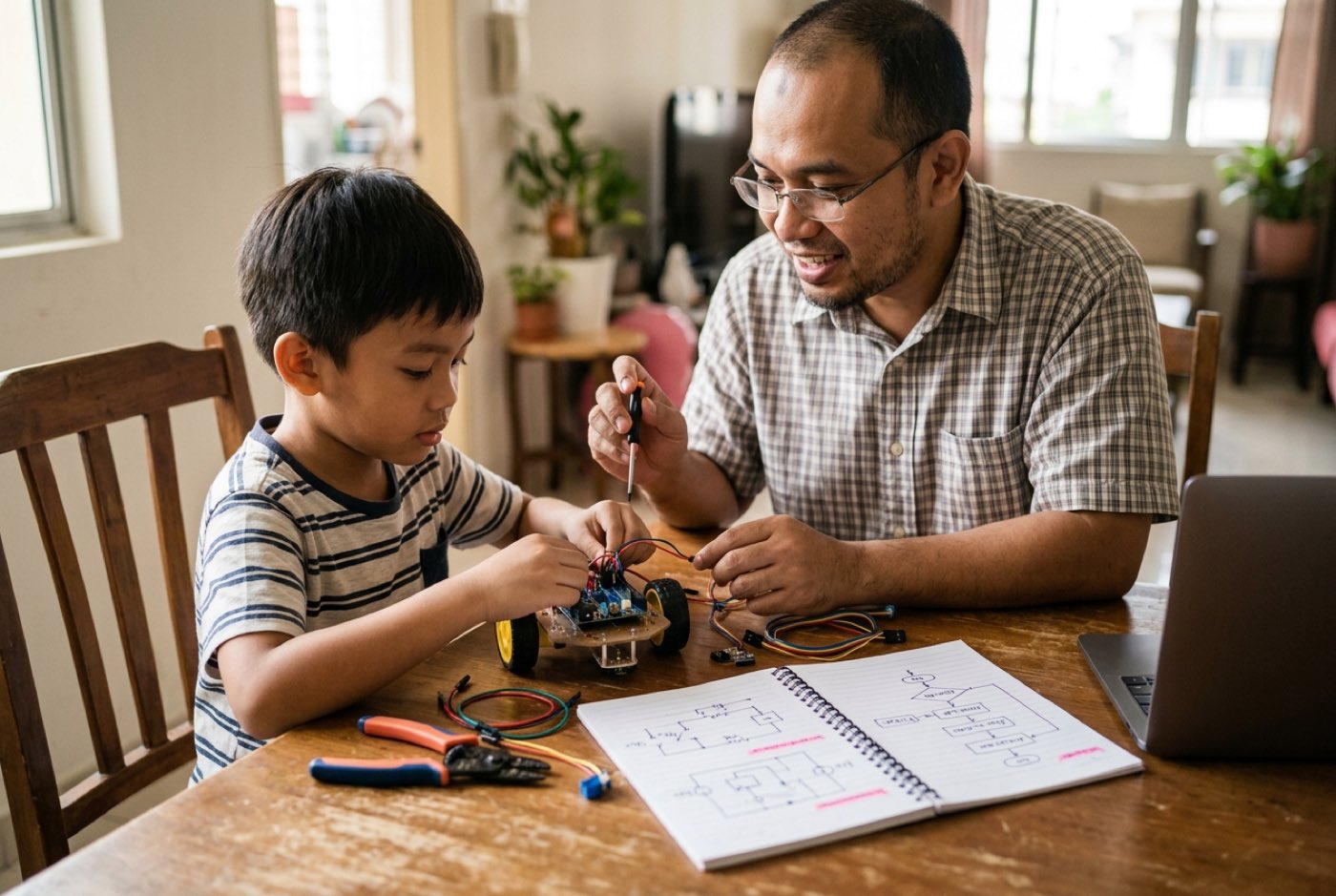
The Application Shortcut: Maths with a Purpose
Purpose does more for maths anxiety than any amount of extra practice. Traditional instruction hands over the abstraction first and promises the application later, sometimes years later. To a struggling student, that promise is worthless, and the abstraction feels arbitrary.
Flip the order. Put a project the child wants to finish in front of them, then introduce maths as the tool that finishes it.
Picture a 10-year-old asked to compute on a worksheet: a chore, with anxiety attached. Now picture the same child positioning a character in a game built in Python or Scratch:
- A sprite that jumps in a smooth arc needs quadratic curves: .
- Collision detection between two objects calls for the Pythagorean theorem:
- A health bar that drains sensibly needs percentages and ratios.
Once the maths stands between the child and a finished game, a working AI model, or a rendered 3D object, the argument about whether they "like" maths stops happening. They reach for the tool because they want the result. Our thinking on this is set out in more detail in maths behind game development for kids.
A 4-Week Home Plan with Weekly Scripts
Four weeks, no tuition workbooks, aimed at resetting how your child feels about maths before worrying about what they know.
Week 1: De-escalation and Neutralisation
- Goal: Remove emotional tension and stop homework battles.
- Action: Pause all extra non-school worksheets. Declare a "maths truce" at home.
- Parent Script: "We are doing things differently from now on. School maths is for school. At home, we are not going to fight over worksheets. If you get stuck on homework, we write down what part was confusing and leave it for the teacher, or we build it out together without stress."
Week 2: Physical and Visual Representation
- Goal: Shift from abstract symbols on paper to physical objects.
- Action: Use physical items (Lego bricks, kitchen measurements, scale drawings) for every word problem.
- Parent Script: "Don't try to solve this in your head or write equations yet. Let's draw this problem out on a large piece of paper or build it with blocks first."
Week 3: Project-Based Application
- Goal: Connect a mathematical concept to a digital or physical outcome.
- Action: Have the child create a simple digital project, such as customising a Roblox world, building a budget spreadsheet for a family outing, or writing a basic Python script. Explore how early math without worksheets works in practice.
- Parent Script: "We need to calculate the area of these floor tiles for your virtual house design. What formula does the building code require here?"
Week 4: The Teaching Flip
- Goal: Build intrinsic confidence through mastery.
- Action: The child becomes the instructor for 15 minutes once a week.
- Parent Script: "I forgot how slope and intercept coordinates work for this graph. Can you teach me how you plot those points so I can set up this design grid?"
Printable 4-Week Maths Confidence Weekly Planner
- Week 1 Checklist: Declared home maths truce and paused non-essential worksheets.
- Week 1 Checklist: Identified and recorded physical stress symptoms without punishment.
- Week 2 Checklist: Replaced abstract scratchpads with drawing paper or physical blocks.
- Week 2 Checklist: Validated effort on multi-step problems regardless of final score.
Designed, ready to print and sign. We email it to you together with a 5% discount on your next registration.
How to Talk to Your Child's School Teacher
Teachers here work to tight syllabus deadlines across KSSR and IGCSE frameworks, and they know it. Most will meet you halfway if you come with questions rather than complaints. Ask for a short meeting and keep it narrow.
What to Ask
- "Which specific mathematical concepts trigger hesitation in class?"
- "Does my child freeze during timed assessments specifically, or also during untimed group tasks?"
- "Can we adjust homework targets to focus on working out process steps rather than total question volume for the next three weeks?"
What to Avoid
- Do not blame the teacher or the school syllabus.
- Do not demand that your child be exempted from standard national assessments.
- Avoid comparing your child's progress to other students in the class.
Two Classroom Stories: 10-Year-Old and 15-Year-Old
Story 1: Jun Wei (Age 10, Petaling Jaya)
Initial State: Sunday nights ended in tears over Form 4-preparatory primary maths worksheets. His parents had him in two separate tuition centres in PJ. His homework pages were grey with erasing, and he said openly that he hated numbers.
The Shift: At Kidocode, Jun Wei started building games in Python. Moving a character across a grid meant learning Cartesian coordinates . Gravity and jumping meant algebraic variables. He wanted his character to clear a particular obstacle, and he spent two hours on velocity vectors to get it right, without ever labelling any of it as middle-school maths.
The Outcome: Three weeks in, the crying at home stopped. His working memory was no longer being spent on dread. When coordinate geometry turned up in his primary textbook, he recognised it as the movement code from his game. School results followed, though the change that mattered at home was the end of the nightly fight. More on this in math tuition compares to learning math by building.
Story 2: Sarah (Age 15, Penang)
Initial State: Sarah was failing IGCSE-level mathematics mocks. She studied for hours and still left half the paper blank, undone by test anxiety. Her parents were close to dropping additional mathematics.
The Shift: Sarah joined our AI and technology track at our Q2 Waterfront campus in Penang and began building a machine learning model to predict local weather patterns. Tuning it meant handling data matrices, probability distributions, and linear regression:
She worked alongside a personalised AI tutor that walked through the logic step by step without a hint of judgment, and the advanced concepts turned out to be within reach once they were laid out in order.
The Outcome: Mistakes stopped costing her anything, because the AI trainer let her make them privately. She passed her IGCSE mathematics exams comfortably and said afterwards that understanding the why behind the algorithms was what changed things. For teenagers at a similar crossroads, see our guide on secondary school math transitions.

How Kidocode Solves Maths Anxiety Without Tuition
Kidocode is not a tuition centre, and it is not a traditional coding school either. We are Malaysia's coding and AI school for kids aged 5 to 18, with five physical campuses in KL (Solaris Mont Kiara flagship, Sunway Nexis PJ) and Penang (Q2 Waterfront, Vantage Tanjung Tokong, Icon City), plus a live online programme.
The standards we teach to are the usual international ones (IGCSE, Cambridge, US Common Core). The delivery is not.
- AI School First: We train kids to direct AI models confidently, teaching digital literacy and technical safety together rather than one after the other.
- Maths Through Builds: Repetitive drill worksheets are replaced by project builds. Children learn mathematical principles because the game, the AI model, or the electronic prototype will not work without them.
- Personalised AI Tutor Per Child: Every student works with a dedicated AI engine (Cubie) alongside expert human trainers. The AI gives instant feedback at the child's own pace and never puts a mistake on public display.
- Coding Bundled Free: Coding itself is public knowledge now; what we actually teach is computational thinking. Coding tracks come bundled within our memberships.
Remove red pens, timed drills, and public comparison, and the anxiety generally recedes within 2 to 4 weeks. The child was fine all along. The method around them needed the upgrade. Read more about our approach with an AI math tutor for kids in Malaysia.
The easiest way to judge any of this is to watch it happen. Book a free trial class at your nearest campus or live online. In up to two hands-on hours, your child builds a real project using maths, AI, or tech concepts, then presents the working result to you.
Start with a free trial class. You can also look through our core offerings across Maths, AI, and Tech pillars, check the degree plans on our Pricing page, or drop by our Solaris Mont Kiara flagship campus.
Frequently Asked Questions
Is maths anxiety a recognized learning disability?
No. It is an emotional response rather than a cognitive or learning disability like dyscalculia. Dyscalculia involves underlying visual-spatial processing deficits; maths anxiety is a stress response that temporarily impairs working memory in otherwise neurotypical brains [4].
How long does it take for a child to recover from maths anxiety?
Once the delivery method moves from memorisation and speed drills to project-based application, the emotional stress usually drops within 2 to 4 weeks. Rebuilding full confidence on school exams takes longer, typically 2 to 3 months of consistent low-stakes practice.
Should I stop my child's existing math tuition immediately?
If the sessions reliably produce tears, stalling, or physical distress, pause them. Traditional drill-based tuition stacked on top of school work tends to deepen the anxiety rather than relieve it. Use that time for low-stakes building projects or constructivist learning until your child's emotional baseline settles.
Will learning maths through coding and AI help with school exam scores?
Usually yes, as a by-product. We do not teach to test papers and we do not promise specific grade jumps. What happens is that a child who has understood the logic through building handles school problems and high-order thinking (KBAT) questions more easily.
Can a child with mild autism or ADHD overcome maths anxiety using this approach?
Yes. Neurodivergent children often take the worst of traditional classroom instruction, between the sensory load and the rigid formatting. Project-based application with a personalised AI tutor lets them work visually and hands-on, at their own pace, without an audience.
References
- OECD. (2026). Malaysia: PISA 2025 Results and Country Profile. OECD GPS Education. https://gpseducation.oecd.org/CountryProfile?primaryCountry=MYS&treshold=5&topic=PI
- Yap, J. W., & Goh, V. W. Y. (2026). Mathematics anxiety and intrinsic motivation among secondary school students in Malaysia. Malaysian Journal of Learning and Instruction, 23(1), 84–117. https://files.eric.ed.gov/fulltext/EJ1513354.pdf
- Alias, Z., Jafar, M. F., & Kasim, M. (2024). Mathematics anxiety and attitude towards problem-solving skills among primary school pupils in Kedah. International Journal of Modern Education, 5(16), 12–28. https://gaexcellence.com/ijmoe/article/view/1797
- Centre for Neuroscience in Education. (2026). Exploring working memory, maths anxiety and dyscalculia. University of Cambridge. https://www.cne.psychol.cam.ac.uk/exploring-working-memory-maths-anxiety-and-dyscalculia
- Zhou, D., Zheng, B., Chen, Y., Yuan, S., Zhang, F., Qu, K., & Li, Y. (2026). Parental Mathematics Education Anxiety (PMEA) and children's mathematics achievement: An experimental and regression analysis. Behavioral Sciences, 16(1), Article 77. https://www.mdpi.com/2076-328X/16/1/77
- Wang, J. (2018). Kids benefit when parents overcome math anxiety. University of Chicago News reporting on Schaeffer et al. (2018). https://news.uchicago.edu/story/kids-benefit-when-parents-overcome-math-anxiety