


Plenty of Malaysian households have a version of the same evening: the workbook comes out, the parent explains a method, the child says the teacher does it another way, and twenty minutes later somebody is crying and somebody else is staring at the ceiling. If that sounds like your kitchen table, you are far from alone.
Most of the time the problem is not effort and it is not parenting. School maths tends to hand children the rules before showing them the job those rules were invented to do. Asked to follow procedures whose only apparent purpose is being marked, children dig in their heels. Give the same child a reason to use the same arithmetic (a game to finish, a budget to stretch, a recipe to triple) and the resistance usually drops away on its own. What follows are eight builds you can run at home with a child aged 7 to 12.
Key Takeaways for Busy Parents
| Challenge at Home | Why It Happens | The Real-Life Build Solution | Core Mathematical Skill |
|---|---|---|---|
| Child refuses to do fraction workbooks | Fractions feel like meaningless symbols on paper | Scale a festive cookie recipe for 20 guests | Ratios, fractions, multiplication |
| Tears over percentages and money problems | Word problems lack personal context | Create a pasar malam shopping budget spreadsheet | Percentages, decimals, unit economics |
| Struggling with negative numbers and graphs | Coordinate planes seem purely academic | Code a ball bounce mechanic in Scratch | XY coordinates, negative integers, logic |
| Mindless guessing on area and volume homework | Abstract formulas () lack physical form | Measure and scale a floor plan in Minecraft | Spatial reasoning, area, 3D volume |
| Frustration with averages and statistics | Calculating means feels like empty drills | Track and graph personal badminton or football stats | Data collection, averages, graphing |
| Fear of making mistakes during homework | High-stakes testing creates math anxiety | Run dice probability tests to design a fair board game | Probability, risk analysis, data tracking |
| Resistance to word problems (KBAT) | Long text masks the simple underlying arithmetic | Optimize a shopping mall route for errands | Speed, distance, time calculations |
| Over-reliance on homework answer keys | Passive memorization stops deep critical thinking | Use AI to generate math challenges and check its work | Error analysis, prompt evaluation, logic |
Table of Contents
- Why Homework Help Turns into a Fight (and Why You Are Not the Villain)
- Rule One: Give the Math a Job Before You Give It a Name
- Build 1: Pasar Malam Budget Spreadsheet
- Build 2: Festive Cookie Recipe Scaling
- Build 3: Scratch Game Ball Bounce Mechanic
- Build 4: Minecraft or Roblox Scale Model
- Build 5: Badminton or Football Performance Tracker
- Build 6: Dice and Card Board Game Probability Challenge
- Build 7: Shopping Mall Walking Route Optimiser
- Build 8: Ask an AI to Generate Custom Math Word Problems (and Spot Its Errors)
- How Traditional Worksheets Compare to Real-Life Builds
- How to Talk About Mistakes So Your Child Keeps Going
- From Kitchen-Table Math to Independent Building: How Kidocode Steps In
- Printable Home Math Build Checklist
- Frequently Asked Questions
- References
Why Homework Help Turns into a Fight (and Why You Are Not the Villain)
There is a reason these sessions sour so fast. Researchers at the University of Chicago found that when parents who carry their own mild unease about maths help with homework often, their children learn less maths over the school year and pick up more maths anxiety themselves [1].
Brain imaging adds detail to the picture. In maths-anxious children, the region that handles negative emotion runs hot while the regions doing the actual problem-solving quieten down [2]. Lean over a child's shoulder correcting each missed step and you are competing with that stress response for the working memory the calculation needs.
graph TD
    A[Worksheet Presented] --> B[Child Feels Pressure]
    B --> C[Emotional Brain Overactive]
    C --> D[Working Memory Closes Down]
    D --> E[Errors & Frustration Increase]
    E --> F[Parent Steps In to Correct]
    F --> B
Peer-reviewed work in Behavioral Sciences describes the same effect under the label Parental Mathematics Education Anxiety (PMEA), which predicts lower mathematical achievement in primary school children [3]. Closer to home, a study of 450 primary school pupils in Kedah found that maths anxiety directly impairs problem-solving [4].
The national picture makes the pressure worse. Analysis of the PISA 2022 dataset shows nearly 60% of Malaysian secondary students falling short of baseline mathematics proficiency [5], and Malaysia's mathematics score dropped 32 points between 2018 and 2022, an estimated 1.6 years of learning [6].
Read those numbers and the instinct is to buy another workbook. But extra drilling on an already anxious child mostly confirms what she suspects about herself. The delivery is what needs changing.
Rule One: Give the Math a Job Before You Give It a Name
Whether the syllabus is KSSR, IGCSE or Cambridge Primary, children usually meet the vocabulary first: fractions, Cartesian coordinates, percentages, mean averages. Formulas get memorised long before anyone explains what problem the formula was built to answer.
At home, flip that order. Give the math a job before you give it a name.
Work out how many blocks a Minecraft roof needs and you are calculating area. Tweak a game character's jump speed on screen and you are pushing values around an XY grid.
PISA 2022 data puts a figure on how much this thinking carries over: 40% of the variance in creative thinking performance among Malaysian 15-year-olds is explained by mathematical capability, with a correlation of between the two [7]. Mathematical thinking lives in weighing constraints and getting something to work. Even early frameworks build it this way. Ontario's Grade 1 spatial sense module has children compare length, mass and capacity by hand long before any formula appears [8].
Here are eight home builds for ages 7 to 12. Each ends with something your child can test, use, or show somebody.
Build 1: Pasar Malam Budget Spreadsheet
"15% off an RM 80 item" means nothing to a child who has never had RM 80 to lose. Hand her the family snack budget for one night at the pasar malam and percentages turn into decisions she actually cares about.

How to run this build
- Open Google Sheets or Microsoft Excel on a laptop or tablet with your child.
- Set a real or hypothetical spending limit (for example, RM 50 for family snacks).
- Have your child list five items they want to buy (such as chicken satay, bubble tea, apam balik, coconut water, and fries).
- Create columns for:
Item,Quantity,Price per Unit (RM),Subtotal (RM), andDiscount (%). - Introduce simple formulas. Show your child how multiplying quantity by unit price yields the subtotal.
- Apply a conditional rule: if the total exceeds RM 50, your child must decide whether to reduce quantities or apply a 10% cash discount negotiated on larger satay orders.
Mathematical concepts mastered
- Multi-step multiplication and addition.
- Converting percentages into decimals ().
- Budgeting constraints and financial logic.
Build 2: Festive Cookie Recipe Scaling
Hari Raya, Chinese New Year and Deepavali all come with baking, and baking comes with fractions whether anyone names them or not. Doubling or halving a cookie recipe is proportional reasoning with butter in it.
How to run this build
- Take a standard recipe card (for instance, a butter cookie recipe that yields 24 cookies).
- Tell your child that you need to bake exactly 60 cookies for visiting relatives.
- Ask your child to compute the scaling factor:
- Have your child recalculate every ingredient amount:
- cups of flour scaled by cups.
- of butter scaled by .
- Head into the kitchen and let your child weigh and measure the scaled ingredients precisely using digital kitchen scales and measuring cups.
With a younger child (ages 5 to 7), stay on plain measuring and attribute comparison rather than fractional scaling. Our guide on early math for 5 to 7 year olds without worksheets covers that age group in more detail.
Mathematical concepts mastered
- Equivalent fractions and improper fraction conversions.
- Scaling factors and ratio proportions.
- Real-world measurement units (grams, millilitres, cups).
Build 3: Scratch Game Ball Bounce Mechanic
On grid paper, the and axes are a chore. In Scratch, the visual programming environment built at MIT, they are the only way anything moves at all.
graph LR
    A[Screen Center: X=0, Y=0] --> B[Move Right: X increases]
    A --> C[Move Left: X decreases / negative]
    A --> D[Move Up: Y increases]
    A --> E[Move Down: Y decreases / negative]
How to run this build
- Open a free account at Scratch (scratch.mit.edu).
- Create a simple project featuring a paddle sprite and a ball sprite.
- Challenge your child to make the ball bounce off the paddle realistically.
- Show them how the ball's direction relies on basic degree angles and negative velocity values:
- Moving right means adding to ().
- Moving left means subtracting from ( or adding ).
- Bouncing off the top edge requires inverting the velocity ().
- Let your child adjust the speed numbers. They will immediately see that higher numbers increase velocity, while negative numbers reverse direction.
Watching a number change and a sprite respond is what makes negative values click. It is also the natural stepping stone from blocks to typed code, which we unpack in our comparison of Scratch vs Python for kids.
Mathematical concepts mastered
- 2D Cartesian coordinate systems ().
- Positive and negative integer operations.
- Angular reflection and basic physics logic.
Build 4: Minecraft or Roblox Scale Model
Your child already spends hours in Minecraft or Roblox. With one rule added, that time becomes a geometry workshop. Our article on how Minecraft coding turns kids into creators goes further into the shift.
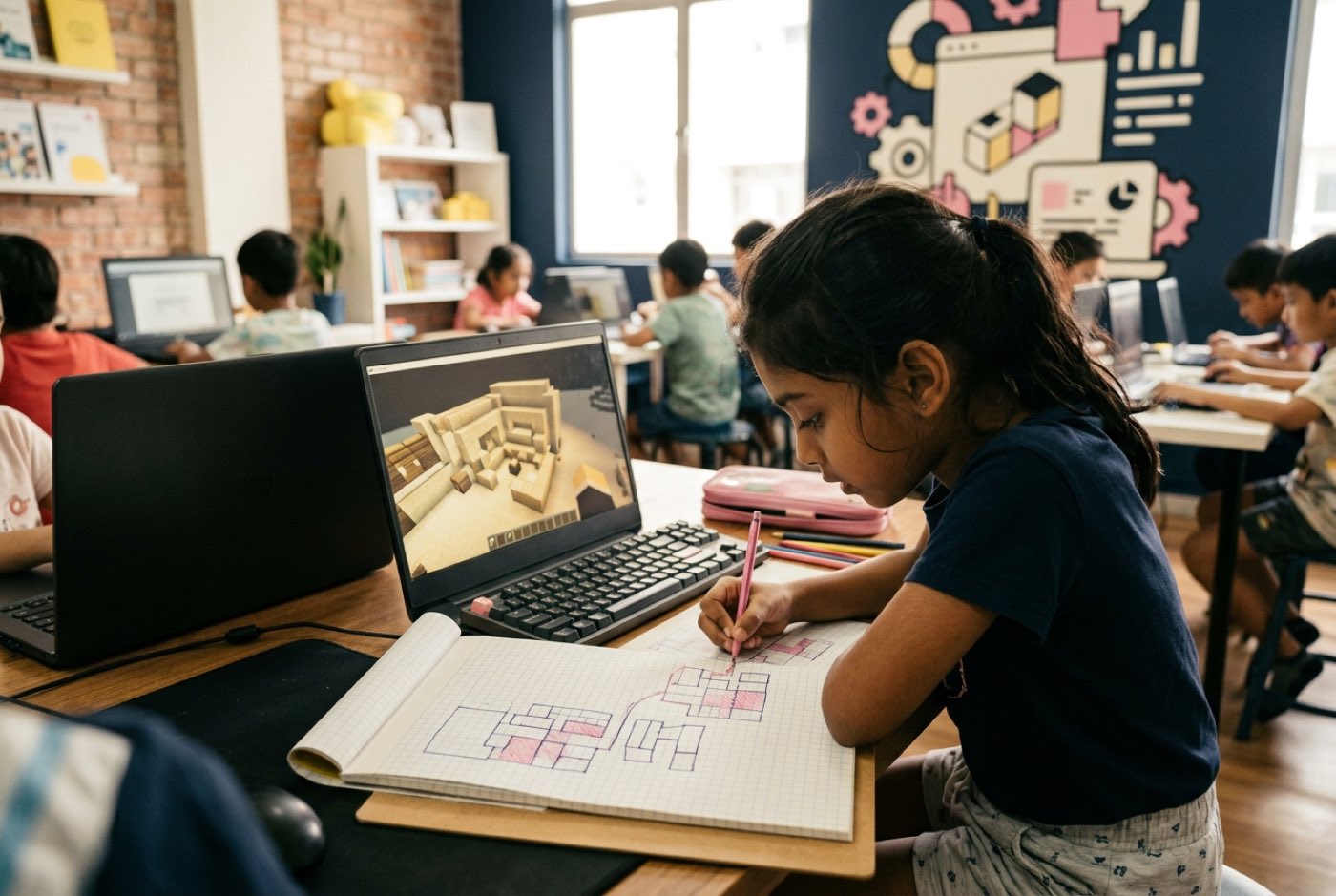
How to run this build
- Ask your child to pick a real structure, such as their bedroom, their school hall, or a local landmark like the PETRONAS Twin Towers.
- Establish a scale ratio before building starts: 1 block in Minecraft = 1 metre in real life.
- Have your child measure their physical room using a tape measure (for example: ).
- Ask them to calculate:
- Floor Area: ().
- Room Volume: ().
- Have them construct the floor plan inside Minecraft according to those precise dimensions.
Laying out a real room block by block shows the difference between area and volume far better than reciting . For more on using gaming platforms this way, see our piece on gamified learning in Roblox.
Mathematical concepts mastered
- Scale ratios and spatial proportions.
- Area calculation () vs Volume calculation ().
- Dimensional transformation (converting 2D measurements into 3D models).
Build 5: Badminton or Football Performance Tracker
Mean, median and mode are hard to care about when the numbers belong to an imaginary class of 30 pupils. Numbers your child generated on court are a different matter.
How to run this build
- Pick your child's favourite sport (such as badminton, football, basketball, or swimming).
- Over two weeks, have your child record data points after every game or practice session:
- Badminton: Number of successful serves vs unforced errors per game.
- Football: Number of shots taken vs shots on target.
- Create a clean paper chart or digital sheet.
- Have your child calculate their average performance across five sessions:
- Plot the results on a simple line graph. Ask your child to interpret the trend: Is your serve accuracy improving over time? What caused the sudden dip on Tuesday?
Mathematical concepts mastered
- Data collection and tallying methodologies.
- Calculating the arithmetic mean.
- Graph construction and trend line interpretation.
Build 6: Dice and Card Board Game Probability Challenge
Chance, outcome sets and risk stay slippery as long as they arrive only as textbook fractions. Designing a board game forces your child to bet on them.
How to run this build
- Take two standard six-sided dice, a deck of cards, and a sheet of poster paper.
- Ask your child to design a simple board game where players advance spaces based on the sum of rolling two dice.
- Before drawing the game spaces, ask your child to map out all possible outcomes from rolling two dice (from 2 to 12).
- Have them construct a simple frequency table:
| Sum of 2 Dice | Possible Combinations | Total Ways | Probability |
|---|---|---|---|
| 2 | (1,1) | 1 | |
| 7 | (1,6), (2,5), (3,4), (4,3), (5,2), (6,1) | 6 | |
| 12 | (6,6) | 1 |
- Have your child place "Trap Spaces" (where players must move backward) on the board's most likely outcome (7), while placing "Treasure Chests" on rare outcomes (2 and 12).
- Play the game together to test whether the mathematical probabilities hold true over 20 turns.
Mathematical concepts mastered
- Sample spaces and outcome combinations.
- Calculating theoretical probability vs experimental results.
- Ratio expressions and percentages.
Build 7: Shopping Mall Walking Route Optimiser
Malaysian families log serious hours in Mid Valley Megamall, Gurney Plaza and 1 Utama. Hand the weekend errand run to your child as a routing puzzle and the walk pays for itself.
How to run this build
- Before leaving home, give your child a list of 4 errands to complete at the shopping mall (such as buying a book, collecting laundry, picking up groceries, and ordering a drink).
- Download or look up the floor directory map of the mall.
- Challenge your child to calculate the shortest walking path between all four locations while keeping track of time.
- Provide estimates:
- Distance between shop A and shop B = 150 metres.
- Average walking speed = 50 metres per minute.
- Have your child calculate estimated walking times:
- Use a phone stopwatch at the mall to compare your child's calculated predictions against your actual walking times.
Mathematical concepts mastered
- The relationship between distance, speed, and time ().
- Spatial mapping and network graph optimisation.
- Estimating, measuring, and analyzing real-world variance.
Build 8: Ask an AI to Generate Custom Math Word Problems (and Spot Its Errors)
KBAT and HOTS questions in Malaysian primary exams trip up plenty of capable children, and usually the arithmetic is not the obstacle. The phrasing is. Our guide on helping kids with KBAT math word problems digs into that.
An AI tool such as ChatGPT, Claude or Google Gemini lets you move your child out of the answering seat and into the marking seat.
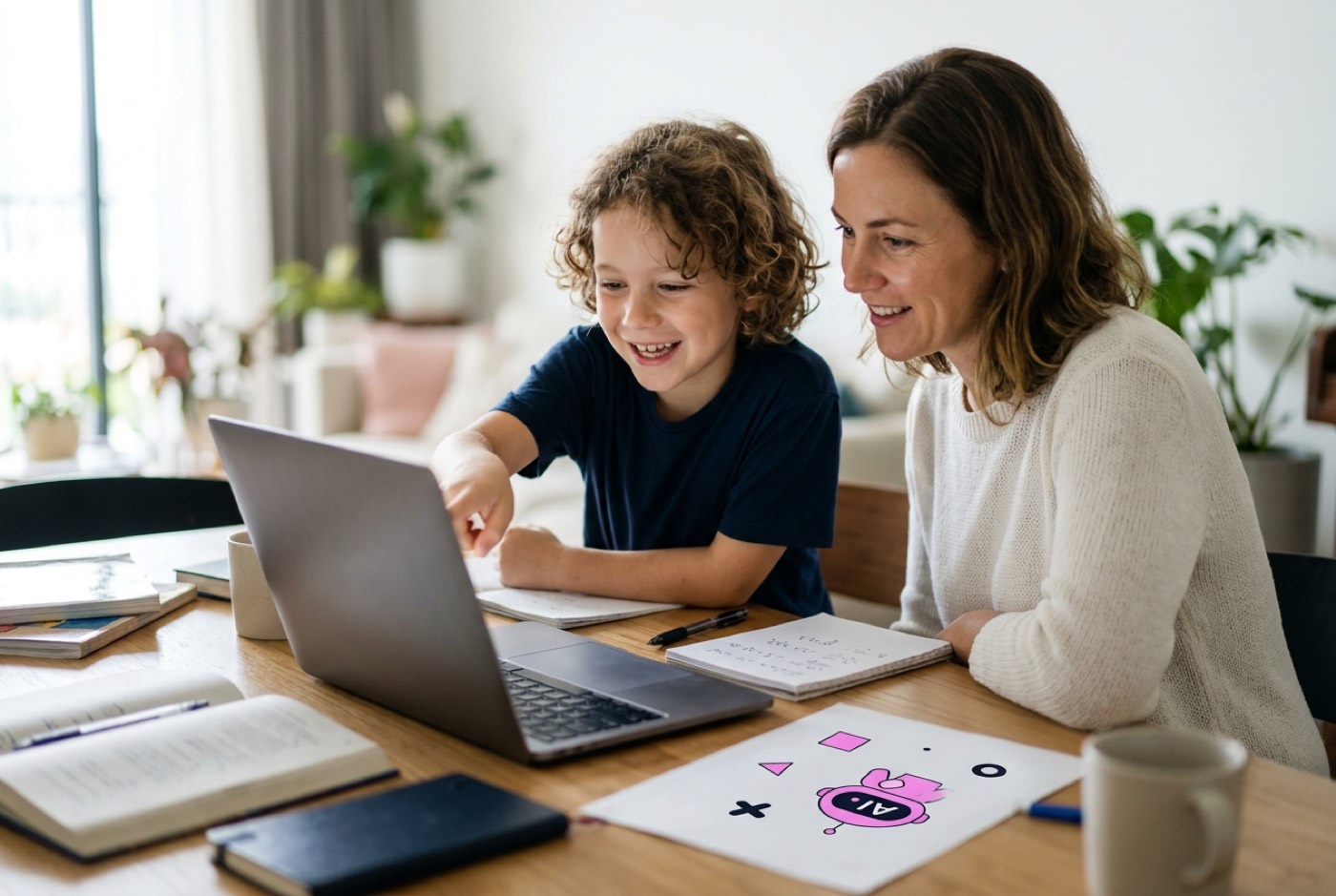
How to run this build
- Open an AI platform alongside your child.
- Enter a prompt tailored to your child's interests:
"Write 3 primary school math word problems involving Pokémon trading cards. Include multi-step addition, multiplication, and a 15% trade tax. Provide step-by-step solutions, but deliberately make ONE error in question 2."
- Have your child read the generated output, solve the problems on paper, and identify where the AI made its mistake.
- Once your child spots the error, have them type a correction back to the AI: "You made a mistake on step 2 because you multiplied before calculating the discount."
The dynamic changes completely. Nobody is testing your child; your child is auditing a machine. If you want a broader view on managing these tools at home, see our breakdown of what parents should do when kids use ChatGPT for homework.
Mathematical concepts mastered
- Critical error analysis and logical verification.
- Decoding complex word problems into distinct steps.
- AI prompt editing and evaluation, supporting broader AI literacy skills.
How Traditional Worksheets Compare to Real-Life Builds
| Metric | Traditional Drill Worksheets | Real-Life Math Builds |
|---|---|---|
| Primary Goal | Memorise procedures for high-stakes tests | Apply mathematical logic to solve real problems |
| Child Motivation | External compliance (avoiding bad grades or scolding) | Internal drive (building a game, model, or project) |
| Error Perception | Failure, resulting in lost marks and frustration | Debugging signal (a normal step in refining a build) |
| Parent Role | Supervisor and disciplinarian | Collaborator and client |
| Retention Rate | Short-term memorization reset after exam season | Long-term mental models tied to real applications |
| Skill Breadth | Isolated arithmetic drills | Math combined with coding, logic, and spatial reasoning |
How to Talk About Mistakes So Your Child Keeps Going
Nothing brings maths anxiety into a home project faster than an instant "No, that's wrong" or "How many times have I explained this?"
Software developers do not treat mistakes as character flaws. They call them bugs, and debugging is just the work of collecting enough information to fix one.
graph LR
    A[Build Outcome] --> B{Does It Work?}
    B -- Yes --> C[Celebrate & Expand Build]
    B -- No --> D[Identify the Bug]
    D --> E[Adjust Values or Logic]
    E --> A
Try these swaps during your build sessions:
- Instead of: "That's the wrong answer."
Say: "The game character just jumped off the screen. Let us check which coordinate number caused that." - Instead of: "You are not listening to the formula."
Say: "Our cookie dough is too wet. Let us check the scaled fraction for the flour again." - Instead of: "You need to work faster."
Say: "This is a complex problem. Let us break it down into two smaller steps."
Frame the error as something the system did rather than something the child is, and the defensiveness drops far enough for the thinking to restart.
From Kitchen-Table Math to Independent Building: How Kidocode Steps In
Home builds take the heat out of homework, but no working parent can invent a fresh project every evening. Sooner or later children need a structured place where mathematical thinking is attached to real technology.
That is what we do at Kidocode. The school was founded in 2014 in Solaris Mont Kiara by computer scientist Unclecode, creator of Crawl4AI, and has since worked with over 9,500 students aged 5 to 18 across Malaysia on real projects built from maths, artificial intelligence and software engineering.
Three pillars hold the programme together:
- AI School First: We teach children how to direct, evaluate, and build with artificial intelligence safely and effectively, shifting them from passive tech consumers to capable builders.
- Math Through Builds: We do not run a traditional tuition centre with repetitive drills. We cover standard mathematical concepts (aligned with international benchmarks like IGCSE, Cambridge, and Common Core), but deliver them in reverse: kids build games, electronics, and AI models first, discovering the necessary math along the way. Every child receives a personalized AI tutor tailored to their learning speed.
- Tech & Coding Bundled Free: Because basic syntax and coding knowledge are increasingly accessible, coding is bundled into our membership. What we focus on teaching is deep computational thinking.
The approach is the same whether your child attends in person at our Klang Valley campuses (Solaris Mont Kiara flagship, Sunway Nexis Kota Damansara), at our Penang campuses (Q2 Waterfront Bayan Lepas, Vantage Tanjung Tokong, Icon City Bukit Mertajam), or in our camera-on live online sessions. Our 4.6-star rating across 177 parent reviews comes largely from what happens in the first session, when a child who had written maths off starts building something that works.
If your child is stuck in a difficult transition year, read our analysis of why Malaysian kids fall off math between Standard 4 and Form 1. For how our model compares with conventional classes, see math tuition vs learning math by building.
Printable Home Math Build Checklist
Print this checklist or save it on your phone to track your child's progress across all eight real-life builds.
- Build 1: Pasar Malam Budget Spreadsheet
- Set a total budget cap (e.g. RM 50).
- Calculated subtotals using unit prices and quantities.
- Applied a percentage discount formula ().
- Build 2: Festive Cookie Recipe Scaling
- Identified original recipe yield and target yield.
Designed, ready to print and sign. We email it to you together with a 5% discount on your next registration.
Frequently Asked Questions
1. How do practical math builds help if my child still has to sit for written school exams?
Builds give your child the mental models that sit underneath the operations. Once she has used fractions to scale a recipe and coordinates to steer a sprite, an exam question stops reading like a riddle. She recognises the pattern inside the words, and accuracy improves without another round of drilling.
2. My child claims they are simply "not a math person." Can these builds really help?
Yes. There is no such thing as a maths person. Children usually reach that conclusion after enough timed drills and corrected workbooks, not after failing to understand anything in particular. Move the maths into a game, a budget or a recipe and the exam pressure disappears along with most of the refusal.
3. How much time should we spend on these math activities each week?
You do not need to add hours to the week. Swap one 30-minute workbook session for a build, such as baking together or setting up the budget sheet, and that is enough to start shifting how your child sees the subject. Consistency matters more than volume.
4. What if I am not confident in my own math skills?
None of these builds require a maths background. Telling your child you are working out the recipe scale or the Scratch script alongside her is an advantage, not a confession. It shows her that problem-solving runs on trial, error and testing rather than on already knowing.
5. How does Kidocode's math approach differ from standard tuition centers in Malaysia?
Tuition centres typically run on repeated worksheets and exam drills. We go the other way. Children learn mathematics by building software projects, game physics engines and AI models, with a personalised AI tutor that adapts to each student's pace, so the logic is acquired through making things rather than through repetition.
Experience Math Through Building at Kidocode
If you would rather your evenings involve building than battling, bring your child to a free hands-on trial session at Kidocode.
The trial runs up to 2 hours, and your child leaves having built a real project in AI, mathematics or tech with one of our trainers. Both parents are welcome to sit in and watch how quickly a child's attitude to maths can change with the right tools in front of her.
Sessions run at all five campuses (Mont Kiara, Sunway Nexis PJ, Bayan Lepas, Tanjung Tokong, Bukit Mertajam) and live online.
Book Your Free 2-Hour Hands-On Trial Class at Kidocode
References
-
University of Chicago News. Parents' math anxiety can undermine children's math achievement. Susie Allen. Published August 10, 2015.
https://news.uchicago.edu/story/parents-math-anxiety-can-undermine-childrens-math-achievement -
KQED MindShift. Homework Battles: When Parent Help Negatively Affects Students. Katrina Schwartz. Published August 20, 2015.
https://www.kqed.org/mindshift/41639/homework-battles-when-parent-help-negatively-affects-students -
MDPI Behavioral Sciences. Parental Mathematics Education Anxiety and Children's Mathematics Achievement. Dandan Zhou et al. Published January 6, 2026.
https://www.mdpi.com/2076-328X/16/1/77 -
Global Academic Excellence / IJMOE. Influence of Maths Anxiety and Attitude towards Mathematics on Primary School Pupils' Problem-Solving Skills in Kedah. Zulianis Alias, Mohd Fairuz Jafar, Marini Kasim. Published September 24, 2024.
https://gaexcellence.com/ijmoe/article/view/1797 -
ERIC / Mathematics Teaching Research Journal. Navigating Mathematics Education Challenges in Malaysia: Lessons from PISA 2022. Lim Yi Wei, Darmesah Gabda, Nicholas Pang Tze Ping, Ho Chong Mun. Published 2025.
https://eric.ed.gov/?id=EJ1481827 -
Institute of Strategic & International Studies (ISIS) Malaysia. Understanding Malaysia's Decline in PISA Scores. Sofea Azahar, Calvin Cheng. Published June 2024.
https://www.isis.org.my/wp-content/uploads/2024/07/Understanding-Malaysias-decline-in-PISA-scores.pdf -
OECD. PISA 2022 Results (Volume III): Creative Thinking Factsheet - Malaysia. Published June 18, 2024.
https://www.oecd.org/en/publications/pisa-results-2022-volume-iii-factsheets_041a90f1-en/malaysia_4aa2f8e4-en.html -
TVO Learn. Grade 1 Mathematics: Spatial Sense - Learning Activity 10: Attributes and Comparison. Published 2026.
https://tvolearn.com/pages/grade-1-mathematics-spatial-sense-learning-activity-10