

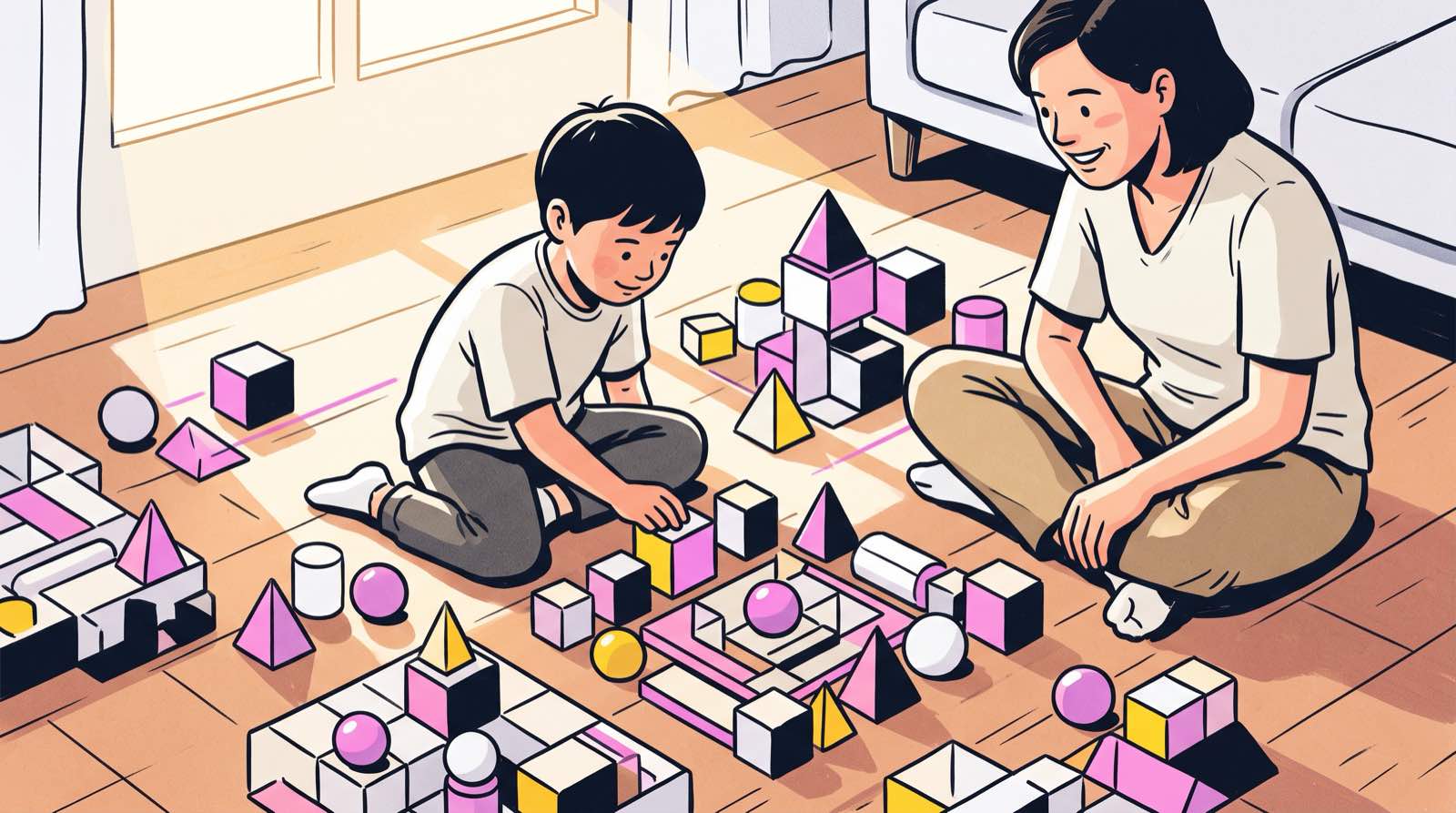
Parents come into our Mont Kiara and Penang centers with a five or six year old, and half the time the workbook comes out of the bag before anyone has sat down. Thick ones. Hundreds of addition drills, columns waiting to be filled, page after page of tracing. The parent is worried, and the worry usually sounds like one of two things: "She can count to a hundred but she can't hand me four apples," or "He cries every evening when I open the book."
My answer is the same in both cases. Your child is fine. The teaching was not.
Early mathematics in Malaysia gets flattened into three things: speed, neat handwriting, and mechanical counting. We have confused the syntax of math, which is writing symbols on paper, with the substance of math, which is understanding quantity, space, and pattern. Fifty drill problems a day does not build a mathematical mind in a five-year-old. It builds a slow, anxious human calculator, and it does so at the precise moment in history when calculators and AI have made mechanical computation worth almost nothing.
Math at this age is a way of seeing and structuring the world, not a stack of completed pages. Below I want to lay out what early math actually consists of, why drilling fails children this young, and what you can do at home and through computational projects long before your child sits for any formal exam.
Key Takeaways
| Concept | The Traditional Drill Approach | The Building & Play Approach |
|---|---|---|
| Core Focus | Writing symbols, speed, and paper drills | Quantity, spatial logic, and pattern recognition |
| Primary Tool | Worksheets and repetitive flashcards | Blocks, real-world objects, and visual logic builds |
| Screen Use | Passive counting videos or gamified drills | Directing logic, spatial coordinates, and visual scripts |
| Success Metric | Finishing 20 sum lines in 5 minutes | Building a physical structure or digital animation |
| Child Sentiment | Anxiety, frustration, and memorisation | Curiosity, spatial experimentation, and agency |
Table of Contents
- The Malaysian Preschool Trap: Worksheets Without Number Sense
- What Number Sense Really Means
- The Four Foundations That Matter Before Standard 1
- What the Four Foundations Look Like in Real Play
- Handwriting and Speed Are Not Math
- Screens at Age 5 to 7: Passive Apps vs Active Logic Builds
- Is It Too Early? My Answer to Parents of 5 to 7 Year Olds
- Red Flags at Ages 6 to 7 That Are Worth Acting on Now
- How We Teach Early Math at Kidocode
- A Gentle 4-Week Early Math Home Plan
- Printable Early Math Home Activity Checklist
- Frequently Asked Questions
- References
The Malaysian Preschool Trap: Worksheets Without Number Sense
On paper, Malaysia is in good shape. Preschools run under the National Preschool Standard Curriculum (KSPK), which sets structured time allocations for early mathematics [6], and the curriculum document explicitly calls for Developmentally Appropriate Practice (DAP) and Higher-Order Thinking Skills (KBAT) [7]. Walk into an actual classroom, or worse, a commercial enrichment center, and the picture changes.
An observational study of Malaysian public preschool classrooms found teachers leaning heavily on solitary paper-and-pencil worksheets during early mathematics sessions, even while those same teachers said they believed in play-based, concrete learning [1]. Their reasons were practical rather than ideological. With a standard allocation of only 40 minutes a week for math, worksheets were the fastest way to produce something written that could be shown to a parent or an administrator [1].
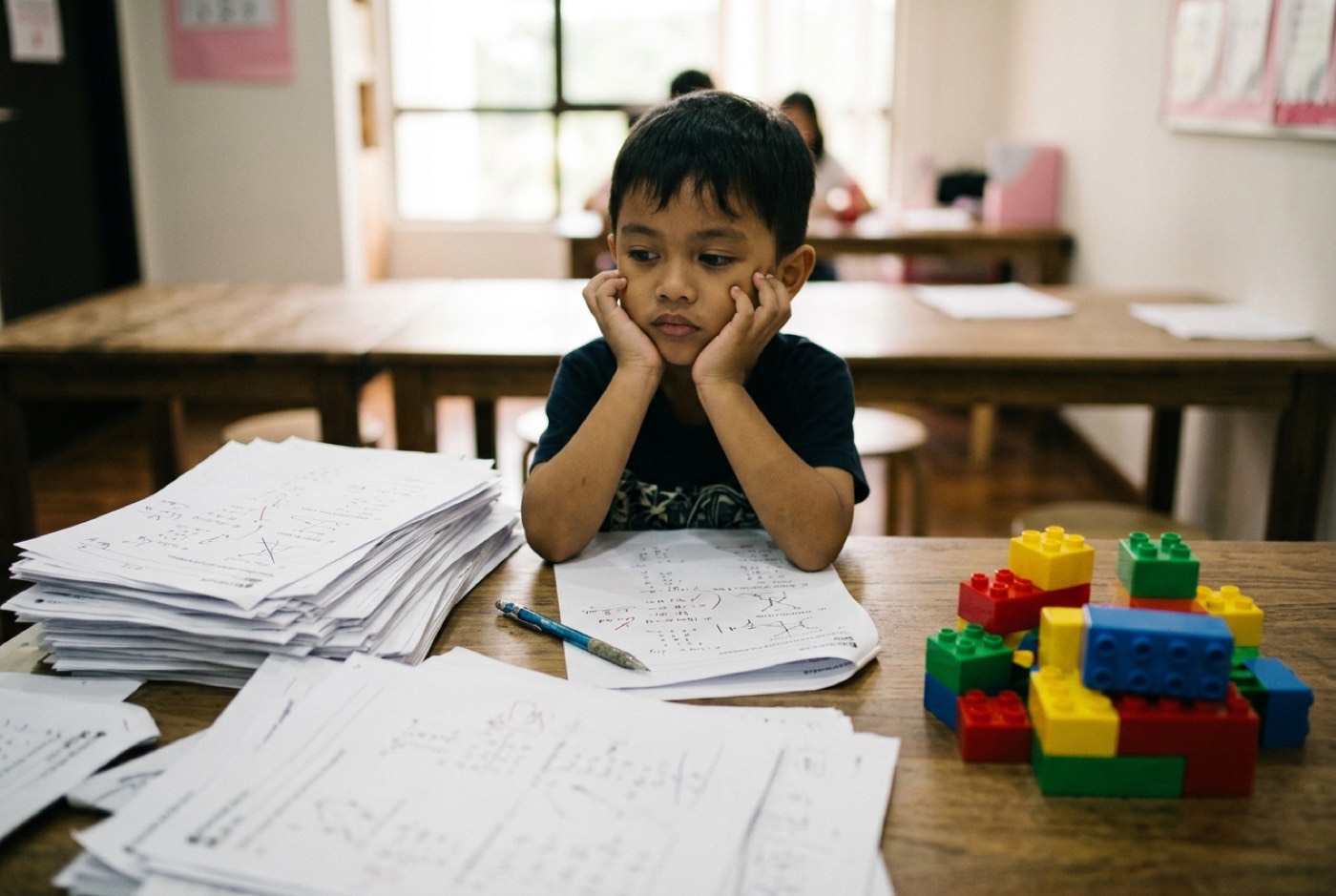
That written output is where the illusion starts. A child can fill in perfectly by memorising the shape of the sequence or copying the pattern from the whiteboard, then freeze completely when you ask her to split five blocks between two toy animals. The numbers on the page were never attached to anything. And the gap shows up in the aggregate data too: while some regional assessments report high mastery of basic counting, national figures show only 58% of Malaysian preschool children able to solve basic mathematical operations, against 78.5% reaching mastery in reading [1].
Home doesn't always compensate, either. Work published in MDPI's Education Sciences notes that parents tend to think of mathematics as formal school work, not as something already embedded in play, which leaves a large amount of informal learning on the table [3].
What Number Sense Really Means
Ask an early childhood researcher what predicts a child's later mathematical success and you will not get an answer about counting range. You will get an answer about number sense.
Researchers in the field estimate that 80% to 90% of fundamental math weaknesses in older students trace back to a shaky understanding of number and magnitude [5]. In the United States, nearly a quarter of fourth graders and 39% of eighth graders score below basic proficiency on national assessments [5]. Follow those students backwards through their schooling and the same story keeps appearing: procedures learned, quantities never understood.
Number sense is really a cluster of related abilities:
- Subitising: Seeing how many items are in a small group instantly, without counting them one at a time. Three dots on a die register as "three," not as "one, two, three."
- Magnitude Understanding: Knowing that 8 isn't merely the symbol that follows 7. It is twice as much as 4 and a great deal more than 2.
- Relational Thinking: Pulling numbers apart and putting them back together. Five can be 3 and 2, or 4 and 1, depending on what's useful.
- Spatial Alignment: Attaching quantities to distance, scale, and arrangement in space.
Worksheet-trained children treat numbers as static marks. Give a six-year-old who has only done paper drills the problem and watch what happens: fingers come out, and the count usually restarts from one. A child with number sense does something else entirely. She moves a single unit from the 6 across to the 7, gets , and is done. That kind of flexibility does not come from repeating sums on a page. It comes from having handled quantities enough times to know they can be pushed around.
The Four Foundations That Matter Before Standard 1
Your child does not need column addition before Standard 1. Long division certainly isn't on the list. What matters is four foundations, and when a child arrives in primary school with all four in place, school mathematics tends to feel obvious rather than threatening.
flowchart TD
    A[Early Math Foundations] --> B[1. Quantity Sense]
    A --> C[2. Pattern Recognition]
    A --> D[3. Spatial Reasoning]
    A --> E[4. Sequential Logic]

    B --> F[Subitising & Magnitude]
    C --> G[Symmetry & Prediction]
    D --> H[Coordinates & Orientation]
    E --> I[Step Sequences & Loops]
1. Quantity Sense (Beyond Counting Words)
This is the physical, gut-level sense of "how much." Plenty of five-year-olds can chant number names to fifty, and parents are understandably proud of it, but that is a song they have memorised. Quantity sense means knowing that "five" is a fixed amount whether it describes five elephants or five marbles.
2. Pattern Recognition
Mathematics is the study of patterns before it is anything else. A child who spots a pattern, extends it, and then invents her own is doing real mathematical analysis. Patterns come in several flavours: visual (red block, blue block, red block), auditory (clap, clap, stomp), and numerical (skip counting by twos or fives).
3. Spatial Reasoning
Spatial reasoning is the mental manipulation of shapes, positions, and distances in two and three dimensions. Early spatial skill correlates directly with later achievement in geometry, algebra, and computer science. When your child turns a block around in her hand to make it fit a gap, that is applied geometry, no matter how it looks.
4. Sequential Logic
Cause, effect, and order. "If I do A, what happens to B?" This is the point where early mathematics and computational thinking become the same subject. Long before a child can write out a word problem, she has to grasp that reordering the steps changes the result.
What the Four Foundations Look Like in Real Play
None of this requires special flashcards or an expensive workbook series. Your kitchen, your living room floor, and a box of blocks will outperform most of what is sold in bookshops.
Quantity in the Kitchen and Market
- Baking Ratios: Put your child in charge of measuring. "Two cups of flour makes one loaf. We want two loaves. How many cups?" That is multiplication and scaling, done functionally, with no sum written anywhere.
- Fruit Sorting at the Pasar: Have her pick four apples and two oranges. Then ask which bag holds more, and how many more apples there are than oranges. Magnitude comparison, with real weight in her hands.
Patterns in Building Blocks and Art
- Block Symmetry: Build one wall of a castle, then ask her to mirror it on the other side. Symmetry, distance measurement, and balance, all in one task.
- Rhythmic Patterns: Tap a bowl twice, clap once, repeat. Ask what comes next, then let her invent one for you to continue.
Spatial Reasoning with Construction and Maps
- Toy Car Parking Grids: Draw a 3x3 grid on paper. Place toy cars in specific cells and issue directions: "Park the red car one square above the blue car, and two squares to the right of the green car." She is using a coordinate system , which is exactly what she will meet later in geometry and graph plotting.
- Building Tower Constraints: Ten wooden blocks, tallest possible tower. The constraint forces her to experiment with base width, weight distribution, and what gravity does to a narrow stack.
Sequential Logic with ScratchJr and Unplugged Mazes
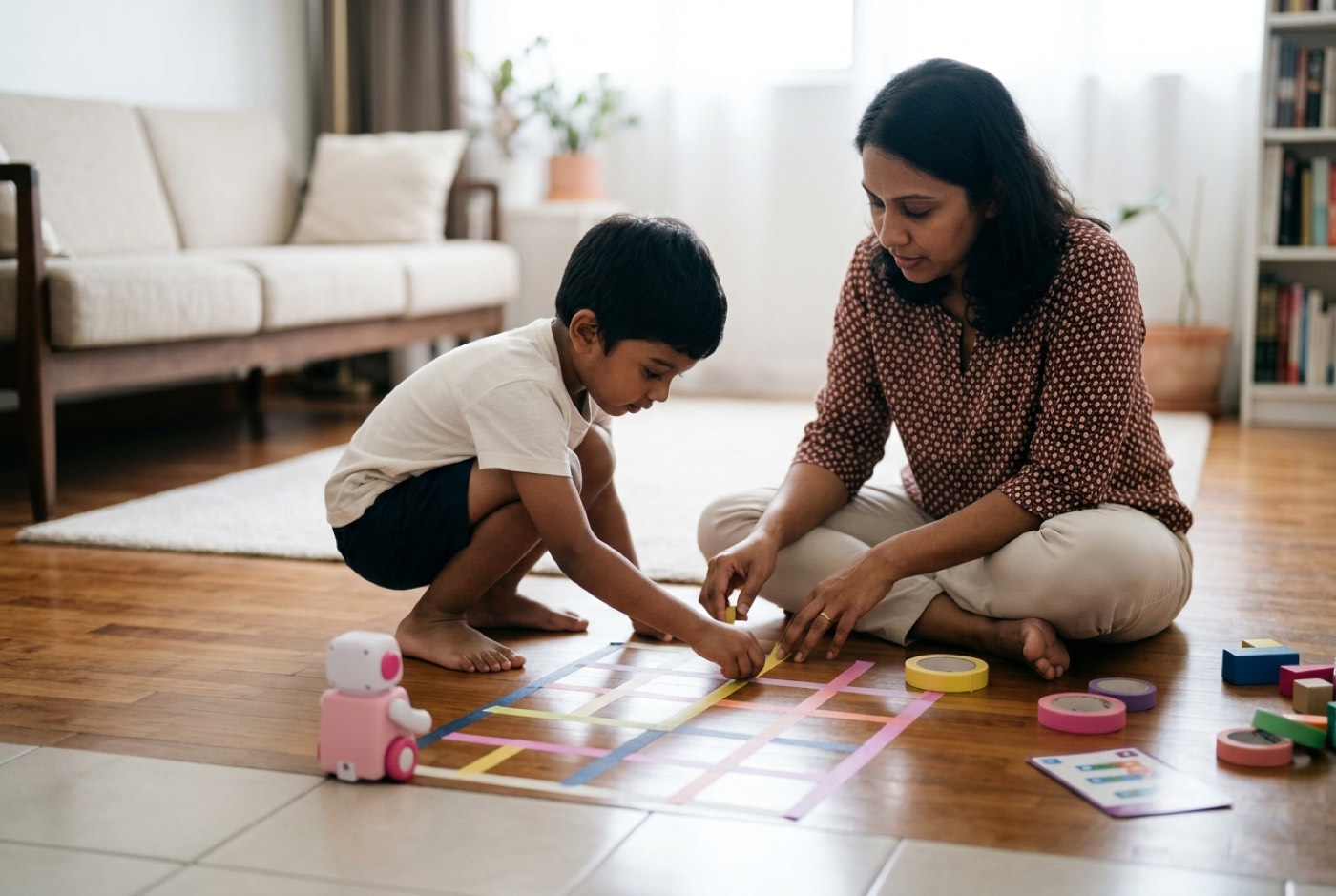
- Grid Navigation: Tape out grid squares on the living room floor. Hide a toy "treasure" in one square and ask your child to instruct you step by step: "Move forward 2 steps, turn left, move forward 1 step." Here is the important part. When she gives you a wrong instruction, don't correct her out loud. Take the wrong step. Let her watch you end up somewhere useless, and let her fix it. That is debugging.
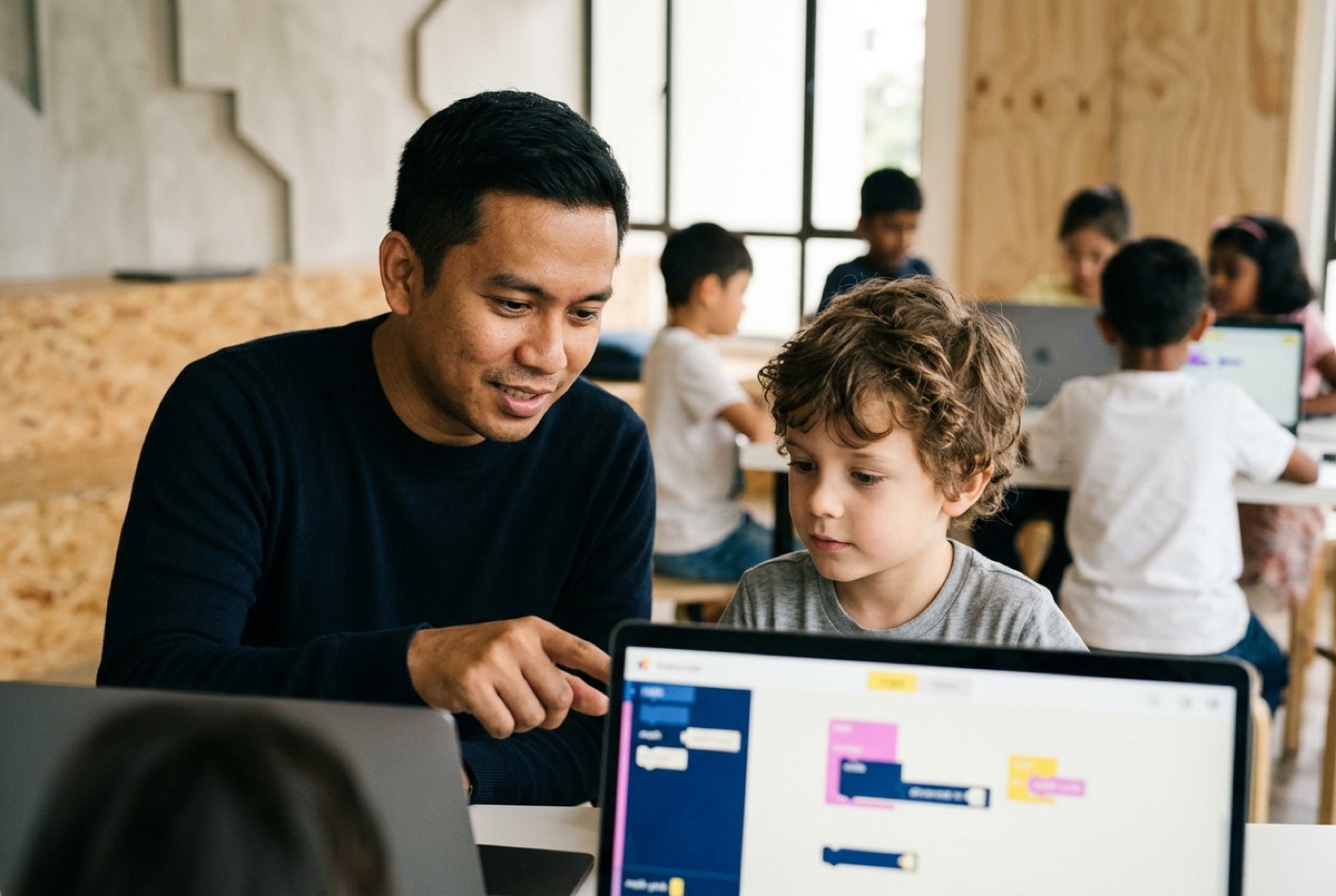
- Visual Scripting: In a visual block environment like ScratchJr, a five-year-old can snap together
When Green Flag Clicked -> Move Right 3 Steps -> Jumpand immediately see that the number in the block controls how far the character travels.
Handwriting and Speed Are Not Math
"My child is slow at math." I hear this constantly from parents of six-year-olds, and when I sit with the child, the diagnosis is almost always the same: he isn't slow at thinking. He's slow at writing.
A five or six year old's fine motor control is still under construction. Gripping the pencil, forming an 8 that doesn't collapse, keeping the digits inside those tiny grid boxes: all of it consumes attention that could have gone toward the actual problem. Judge that child's mathematics by how quickly he fills a worksheet and you have measured his motor control and his visual memory. You have not measured his logic.
Timed drills make it worse. Under the clock, a young brain shifts into a threat response. Adrenaline rises, working memory shrinks, and the child abandons exploratory thinking for whatever memorised scrap will get him through the next line. Math anxiety starts in exactly this place, and it can set in within weeks.
So in our sessions we deliberately separate conceptual work from writing speed. A five-year-old can handle spatial transformations, conditional loops, and quantity comparisons with physical manipulatives or graphical blocks long before his hand is ready to write a line of equations. If you want to know what your own child actually understands, take the pencil away. Ask him to show you with blocks, or move things around, or just explain it out loud. Most parents discover their child's mathematical understanding is running several months ahead of his handwriting.
For a closer comparison between learning math through building and conventional tuition or Kumon-style drilling, see our detailed piece on learning math by building vs math tuition and our structural analysis of Kumon and Abacus versus constructivist math builds.
Screens at Age 5 to 7: Passive Apps vs Active Logic Builds
Screen time comes up in nearly every parent conversation I have. Will the tablet make him passive? Will he get hooked?
Fair questions. But the word "screen" hides the distinction that actually matters, which is the one between passive screen consumption and active computational building.
flowchart LR
    SubGraph1[Passive Screen Use] --> A[Swiping Videos]
    SubGraph1 --> B[Gamified Flashcards]
    SubGraph1 --> C[Dopamine Rewards]

    SubGraph2[Active Logic Building] --> D[Spatial Navigation]
    SubGraph2 --> E[Parameter Adjustment]
    SubGraph2 --> F[Direct Logic Execution]
Most preschool "math apps" are worksheets in a costume. The child taps whether is 4, 5, or 6, and confetti explodes either way. Nothing in that loop trains mathematical intuition. What it trains is fast guessing in exchange for a reward animation.
Active screen use looks nothing like this. When a child directs objects through space, builds a game, or tunes a parameter and watches the result, the screen turns into a live mathematical canvas.
Put the two side by side:
- Passive App: The app shows and awards virtual coins for tapping .
- Active Logic Build: The child builds a scene where a character has to clear an obstacle. To get the jump high enough, she has to change the vertical velocity parameter from to .
In the second case, she is watching a numerical input produce a spatial result, adjusting, and watching again. That feedback loop is where applied physics, geometry, and computer science all begin.
For more on how engagement changes when children become creators instead of consumers, see our guide on how screen time transforms into coding time and our breakdown of computational thinking for young minds.
Is It Too Early? My Answer to Parents of 5 to 7 Year Olds
Is five too early for structured mathematical thinking, coding, or AI concepts? I've given the same answer for years:
"The moment your child can play a game on a mobile screen is the moment they should learn to build the game as well. So it is not too early; it depends entirely on the teaching approach."
If "teaching math" means parking a five-year-old at a desk for an hour of paper drills, then yes, five is far too early. Honestly, that approach is wrong at any age. But if it means an environment where the child uses spatial logic, quantity manipulation, and step-by-step instructions to build something physical or digital, then five is close to ideal.
Children between five and seven don't yet separate play from learning. That division is something adults impose later. Introduce spatial math and logic as tools for making things, before that split hardens, and the concepts go in almost without friction.
If you're thinking about how early exposure shapes the years that follow, read our guide on why early age exposure matters and our parental guide on benchmarking your child's math progress across primary school.
Red Flags at Ages 6 to 7 That Are Worth Acting on Now
Avoiding rigid drills is not the same as ignoring warning signs. Certain behaviours signal that a child is building a misunderstanding about what mathematics is, and it is far easier to change course now than after math-hate has set in.
| Observed Behavior | What It Usually Means | How to Address It |
|---|---|---|
| Complete dependence on verbal counting for small sets | Lacks subitising skills; views numbers solely as a sequence of words rather than distinct quantities. | Use dot cards, dominoes, and physical block groups. Practice visual recognition of sets up to 5 without counting one by one. |
| Extreme anxiety when seeing written numbers | Early over-drilling or pencil-control frustration has associated math with failure or pressure. | Put away all pencils and worksheets. Shift entirely to physical building, verbal challenges, and interactive visual scripts for 4 weeks. |
| Inability to transfer math to real objects | The child has memorized paper procedures without connecting them to physical reality. | Use kitchen ingredients, toy cars, and physical blocks to represent every sum. Ask the child to "show" you the problem physically. |
| Blind guessing on word problems | The child looks for number keywords ("altogether", "left") and guesses an operation without mental visualization. | Stop asking for immediate answers. Ask the child to draw or build a physical model of the story first before doing any calculation. |
| Difficulty predicting simple spatial patterns | Weak spatial visualization skills, which will impact future geometry and problem-solving. | Spend time on 3D construction blocks, tangrams, visual puzzle rotation, and spatial coordinate navigation games. |
If word problems in school are already a battleground, we've written a dedicated breakdown on helping kids who struggle with math word problems and KBAT questions.
How We Teach Early Math at Kidocode
Kidocode is not a tuition center and not a homework club. We teach mathematics through a three-pillar framework: AI to survive, Math to think, and Tech to build.
A five, six, or seven year old who joins us doesn't sit in a row facing a whiteboard with a workbook open. She walks into a studio where math is the engine that makes her idea work.
Four things define how we run early mathematics:
- Same Syllabus, Opposite Delivery: We cover international mathematical standards, including IGCSE, Cambridge, Common Core, and KSPK foundations. Nothing your child needs is skipped. The order is reversed, though. Instead of handing over an abstract formula followed by 20 drill problems, we hand over a construction challenge or a software project that simply won't function without that concept.
- Personalized AI Tutors: Each child works alongside an AI tutor built for young learners, and it moves at the child's pace rather than the class's. When a six-year-old gets stuck on spatial coordinates, the tutor withholds the answer. It offers a visual hint, narrows the parameter space, and pushes her back toward debugging her own model.
- Coding Bundled Free: Coding isn't an expensive add-on here; it comes with the membership, because code is applied computational thinking and mathematics. Syntax is public knowledge now, freely available to anyone with a browser. What we teach is structured logic, problem-solving, and spatial reasoning.
- Project-First Achievement: Every session ends with something that exists. Not a marked worksheet, but an interactive digital story, a programmed robot movement, a block structure that stands up. The child leaves with evidence that math builds things.
The pattern I've watched repeat for years: the math-hate stops within two to four weeks, once a child works out that math isn't a paper test but a superpower.
To see how the pillar model plays out across age groups, read our overview on how we teach, and our reasoning behind why coding is bundled free.
A Gentle 4-Week Early Math Home Plan
If you want to pull your child out of worksheet fatigue and rebuild real mathematical intuition at home, here's a four-week plan you can begin this evening.
Week 1: Master Subitising and Quantity
- Goal: Eliminate finger counting for quantities up to 5.
- Activity: Take a deck of playing cards with the face cards removed, or a set of dot dominoes. Flash one for two seconds, cover it, then ask how many dots she saw.
- Kitchen Integration: While you cook, ask her to hand you specific quantities of vegetables without counting them out one by one.
Week 2: Spatial Coordinates and Geometry
- Goal: Understand two-dimensional relative position .
- Activity: Tape a grid onto the floor or a table. Put small toys inside the boxes and practise commands: "Move 2 steps forward (up ), 1 step right (across )."
- Physical Build: Craft sticks, three shapes: triangle, square, rectangle. Then count the corners (vertices) and the edges together.
Week 3: Patterns and Skip Counting Ratios
- Goal: See numbers as repeating structures and equal groups.
- Activity: Build repeating sequences with coloured lego blocks (AAB, ABB, ABC) and have her carry each one further.
- Physical Movement: Skip count by 2s and 5s while jumping along a play mat or climbing stairs, one number per leap.
Week 4: First Computational Script
- Goal: Connect numerical input to visible logical actions.
- Activity: Open ScratchJr, which is free. Show her that changing a number block from 2 to 6 sends her character three times as far across the screen.
- Debugging Challenge: Slip a wrong number block into a simple movement script on purpose. Then ask: "The cat was supposed to reach the house, but it stopped short. Which number needs to change?"
For more on how early computational projects build lasting confidence, see our guide on what kids learn in a modern coding and AI class.
Printable Early Math Home Activity Checklist
Print this, stick it on the fridge, and track four weeks of play-based mathematics without opening a single workbook.
- Week 1: Subitising & Quantity
- Flash dot cards (1-5) for 2 seconds and identify quantities without counting one-by-one.
- Divide 10 small snacks equally between two plates, discussing fair sharing.
- Play a dice board game, encouraging instant recognition of dice patterns.
- Week 2: Spatial Reasoning & Coordinates
- Build a floor grid and navigate a toy using step-by-step direction commands.
Designed, ready to print and sign. We email it to you together with a 5% discount on your next registration.
Frequently Asked Questions
Should I completely stop giving my 6-year-old math worksheets?
If they're producing tears, stress, or a fight every evening, stop today. Worksheets at five to seven measure handwriting and memorisation, not mathematical intuition. A few weeks of blocks, spatial games, and interactive projects will do more for your child's long-term academic confidence than several hundred more paper drills, and you can always return to written work once the relationship with math is repaired.
My child's kindergarten teacher gives daily math homework. How should I handle this?
Do the homework, but don't let it cost you your child's goodwill. If sums need writing, solve the problem first with blocks or objects on the table. Once he understands what's happening, either scribe for him or cap the writing at 10 to 15 minutes. It's also worth telling the teacher what you're doing at home; most are glad to hear a parent is working on concrete understanding.
How does learning math through building help with school exams later on?
Malaysian KSSR and SPM papers, along with international curricula like IGCSE, have moved substantially toward Higher-Order Thinking Skills (KBAT) and application questions. Students who only memorised procedures stall on these, because an unfamiliar context gives them nothing to picture. A child who spent early years building spatial projects and computational models has the underlying logic available, so a novel word problem is just another situation to model.
Is coding necessary for a 5 or 6 year old to learn math?
Not necessary. But it's one of the best visualisation tools we have. In visual block coding, coordinates , variables, conditional logic, and scale stop being abstractions and become things that happen on screen the moment the child changes a number. She can see it, test it, and control it, which is a lot to ask of a worksheet.
How do I know if my child is ready for Kidocode's early math and tech sessions?
If she can follow a basic multi-step spoken instruction and handle a tablet screen or a set of blocks, she's ready. No prior reading, writing, or math proficiency required. Trial sessions let you and your child see the project-first approach for yourselves. You can book a free hands-on trial class at any of our campuses in Solaris Mont Kiara, Sunway Nexis, Penang (Q2 Waterfront, Vantage Tanjung Tokong, Icon City), or in our live online classroom at Kidocode Trial Class Booking.
References
- Siew, S. K., & Tee, Y. Q. (2024). Perspectives of Early Mathematics Implementation among Malaysian Public Preschool Teachers: Issues, Challenges, and Way Forward. International Journal of Academic Research in Progressive Education and Development. https://www.researchgate.net/publication/379902273_Perspectives_of_Early_Mathematics_Implementation_among_Malaysian_Public_Preschool_Teachers_Issues_Challenges_and_Way_Forward
- Abdurahman, M. S., Suhaimi, U. S., Syahrizal, F. Z., & Harun, N. H. (2025). Penguasaan Literasi dan Numerasi Kanak-Kanak Prasekolah di Hulu Selangor. Jurnal Pemikir Pendidikan, 13(1), 277-293. https://jurcon.ums.edu.my/ojums/index.php/jurnal-pemikir-pendidikan/article/download/6966/4276/26746
- Panaoura, A. (2026). Play-Based Mathematical Learning in Early Childhood: An Ecological Framework for Parental Mediation and Guided Exploration. Education Sciences, 16(5), 775. https://www.mdpi.com/2227-7102/16/5/775
- Heubeck, E., & Vilcarino, J. (2026). Does Pre-K Give Kids a Lasting Edge? Here's What the Latest Study Says. Education Week. https://www.edweek.org/teaching-learning/does-pre-k-give-kids-a-lasting-edge-heres-what-the-latest-study-says/2026/08
- Korbey, H. (2025). The Building Blocks of Math Students Need to Excel. The Hechinger Report. https://hechingerreport.org/the-building-blocks-of-math-students-need-to-excel/
- Ministry of Education Malaysia. (2016). Dokumen Standard Kurikulum dan Pentaksiran (DSKP) Kurikulum Standard Prasekolah Kebangsaan (KSPK). Bahagian Pembangunan Kurikulum KPM. https://anyflip.com/kuvcg/pinj/basic
- Ministry of Education Malaysia. (2016). Dokumen Standard Kurikulum dan Pentaksiran Pendidikan Prasekolah 2016. KPM. https://id.scribd.com/document/375965857/Dokumen-Standard-Kurikulum-dan-Pentaksiran-Pendidikan-Prasekolah-2016