

Parents sit down with me at our Mont Kiara flagship or at one of our Penang campuses, and sooner or later the same question surfaces. Usually it comes out sideways, after we've talked about schedules and fees: "My child is studying hard, but by the time they finish university in 2035, will the jobs even be there?"
I never treat that as an irrational worry, because it isn't one. Parents read the headlines. AI writes code, drafts legal briefs, runs administrative workflows. It's fair to wonder whether the standard academic track in Malaysia is preparing children or quietly leaving them exposed.
Here's my honest answer. AI will wipe out millions of entry-level tasks. It will not wipe out human capability. The real split in the 2035 workforce won't run between humans and machines at all. It will run between adults who simply consume whatever AI hands them and adults who direct AI systems to solve problems worth solving.
So let's look at the economic picture Malaysian students are walking into, which capabilities actually hold their value, and what you can do at each age to move your child from passive tech consumer to builder.
Key Takeaways: What Parents Need to Know About AI and Future Careers
| Concept | Traditional View | AI-Era Reality |
|---|---|---|
| Job Threat | AI replaces entire professions overnight. | AI unbundles entry-level tasks and deskills routine cognitive roles. |
| Coding Value | Learning syntax and memorising code guarantees job security. | Syntax is automated; computational thinking and architecture become the true assets. |
| Math Education | Rote worksheet drills prepare kids for technical careers. | Worksheets cause math-hate; applying math inside interactive builds creates deep fluency. |
| Career Strategy | Pick a stable fixed job title for the next 30 years. | Build durable capabilities that amplify human judgement across shifting industries. |
| AI Tooling | Ban or restrict AI to prevent academic cheating. | Teach structured AI direction, safety guidelines, and system design early. |
Table of Contents
- What Is Actually Happening to Entry-Level Work in Malaysia?
- Exposure vs Displacement: Why 'AI Does Everything' Is the Wrong Conclusion
- The Four Durable Capabilities AI Cannot Replicate
- Careers That Expand (Not Shrink) When a Child Is AI-Fluent
- The Trap to Avoid: Chasing Today's Short-Term Software Tools
- Age-by-Age Action Plan: From Primary School to Pre-University (Ages 5–18)
- How to Talk to Your Teen About AI and Career Anxiety Without Panic
- How We Train AI Fluency at Kidocode: The Build-First Model
- Decision Framework: Evaluating Your Child's Preparedness Today
- Frequently Asked Questions
- References
What Is Actually Happening to Entry-Level Work in Malaysia?
Before we talk about what to do, let's look at what the data says rather than what the headlines say. Malaysian work has been restructuring itself for a century, moving from an economy dominated by agriculture in the 1920s to today's services and manufacturing base [1] [2].
The Khazanah Research Institute found that 80% of Malaysia's workforce now sits in services and manufacturing, and that 90% of middle-skilled jobs are held by Malaysian citizens [2]. What's changed recently is the target of automation. It used to be manual routine. Now it's cognitive routine.
Parliamentary reporting from Malaysia's Ministry of Human Resources (KESUMA) put the number of jobs affected by automation and technological shifts at roughly 300,000 between 2020 and late 2024 [4]. A joint analysis by the World Bank and ISIS Malaysia went further, finding that about 45% of Malaysian workers hold roles with medium to high exposure to generative AI, with that exposure clustered among clerical, urban, and younger workers [7]. Younger workers. That's the part parents feel in their stomach.
timeline
    title Shift in Malaysian Workplace Tasks
    1920s : Manual Agriculture : Physical Harvesting
    1980s : Factory Automation : Assembly & Production
    2010s : Office Computerisation : Basic Data Entry
    2026+ : AI System Integration : Automated Content & Code
The services sector employs around 10 million Malaysians and produces 60% of national GDP, so the modelling there matters most [4]. Scenario work from the ISEAS – Yusof Ishak Institute puts 320,000 service-sector jobs under potential restructuring from generative AI deployment, rising to as many as 680,000 once you assume advanced multi-step agentic AI [4].
Translate that for a teenager graduating in a few years and it comes down to one thing: the stepping stones are being removed. The junior developer used to write boilerplate. The junior accountant formatted spreadsheets. The junior marketer drafted routine social copy. Those were the tasks that bought a fresh graduate two or three years to learn the trade, and an AI assistant now finishes them before you've made coffee.
A graduate who can only do routine cognitive work is competing against a tool that never sleeps and costs almost nothing. A graduate who can design, prompt, evaluate, and stitch together AI tools into finished projects is doing something else entirely, and their output multiplies.
Exposure vs Displacement: Why 'AI Does Everything' Is the Wrong Conclusion
Read "45% of jobs are exposed to AI" quickly and you'll conclude half the country is about to be unemployed. The World Bank said so plainly in its own analysis of the Malaysian labour market: exposure is not displacement [7].
Exposure means a job contains tasks that AI can assist with or automate. Whether that ends in job loss or a career jump depends on the human doing the work and on how the workplace is redesigned around them [7].
There's a Harvard field experiment worth knowing about here, run on knowledge workers completing real professional tasks [4]. The workers who folded AI into their workflow outperformed non-users by more than 30% inside the core operational domains [4]. But the study also mapped the edge of that benefit. Push AI beyond the scope where it's actually valid, trust it blindly, and output quality drops off sharply [4]. Knowing where that edge sits is a human skill, and it's teachable.
 Which gives us two very different working lives:
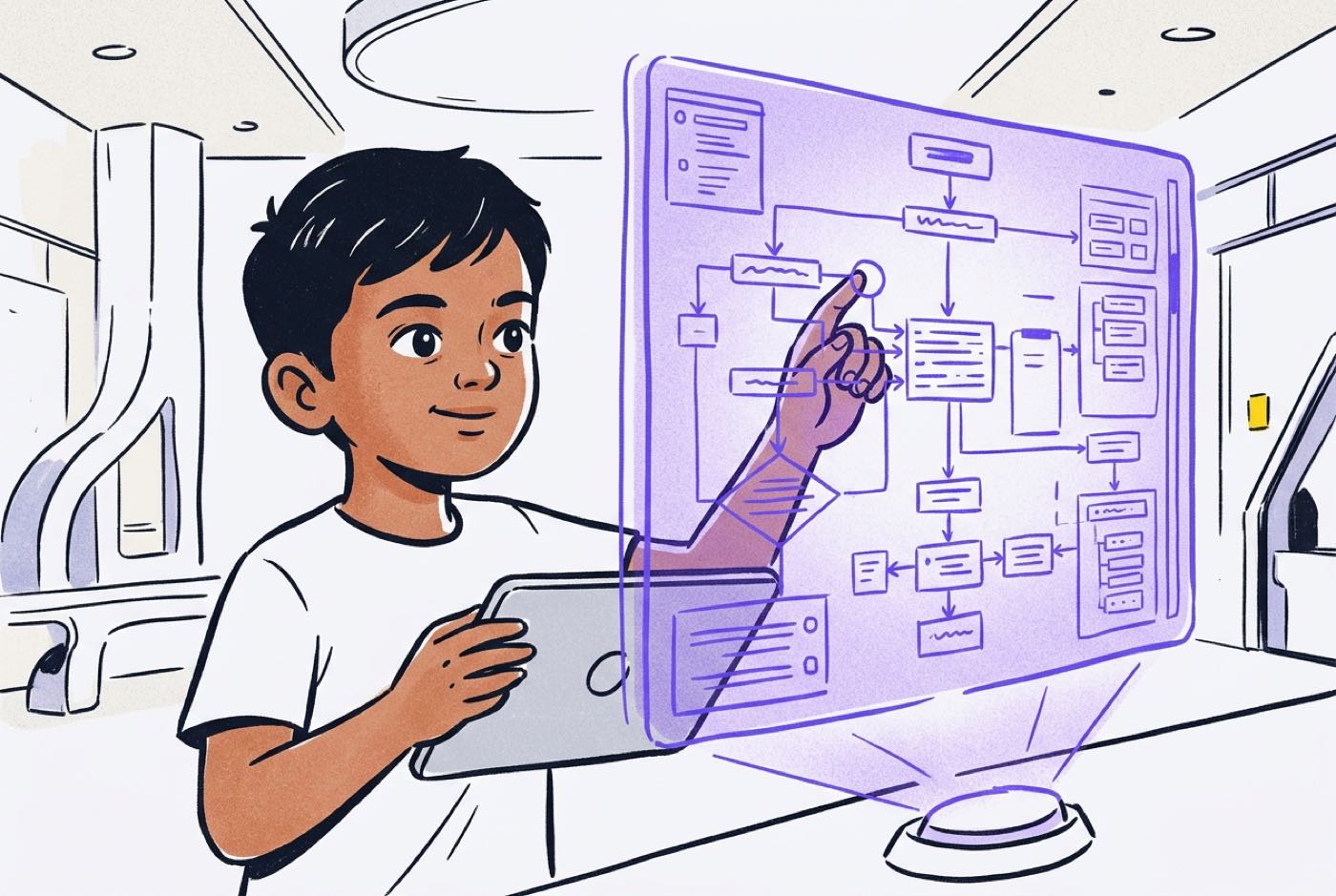
- The directed worker: follows static instructions, performs the keystrokes, lets the AI make the calls. These roles are where wage pressure lands first, and where the eliminations happen.
- The system director: understands computational logic, knows how to frame a problem, brings domain context, and verifies what comes back. The AI is a fast engine; architecture, ethics, and quality stay in human hands.
Kuala Lumpur, Penang, Singapore, London, it doesn't matter where our children end up working. The second column is the one to aim for.
The Four Durable Capabilities AI Cannot Replicate
The Khazanah Research Institute's automation analysis found the strongest technical resistance in roles requiring complex physical manipulation, original creativity, and deep social intelligence [2].
Turned into something you can actually teach a nine-year-old, that becomes four capabilities.
1. Computational Thinking
Computational thinking has nothing to do with memorising Python or C++ syntax. It's the ability to take a messy problem, break it into ordered logical steps, spot the algorithmic pattern underneath, and design a solution that works more than once.
Watch what happens when an AI spits out 500 lines of code. A child with weak computational thinking accepts it. A child with strong computational thinking sees the structural flaw, the security gap, the case nobody handled. The machine generated the code. The architecture belonged to the kid.
2. Quantitative Reasoning & Applied Mathematics
Maths tuition in Malaysia too often collapses into calculation worksheets. Hours of detached equations, no context, no reason. What that builds is frustration, not fluency.
Change the setting and the subject changes character. A student building a 3D simulation, a game physics engine, or a machine learning model is using maths as a tool that does something visible. Vector trajectories decide whether the ball lands where they wanted. Probability matrices decide whether the model guesses right:
Once the logic underneath is clear, students can direct mathematical models instead of merely executing them. We've written more on how building changes engagement in our piece on math tuition vs learning math by building.
3. Ethical Judgement and Human Mindset
UNESCO's competency framework for students lays out four pillars for AI education: a human-centred mindset, AI ethics, techniques and applications, and system design [3]. Its position is explicit, and I think correct: AI should complement and extend human capability, never take over human responsibility [3].
A child with trained judgement asks the awkward questions. Where did this training data come from? Is the output skewed? What happens to the user's private information inside this system? No text model asks those on your behalf.
4. End-to-End Building Capability
The World Economic Forum estimates that 65% of children entering primary school today will end up in roles that don't currently exist [6].
When job descriptions won't sit still, self-directed execution becomes the asset that survives. An end-to-end builder starts with an idea and finishes with something running: prototype, logic, database connections, a generative model wired in, deployed.
Careers That Expand (Not Shrink) When a Child Is AI-Fluent
The follow-up question in almost every parent meeting is whether medicine, law, engineering, or business are still worth pursuing. Yes, they are, on one condition. Your child enters the field as an AI-fluent practitioner rather than a traditional one.
| Dimension | Traditional Practitioner (Doctor / Lawyer / Engineer) | AI-Fluent Specialist |
|---|---|---|
| Daily work | Manual research and routine documentation | Directs diagnostic and research models |
| Capacity | Bottlenecked by personal hours | Scales impact across larger systems |
| Risk profile | Routine tasks exposed to displacement | Time concentrated on complex, high-value judgement |
Look at what that shift does inside each field:
- Medicine and bio-engineering: the AI-fluent clinician isn't manually reviewing basic scan data for hours. They direct diagnostic algorithms, cross-reference genetic datasets, and spend their own expertise on patient care, complex surgery, and the treatment decisions that carry ethical weight.
- Law and legal strategy: document discovery and contract drafting, the classic junior paralegal grind, are heavily automated already. An AI-fluent lawyer runs multi-agent search across thousands of precedents in minutes and puts the recovered hours into argument framing, negotiation, and advocacy.
- Civil and software engineering: rather than hand-writing routine infrastructure code or working through standard load stresses line by line, the AI-fluent engineer designs the system architecture and has AI assistants simulate stress scenarios in real time.
- Entrepreneurship and business: launching something used to require a team for marketing, web design, financial forecasting, and customer service. An AI-fluent teenager can now build the prototype, automate the customer workflows, and test whether the business model holds, largely alone. There's more on this in our article on entrepreneurship in the age of AI.
The Trap to Avoid: Chasing Today's Short-Term Software Tools
One mistake I see often: enrolling a child in a course built entirely around one piece of software. Ten-year-olds taught to write prompts for a single image generator. Kids memorising the menu positions in one cloud app.
Tools don't hold still. Whatever is popular this year will have been rewritten or retired before your child reaches the workforce.
 Teaching prompt tricks with no logic underneath is like teaching a child which calculator buttons to press without teaching arithmetic. Move the buttons and they're stranded.
At Kidocode we bundle coding into our membership packages at no extra charge, for a simple reason: coding syntax has become public knowledge. The scarce things are computational thinking, algorithmic structure, and system architecture. And there's a bonus. Once a child can direct AI coding assistants, they skip most of the syntax memorisation and start building genuine text-based applications in Python and web architectures years earlier than the old sequence ever allowed.
Age-by-Age Action Plan: From Primary School to Pre-University (Ages 5–18)
None of this works as one undifferentiated programme. Here's how it maps onto a child's cognitive stage.
Ages 5–8: Building Logic and Spatial Thinking
Don't push complex syntax or dense technical reading at this age. What you're after is cause and effect, the sense that actions have predictable consequences.
- Primary focus: spatial logic, visual sequence planning, basic algorithmic thinking.
- Core activities: visual block scripts in Scratch, mechanical logic built inside Minecraft, hands-on electronics.
- Outcome: the screen stops being a place where entertainment arrives and becomes a place where things get made. Our guide on what age kids should start coding goes into more detail.
Ages 9–12: Transitioning to Text Code, Applied Math, and System Directing
In the upper primary years, children can leave visual blocks behind and work in text environments with AI guidance alongside them.
- Primary focus: Python programming, applied maths through physics engines, first principles of generative AI.
- Core activities: building 2D games, making personal maths simulation tools, training simple classification models on supervised learning platforms.
- Outcome: the child writes real code and understands how a model actually consumes data. Milestones are laid out in our guide on what AI-savvy looks like at ages 8, 12, and 16.
Ages 13–18: Complex Architecture, Data Science, and Real Project Deployment
Secondary and pre-university students can handle production-grade applications and real developer workflows.
- Primary focus: web app architecture, API integration, data science foundations, multi-agent AI workflows, safety frameworks.
- Core activities: designing full-stack applications, using AI coding assistants to write clean backend services, testing model outputs for bias, shipping working software prototypes.
- Outcome: a portfolio of live projects, which is exactly what separates one applicant from another in university admissions and internship shortlists. Our AI curriculum track covers the full sequence.
How to Talk to Your Teen About AI and Career Anxiety Without Panic
In trial sessions across Kuala Lumpur and Penang, parents tell me their teenagers are already stretched thin. SPM, IGCSE, or A-Level preparation eats the calendar, and then a headline about AI automating away half the job market lands on top of it.
Three things that tend to help when you raise the subject at home:
- Turn screen time into creation time. Rather than fighting about hours lost to Roblox or Minecraft, redirect the interest. Try: "What if two of those hours went into building your own game mechanics instead?"
- Talk about capability, not job titles. "You must become a software engineer" narrows everything to one door. "If you master computational thinking and AI direction, you can lead projects in medicine, law, finance, or aviation" opens the whole corridor.
- Let them experiment with AI as a study partner. Used well, AI explains and tutors. Used badly, it copies and pastes. Our playbook on children using ChatGPT for homework sets out practical ground rules.
How We Train AI Fluency at Kidocode: The Build-First Model
Kidocode isn't a tuition centre and isn't a coding bootcamp. We're Malaysia's dedicated coding and AI school for kids aged 5 to 18, running five physical campuses across the Klang Valley and Penang plus a live online programme.
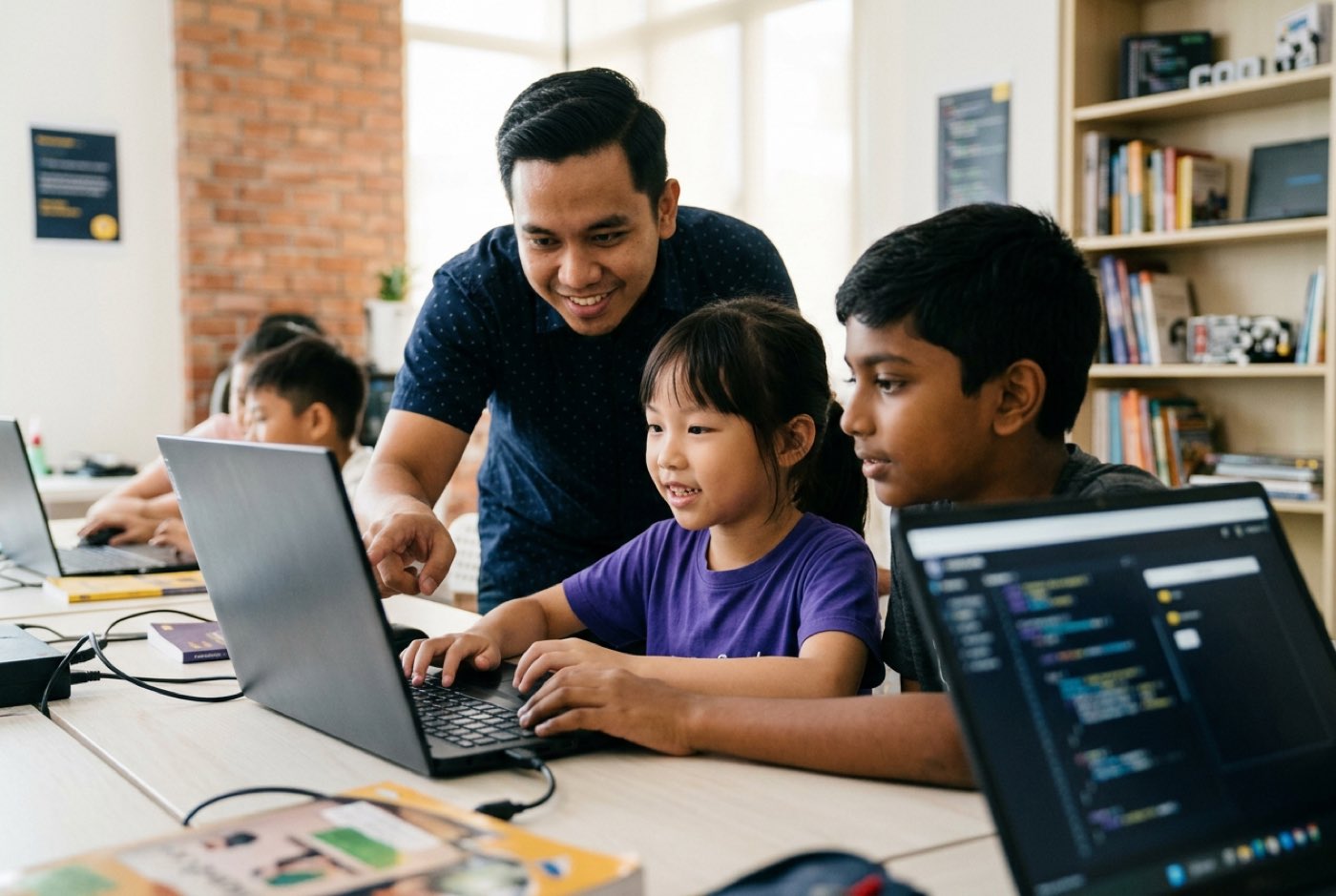 Three pillars hold the whole thing up:
- AI school first. Children learn to direct AI safely, judge what the model gives back, and build intelligent applications from scratch.
- Maths through builds. We drop the drills and put mathematics inside real construction, with personalised AI tutoring support alongside. Geometry, algebra, and probability become the material for game engines and data models. Parents usually arrive at the same realisation within two to four weeks: the child was fine all along, the teaching approach wasn't.
- Coding bundled free. Six technology tracks (Python, Web Development, Mobile Apps, Game Development, Electronics, and 3D Modeling) come at no additional cost inside our degree packages, so computational thinking is learned through actual development work.
Solaris Mont Kiara is our flagship. We're also at Sunway Nexis in Kota Damansara, and in Penang at Q2 Waterfront, Vantage Tanjung Tokong, and Icon City. Families who prefer to join from home use our live online classes. The format changes; the emphasis on building something real doesn't.
If you'd like to see the model rather than read about it, you can book a hands-on session on our free trial registration page.
Decision Framework: Evaluating Your Child's Preparedness Today
Before you change anything, work out where your child sits right now. This matrix is the quickest way I know to tell a consumer from a builder.
| Evaluation Metric | Consumer Mindset (High Risk) | Builder Mindset (Future-Ready) |
|---|---|---|
| Device Usage | Uses devices primarily for streaming videos and playing pre-built games. | Uses devices to write code, design 3D models, and build custom projects. |
| Stance Toward AI | Copies AI answers directly into school assignments without verification. | Prompts AI deliberately, checks output for errors, and refines system logic. |
| Math Perspective | Views math as boring worksheet drills disconnected from real life. | Uses math as an active tool to solve physics, logic, and graphics problems. |
| Response to Errors | Gives up quickly when software or academic instructions become complex. | Uses debugging strategies and logical decomposition to solve problems step by step. |
| Portfolio | Has zero tangible digital projects or creations to show for screen time. | Maintains a portfolio of original apps, games, websites, or AI models. |
Printable Future-Proofing Checklist for Parents
- Audit screen habits: count the weekly hours spent consuming content versus creating digital projects.
- Reframe mathematics: find projects where maths concepts directly control game physics, art, or logic systems.
- Set responsible AI rules: agree at home that AI is for deep explanation and project work, and that unverified copying isn't acceptable.
- Introduce text-based coding early: move past drag-and-drop blocks into real Python once your child has the logic basics.
Designed, ready to print and sign. We email it to you together with a 5% discount on your next registration.
Frequently Asked Questions
Will AI make learning to code completely obsolete by 2035?
No. AI automates basic syntax writing, but somebody still has to define the software architecture, assess security, specify the business logic, and verify that the pieces work together. Computational thinking is what lets a student direct AI code generators instead of merely accepting their output.
Should my child still pursue traditional degrees like law, medicine, or engineering in Malaysia?
Yes. These professions will keep requiring human oversight, ethical judgement, and deep domain expertise. What changes is who advances fastest inside them: graduates who can direct AI systems and interpret complex data.
How does Kidocode address math frustration if my child is currently struggling in school?
We change the delivery, not the curriculum standard. Instead of relying on repetitive paper drills, students apply mathematical principles to game physics, 3D spatial models, and AI logic systems. Seeing the result of a calculation on screen makes abstract concepts click in a way a worksheet rarely does.
Is a 5 or 6-year-old child too young to learn AI and coding concepts?
Not too young, as long as the teaching fits the age. Young children start with spatial logic, sequence building, and visual block scripts in Scratch Jr and Scratch, then move to text-based code once reading and typing catch up.
What is the difference between attending physical classes in KL or Penang versus learning online?
Our campuses at Solaris Mont Kiara, Sunway Nexis PJ, Q2 Waterfront, Vantage Tanjung Tokong, and Icon City give students dedicated hardware and face-to-face mentorship. The live online programme runs the same curriculum, the same project builds, and the same instructor interaction through camera-on virtual classrooms.
References
- World Bank Group, Malaysia Supporting Inclusive Growth by Strengthening Human Capital (2025)
- Khazanah Research Institute, An Uneven Future: An Exploration of the Future of Work in Malaysia (2017)
- UNESCO, UNESCO AI Competency Framework for Students and Teachers (2024)
- ISEAS – Yusof Ishak Institute, Augmentation or Elimination? The Potential Impact of AI on the Malaysian Economy (2026)
- SEADS / Asian Development Bank, Augmenting Intelligence: Shaping the Future of Work in Southeast Asia (2025)
- World Economic Forum, From Classroom to Career: Building a Future-Ready Global Workforce (2024)
- Free Malaysia Today, AI Impact on Jobs in M'sia Depends on Adoption, Reskilling, Says World Bank (2026)