

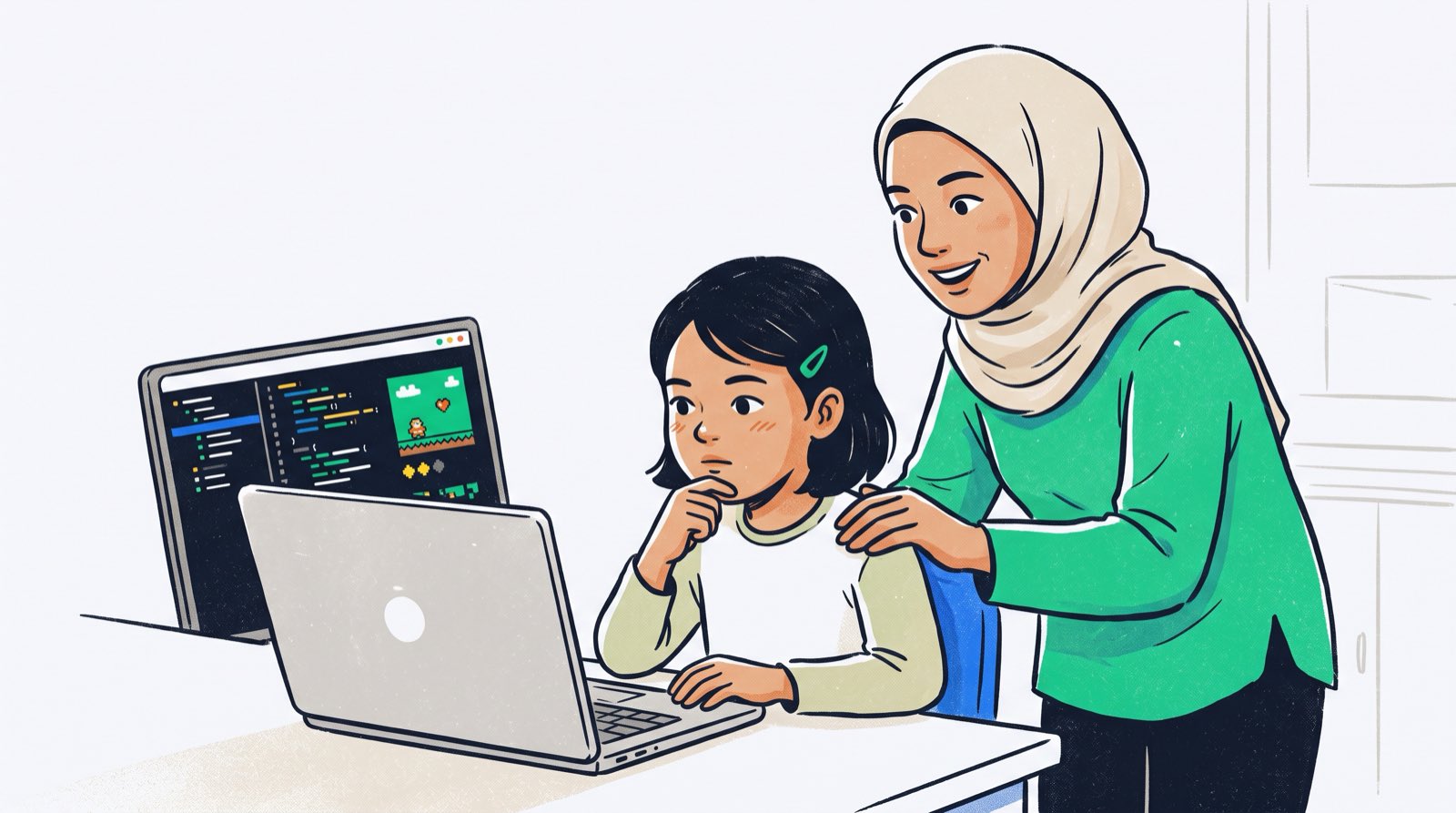
It starts the same way every term. Your child watches a friend draw digital art, build a world in Roblox, or play piano, and comes home asking to sign up. You buy the equipment. You book the weekly slot. You rearrange Saturday mornings around it. Then week four arrives and the excitement is gone. Practice turns into a negotiation, excuses show up before every session, and by week six the gear is in a corner collecting dust.
When this happens two or three times in one year, parents tend to land on one of two explanations: the child has no discipline, or the child hasn't found their thing yet.
I have been running Kidocode for eleven years, and building AI tools like my open-source project Crawl4AI alongside it. In that time I've sat with thousands of parents in Kuala Lumpur and Penang who describe almost exactly the scene above. My answer is usually the same, and it surprises them: your child is fine. The activity is badly built.
Children don't usually quit because they lack focus. They quit because most enrichment programs run on passive repetition, syntax drilling, and rewards that arrive months later. Change those conditions, so that a child gets visible output fast, real say over what they make, and AI help with the tedious parts, and sticking with it stops being a battle.
Key Takeaways
| Section | Core Insight | Parent Action |
|---|---|---|
| Why Kids Quit | Quitting usually traces back to how the activity is designed, not to a missing character trait. | Judge a program by how much building happens in it, not by how much discipline it demands. |
| The 3 Drop-Off Points | Week 2 (novelty fades), Week 6 (friction spike), Month 4 (plateau). | Match your response to the milestone instead of simply enforcing attendance. |
| The Gaming Mechanic | Games hold attention through tight feedback and genuine control. | Look for learning environments that respond as quickly as a game does. |
| The AI Accelerator | AI handles the syntax so the child keeps working on the logic. | Let your child use an AI assistant to get past the typo wall. |
| Flexible Commitments | Fixed weekly slots collapse under Malaysian school calendars. | Choose hour-based scheduling that survives exam season. |
Table of Contents
- Why the Quitting Pattern Is About Activity Shape, Not Character
- The Three Quitting Milestones: Week 2, Week 6, and Month 4
- The Four Mechanics That Keep Children Engaged
- Why Gaming Holds Attention for Hours While Worksheets Fail
- Bridging Scratch to Text Coding Without the Frustration Wall
- How AI Assistants Remove the Syntax Trap
- Comparing Traditional Enrichment with Build-First AI Learning
- Parent Moves That Help (And Two That Backfire)
- Flexible Schedules vs Fixed Weekly Commitments
- How We Teach at Kidocode: Combining AI, Math, and Tech
- The 4-Week Stickiness Test with Honest Exit Criteria
- Printable Activity Agreement Checklist
- Frequently Asked Questions
- References
Why the Quitting Pattern Is About Activity Shape, Not Character
When a child loses interest quickly, the worry usually goes straight to attention span or resilience. The research points somewhere else. Dropping out of a youth activity is an ongoing process of re-evaluation, triggered when the activity stops feeling meaningful or starts producing mostly negative emotional experiences [2]. In sport, young athletes disengage once the environment tilts from enjoyable skill-building toward high-pressure demands [2].
Angela Duckworth, who spent her career studying grit, argues that quitting is necessary for young children: interest has to develop before discipline and hard work can be built on top of it [3]. So if an activity is nothing but isolated drills with no visible use for months, walking away is a reasonable read of a boring situation.
Look at how most enrichment classes are actually run:
- Music lessons spend months on scales before the student plays a song anyone recognises.
- Math tuition leans on repetitive worksheets that strip formulas away from any real use [5].
- Traditional coding classes drill syntax rules and terminal commands before the child makes anything they can see.
Children spend their days in systems that answer them instantly. Put them in an environment built entirely on delayed gratification and engagement drains out of it. Put them in one built around making things and owning them, and the same child will sit with a problem far longer than you expected.
flowchart TD
    A[Child Starts New Activity] --> B{Structure of Activity}
    B -->|Passive Drills & Delayed Output| C[Frustration & Boredom Peak]
    C --> D[Child Quits by Week 4]
    B -->|Immediate Builds & AI Acceleration| E[High Agency & Fast Feedback]
    E --> F[Sustained Project Ownership]
The Three Quitting Milestones: Week 2, Week 6, and Month 4
Disengagement tends to arrive on a schedule. Noticing when your child starts pulling away tells you why.
timeline
    title The Three Quitting Milestones
    Week 2 : Novelty Fades : Spark of initial excitement wears off
    Week 6 : Friction Spike : First real technical or cognitive wall
    Month 4 : Progress Plateau : Absence of visible growth or social outlet
Milestone 1: Week 2 (The Novelty Fade)
For the first fortnight, the new room, the new software, the new tools carry everything. Then the novelty runs out and what's left is the actual work. If the activity hasn't handed the child something of their own by then, resistance starts showing up at the door.
Milestone 2: Week 6 (The Friction Spike)
Around week six the curve steepens. In piano it's sheet music. In math it's multi-step word problems. In traditional coding it's a missing bracket somewhere in forty lines. Without a tool or a person to get them across that gap, self-doubt fills the space, and it comes out as "this is too hard" or "I don't like this anymore."
Milestone 3: Month 4 (The Progress Plateau)
Children who survive the first month usually hit the plateau near month four. The basics are handled, but there's no visible line from today's exercise to anything worth making. If they're still doing drills instead of publishing an app, shipping a playable game, or cracking a problem that matters to them, they conclude the time isn't buying them anything [2].
The Four Mechanics That Keep Children Engaged
Four things have to be true of the environment. Not three, and not a philosophy statement.
- Fast visible output: something concrete comes out of every session, on screen, working.
- Personal ownership: the child picks what gets built, whether that's a custom game mechanic, an artwork generator, or a physics simulator.
- Peer recognition: the project can be shared, played, and judged by friends and family.
- Immediate problem-solving utility: a new concept shows up because it solves the design problem in front of them, not because it appears in a test next year.
Get those four right and perseverance takes care of itself. Nobody has to be forced to practise, because practising is how the thing they made gets better.

Why Gaming Holds Attention for Hours While Worksheets Fail
The question I get most often: "Why can my child sit with Roblox or Minecraft for three hours straight but lose the thread ten minutes into math homework?"
It isn't screen addiction, and it isn't a short attention span. Games are simply better designed as instruction:
- Instant feedback loops. The player acts, the engine answers, immediately.
- Low-stakes failure. Dying carries no judgement. It's information for the next attempt.
- Scaffolded difficulty. The challenge keeps adjusting to hold the player near the edge of their ability.
A worksheet gives slow feedback, attaches moral weight through grades, and never adjusts its difficulty for anyone.
In our write-up on Roblox and Minecraft learning frameworks, we put those mechanics to work on serious subjects. A child editing a Roblox Studio script to change the game's gravity isn't consuming anything. They're using spatial geometry and programming logic to bend their own world. That's the whole swap: passive screen time becomes active building. Interactive educational media paired with active guidance supports cognitive development, while passive consumption tends toward attention fatigue [4].
Bridging Scratch to Text Coding Without the Frustration Wall
Block platforms like Scratch are a good door in for children aged 5 to 7. Dragging blocks removes the typing barrier and still teaches sequencing, loops, and conditionals.
The wall arrives around age 9 or 10, when a child is pushed straight from coloured blocks into Python, C++, or JavaScript. It feels like moving from plastic bricks to writing formal essays in a second language, overnight.
The traditional ladder handles that jump by asking children to memorise syntax, which is exactly where a lot of them leave. In our article on the signs a child has outgrown Scratch, we lay out a gentler route:
| Stage | Typical tools | What the child is doing |
|---|---|---|
| 1. Visual blocks | Scratch | Dragging logic into place, no typing required |
| 2. Hybrid visual and code | Roblox, Micro:bit | Reading and tweaking real code inside a visual project |
| 3. AI-assisted text coding | Python with Copilot or ChatGPT | Writing text code with a translator on hand for syntax |
| 4. Independent text coding | Python and beyond | Building and debugging software without assistance |
With an AI assistant sitting in as a real-time translator, children move into text code years earlier than the old ladder allowed. A missing colon stops being a dead end. They tell the AI to lay down the boilerplate and spend their attention on how the program is put together.
How AI Assistants Remove the Syntax Trap
In a conventional coding class, up to 70% of a beginner's time goes into hunting simple typos: a missing semicolon, an unmatched parenthesis, an indentation that looks fine. Ask a 10-year-old to search for an invisible mistake for forty minutes and you will find out very quickly why children abandon technical subjects. This is the single biggest cause I see.
AI assistants change the shape of that work. The lookup is handled, and the child gets to operate one level up:
# Traditional Way: Child spends 30 minutes struggling with syntax errors
# AI-Assisted Way: Child defines logic, AI generates correct structure

# Child's logic goal: Create a bouncing ball with gravity simulation
import pygame

# AI generates boilerplate setup, child adjusts physics parameters
gravity = 0.5
bounce_loss = 0.85
ball_y_velocity = 0

def update_ball_position(ball_y, height):
    global ball_y_velocity
    ball_y_velocity += gravity
    ball_y += ball_y_velocity

    if ball_y >= height - 20:
        ball_y = height - 20
        ball_y_velocity = -ball_y_velocity * bounce_loss
    return ball_y
Once the AI writes the scaffolding, the child's job becomes design: what should the system do, what happens when I change this number, why did the ball sink through the floor. The memorisation drops away. So does the trap that usually ends the whole experiment.
For more on where we draw that line, read our analysis on why kids still need to learn coding in the age of AI.
Comparing Traditional Enrichment with Build-First AI Learning
Side by side, the difference in retention makes more sense.
| Dimension | Traditional Enrichment Classes | Build-First AI Learning (Kidocode) |
|---|---|---|
| Primary Focus | Syntax memorization, scale drills, isolated formulas | Project construction, systemic logic, AI direction |
| First-Session Output | Copying examples from a board | A working interactive app or game prototype |
| Feedback Loop | Teacher reviews homework days later | Real-time output execution and immediate AI feedback |
| Handling Mistakes | Marks lost for syntax errors | Instant error debugging using AI assistants |
| Mathematics Integration | Abstract worksheets and test prep | Applied math used to control game physics and layout |
| Pacing Model | Fixed group progression | Personalized pacing driven by individual AI tutors |
Parent Moves That Help (And Two That Backfire)
What happens at home matters as much as what happens in class. Two of the most common parental habits are also the two most likely to end the activity.

Helpful Move 1: Ask to Be Shown, Not Told
"What did you learn in class today?" buys you one word. Try "Can you show me what your app does right now?" instead. Let them run the code, break something, fix it in front of you. Explaining a build to someone who is actually interested is where the pride comes from, and it locks the learning in.
Helpful Move 2: Apply Angela Duckworth's Quitting Rule
Set the rule out loud at home: you may drop an activity because it isn't for you, but you may not drop it on a bad day [3]. Fix the bug, finish the build, then decide. The child keeps the choice, and the choice gets made with real information.
Backfiring Move 1: Micro-Managing Progress Checks
Standing behind your child correcting their syntax or their colour choices takes the project away from them. Once the work has to meet your standards instead of theirs, it's homework.
Backfiring Move 2: Comparing Siblings or Classmates
"Your sister finished hers in two weeks" ends intrinsic motivation on the spot. The only comparison worth making is with what your child built a month ago.
Flexible Schedules vs Fixed Weekly Commitments
A lot of Malaysian families don't quit because the child lost interest. They quit because the calendar gave out. Between school workloads, project deadlines, co-curricular duties, and KSSR, IGCSE, or SPM preparation, two missed weekly slots during exam season can leave a child so far behind the cohort that dropping out feels like the only option.
At Kidocode we took the fixed slot out of the equation and run an hour-based membership instead.
Families set the frequency. A quiet week might mean three sessions and a fast run at a project. An exam month or a family trip means pausing without burning hours or losing your place.
There's evidence for keeping it loose. Structured out-of-school activities support cognitive development up to a point, but rigid scheduling past that point starts working against the child; in preschool populations, the drag showed up beyond roughly 9 hours per week [7]. Enrichment should fit around the life the family already has.
How We Teach at Kidocode: Combining AI, Math, and Tech
Kidocode is Malaysia's AI school for kids aged 5 to 18. The mission is narrow on purpose: make children AI-savvy, clear up math frustration, and turn screen users into builders.
The membership runs on three pillars, with a personalised AI tutor attached to every child:
| Pillar | What it covers |
|---|---|
| AI to Survive | Directing LLMs, prompting, ethics and safety |
| Math to Think | Applied builds, AI tutor, zero worksheets |
| Tech to Build | Six tracks: Web, Python, Mobile, Games, 3D, Hardware |
- AI to Survive: how to prompt, direct, and work safely alongside modern AI systems, so it becomes a thinking partner rather than a way to skip the thinking.
- Math to Think: we teach to international standards (IGCSE, Cambridge, US Common Core) and throw out the repetitive worksheets. Students use geometry, vectors, and algebra to calculate game collisions, render 3D assets, and structure data. Most children who arrive hating math reverse that within 2 to 4 weeks, once math becomes the tool that makes the build work. See our approach to learning math through building vs traditional tuition.
- Tech to Build: coding sits inside every program, because basic coding literacy is now assumed everywhere. What we're really teaching is computational thinking. Students choose among six tracks: Python, Web Development, Mobile Apps, Game Engineering, Electronics, and 3D Modelling.
Students work with a dedicated trainer and their own AI software either in person, at Solaris Mont Kiara, Sunway Nexis in Kota Damansara, Q2 Waterfront in Penang, Vantage Tanjung Tokong, or Icon City in Bukit Mertajam, or through our live interactive online program.
The 4-Week Stickiness Test with Honest Exit Criteria
Before you commit to anything long-term, run a four-week trial and watch for specific behaviour rather than asking your child whether they like it.
flowchart LR
    W1[Week 1: Visual Pride] --> W2[Week 2: Autonomous Play]
    W2 --> W3[Week 3: Unprompted Fix]
    W3 --> W4[Week 4: Project Push]
Observation Checkpoints
- Week 1 (Visual Pride): does your child open their project to show you something they customised, without being asked?
- Week 2 (Autonomous Play): do they spend fifteen minutes messing with the build outside class time?
- Week 3 (Unprompted Debugging): when something breaks, do they try the AI tutor or their own logic before calling for help?
- Week 4 (Project Expansion): are they pitching new features, levels, or tools they want to build next?
Clear Exit Criteria: When It Is Right to Stop
If four weeks of project-based work still produce real distress, if your child refuses to engage even when they get to pick the topic, and if they show no interest in testing what they made, stop. That's not failure. It frees up time and energy for something that might actually fit.
Two of the four checkpoints is enough, though. If your child clears two, the model is working and engagement usually builds from there.
Printable Activity Agreement Checklist
Go through this with your child before the first session. Print it, sign it together, stick it near their workspace.
- Our Project Goal: We have chosen one clear project to design, build, and publish over the next 4 weeks.
- The "No Quitting on Hard Days" Rule: If a bug or obstacle shows up, we fix it with the trainer or AI assistant before we decide anything about continuing.
- Weekly Show-and-Tell: The child gives a 2-minute live demo of the build every weekend. No written progress reports.
- Ownership of Choice: The child picks the theme, the visual assets, and the game mechanics. The parent cheers and stays out of the code.
Designed, ready to print and sign. We email it to you together with a 5% discount on your next registration.
Frequently Asked Questions
Why does my child get excited about new hobbies but drop them after a month?
Because once the novelty is gone, what remains is repetition and a reward that's months away. Activities built around instant feedback, a project the child owns, and challenges sized to them hold on much longer.
Is my child too young to start learning coding and AI?
If they can use a touchscreen or play a simple game, they can start building. Children aged 5 to 7 pick up computational logic through Scratch and basic electronics. AI assistants then carry them into real text-based code as they get older.
How does learning to code help if my child struggles with math at school?
Very few children hate math itself. They hate memorising it in the abstract. Point it at a game's physics, a collision check, or a screen layout and it turns into something useful. In our classes, math anxiety usually lifts within 2 to 4 weeks of project work.
Will using AI tools prevent my child from learning how to think independently?
The AI removes syntax lookup, not thinking. What's left for the child is the harder part: the logic, the architecture, the design decisions. Knowing how to direct an AI well is its own literacy now, and it has to be learned.
What should I do if my child gets stuck on a difficult project and wants to give up?
Use the "No Quitting on Hard Days" rule. Debug the immediate problem with the AI tutor or the instructor, finish that phase of the build, then talk about whether the project scope needs changing. Getting through one genuinely hard technical problem does more for resilience than a term of easy wins.
Can flexible schedules really work for busy families in Malaysia?
They work better than fixed ones. Weekly slots collide with exams, tuition, and travel. Hour-based membership lets you push hard during holidays and pause during exam weeks, so nothing has to be abandoned.
References
- MDPI, Excessive Screen Time Prevalence and Its Determinants Among Children Under Five Years Old in Petaling District, Selangor, Malaysia (2022)
- Taylor & Francis, Losing fun: A grounded theory of adolescent sports dropout (2025)
- Association for Psychological Science, Raising a Child With Grit Can Mean Letting Her Quit (2016)
- MDPI, Impact of Screen Time on Child Development: A Narrative Review (2025)
- PubMed Central, Physical Activity, Sedentary Behavior, and Dietary Patterns Among Malaysian Adolescents (2022)
- Active Healthy Kids Malaysia, 2022 Report Card on Physical Activity for Children and Adolescents (2022)
- EurekAlert / Journal of School Psychology, Extracurricular activities don't always improve young children's academic skills (2023)
- PubMed Central, Early Sport Specialisation and Sampling in Youth Team Sports (2023)
Give Your Child a Learning Experience That Sticks
Want to see how your child reacts to build-first learning? Book a free hands-on trial at any of our five campuses across Klang Valley (Solaris Mont Kiara, Sunway Nexis PJ) and Penang (Q2 Waterfront, Vantage Tanjung Tokong, Icon City), or join us live online.
It runs two hours, it's free, and your child leaves with a working AI, math, or coding project they built themselves. Sit in for the whole thing if you like. Most parents do.