


One parent comes back from a work seminar, or finishes an article about what AI is doing to entry-level jobs, and decides the kids need to start learning this now. The other parent is looking at the family calendar, the pile of tuition receipts, and the fact that nobody in this house has managed a screen-free weekday in months. We hear some version of this conversation from families in Kuala Lumpur and Penang almost every week.
The argument tends to stall in the same place. It circles: too expensive, too young, probably a fad, we'll see. Nobody has a shared way to test the question, so either nothing happens, or one parent gives in and quietly waits for the class to disappoint them.
What follows is a neutral 20-minute framework two adults can work through at a kitchen table. It covers the five questions the hesitant partner is actually asking, sets a low-risk trial rule, and gets you to a decision you both made.
Key Takeaways
| Perspective | Common Concern | Framework Resolution |
|---|---|---|
| Skeptical Parent | "It is just more screen time and passive consumption." | Shift focus to active creation and computational thinking with clear time boundaries. |
| Enthusiastic Parent | "Our child will fall behind in an AI-driven economy." | Set concrete 90-day learning milestones rather than relying on abstract future fears. |
| Household Budget | "We are already spending heavily on standard academic tuition." | Use a 90-day stop rule and evaluate whether the class replaces passive screen hours or duplicate tuition. |
| Child's Schedule | "Our child is already overloaded with school assignments." | Choose flexible project-based schedules rather than rigid weekly homework drills. |
Table of Contents
- Why This Argument Is Rarely About Money
- The Five Fair Questions the Skeptical Parent Is Asking
- The 20-Minute Joint Decision Framework
- The Stop Rule That Ends Perpetual Debates
- Decision Matrix: Evaluating Enrichment Options Together
- Applying the Framework to AI, Math, and Tech
- Visualizing the Decision Process
- Why Both Parents Should Attend the Hands-On Trial
- What to Do When the Child Is the Holdout
- Step-by-Step Action Plan: Your 20-Minute Alignment Session
- How Kidocode Supports Partner Alignment
- Frequently Asked Questions
- References
Why This Argument Is Rarely About Money
Cost is what gets said out loud. It is rarely what the argument is about.
In most households, the two parents have drifted into different jobs on this question. One is the growth sponsor, thinking about career positioning ten years out, worrying that school alone will not prepare a child for a workforce reshaped by AI. The other is the protective guardian, thinking about tonight: the homework still undone, the money already committed, the child who has been on a device since four o'clock. That parent worries about over-scheduling, screen habits, mediocre teaching, and money spent on something unproven.
Neither role is the wrong one to play. The Khazanah Research Institute found that real median household income in Malaysia in 2022 was still roughly 13% below pre-pandemic trends, while mean household expenditure climbed to 77.6% of income [2]. Over the same pandemic period, real household spending on information and communication technology (ICT) grew by 49% [2].
So families are putting more money into technology and education while the budget itself has less room in it. Add to that the tuition load already in place: in a 2024 survey of 263 Malaysian parents, 79.8% said their children attend private academic tuition, averaging 8 hours a week across subjects [4].
Put a new enrichment proposal on top of that and the hard questions are earned. The disagreement is a collision between one parent's long-range risk anxiety and the other parent's very real Tuesday evening.

The Five Fair Questions the Skeptical Parent Is Asking
If you are the enthusiastic one, the fastest way to stay stuck is to treat hesitation as stubbornness. Underneath it are usually five specific questions. Answer them properly and the conversation moves. Dodge them and it won't.
1. "Is this just more screen time?"
This objection comes up more than any other, and for good reason. A parent who spent the morning negotiating an iPad out of a child's hands is not enthusiastic about paying for another screen-based hour.
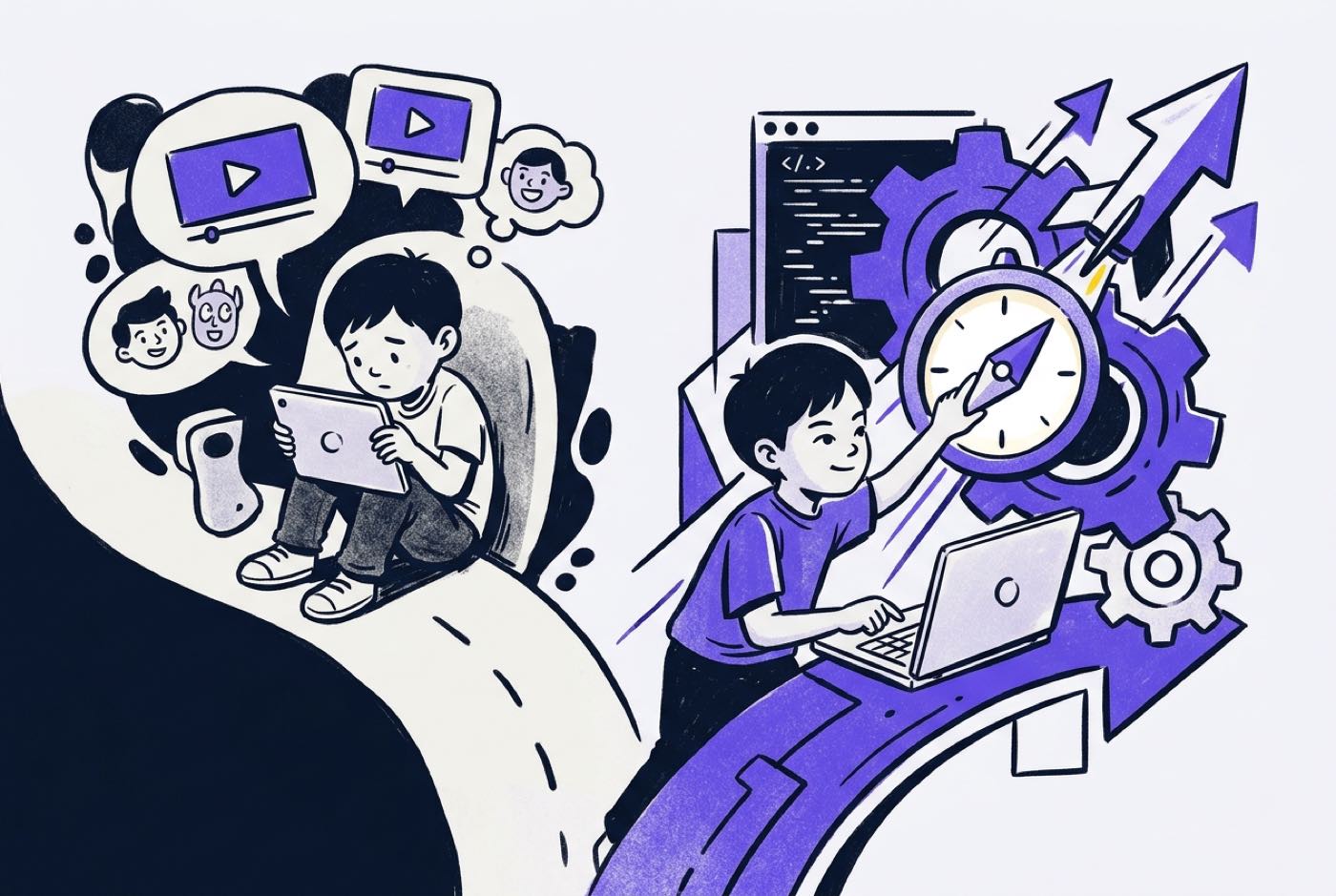
What matters here is what the child is doing with the screen. Long-term longitudinal research tracking physical activity, screen media, and cognition in young people found that active screen time, the kind involving problem-solving, learning, and creative production, is associated with higher adolescent cognitive processing [8]. Passive consumption shows nothing comparable. A class worth paying for has the child instructing the machine, writing algorithms, and directing AI models at real problems. We go deeper into that distinction in our guide on screen time versus coding time.
2. "Will AI make coding obsolete anyway?"
Fair question. If a model can produce working software from a paragraph of English, why should a twelve-year-old memorize syntax?
They shouldn't, particularly. The durable skill is computational thinking. AI handles syntax, including the syntax errors, but somebody still has to define the logic, design the system, and judge whether the output is any good. Research from Harvard University points out that generative AI assistants can lift short-term task performance, while actual learning depends on whether the tool scaffolds reasoning or simply supplies answers [7]. Directing AI well takes clearer logic, better-structured prompts, and stronger mathematical thinking than writing the code yourself ever did. Syntax is just the material children use to learn how logic behaves.
3. "Is our child too young or already overloaded?"
When school homework already eats the evening, adding anything looks reckless.
The load, though, depends mostly on how the class is taught. Academic tuition often runs on repetitive worksheets and memorization, which is a large part of why students burn out on it [4]. Constructivist teaching works differently: children pick up concepts by building something that has to actually work, whether that's a game, a simulation, or a small AI application. UNESCO's global AI competency framework makes the case that primary-age students can already develop foundational AI literacy across three levels, understanding, applying, and creating [1].
4. "How do we know this is not an answer-generator that stops our child from thinking?"
Plenty of parents have watched a child paste a homework question into a chatbot and copy the result. The worry is legitimate.
Stanford University's SCALE Initiative reviewed more than 1,100 research papers on AI in education [5]. Only 20 of those were high-quality causal studies measuring real student learning outcomes. Those studies point the same direction: AI tools built with pedagogical scaffolding, meaning hints, structured questioning, and error analysis, produce considerably better long-term retention than general-purpose chatbots that hand over answers [5].
So the question to ask any provider is what their AI does when a child gets stuck. A good one asks a question back and makes the child explain their reasoning.
5. "What if our child loses interest after a few weeks?"
Most families have a violin, a pair of football boots, or a robotics kit somewhere in a cupboard as evidence for this concern.
The protection here is procedural: no long lock-in without a structured trial and a written stop rule. If a programme cannot show real engagement in the first few weeks through working builds, you need a way out that doesn't require another argument.
The 20-Minute Joint Decision Framework
Set a timer for twenty minutes. Take a blank sheet of paper or the worksheet further down this page, and work through four steps in order.
Step 1: Define the Single Outcome (5 minutes)
Agree on what success looks like over the next 90 days. "Getting good at tech" and "improving grades" are too loose to test. Pick one:
- Option A (Logical Confidence): Rebuilding math confidence by applying mathematical concepts directly inside game engines or physics simulations.
- Option B (AI Literacy & Safety): Learning how generative AI models work, how to direct them safely, and how to verify their outputs critically.
- Option C (Project Creation): Completing two independent, published digital builds (a mobile app, a web platform, or a trained machine learning model) for a portfolio.
Once you both name the same target, judging whether a course hits it stops being a matter of opinion.
Step 2: Establish Schedule and Screen Boundaries (5 minutes)
Fix the limits before you look at any timetable:
- Maximum weekly class time (for example, 2 to 3 flexible hours per week).
- Zero compromise on sleep or core school homework.
- Substitution rule: Every hour spent in active technical creation must replace an hour previously spent on passive gaming or social media.
Step 3: Establish the 90-Day Stop Rule (5 minutes)
Write down, now, the exact conditions under which you will stop after 90 days. Naming them in advance takes the pressure off the skeptical parent, and it gives the enthusiastic one a fair window to be right.
Step 4: Determine the Evidence You Will Accept (5 minutes)
Decide what proof counts. School grades lag by months and move for a dozen unrelated reasons, so they make a poor first indicator. Better ones:
- The child can independently explain the code or logic behind a project they built.
- The child shows reduced frustration when solving complex multi-step math or logic problems.
- The child demonstrates responsible AI usage, such as checking AI outputs for errors rather than accepting them blindly.
The Stop Rule That Ends Perpetual Debates
The 90-day Stop Rule does more work than the rest of the framework combined. It turns an open-ended commitment into a trial with a review date.
flowchart TD
    A[Start: 20-Minute Partner Discussion] --> B{Agree on Primary Goal?}
    B -- No --> C[Refine Outcome: Math, AI Safety, or Project Build]
    B -- Yes --> D[Set Schedule & Screen Boundaries]
    C --> D
    D --> E[Establish 90-Day Stop Rule]
    E --> F[Attend Joint Free Trial Class]
    F --> G{Both Parents & Child Aligned?}
    G -- No --> H[Pause Decision or Adjust Options]
    G -- Yes --> I[Enroll for Initial 90-Day Period]
    I --> J[90-Day Review Checkpoint]
    J --> K{Criteria Met?}
    K -- Exit Criteria Triggered --> L[Stop Class & Reallocate Time]
    K -- Growth Criteria Met --> M[Continue Programme confidently]
Write down three triggers that end the programme:
- Engagement Trigger: The child actively resists attending classes for three consecutive weeks despite teacher adjustments.
- Output Trigger: The child has not produced a working project build (a functional game, app, or AI project) by Day 60.
- Passive Behavior Trigger: The class relies on passive video lectures or copy-pasting pre-written code without live teacher interaction.
Any of the three still standing at the 90-day mark, and the class ends. No relitigating it. That guaranteed exit is usually what allows the protective parent to say yes to trying in the first place.
Decision Matrix: Evaluating Enrichment Options Together
Bring this table into your twenty minutes and score the options you are actually considering:
| Criteria | Traditional Academic Tuition | General Passive Video Course | Project-First AI & Math School |
|---|---|---|---|
| Primary Method | Worksheets, exam drill papers, and formula memorization. | Pre-recorded videos, multiple-choice quizzes. | Live guidance, active building, and personalized AI tutoring. |
| Cognitive Mode | Passive repetition aimed at short-term exam recall. | Low-engagement viewing with high drop-out rates. | Active computational thinking and problem solving [8]. |
| AI Pedagogy | Rarely integrated; often treated as a cheating concern. | Basic overview videos without custom feedback. | Guided AI scaffolding with built-in safety guardrails [5]. |
| Tangible Output | Marked test sheets and past-year paper drills. | Course completion certificate. | Portfolio of working apps, games, and machine learning models. |
| Schedule Impact | Rigid weekly timeslots; adds to homework load [4]. | Self-paced, but requires high parent supervision. | Flexible hours; replaces passive screen consumption time. |
Applying the Framework to AI, Math, and Tech
Families evaluating Kidocode are often surprised that we don't open with coding syntax drills. Syntax is close to free now. What isn't free is knowing how to think computationally and how to point technology at a problem without breaking something.
Three pillars carry the curriculum.
Pillar 1: Artificial Intelligence First
AI is not an advanced elective here, reserved for teenagers or university. It sits at the center of what we teach from age 5 through 18. Students work on how large language models function, how to structure complex prompts, how to spot algorithmic bias, and how to stay safe. UNESCO makes the same point in its framework: a human-centered, ethically grounded understanding of AI systems belongs early in a young learner's education [1]. The habit we're after is treating AI as something you direct, not something you outsource your thinking to. Our overview of what AI-savvy looks like at ages 8, 12, and 16 shows how that develops by age.
Pillar 2: Mathematics Through Building
When a child says they hate math, they almost never mean they can't do it. They mean they've had years of abstract memorization and drill sheets and have concluded the subject is hostile.
We teach the same international standards, including Cambridge IGCSE and US Common Core frameworks, in reverse order. The math shows up because a build needs it. To make a game character jump in a way that looks right, a student ends up working with quadratic equations and physics parameters:
At that point the equation is a tool for finishing something the child wants to finish. Our comparison of math tuition versus learning math by building goes through how the delivery works.
Pillar 3: Technology and Coding as the Execution Layer
Coding comes bundled free with our membership packages, alongside AI and math. Six tracks: Python, Web Development, Mobile Apps, Game Development, Electronics, and 3D Modeling. Code is where computational thinking gets expressed and tested. Pairing text-based languages like Python with interactive AI assistants means students get past the syntax roadblocks that used to eat the first two years and start shipping real software far earlier.
Visualizing the Decision Process
The whole evaluation fits on one page. Keep it that way:
- Identify whether the primary hesitation stems from schedule load, screen time concerns, or curriculum doubts.
- Set concrete boundaries around weekly hours and passive screen replacement.
- Attend a live trial together to witness how the child responds to hands-on building.
- Apply the 90-day review checkpoint using agreed-upon output criteria.
Each step produces something specific, which is what stops the discussion sliding back into the vague version of itself.
Why Both Parents Should Attend the Hands-On Trial
We ask both parents to come to the first trial session wherever possible. That holds whether you visit a campus in Klang Valley (Solaris Mont Kiara flagship, Sunway Nexis PJ) or Penang (Q2 Waterfront Bayan Lepas, Tanjung Tokong, Icon City Bukit Mertajam), or join the live camera-on online programme.
Our own enrollment data shows why. When only one parent attends, enrollment drops off sharply, and the reason is usually translation loss at home:
- "It looked like they were playing computer games" (when the child was actually configuring coordinate physics).
- "They were just using a chatbot" (when the child was actually engineering multi-step prompts and evaluating logic errors).
Sitting in the room removes the middleman. Both parents see the custom AI tutor work a child through a math obstacle without handing over the answer. Both watch the shift from scrolling to building, which usually takes less than two hours. And both get to put their technical and logistical questions to the instruction team on the spot, rather than half-remembering the answers over dinner.
Our breakdown of what happens at a free trial class covers the session in detail.
What to Do When the Child Is the Holdout
Sometimes the adults agree and the child is the one saying no. Usually because they assume this is math tuition with a different name.
Most children between 7 and 14 already spend their free hours inside Roblox or Minecraft. We don't ask them to trade that in. We change their position in it. The moment a child understands that this logic lets them design their own Roblox mechanics, or write Minecraft modifications instead of downloading someone else's, the objection tends to evaporate on its own. See our pieces on how Roblox learning works and how Minecraft coding turns players into creators.
Step-by-Step Action Plan: Your 20-Minute Alignment Session
Work through this with your partner tonight.
Printable Partner Alignment Worksheet
Step 1: Set the Timer (20 Minutes)
Agree that this session is a collaborative exercise to make a decision, not an unstructured debate.
-
Step 1: Set the Timer (20 Minutes)
Agree that this session is a collaborative exercise to make a decision, not an unstructured debate. -
Step 2: Define the Target Outcome
Select one primary goal for your child over the next 90 days:- Rebuild math confidence through practical project builds
- Develop AI literacy, safety awareness, and prompt engineering skills
- Create a tangible portfolio of independent digital projects
Designed, ready to print and sign. We email it to you together with a 5% discount on your next registration.
How Kidocode Supports Partner Alignment
Kidocode has spent over 11 years working with more than 9,500 students aged 5 to 18 across AI, mathematics, and technology. The school was founded in 2014 in Solaris Mont Kiara by computer scientist Unclecode, who also created the open-source Crawl4AI project, now past 76,000 GitHub stars. It was built to address gaps he kept running into in conventional schooling.
Families have given us a 4.6-star Google rating across 177 independent reviews, and Tallypress voted Kidocode the #1 coding and tech class for kids in KL and Selangor.
What tends to matter most to parents negotiating this decision:
- Complete Flexibility: Three core pillars (AI, Math, Tech) integrated into flexible membership plans. Families can adjust weekly trainer sessions across pillars based on their child's changing school workload.
- No Per-Hour Traps: Clear monthly and annual membership options described transparently during your trial session, removing pricing ambiguity.
- Five Convenient Locations + Live Online: Flagship campuses at Solaris Mont Kiara (KL) and Q2 Waterfront (Bayan Lepas, Penang), along with centers at Sunway Nexis (PJ), Tanjung Tokong (Penang), and Icon City (Bukit Mertajam). Our live camera-on online programme offers full equivalence for families living elsewhere.
- Risk-Free Hands-On Trial: A two-hour session where your child builds a real project in AI, math, or tech while both parents watch how we teach.
You can look at our how we teach page, our AI curriculum, or our membership framework.
To finish your decision framework with actual evidence instead of guesswork, book a free trial class for your family.
Frequently Asked Questions
What if my partner and I attend the trial and still disagree?
That is a perfectly acceptable outcome, and it happens. The trial exists to give both parents firsthand evidence, not to produce a signature. If one of you leaves unconvinced, go back to your 90-day Stop Rule criteria or park the decision. Either beats enrolling with unresolved doubt.
How does learning math through building differ from standard tuition?
Traditional math tuition runs on memorizing rules and repeating past-year exam questions on paper [4]. Building delivers the same international curricula (IGCSE, Cambridge, US Common Core) through application. Students use algebra, geometry, and physics formulas to program game mechanics, construct 3D models, or calibrate AI algorithms.
Will an AI class interfere with my child's current school performance?
It shouldn't. Sessions are scheduled flexibly rather than around fixed weekly homework, so students scale hours down during exam periods and back up afterwards. Computational thinking and structured problem-solving also feed directly into school STEM subjects.
Is online instruction as effective as physical campus sessions?
Yes. The live online programme requires cameras on and screen sharing, so trainers, students, and their personalized AI tutors stay in genuine interaction. Online students build the same software applications and machine learning projects as students on campus.
Is coding really included for free in Kidocode programmes?
Yes. Coding syntax has become public foundational knowledge, and pricing it as a premium makes little sense. What we charge for is computational thinking, AI directional capability, and mathematical problem-solving, so coding instruction across all six tech tracks comes bundled inside the AI and math membership plans.
References
- UNESCO, AI competency framework for students (2024)
- Khazanah Research Institute, The State of Households 2024: Households and the Pandemic 2019-2022
- Kementerian Pendidikan Malaysia, Dasar Pendidikan Digital (2024)
- Zekolah, Academic Tuition in Malaysia: Survey Report (2024)
- Stanford University SCALE Initiative, Understanding the Evidence Base for AI in K-12 Education (2026)
- PubMed Central, Constructive and Destructive Marital Conflict, Parenting, and Child Adjustment (2014)
- Harvard Graduate School of Education, The Impact of AI on Children's Development (2024)
- ScienceDaily / University of Jyväskylä, Active Screen Time and Cognitive Processing in Adolescents (2026)