


A mother in Mont Kiara asked me this last month, and a father in Penang asked almost the same thing two weeks later: "Unclecode, I saw a short course online teaching prompt engineering for kids. They promise my ten-year-old will become an AI whisperer by learning how to talk to ChatGPT. Is this worth paying for?"
I understand why the question keeps coming. For a few years now the internet has been selling "prompt engineering" as the career skill of the era. The early headlines suggested that typing clever phrases into a text box would replace software engineering outright.
I've watched this hype cycle up close as a computer scientist, an AI researcher, and the person behind open-source projects like Crawl4AI. My answer over coffee is usually blunt. Static prompt tricks are a waste of your money, because they expire every few months. Teaching a child to structure context, break down a messy problem, and check whether the machine is lying to them, that is one of the best educational investments available right now.
So let's separate the two. Below is why standalone prompt engineering courses fail, what durable AI literacy actually looks like, and how we fold real AI directing into software building and mathematics.
Key Takeaways
| Perspective | Standalone "Prompt Engineering" Courses | Integrated AI Directing & Context Engineering |
|---|---|---|
| Core Focus | Memorising specific text templates, role-play prompts, and keyword hacks. | Task decomposition, context structuring, logic validation, and system design. |
| Lifespan of Skills | Perishable (expires whenever model updates or system prompts change). | Durable (rooted in computational thinking and critical analysis). |
| End Result for Student | A cheat sheet of text prompts and generated text outputs. | Real working software, games, mobile apps, or mathematical models. |
| Industry Demand | Declining rapidly for standalone prompters; automated by system software [1]. | High demand for analytical thinkers who direct AI tools effectively [2]. |
| Pedagogical Approach | Rote repetition of text commands in a chatbot window. | Hands-on constructionist learning through project creation [3]. |
Table of Contents
- The Prompt Engineering Hype Cycle: What Happened Between 2023 and 2026?
- Three Prompting Tricks That Expire (And Why Courses Selling Them Fail)
- Three Core Directing Skills That Last (What Real AI Literacy Demands)
- Prompt Engineering vs Coding for Kids: The Real Relationship
- The Artefact Test: Is Your Child Building or Just Copy-Pasting?
- How Prompting and Directing AI Sits Inside Kidocode's Three Pillars
- What AI Directing Looks Like at Age 8 vs 12 vs 16
- 5 Questions Parents Must Ask Before Enrolling in an AI Class
- Action Plan for Parents: Evaluating AI Literacy at Home
- Frequently Asked Questions
- References
The Prompt Engineering Hype Cycle: What Happened Between 2023 and 2026?
Before you decide whether a prompt engineering course is worth the fee, look at what the job market actually did.
Between January and April 2023, search query volume for prompt engineering jumped from 2 to 144 listings per million job searches [1]. Newspapers ran stories about AI startups advertising prompt engineer roles paying up to $375,000 [1]. Within months, education providers had packaged those headlines into weekend workshops and standalone certificates for children.
The industry data then went the other way. By mid-2025, dedicated prompt engineering postings made up less than 0.5% of technical listings on platforms like LinkedIn, 72 postings out of 20,662 sampled [4]. Microsoft surveyed 31,000 workers across 31 countries and found employers ranked "prompt engineer" second to last among the technical roles they planned to hire for [1].
So what collapsed the hype so fast?
flowchart TD
    A[2023: Manual Prompting Hype] --> B[Model Intelligence Increases]
    B --> C[Algorithms Generate Better Prompts Than Humans]
    C --> D[Transition to Context Engineering & System Design]
    D --> E[Human Focus Shifts to Critical Verification & Logic]
Two things. Algorithmic prompt optimisation got better than human phrasing: in controlled benchmark evaluations, algorithmically generated prompts beat human-crafted ones across open-source models, and did it in hours rather than days [1]. Meanwhile, research firms like Gartner tracked enterprises moving away from manual prompting toward "context engineering", designing the data architecture, workflows, and environments so the model understands intent without a user typing text hacks at it [5].
There's a lesson in that for parents. If the commercial stacks have stopped depending on clever phrasing, then a course built on prompt recipes is training your child for a version of the technology that has already passed.
Three Prompting Tricks That Expire (And Why Courses Selling Them Fail)
Look at the syllabus of most prompt engineering classes aimed at primary or secondary students and you'll find the same three interaction patterns. They demo beautifully in a 60-minute trial. They teach almost nothing that survives the year.
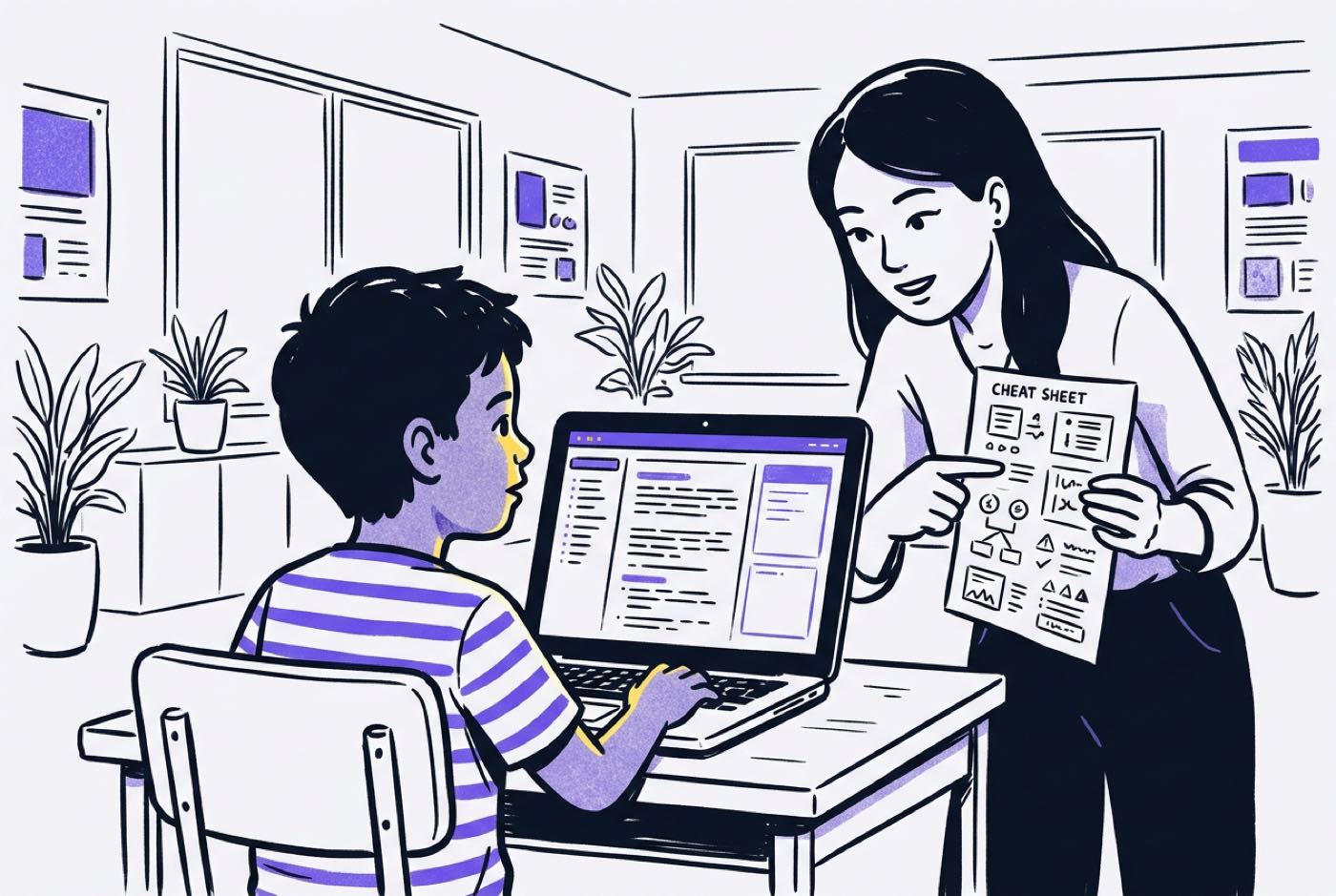
1. Magic Phrases and Keyword Hacks
Older language models needed a nudge, "think step by step", "take a deep breath", before they'd produce chain-of-thought reasoning. Whole course modules were built on memorising those exact phrases.
Frontier models now bake reasoning pipelines into their architecture. Drilling a child on specific phrasing is like teaching a new driver to adjust a carburetor by hand in the age of electronic fuel injection. One model update and the magic phrase does nothing.
2. Static Role-Play Templates
Nearly every introductory prompting class hands children a prefix to paste into the chatbot: "Act as an expert math professor with 20 years of experience..."
Persona framing does narrow a model's responses, so the technique isn't worthless. The problem is the false confidence. A student who doesn't know the subject can't tell the difference between a correct answer and a persuasive wrong one, and models produce authoritative hallucinations routinely when they're prompted without structured context [5]. The expert persona makes a fundamental error and the child nods along.
3. Single-Message Answer Retrieval
The third pattern treats the AI as a supercharged search engine. Ask in one message, receive a finished output, copy, paste, done.
That habit trains passive consumption. The cognitive friction a child skips is precisely the friction that builds analytical thinking, the skill employers name as the most sought-after core competency, rated essential by 70% of organisations globally [2]. One-shot prompt recipes work directly against it.
Three Core Directing Skills That Last (What Real AI Literacy Demands)
If the phrasing tricks expire, what's left worth teaching? At Kidocode we build around three competencies that hold their value because they sit on top of computational thinking rather than on top of any particular model [6].
1. Task Decomposition (Breaking Problems Down)
No model builds a complex application or solves a multi-step engineering problem from one high-level instruction. Directing an AI starts with cutting a large problem into small, logical, executable pieces.
Take a 12-year-old who wants a 2D platformer in Python. "Build me a platformer game" gets her nowhere useful. The project has to come apart into computational modules:
- Define the player sprite's hit-box and movement physics.
- Implement gravity calculations using acceleration vectors:
- Write collision-detection logic between the player and ground platforms.
- Structure the game loop state management.
None of that is prompt engineering. It's computational thinking, full stop. The assistant handles the routine syntax; the child supplies the structure.
2. Context Engineering and Specification Writing
Effective directing depends on the context you supply, not the sentence you craft. In working software and data environments that means clear input boundaries, data formats, edge cases, and architectural constraints [5].
Which is to say: we teach children to write technical specifications. An analysis of technical job markets found that even specialised AI roles weight testing methodology (18.7%), structured communication (21.9%), and problem-solving (15.8%) far above manual text phrasing [4]. A child who learns to specify input variables, expected data types, and boundary conditions is learning how systems work underneath.
3. Verification, Code Auditing, and Output Evaluation
Verification is the skill I'd protect above all others. Language models run on probabilistic pattern matching, so they regularly hand back code that parses cleanly and fails logically, or maths that looks like a derivation and isn't one.
One study analysing 211 million lines of code modified by AI assistants found several indicators of eroding code quality across software repositories [7]. The same body of research shows that workers who are confident they could complete a task without AI apply noticeably more critical thinking when they evaluate what the AI produced [7].
A child without foundational coding principles or mathematical logic has no way to audit the output. Dependence follows. Teaching children to test, debug, and verify keeps them in the director's chair instead of the passenger seat [8].
Prompt Engineering vs Coding for Kids: The Real Relationship
Plenty of parents arrive believing the two are alternatives, that a child can skip syntax and logic entirely and just get very good at natural language prompts.
That reading misunderstands how software actually gets made. As the Raspberry Pi Foundation put it in their global analysis of computing education, AI coding assistants have automated routine syntax generation, but they haven't automated the craft of software engineering or the logical problem-solving underneath it [7].
 Put a real language like Python or JavaScript next to an AI assistant and the assistant becomes an accelerator. In the old model, a young student spent months fighting syntax errors, missing semicolons, and mismatched brackets before producing anything that ran.
With an AI assistant in the workflow:
- The AI absorbs the tedious syntax lookups.
- The child accelerates past early syntax frustration.
- The child reaches real text-based coding and architectural design much sooner than the old Scratch-then-Python progression suggested [9].
The child still has to understand what the code does. Without loops, variables, functions, and data structures, a student who prompts an AI into generating a web application is stranded the first time a runtime error or a security hole appears.
That's why we treat coding as a public fundamental and bundle it free into our model. The subject we actually teach is structured computational thinking. Coding is the medium; AI is the accelerator [10].
The Artefact Test: Is Your Child Building or Just Copy-Pasting?
When you're evaluating any programme that claims to teach AI or prompt engineering, one diagnostic cuts through the marketing. I call it the Artefact Test.
At the end of a 90-minute session, or a 10-week term, what did the child make?
- The Standalone Prompting Class Model: The child leaves with a document containing text prompts, a printed cheat sheet of ChatGPT templates, and a few AI-generated text paragraphs or images copy-pasted into a slide deck.
- The Constructionist Directing Model: The child leaves with an active, running digital artefact, a playable game, a functional web application, a trained image-recognition model, or a physical electronic device controlled by microcontrollers and code.
Peer-reviewed work published in Informatics in Education backs this up: constructionist methodologies, where students learn AI concepts by building tangible artefacts, develop conceptual understanding, ethical reasoning, and critical agency far more effectively than passive instruction [3].
That same literature names five pedagogical requirements for AI education at school level:
- Active hands-on learning through real creation [3].
- Project-based inquiry rooted in authentic problem-solving [3].
- Ethics integration addressing safety and responsible use [3].
- Age-appropriate scaffolding tailored to cognitive maturity [3].
- Structured instructor guidance using accessible development tools [3].
A course with no software development, no mathematical application, and no artefact isn't teaching AI engineering. It's teaching software operation, which your child will pick up anyway.
How Prompting and Directing AI Sits Inside Kidocode's Three Pillars
We don't sell a standalone "prompt engineering" certificate, and we won't. Separating prompt text from domain knowledge is the flaw at the centre of the whole category. Our curriculum runs on three connected pillars, with AI directing threaded through every track.
| Pillar | 1. AI to Survive | 2. Math to Think | 3. Tech to Build |
|---|---|---|---|
| What it covers | Prompting and directing | Syllabus-aligned mathematics | Six technology tracks |
| Safety and ethics | Build-first maths | Python, Web, Mobile | |
| Context engineering | Personal AI tutor | Games, Electronics, 3D | |
| Model architecture | Physics and logic |
Pillar 1: AI to Survive (AI Literacy & Directing)
AI literacy comes first in the sequence, not last. Students learn how transformer models work, how dataset bias shows up in outputs, how to hold the line on privacy and safety, and how to direct assistants through context engineering [5]. Safety and critical evaluation carry the same weight as technical operation.
Pillar 2: Math to Think (Math Through Builds)
A lot of parents tell me, usually apologetically, that their child struggles with school mathematics or simply hates it. My answer at trial sessions is always the same: the child is fine, the teaching method wasn't.
Tuition centres tend to run on repetitive worksheets and mechanical memorisation. We deliver the same international standards, Cambridge IGCSE, US Common Core, IB mathematics, from the opposite end. Students meet the concept by building something with it.
Every child also works alongside a personalised AI tutor tuned to their pace. Calculate a parabolic trajectory for a game, or a probability distribution inside a machine learning model, and maths stops being an abstract chore and starts being a tool. For most students, the anxiety clears within 2 to 4 weeks of build-first work.
Pillar 3: Tech to Build (Six Applied Tracks)
Coding is bundled free across every package because syntax access is public knowledge now [10]. The technology pillar runs six tracks:
- Python Data Science & AI
- Web Development
- Mobile Application Engineering
- Game Development (Scratch, Roblox, Minecraft, Unity)
- Electronics & Hardware Integration
- 3D Modelling & Computer Graphics
Because AI directing lives inside those tracks, students never prompt in a vacuum. They use assistants to generate boilerplate, debug awkward functions, and prototype assets while keeping command of the logic underneath [11].
What AI Directing Looks Like at Age 8 vs 12 vs 16
Children at different developmental stages need genuinely different approaches to AI literacy [3]. The lesson that thrills a 7-year-old will lose a 15-year-old in four minutes.
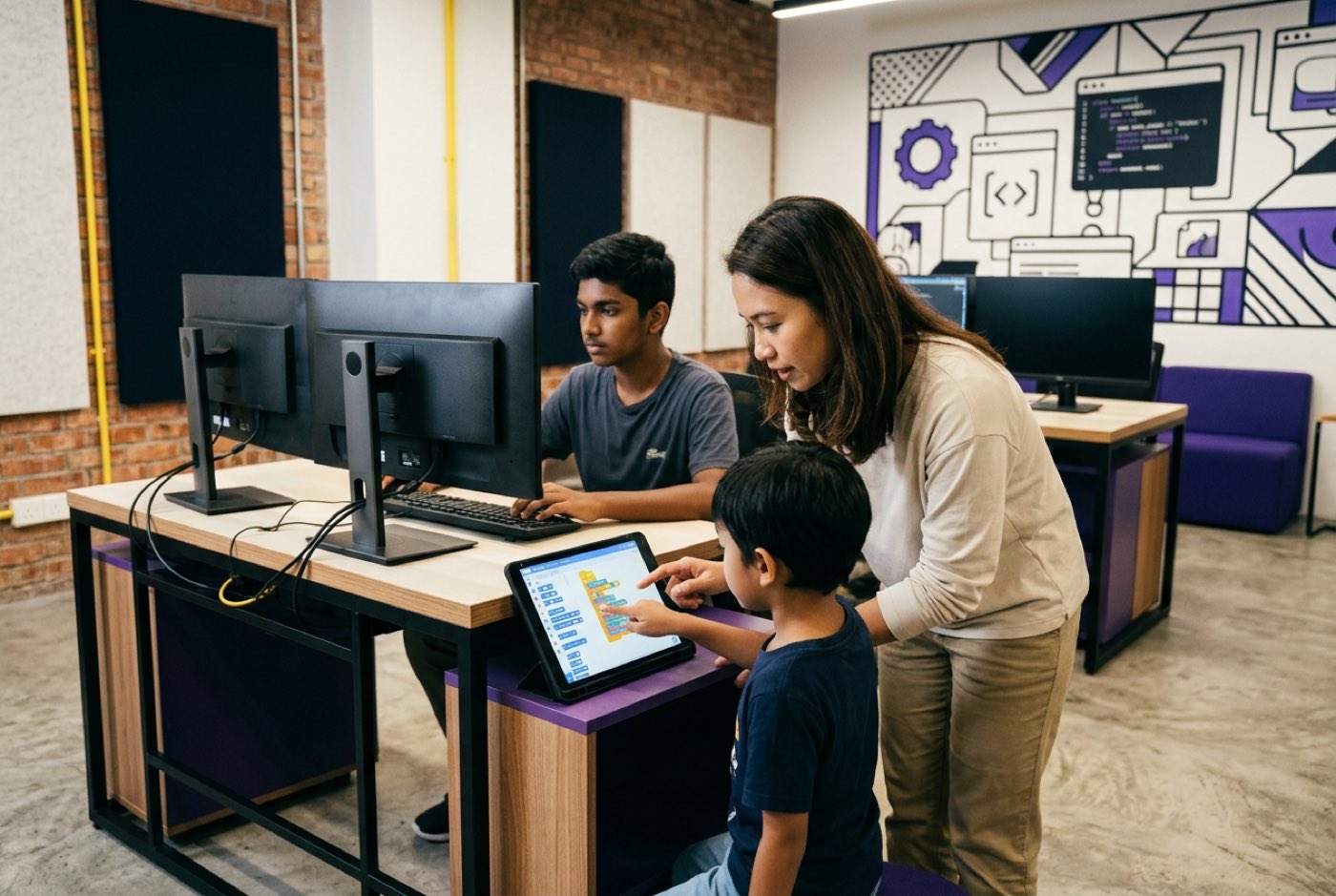
Ages 5–8: Embodied Analogies and Visual Construction
Vector embeddings and large language models reach young learners through physical analogies, visual blocks, and stories they can act out [3].
- Engagement Layer: Scratch, ScratchJr, and basic block-based logic.
- AI Directing Focus: Speech-to-text interfaces, visual pattern recognition, and simple decision trees.
- Core Skill Built: Understanding that computers only follow explicit instructions and that AI models make decisions based on training examples, not human feelings [12].
Ages 9–12: Structured Environments and Logic Integration
Through middle primary and lower secondary, students move into hybrid block-text environments and gamified platforms like Roblox Studio and Minecraft Education [3].
- Engagement Layer: Scratch to Python transitions, Roblox Lua scripting, and 3D design tools.
- AI Directing Focus: Multi-turn prompting, task decomposition for game mechanics, and basic context specification.
- Core Skill Built: Learning to break complex game features (such as inventory systems or NPC pathfinding) into structured prompt workflows while auditing the generated code for errors [13].
Ages 13–18: Text Coding, Context Engineering, and Real System Architecture
Teenagers work in professional development environments with real text languages and production-grade AI tools.
- Engagement Layer: Full-stack Python, JavaScript, HTML/CSS, SQL databases, and hardware integration.
- AI Directing Focus: Advanced context engineering, API integration, custom system instructions, automated testing, and dataset curation [5].
- Core Skill Built: Writing complete software design documents, leveraging AI assistants to accelerate code generation, and performing rigorous line-by-line security and performance audits [14].
5 Questions Parents Must Ask Before Enrolling in an AI Class
Considering an external AI or prompt engineering class here in Malaysia? Five questions will tell you most of what you need to know.
-
"Does my child end the module with a functional software artefact or a text cheat sheet?" If the outcome is a document of saved prompts or a few AI-generated paragraphs, you're paying for tool operation, not computational creation [3].
-
"How does your syllabus teach students to verify whether the AI's output is correct?" Without foundational coding logic, data validation, or mathematical checks, a student has no mechanism for catching hallucinations or broken code [7].
-
"Are coding and mathematics integrated into the AI curriculum, or sold separately?" AI directing can't stand alone. Serious programmes bundle computational thinking, mathematics, and software development so students see how AI meets the systems underneath [6].
-
"Does the teaching approach adapt to my child's age, or is it a one-size-fits-all slides presentation?" Primary students need visual constructionist tools and embodied analogies. Secondary students need real text environments and architecture problems that bite [3].
-
"What credentials and open-source contributions do the curriculum designers hold?" Ask whether working computer scientists and AI researchers who ship production tools designed the curriculum, or whether it was adapted from generic online tutorials.
Action Plan for Parents: Evaluating AI Literacy at Home
You don't need to wait for a class to start building durable AI literacy at home. Three habits will do most of the work:
- Shift from "Search Engine" to "Collaborative Partner": When your child asks an AI tool for help, tell them never to accept the first response. Ask: "What constraint did we forget to give it?" or "How can we test if this answer is right?"
- Practice Manual Verification: If your child used an assistant to explain a maths problem or generate a Python script, make them walk you through the logic step by step without reading off the screen.
- Focus on Building Real Projects: Steer the tool toward making something, a simple personal website, a game mod, a calculator, rather than generating static text [8].
To judge whether a course or a home activity builds lasting skills, run through the checklist below.
Printable Prompt Engineering Course Evaluation Checklist
- Artefact Creation: The course guarantees the student will build real running software, games, or mathematical models rather than text cheat sheets [3].
- Verification Training: Lessons explicitly teach students how to audit, test, and debug AI-generated outputs for errors and hallucinations [7].
- Context Engineering: Students learn how to structure data inputs, system rules, and edge cases rather than memorising magic phrasing hacks [5].
- Integrated Coding: Programming fundamentals (Python, JavaScript, or visual logic) are taught alongside AI directing as the foundational literacy [9].
Designed, ready to print and sign. We email it to you together with a 5% discount on your next registration.
See AI Directing in Action: Book a Free Trial Session
Reading about AI directing only goes so far. Come and watch it happen.
Parents and children are welcome at a free hands-on trial session (up to 2 hours) at any of our five campuses across Malaysia, or in our live online classroom:
- Klang Valley Flagship: Solaris Mont Kiara, Kuala Lumpur
- Petaling Jaya Campus: Sunway Nexis, Kota Damansara
- Penang Campuses: Q2 Waterfront (Bayan Lepas), Vantage (Tanjung Tokong), Icon City (Bukit Mertajam)
- Live Online Campus: Camera-on interactive sessions for families across Malaysia and internationally
During the trial session:
- Your child will work directly with our trainers to build a real working project in AI, math, or technology.
- Both parents are welcome to sit in, observe the teaching methodology, and ask questions.
- There is zero payment required, no pressure, and no sales presentation.
Book Your Free Trial Class at Kidocode
Frequently Asked Questions
Is prompt engineering a real standalone career for the future?
The data says no. Dedicated "prompt engineer" postings account for less than 0.5% of technical job listings [4], and employers rank the role near the bottom of their future hiring priorities [1]. Prompt directing has become a baseline expectation inside broader software engineering, data science, and domain-specific analytical roles [2].
Will AI make learning to code obsolete for my child?
No. Coding assistants generate syntax fast, but they need skilled human oversight to structure system architecture, specify requirements, and debug errors [7]. Coding education has shifted toward computational thinking and logic, with AI acting as an accelerator that lets kids build complex projects much sooner [9].
At what age should a child start learning about AI?
How does Kidocode teach AI differently from standard coding centres?
What equipment does my child need to start learning AI directing?
At our campuses in KL and Penang, all hardware, software environments, and AI tools are provided. For live online classes, a laptop or desktop with a stable internet connection, a web camera, and a standard browser is enough.
References
- Labwyze, What Happened to Prompt Engineering? (2026)
- World Economic Forum, The Future of Jobs Report 2025 (2025)
- Informatics in Education / ERIC, Constructionist Methodologies in K-12 AI Literacy Education (2025)
- arXiv / University of Oulu, Demystifying Prompt Engineering Job Postings: Skill Profiles and Empirical Demand (2025)
- Gartner, Context Engineering Replaces Prompt Engineering (2025)
- Kementerian Pendidikan Malaysia, Dasar Pendidikan Digital (2026)
- Raspberry Pi Foundation, Why Kids Still Need to Learn to Code in the Age of AI (2025)
- Malaysia Gazette, Pemuda UMNO Gesa KPM Perkasa AI, TVET di Sekolah