


Parents who ask us what maths is needed for AI usually expect the answer to be third-year university calculus, or pages of abstract proofs. Some are thinking about a ten-year-old who still trips over long division and quietly wondering whether that child has already missed the boat. Others ask the opposite question: with coding assistants writing half the code now, is school algebra even worth the effort?
The honest answer is narrower than most people fear. Artificial intelligence draws on a specific, fairly small slice of mathematics, and most of it already sits in the school syllabus under different names. What changes everything is the order of discovery. A child who meets a coordinate grid on a worksheet learns to plot points. A child who meets the same grid while telling a camera where to look learns what coordinates are for.
This guide maps the progression age by age, from primary school to pre-university. If your child follows KSSR, KSSM, IGCSE, or Cambridge, you will recognise nearly every topic below, the difference is seeing where each one shows up inside real AI tools.
Key Takeaways
| Age Group | Core Maths Concepts | Real AI Application | School Curriculum Equivalent |
|---|---|---|---|
| Ages 8–10 | Number lines, 2D coordinates, simple logic, basic data sets | Grid movement, image pixels, rule-based classifiers | KSSR Primary / Cambridge Primary Maths |
| Ages 11–13 | Ratios, percentages, basic probability, variable algebraic equations | Spam filters, simple recommender engines, game physics | KSSM Lower Secondary / IGCSE Lower Secondary |
| Ages 14–16 | Descriptive statistics, distributions, functions, matrix representation | Training image recognition models, evaluating model accuracy | KSSM Upper Secondary (SPM Maths) / IGCSE Maths |
| Ages 16–18 | Vectors, dot products, matrix multiplication, derivative gradients | Neural networks, embedding search, loss function optimization | SPM Additional Maths / A-Level Maths & Further Maths |
Table of Contents
- The Honest Map: The 4 Maths Pillars Behind Artificial Intelligence
- Ages 8 to 10: Number Sense, Patterns, Coordinates, and Simple Data
- Ages 11 to 13: Ratios, Percentages, Algebraic Thinking, and Basic Probability
- Ages 14 to 16: Statistics, Functions, and Matrices as Grids of Numbers
- Ages 16 to 18: Vectors, Dot Products, and Downhill Optimization
- Mapping AI Maths to School Syllabi: KSSM, SPM, IGCSE, and Cambridge
- For Math-Strong Kids: 3 Stretch Projects That Beat Another Worksheet
- 3 Common Myths About AI and Maths
- Free Tools and Datasets to Start This Weekend: A 6-Month Self-Study Sequence
- How Kidocode Rebuilds Maths Through AI and Real Builds
- Actionable Roadmap: How to Support Your Child at Home
- Frequently Asked Questions
- References
The Honest Map: The 4 Maths Pillars Behind Artificial Intelligence
There is no single subject called "AI maths". Four ordinary branches of mathematics do the work: one turns the world into numbers, one describes relationships between those numbers, one handles uncertainty, and one adjusts the numbers until the answers improve. The UNESCO AI Competency Framework for Students emphasises that understanding AI system design requires structured progression across mathematical logic and computational thinking [1]. The standard reference text Mathematics for Machine Learning organises the field along the same four lines [2]:
timeline
    title AI Mathematics Progression
    Ages 8-10 : Number lines & 2D grids : Logical rules : Sorting data
    Ages 11-13 : Ratios & percentages : Algebraic variables : Basic probability
    Ages 14-16 : Matrix grids : Functions & graphs : Descriptive statistics
    Ages 16-18 : Vectors & dot products : Derivative gradients : Optimization algorithms
- Arithmetic and Number Sense: Computers process image pixels, speech waveforms, and text words as numbers. Scaling, coordinates, and basic arithmetic operations are what turn raw real-world data into something a machine can read.
- Algebra and Functions: Algorithms use equations to express relationships between input data and predicted output labels. A linear equation like is the direct precursor to single-layer neural network predictions.
- Probability and Statistics: Machine learning models work under uncertainty. Rather than returning a flat true or false, they calculate probabilities, evaluate distributions, and report confidence scores.
- Linear Algebra and Optimization: Large-scale models, including Large Language Models and computer vision neural networks, manipulate arrays of numbers arranged in vectors and matrices. Training them depends on calculating how a small change in one number moves the overall error score.
Seen this way, the idea that a child must finish university calculus before touching machine learning falls apart. The concepts arrive in sequence, and each one can be introduced through a build the child is old enough to finish.
Ages 8 to 10: Number Sense, Patterns, Coordinates, and Simple Data
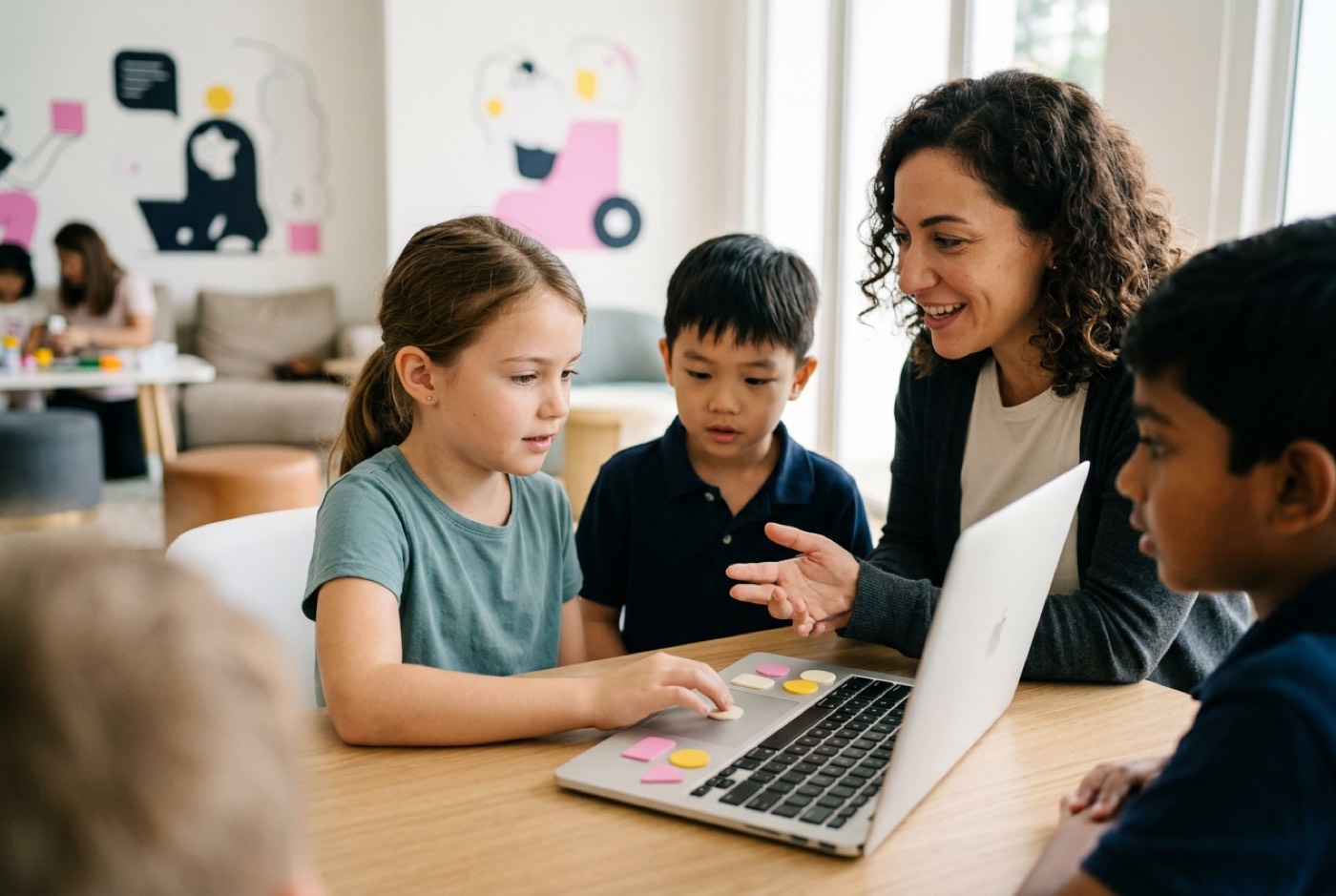
Eight-year-olds do not need abstract algebra. They need one idea: that a computer sees the world as structured numbers. Primary frameworks such as KSSR in Malaysia and Cambridge Primary already spend considerable time on whole numbers, 2D coordinates, basic geometry, and collecting data into tables [3].
Core Mathematical Concepts
- 2D Cartesian Coordinates : Locating points on a grid, understanding positive direction, and measuring grid distance.
- Pattern Recognition and Sequencing: Identifying numerical step increases, skip counting, and logical conditionals (If-Then statements).
- Basic Data Categorisation: Grouping objects by discrete attributes (colour, height, speed, price) and representing counts in tally charts or basic bar graphs.
The Real AI Project That Uses This
Swap the worksheet for a build. A nine-year-old can use the same coordinates and conditional logic to make a rule-based image classifier or a grid-based sensor simulator.
In a block-based environment or a beginner Python workspace, the student writes a simple camera filter or object sorter. The program checks the pixel value at a given coordinate . If the RGB brightness there rises above a threshold the child chose, the pixel gets tagged as foreground. Then the child moves the threshold and watches the result change. That single adjustment teaches something a worksheet cannot: automated decisions are made of numerical boundaries somebody picked.
Once coordinates start controlling where a character stands or where a camera stops looking, grid plotting stops feeling arbitrary. If your child struggles with basic geometry or word problems at this age, our guide on how to help a child who cannot do math word problems has strategies for connecting text to spatial logic.
Ages 11 to 13: Ratios, Percentages, Algebraic Thinking, and Basic Probability
Lower secondary (Forms 1 to 2 in Malaysia, Years 7 to 8 in the UK system) introduces variables, ratio calculations, percentage change, and experimental probability [4]. These are the tools a machine uses to make a prediction rather than a lookup.
Core Mathematical Concepts
- Ratios, Proportions, and Normalisation: Scaling numbers between 0 and 1, converting fractions to percentages, and balancing relative weights.
- Algebraic Expressions and Variables: Using symbols to represent unknown values, solving single-variable equations, and calculating linear outputs.
- Basic Probability: Understanding sample spaces, independent events, relative frequencies, and calculating odds from 0 to 1.
The Real AI Project That Uses This
At this age a student can build a naive spam classifier or a recommendation engine by hand, before ever importing a machine learning library [5].
Take the spam filter. The algorithm counts how often certain keywords, "free", "discount", "urgent", appear in junk mail compared with ordinary mail. A new email arrives with three flagged words, and the program combines their relative percentages:
The child writes a program that tallies word frequencies, converts them to percentages, and applies a threshold, label it spam if total confidence passes 0.75. That is a working text classifier, built from Form 1 ratio work. The lesson lands on its own: the "intelligence" is arithmetic with a cut-off.
Students who find textbook exercises dry often respond to the same algebra when it controls a game character or scores a recommendation. Our article on the math behind game development for kids goes deeper into how those mechanics work inside real software.
Ages 14 to 16: Statistics, Functions, and Matrices as Grids of Numbers
From 14 to 16 (Forms 3 to 5 in Malaysia heading towards SPM, or the IGCSE years), school maths moves into formal statistics, functions, and coordinate geometry [5]. Those three topics are what you need to handle a dataset with more than one feature and to judge whether a model is any good.
A matrix sounds intimidating until a student sees it is just a table with the labels stripped off. Three students, three measurements each:
| Row | Height | Weight | Age |
|---|---|---|---|
| Student 1 | 165 | 55 | 14 |
| Student 2 | 170 | 62 | 15 |
| Student 3 | 158 | 48 | 13 |
That is a 3 × 3 matrix. In computer memory it flattens into a single array: [165, 55, 14, 170, 62, 15, 158, 48, 13]. Same numbers, three notations, spreadsheet, matrix, array.
Core Mathematical Concepts
- Descriptive Statistics and Distributions: Mean, median, standard deviation, variance, and reading histograms or scatter plots.
- Functions and Linear Relations: Understanding input-output mapping , plotting linear graphs (), and analysing curves.
- Matrices as 2D Arrays: Storing rows and columns of numeric data, performing scalar multiplication, and adding matrices together.
The Real AI Project That Uses This
A 15-year-old can build an automated house price predictor, or an accuracy evaluator for a vision model.
For the linear regression project, the student loads a dataset of property square footage, bedroom counts, and distance to public transport, plots the points, and fits a line of best fit using the equation they already know:
Here is house area, is estimated price, is the price increase per square foot, and is the base property value. Next comes the part that makes statistics feel necessary: measuring how wrong the line is. The student calculates the residual for each real sale and averages them into a Mean Absolute Error:
Run in Python with Pandas or scikit-learn, this is a complete prediction pipeline, and every piece of it came out of the SPM or IGCSE syllabus [5]. If your teen is moving between national and international tracks, see our full guide on switching between KSSM and IGCSE math.
Ages 16 to 18: Vectors, Dot Products, and Downhill Optimization
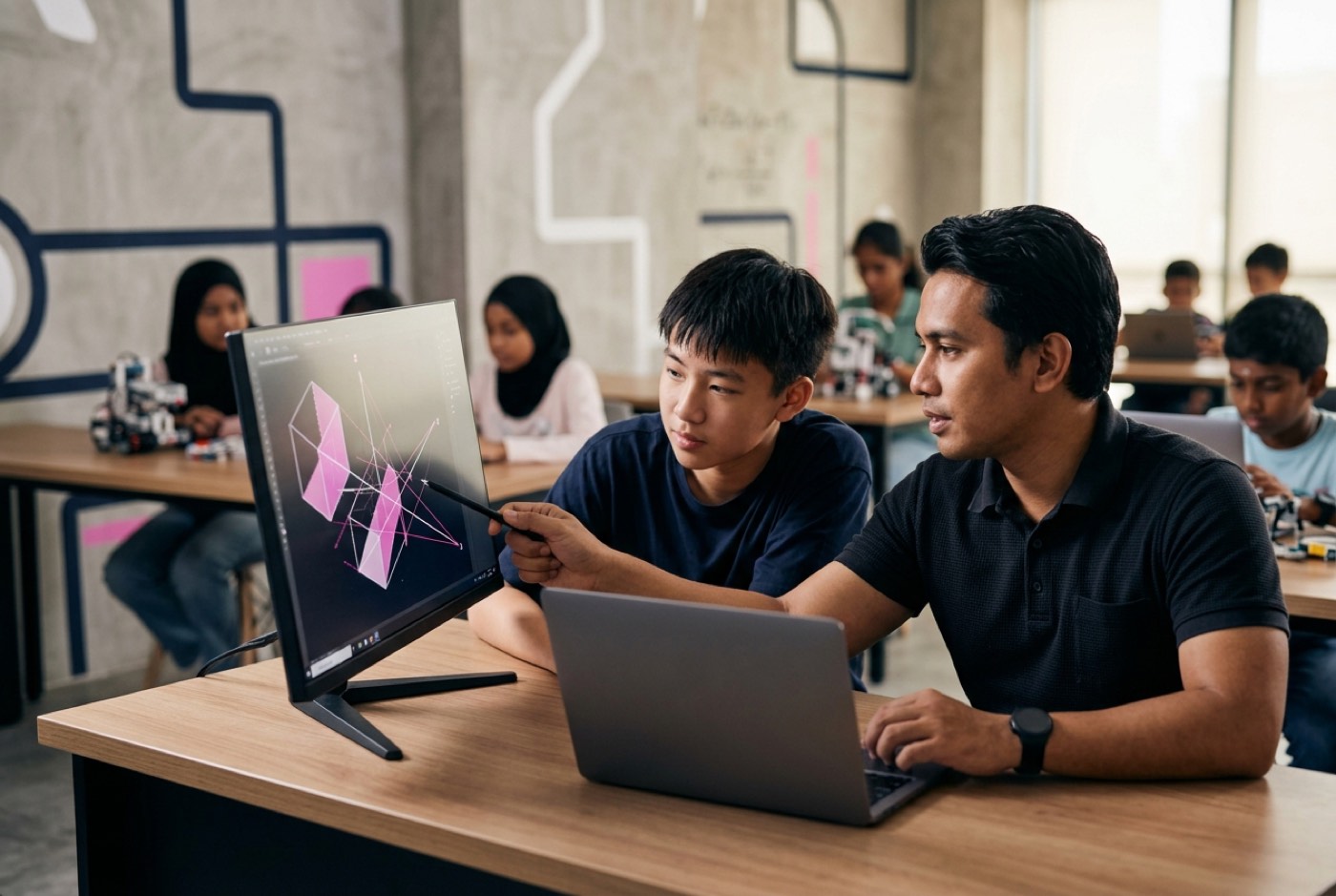
Pre-university maths (Form 6, A-Levels, IB, or diploma programmes) brings in vector spaces, matrix multiplication, derivatives, and optimization [2]. At this point the syllabus and the internals of a neural network are describing the same operations.
Core Mathematical Concepts
- Vectors and Vector Spaces: Directed spatial line segments, representing multi-dimensional data points as vectors .
- Dot Products and Cosine Similarity: Calculating geometric vector projection to measure directional alignment and similarity scores between datasets:
- Calculus and Derivatives for Gradient Descent: Calculating rates of change to determine slope direction and optimize parameter weights down an error surface.
The Real AI Project That Uses This
Students in this bracket can write a multi-layer neural network from scratch, or build a semantic vector search engine for a folder of text documents.
When a system like ChatGPT or an image search engine compares meanings, it first converts sentences into high-dimensional numerical vectors called embeddings. Similarity between two sentences is then the dot product of their vectors, normalised by their lengths:
Training works on the same footing. A loss function measures how wrong the output was, and derivative gradients tell the model which direction to nudge each internal weight, backpropagation and gradient descent, one small step at a time:
Once a student has coded that loop, "machine learning" loses its mystique. It is an algorithm walking downhill on an error surface in tiny increments. Learners ready for the next layer of implementation can read our breakdown of transformer models in AI.
Mapping AI Maths to School Syllabi: KSSM, SPM, IGCSE, and Cambridge
Parents in Malaysia often ask whether AI maths means extra work on top of an already full exam schedule. In practice it is mostly the same content wearing a different label, both national and international curricula already cover these foundations [3], [5].
The table below maps standard school topics directly to their AI application context:
| AI Mathematical Concept | KSSM / SPM Syllabus (Malaysia) | IGCSE / Cambridge Syllabus | How the Topic Is Used in AI |
|---|---|---|---|
| Coordinates & Grids | Form 1: Coordinate Geometry | Year 7–8: Coordinates & Transformations | Mapping image pixels, spatial object detection, game grids |
| Linear Equations | Form 2: Linear Equations / Graphs | IGCSE: Algebra & Graphs (Topic E2) | Single-layer perceptrons, trendlines, price estimation |
| Ratios & Normalisation | Form 1: Ratios, Rates & Proportions | IGCSE: Number & Ratio (Topic N2) | Scaling raw features to ranges between 0 and 1 |
| Probability & Frequency | Form 4: Combined Events | IGCSE: Probability (Topic S1) | Naive Bayes classifiers, spam detection, confidence scores |
| Matrices & Transformations | Form 5: Matrices (SPM Core) | IGCSE / A-Level: Matrices & Transformations | Computer vision filters, image rotations, neural layer inputs |
| Descriptive Statistics | Form 4: Measures of Dispersion | IGCSE: Statistics (Topic S2) | Feature variance, standardisation, evaluating model errors |
| Vectors & Dot Products | Form 5 Add Maths: Vectors | A-Level Maths: Vectors & Mechanics | Word embeddings, semantic search, 3D graphics rendering |
| Derivatives & Gradients | Form 5 Add Maths: Differentiation | A-Level Maths: Introductory Calculus | Gradient descent optimization, adjusting neural network weights |
Revision gets easier when the textbook question has a destination. A student stuck on Form 5 matrix multiplication tends to remember the procedure far better after watching those same numbers process a live camera feed. For a sense of where your child sits against standard curriculum benchmarks, see our guide on benchmark checks for math progression.
For Math-Strong Kids: 3 Stretch Projects That Beat Another Worksheet
When a child is already ahead in maths, the default response is more of the same: harder drill sheets, another Kumon level, past-year papers two grades early. University admissions panels tend to be unimpressed by that. Depth of application reads better than speed, and it is more interesting to do.
Here are three stretch projects for mathematically capable students:
Project 1: High-Dimensional Semantic Embedding Visualiser
- Target Ages: 14–18
- Mathematical Focus: Vectors, dimensionality reduction, coordinate projections.
- The Challenge: The student pulls text embedding vectors from an AI language API (OpenAI, or an open-source Hugging Face model) for 100 words spread across categories such as animals, vehicles, and emotions. Because each embedding has hundreds of dimensions, the student applies a reduction technique, Principal Component Analysis or t-SNE, to project them onto a 2D Cartesian plane.
- The Build Output: An interactive web dashboard where semantically related words cluster visibly on a coordinate chart, so the student can measure the distance between concepts as a number.
Project 2: Monte Carlo Risk and Game Strategy Simulator
- Target Ages: 12–16
- Mathematical Focus: Probability distributions, expected value, law of large numbers.
- The Challenge: Rather than computing static coin-flip probabilities on paper, the student writes a simulation engine for a messier random process, stock price movement, say, or a card game strategy.
- The Build Output: A Python script that runs 100,000 trials in seconds, plots probability density histograms, and calculates confidence intervals, showing how sampling answers questions that are awkward to solve analytically.
The pipeline has three stages:
| Stage | Step | What Happens |
|---|---|---|
| 1 | Define random input variables | Set the distributions the simulation will draw from |
| 2 | Run 100,000 automated trial iterations | Let the script sample outcomes repeatedly |
| 3 | Plot histogram and confidence interval | Summarise the results statistically |
Project 3: Generative Procedural Art Engine Using Trigonometric Functions
- Target Ages: 10–14
- Mathematical Focus: Sine, cosine, parametric equations, angles, polar coordinates.
- The Challenge: Using Processing, JavaScript Canvas, or Python Turtle, the student generates geometric patterns from nested trigonometric formulas:
- The Build Output: A gallery generator with sliders for period, phase, and radial amplitude, redrawing the pattern live as each value shifts.
If school maths is currently too easy, our parent strategy guide on what to do when a child is bored in math class covers the wider problem.
3 Common Myths About AI and Maths
Three beliefs come up in almost every parent conversation we have about this topic, and all three get the requirements wrong.
Myth 1: "You Must Master Advanced University Calculus Before Touching AI"
This one keeps a lot of capable teenagers away from the subject. Researchers designing new algorithm architectures do lean on multivariable calculus. Applied machine learning and model deployment lean on linear algebra, basic statistics, and logical programming [5].
Libraries such as PyTorch, TensorFlow, and scikit-learn compute derivative gradients for you through automatic differentiation [1]. What the young developer supplies is judgement: knowing what gradient descent is trying to do, what an error function measures, and whether a performance metric means what it appears to mean.
Myth 2: "Generative AI and Coding Assistants Mean Kids No Longer Need Maths"
The reasoning goes: ChatGPT, Claude, and GitHub Copilot write the code, so why learn the maths? It runs backwards.
Those tools handle syntax and boilerplate quickly [6]. Deciding whether the generated logic holds, whether the statistical assumptions fit the data, and whether the output numbers are plausible is still human work. Without the maths, a developer cannot spot model bias, read an error term, or tell a good prompt from a confident wrong answer. Our guide on vibe coding for kids using AI assistants looks at how these tools reshape the skills that matter.
Myth 3: "My Child Is Bad at Maths, So They Cannot Excel in Tech or AI"
Children who say they hate maths almost never mean they hate logic or problem-solving. They mean they hate repetitive worksheets, timed drills, and memorising formulas for an exam that never explains what the formula is for.
Give the same child a game mechanic to tune, a camera boundary to set, or an image classifier to train, and the objection usually disappears within a session or two. Numbers with a job attached are a different subject.
Free Tools and Datasets to Start This Weekend: A 6-Month Self-Study Sequence
A teenager can start exploring the maths behind AI this weekend without spending anything. The open-source ecosystem covers the tooling, the datasets, and much of the teaching.
Recommended Free Tools and Datasets
- Google Teachable Machine: A browser tool for seeing classification thresholds, training data, and confidence scores in action without writing code.
- Kaggle Datasets: Thousands of public datasets, sports statistics, movie reviews, weather records, ready for statistical analysis.
- PhET Interactive Simulations (University of Colorado): Free visualisations for coordinate geometry, linear graphing, vector addition, and probability distributions.
- Python with Jupyter Notebooks (Google Colab): A free cloud environment for writing Python, plotting with Matplotlib, and handling data with Pandas, all in the browser.
Recommended 6-Month Self-Study Roadmap
| Month | Theme |
|---|---|
| 1 | Python data basics |
| 2 | Coordinate and function visuals |
| 3 | Probability and spam filtering |
| 4 | Matrix grids and image processing |
| 5 | Linear regression |
| 6 | First neural network |
- Month 1: Python Data Fundamentals
- Focus: Python variables, lists, dictionaries, basic loops.
- Goal: Clean a small public CSV dataset using basic code.
- Month 2: Coordinate Visualisation and Functions
- Focus: Plotting lines using Matplotlib, scatter plots, understanding axis scaling.
- Goal: Build a basic linear trend plotter for historical temperatures or sales data.
- Month 3: Applied Probability and Classification
- Focus: Calculating term frequencies, percentage odds, Bayes rule fundamentals.
- Goal: Write a functional text spam filter using basic frequency formulas.
- Month 4: Matrices and Image Processing
- Focus: Representing images as 2D arrays, understanding RGB colour values, basic scalar matrix operations.
- Goal: Build a custom image grayscale converter and camera filter from scratch.
- Month 5: Linear Regression and Statistical Metrics
- Focus: Calculating mean squared error, line of best fit, plotting residuals.
- Goal: Train a housing price or movie rating predictor using scikit-learn [5].
- Month 6: Intro to Neural Networks and Vector Embeddings
- Focus: Multi-layer arrays, dot products, activation function concepts.
- Goal: Build a basic handwritten digit recogniser (MNIST dataset) or semantic vector search tool.
For more on how data skills develop earlier in a child's education, read our article on why data science learning matters for kids.
How Kidocode Rebuilds Maths Through AI and Real Builds
Kidocode is Malaysia's coding and AI school for learners aged 5 to 18. We run campuses in Kuala Lumpur (Solaris Mont Kiara, Sunway Nexis PJ) and Penang (Q2 Waterfront, Vantage Tanjung Tokong, Icon City BM), plus live online classes. Our job is to make kids AI-savvy, deal with maths frustration head-on, and get them building real software.
 Most tuition centres run on paper drills and formula memorisation. We teach the same syllabi, Cambridge, IGCSE, KSSR, KSSM, and Common Core, in the opposite order: application first, formalism after.
- AI School First: Students learn to direct AI tools safely, productively, and critically, including how the systems are put together, where the safety boundaries sit, and what the underlying algorithms are doing. Passive app use is not the goal.
- Maths Through Real Software Builds: Instead of working through static textbook pages, students use mathematical principles to calculate game physics, plot spatial graphics, and train neural networks. Each child also works with a personalised AI tutor pitched at their own pace, which typically clears maths frustration within 2 to 4 weeks.
- Coding Bundled Free: Programming syntax is public knowledge, and AI assistants now handle most of the typing. So we bundle coding tuition free inside our AI and Maths tracks and spend the teaching time on computational thinking, structural logic, and mathematical problem-solving.
A five-year-old starting on logical patterns and a seventeen-year-old preparing for a computer science degree follow the same curriculum at different points, across six technology tracks: Python, Web Development, Mobile Apps, Game Development, Electronics, and 3D Modelling. Our guide on math tuition vs learning math by building explains the difference in more detail.
Actionable Roadmap: How to Support Your Child at Home
None of this requires a computer science degree from you. It requires a few changes in how maths gets talked about at home:
- Reframe Homework Frustration: When your child is stuck, move the conversation off the right answer and onto the mechanic. Ask: "What is this formula trying to control or measure in real life?"
- Connect Math to Daily Technology: Point out the coordinates, probability scores, and recommendation algorithms already running in the apps they use, navigation maps, video streaming, photo search.
- Encourage Project Depth Over Worksheet Acceleration: One finished software project, game, or data visualisation is worth more than another twenty pages of workbook.
- Schedule a Hands-On Practical Experience: Let your child build something real and watch what happens when the maths has a purpose.
Printable Math-for-AI Readiness Checklist
Use this observation checklist to find your child's current level and pick a matching project pathway:
-
Level 1: Foundation (Ages 5–9)
- Child can navigate a basic 2D grid using coordinate movements.
- Child recognises repeating number patterns and logical conditional sequences (If/Then).
- Child can sort items into discrete categories and count frequencies.
- Recommended Next Step: Block-based grid games, spatial pixel graphics, visual rule-based classifiers.
Designed, ready to print and sign. We email it to you together with a 5% discount on your next registration.
Frequently Asked Questions
Does my child need to be a top scorer in school math to start learning AI?
No. School exams mostly measure speed, recall of formulas, and neat handwriting under time pressure. Machine learning runs on logical thinking, conceptual understanding, and a feel for how data relates to data. Plenty of students who find paper tests tedious do well here once the equations start doing something visible.
Which programming language is best for learning the maths behind AI?
Python is the industry standard for machine learning and AI [5]. Its syntax reads close to English, and the free libraries cover everything a learner needs: NumPy for linear algebra and matrices, Pandas for data manipulation, Matplotlib for plotting, and scikit-learn for models.
My child is taking SPM Additional Mathematics. How does learning AI help their exam results?
SPM Additional Mathematics covers functions, quadratic equations, coordinate geometry, statistics, vectors, and calculus [5], precisely the topics used to build vectors, cost functions, and optimization routines in AI. Watching those concepts run inside working software builds the spatial intuition that makes the written paper questions easier to unpick.
How is learning maths through AI different from enrolling in a traditional math tuition centre?
Tuition centres generally run on drill worksheets, exam shortcuts, and past-year repetition aimed at a grade. That can work for a specific test, but it rarely produces deep understanding or any technical capability. At Kidocode, students cover the same international syllabi by applying each concept to a real build, software projects, game physics engines, AI models. Frustration tends to dissolve along the way, and the tech skills are a genuine by-product.
How can we see if this teaching approach works for our child?
Book a free hands-on trial session at any Kidocode campus in Kuala Lumpur or Penang, or join one live online. The trial runs up to 2 hours, and your child works directly with our trainers on a real AI or tech project. Both parents are welcome to sit in, see how your child responds to this kind of learning, and talk through curriculum options with our team. No payment, no obligation. Book at kidocode.com/trial-class.
References
- UNESCO. AI Competency Framework for Students. Paris: UNESCO, 2024. Available at: [Policy Commons].
- Deisenroth, M. P., Faisal, A. A., and Ong, C. S. Mathematics for Machine Learning. Cambridge: Cambridge University Press, 2020. Available at: [MML-Book].
- Ministry of Education Malaysia (KPM). Dokumen Standard Kurikulum dan Pentaksiran (DSKP) KSSM Mathematics Form 4 & 5. Putrajaya: Bahagian Pembangunan Kurikulum, 2019. Available at: [AnyFlip Document].
- Superprof Malaysia. SPM Mathematics Syllabus and Exam Format Guide. Published March 31, 2023. Available at: [Superprof].
- Superprof Malaysia. SPM Additional Mathematics Format and Paper Breakdown. Published August 23, 2022. Available at: [Superprof].
- Ahmad, F. From Confusion to Clarity: Getting Started with AI/ML in 2025. DEV Community, 2025. Available at: [DEV Community].
- Howard, J. Practical Deep Learning for Coders 2018 Course Launch. fast.ai, January 26, 2018. Available at: [fast.ai].
- Deloitte Southeast Asia. National Guidelines on AI Governance and Ethics (AIGE) Malaysia. Published December 9, 2024. Available at: [Deloitte].